

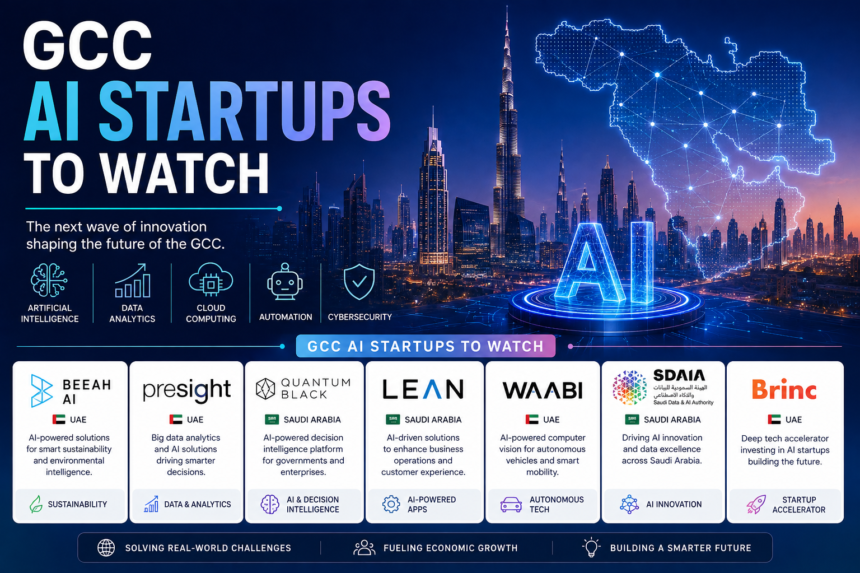
Companies Shaping the Future of Artificial Intelligence: GCC AI Startups to Watch in 2026
Artificial intelligence is rapidly becoming one of the most important drivers of economic and technological transformation across the Gulf Cooperation Council (GCC). From the United Arab Emirates and Saudi Arabia to Qatar, Bahrain, Kuwait and Oman, governments and private companies are investing heavily in artificial intelligence, data infrastructure, automation, cloud computing and emerging technologies.
- Why GCC AI Startups Are Gaining Attention
- 1. Presight: Abu Dhabi’s Applied AI Powerhouse
- 2. MOZN: AI for Financial Crime and Enterprise Intelligence
- 3. Intelmatix: Building AI-Powered Enterprise Decision Making
- 4. Lean Business Services: AI and Digital Healthcare in Saudi Arabia
- 5. AI71: The Rise of Enterprise and Arabic AI
- 6. BEEAH AI and the Future of Smart Sustainability
- 7. Saudi Arabia’s Growing AI Startup Ecosystem
- 8. The UAE as a Regional AI Startup Hub
- 9. AI in Autonomous Transportation
- 10. The Importance of Arabic AI
- Key Sectors Driving GCC AI Startup Growth
- What Makes GCC AI Startups Different?
- Challenges Facing GCC AI Startups
- What Investors Should Watch in GCC AI
- The Future of AI Startups in the GCC
- GCC AI Startups to Watch: What Comes Next?
This growing ecosystem is creating opportunities for a new generation of GCC AI startups. These companies are developing solutions for healthcare, financial services, cybersecurity, smart cities, energy, logistics, government services, enterprise software and autonomous transportation.
The GCC is particularly well positioned for AI growth because it combines significant investment capacity, ambitious national technology strategies, rapidly expanding digital infrastructure and a willingness to deploy AI at scale. The UAE and Saudi Arabia are currently among the region’s most visible AI hubs, while other Gulf countries are also developing startup ecosystems and technology programs.
For entrepreneurs, investors, technology professionals and businesses, the region’s AI startup landscape is becoming increasingly important.
This guide explores some of the GCC AI startups and emerging AI companies to watch in the GCC in 2026, the sectors attracting the most innovation, and why the Gulf could become an important global center for artificial intelligence.
Why GCC AI Startups Are Gaining Attention
The rise of AI startups in the GCC is closely connected to the region’s broader economic diversification strategies. For decades, Gulf economies were strongly associated with oil and gas. Today, governments are investing in technology, tourism, financial services, healthcare, logistics, renewable energy and digital infrastructure to create more diversified economies.
Artificial intelligence fits naturally into this transformation. AI can help governments analyze enormous amounts of data, improve public services, automate administrative processes and create smarter cities. Businesses can use AI to reduce costs, improve customer experiences, detect fraud, optimize operations and make better decisions.
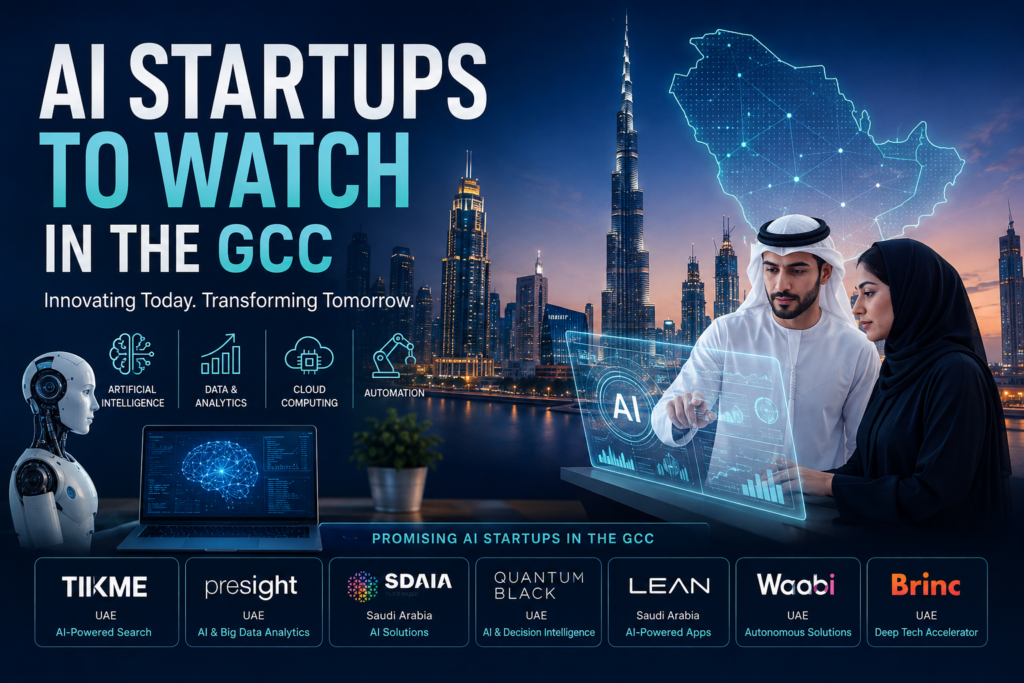
Several factors are making the GCC attractive for AI entrepreneurs:
- Strong government support for emerging technologies
- Significant investment in digital infrastructure
- Growing demand for enterprise AI solutions
- Rapid development of cloud and computing capacity
- Increasing interest in Arabic-language AI
- Large-scale smart city and infrastructure projects
- Growing venture capital activity
- Access to international technology partnerships
- Strong demand for automation across industries
- Ambitious national AI strategies
The result is an ecosystem where GCC AI startups can potentially move from experimentation to large-scale commercial deployment relatively quickly.
1. Presight: Abu Dhabi’s Applied AI Powerhouse
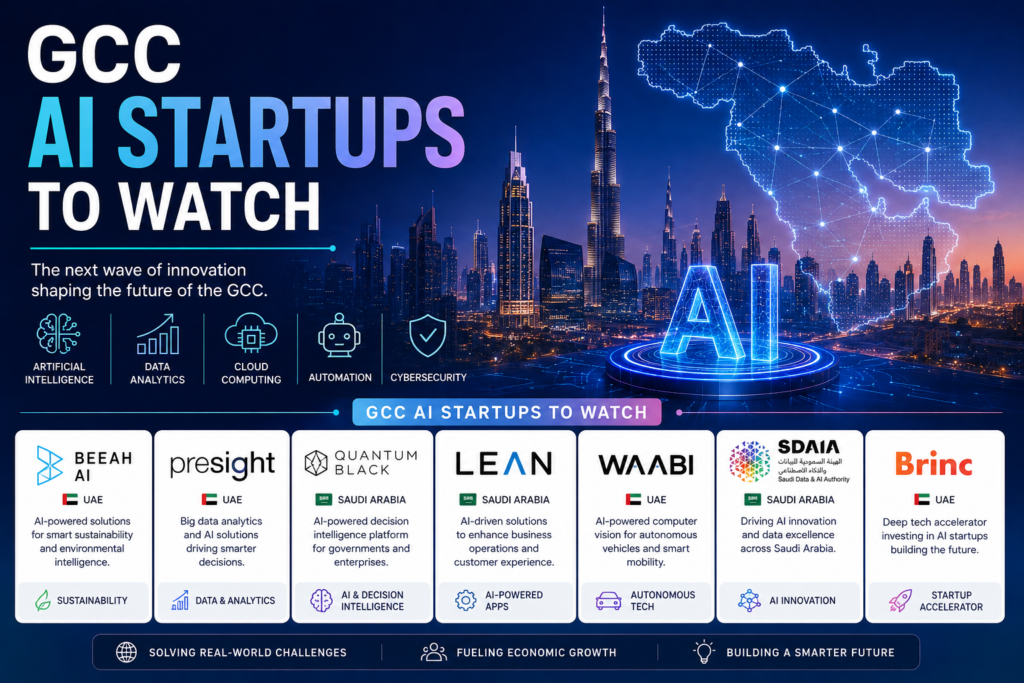
Presight is one of the most prominent AI companies to emerge from the UAE. Headquartered in Abu Dhabi, the company focuses on big data, artificial intelligence and applied intelligence solutions for governments, businesses and critical infrastructure. Presight describes itself as a global leader in big data and AI, with solutions covering areas such as energy, finance, public safety, smart cities and digital transformation. Its approach is particularly relevant to the GCC because it focuses on applying AI to large, complex real-world environments rather than limiting AI to consumer applications.
The company’s technology combines data, analytics and AI to help organizations make faster and more informed decisions. Presight is particularly interesting to watch because of its growing international reach. The company says it has operations across multiple continents and is expanding its portfolio of AI-enabled projects beyond the UAE.
Its AI accelerator program also demonstrates the growing startup ecosystem surrounding Abu Dhabi. The second cohort attracted 376 applications from 62 countries, showing the level of international interest in the region’s AI ecosystem.
Why Presight matters
- Presight represents an important trend in GCC AI: large-scale applied artificial intelligence.
- Rather than focusing exclusively on experimental generative AI applications, companies like Presight are working on AI systems designed for governments, energy companies, financial institutions and smart infrastructure.
- This could make applied AI one of the GCC’s strongest technology categories.
2. MOZN: AI for Financial Crime and Enterprise Intelligence
Saudi Arabia-based MOZN is another AI company worth watching. Its technology focuses on high-assurance applications, particularly financial crime prevention and enterprise knowledge intelligence.
MOZN’s platform is designed to help organizations make informed decisions using AI while addressing the security, compliance and regulatory requirements associated with sensitive data. Financial institutions across the GCC face increasingly sophisticated challenges involving fraud, money laundering, sanctions and financial crime. AI can analyze large volumes of transactions and identify unusual patterns much faster than traditional manual processes.
MOZN is therefore operating in a market where AI has a clear business case. The company’s focus on sovereign and localized AI is also significant for the Gulf. Businesses and governments increasingly want AI systems that can operate within local regulatory, linguistic and data environments.
Why MOZN matters
- Financial services are among the industries most likely to adopt enterprise AI because organizations have enormous amounts of structured and unstructured data.
- AI platforms that combine automation, compliance and decision intelligence could become increasingly valuable as GCC financial markets expand.
3. Intelmatix: Building AI-Powered Enterprise Decision Making
Saudi Arabia’s Intelmatix is another emerging AI company attracting attention for its focus on enterprise intelligence. The company develops AI technologies designed to help businesses become more data-driven and improve decision-making. Its EDIX platform is positioned as a digital brain for enterprises, combining knowledge, data, analysis and AI-driven interaction.
Intelmatix focuses on areas including retail, logistics, manufacturing and healthcare. This broad enterprise orientation is important because many companies are moving beyond basic AI chatbots toward AI systems capable of supporting actual business decisions. For GCC companies, this could be particularly useful in industries where organizations manage complex operations across multiple locations.
Potential applications include:
- Supply chain optimization
- Demand forecasting
- Business intelligence
- Customer analytics
- Manufacturing optimization
- Healthcare analytics
- Enterprise knowledge management
- AI-assisted decision making
Intelmatix illustrates how Saudi AI startups are increasingly moving toward practical enterprise applications rather than simply building consumer-facing AI tools.
4. Lean Business Services: AI and Digital Healthcare in Saudi Arabia
Healthcare is another major opportunity for artificial intelligence in the GCC. Lean Business Services, based in Saudi Arabia, is a digital enabler for the country’s healthcare sector. The company uses data integration, artificial intelligence and digital solutions to support healthcare transformation.
Its AI capabilities include technologies designed to predict health risks and support decision-making. Lean is particularly significant because healthcare generates enormous quantities of information. Electronic health records, medical images, insurance information, laboratory data and patient histories can all potentially be analyzed using AI.
The company is also part of Saudi Arabia’s broader healthcare transformation agenda. According to the Public Investment Fund, Lean was established in 2017 and plays a role in building integrated digital infrastructure for the national health ecosystem.
AI applications in GCC healthcare. AI startups and technology companies in the region are increasingly exploring:
- Predictive healthcare
- Medical imaging
- Personalized medicine
- Patient risk assessment
- Healthcare administration
- Drug discovery
- Clinical decision support
- Insurance automation
- Health data analytics
Healthcare could become one of the most important verticals for AI adoption in Saudi Arabia and the wider GCC.
5. AI71: The Rise of Enterprise and Arabic AI
Abu Dhabi has also emerged as a center for new AI ventures focused on enterprise and generative AI. AI71 is part of the UAE’s growing artificial intelligence ecosystem and reflects the region’s ambition to develop AI companies capable of competing internationally. One of the major opportunities for Gulf AI companies is the development of AI systems designed specifically for Arabic-speaking users and organizations. Arabic is spoken by hundreds of millions of people, but many AI systems have historically been optimized primarily for English and other major languages.
This creates an opportunity for GCC AI startups to build:
- Arabic large language models
- Arabic enterprise assistants
- Arabic speech recognition
- Arabic search systems
- Government AI assistants
- Arabic document analysis
- Localized customer service systems
The UAE’s broader AI ecosystem is already supported by research institutions, government initiatives and major technology investments. This provides startups with an environment in which AI research can be translated into commercial products.
6. BEEAH AI and the Future of Smart Sustainability
Sustainability is another area where AI can play an important role in the GCC. BEEAH’s technology ecosystem demonstrates how artificial intelligence can be connected with waste management, environmental intelligence and smart city solutions.
The Gulf has ambitious sustainability targets, while cities are becoming increasingly dependent on data to manage transportation, energy consumption, waste collection and environmental performance. AI can help organizations predict demand, optimize routes, identify inefficiencies and automate environmental monitoring.
AI and sustainability applications include:
- Smart waste collection
- Recycling optimization
- Environmental monitoring
- Energy efficiency
- Carbon management
- Smart mobility
- Water management
- Predictive maintenance
For GCC cities that are investing in smart infrastructure, sustainability-focused AI companies could become increasingly important.
7. Saudi Arabia’s Growing AI Startup Ecosystem
Saudi Arabia deserves special attention when discussing GCC AI startups. The Kingdom has made artificial intelligence an important component of its Vision 2030 transformation agenda. Riyadh is increasingly becoming a regional center for technology, venture capital, data infrastructure and AI development.
Saudi AI innovation is occurring across multiple areas:
- Financial technology
- Healthcare
- Government technology
- Enterprise software
- Cybersecurity
- Arabic AI
- Robotics
- Data analytics
- Smart cities
- Logistics
Companies such as MOZN, Intelmatix and Lean demonstrate the diversity of the Saudi AI ecosystem.
The country is also developing institutions and infrastructure intended to strengthen AI research, talent development and commercialization. For entrepreneurs, Saudi Arabia offers a large domestic market and major enterprise customers. For investors, the country’s scale makes it an attractive market for AI solutions that can eventually expand across the wider GCC.
8. The UAE as a Regional AI Startup Hub
The UAE, particularly Abu Dhabi and Dubai, is another major center for AI innovation. The country’s advantages include international connectivity, advanced infrastructure, access to global investors and strong government support for artificial intelligence. Abu Dhabi has developed a particularly strong AI ecosystem around companies, research institutions and investment organizations.
The presence of institutions such as the Mohamed bin Zayed University of Artificial Intelligence also strengthens the region’s research and talent pipeline. The partnership between Presight and MBZUAI, for example, has focused on startup sourcing, technical advisory, talent and AI research capabilities.
Dubai, meanwhile, provides a major commercial market for AI applications in tourism, retail, financial services, real estate, logistics and smart-city technologies.
9. AI in Autonomous Transportation
Autonomous transportation is another exciting area connected to the GCC’s technology ambitions. Waabi is a notable example of an AI company working on physical AI and autonomous transportation. Its technology focuses on autonomous trucks and robotaxis, using AI and simulation to develop scalable autonomous driving systems.
While Waabi is headquartered in North America rather than being a GCC startup, its technology is relevant to the region because Gulf countries are investing heavily in smart mobility, autonomous transportation and next-generation logistics. The wider lesson is that GCC markets can become important deployment environments for international AI companies as well as home markets for local startups.
Autonomous AI could transform:
- Freight transportation
- Logistics
- Public transportation
- Robotaxis
- Industrial mobility
- Ports
- Warehousing
- Last-mile delivery
The GCC’s modern infrastructure and ambitious smart-city projects could provide fertile ground for these technologies.
10. The Importance of Arabic AI
One of the biggest opportunities for GCC AI startups is developing technology specifically for Arabic users. AI models need to understand not only language but also local culture, terminology, laws, business practices and regional context. Arabic AI could become a strategic competitive advantage for Gulf companies.
Potential applications include:
- Arabic generative AI
- Government services
- Arabic customer support
- Legal technology
- Education
- Healthcare
- Financial services
- Media
- Translation
- Voice assistants
Companies that can successfully combine advanced AI models with high-quality Arabic data may be able to serve markets across the Middle East and North Africa.
Key Sectors Driving GCC AI Startup Growth
The GCC AI startup ecosystem is not limited to generative AI. Several industries are likely to experience significant AI adoption over the coming years.
1. Fintech and Financial Services: Banks and financial institutions are using AI for fraud detection, risk assessment, customer service and financial crime prevention. The GCC’s rapidly developing fintech sector provides a large market for AI solutions.
2. Healthcare: AI can improve diagnostics, patient management, medical research and healthcare administration. Saudi Arabia’s digital healthcare transformation makes the sector particularly attractive for AI companies.
3. Smart Cities: Cities such as Dubai, Abu Dhabi and Riyadh are investing in connected infrastructure. AI can help manage transportation, utilities, public safety, energy and municipal services.
4. Energy: AI can optimize energy production, consumption and infrastructure maintenance. For Gulf economies with major energy industries, this represents a substantial opportunity.
5. Logistics: The GCC’s strategic geographic position between Asia, Europe and Africa makes logistics an important economic sector. AI can optimize shipping, warehousing, routing and supply chains.
6. Cybersecurity: As digital adoption increases, cybersecurity becomes increasingly important. AI-powered cybersecurity can detect threats, analyze network behavior and automate security responses.
7. Government Technology: GCC governments are among the world’s largest potential users of AI. AI can automate public services, analyze government data and improve citizen experiences.
What Makes GCC AI Startups Different?
One of the defining characteristics of the Gulf AI ecosystem is the strong connection between technology companies and large institutions. In Silicon Valley, startups often begin with a consumer product and gradually expand into enterprise markets. In the GCC, startups can sometimes have a different path.
Large corporations, government agencies and infrastructure operators can provide access to major datasets, infrastructure and commercial opportunities. This can allow AI companies to develop solutions for real-world challenges at significant scale.
Presight’s accelerator is an example of this ecosystem model. Its second cohort selected 12 companies after a global application process involving hundreds of applicants from dozens of countries.
Challenges Facing GCC AI Startups
Despite the enormous opportunity, AI startups in the GCC face several challenges.
Talent:
- Advanced AI requires highly skilled researchers, engineers, data scientists and product specialists.
- Attracting and retaining global AI talent will remain an important challenge.
Data:
- AI systems depend on high-quality data.
- Companies must ensure that data is accurate, representative, secure and legally usable.
Regulation:
- AI regulation is evolving quickly around the world.
- GCC governments will need to balance innovation with privacy, cybersecurity, transparency and responsible AI development.
Commercialization:
- Building an AI model is only the beginning.
- Startups must demonstrate that their technology can solve genuine business problems and produce measurable returns.
Competition:
- GCC startups compete not only with local companies but also with technology giants from the United States, Europe and Asia.
- The strongest regional companies will therefore need clear differentiation.
What Investors Should Watch in GCC AI
Investors evaluating AI startups in the GCC should look beyond headlines and funding announcements.
Important factors include:
- Quality of the founding team
- Proprietary technology
- Access to high-quality data
- Customer traction
- Recurring revenue
- Scalability
- Regulatory readiness
- Cybersecurity
- AI model performance
- Localization capabilities
- Ability to expand internationally
Startups solving specific industry problems may have an advantage over companies offering generic AI tools. The most attractive opportunities may come from AI companies that combine proprietary data, domain expertise and strong distribution.
The Future of AI Startups in the GCC
The next phase of GCC artificial intelligence development is likely to move beyond experimentation. Businesses and governments increasingly want AI systems that deliver measurable results. This means the future could be dominated by applied AI, agentic AI, sovereign AI, Arabic AI and industry-specific intelligence.
Instead of simply asking AI questions, organizations will increasingly expect AI systems to perform tasks, analyze information, recommend decisions and interact with business systems. This could create new opportunities for startups developing AI agents for finance, healthcare, logistics, government and enterprise operations.
The region’s investment in computing infrastructure could also support increasingly sophisticated AI applications.
GCC AI Startups to Watch: What Comes Next?
The GCC AI startup ecosystem is entering an important period of development.
Companies such as Presight are demonstrating how applied AI can operate at government and enterprise scale. MOZN is targeting high-assurance financial and knowledge intelligence. Intelmatix is developing enterprise decision intelligence, while Lean is applying AI and data technologies to healthcare transformation. Other companies and emerging ventures across the Gulf are exploring robotics, cybersecurity, Arabic language models, autonomous systems, climate technology and generative AI.
The region is also becoming increasingly attractive to international AI companies looking for new markets and strategic partnerships.
For startups, the GCC offers access to ambitious customers and large-scale projects. For investors, it offers a growing technology market supported by significant capital and government initiatives. For businesses, it offers an expanding pool of AI solutions capable of improving efficiency and decision-making.
Conclusion
The GCC AI startup ecosystem is becoming one of the most exciting technology stories in the Middle East. The UAE and Saudi Arabia are currently leading much of the region’s AI development, while Qatar, Bahrain, Kuwait and Oman also have opportunities to build specialized technology ecosystems. The most promising AI companies are not simply chasing trends. They are addressing practical challenges in healthcare, finance, cybersecurity, energy, logistics, smart cities and government services.
As artificial intelligence becomes more deeply integrated into the Gulf economy, the companies that combine strong technology with local expertise, responsible data practices and real commercial value are likely to stand out. For entrepreneurs and investors watching the Middle East technology market, GCC AI startups are a sector worth following closely in 2026 and beyond.
The Gulf’s combination of capital, infrastructure, ambitious digital strategies and growing demand for AI solutions could create an ecosystem capable of producing companies with influence far beyond the region. The next generation of GCC technology companies may not simply adopt artificial intelligence. They could help define how AI is developed, deployed and commercialized across emerging markets worldwide.
Do follow us on Instagram
Read More – Best AI Business Ideas for Entrepreneurs and Startups in 2026