


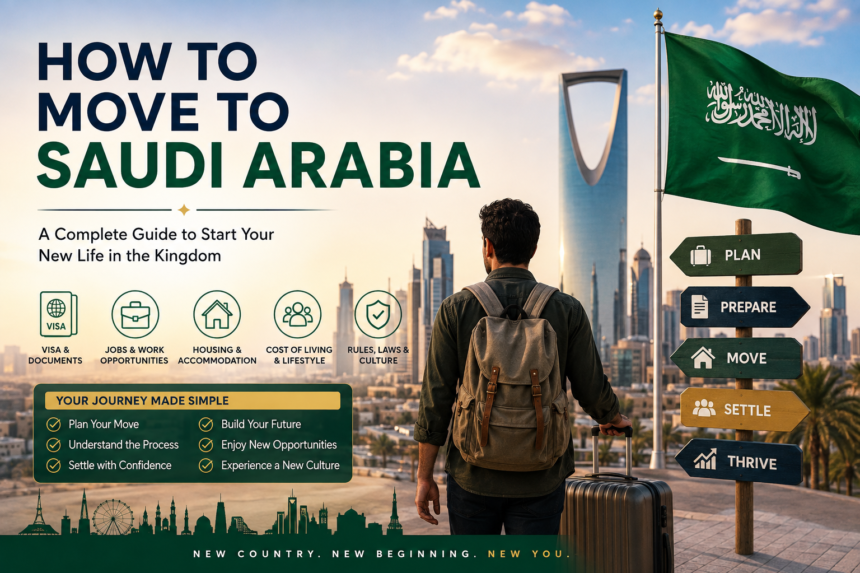
Complete Expat Guide 2026 How to Move to Saudi Arabia
Moving to Saudi Arabia can be an exciting opportunity for professionals, entrepreneurs, families, students, and skilled workers looking for career growth and a new lifestyle in the Gulf. With major economic transformation taking place under Saudi Vision 2030, the Kingdom is attracting international talent and investment across industries such as technology, healthcare, construction, finance, tourism, hospitality, engineering, logistics, renewable energy, and entertainment.
- Why Move to Saudi Arabia?
- Foreigners How to Move to Saudi Arabia?
- Step 1: Decide Why You Want to Move to Saudi Arabia
- Step 2: Find a Job in Saudi Arabia
- Step 3: Understand the Saudi Work Visa
- Step 4: Prepare Your Documents
- Step 5: Complete Medical and Biometric Requirements
- Step 6: Understand the Iqama
- Step 7: Consider Family Residency
- Step 8: Explore Premium Residency
- Step 9: Find the Right City
- Step 10: Find Accommodation
- Step 11: Understand the Cost of Living
- Step 12: Open a Bank Account
- Step 13: Get a Saudi Mobile Number
- Step 14: Understand Healthcare
- Step 15: Learn Saudi Culture and Local Customs
- Step 16: Learn Some Arabic
- Step 17: Understand Saudi Work Culture
- Step 18: Understand Employment Mobility
- Step 19: Learn About Transportation
- Step 20: Understand Property Rules
- What Should You Pack When Moving to Saudi Arabia?
- Common Mistakes to Avoid
- A Practical Saudi Arabia Relocation Checklist
- Frequently Asked Questions About Moving to Saudi Arabia
However, relocating to Saudi Arabia requires careful planning. From choosing the right visa and securing employment to finding accommodation, arranging healthcare, managing finances, and understanding local customs, there are several important steps to complete before and after arrival.
This complete guide explains how to move to Saudi Arabia in 2026, what documents you may need, the main residency options, how to find work, what to expect from everyday life, and practical tips for making your relocation easier.
Why Move to Saudi Arabia?
Saudi Arabia has changed considerably in recent years. The Kingdom is investing in infrastructure, tourism, technology, entertainment, renewable energy, real estate, and new industries as part of its economic diversification strategy.
For many expatriates, one of the biggest attractions is the expanding employment market. Major cities such as Riyadh, Jeddah, Dammam, and emerging economic destinations are creating opportunities for international professionals.

Saudi Arabia can be particularly attractive for people working in:
- Technology and artificial intelligence
- Engineering and construction
- Healthcare and medicine
- Finance and banking
- Education
- Hospitality and tourism
- Logistics and transportation
- Energy and renewable energy
- Real estate
- Marketing and media
- Retail and consumer services
- Project management
Another attraction is the possibility of building an international career while experiencing Saudi culture, modern infrastructure, and a rapidly developing economy.
Foreigners How to Move to Saudi Arabia?
Yes. Foreign nationals can live and work in Saudi Arabia when they have the appropriate authorization and residency status.
The route you take depends on your reason for moving. A person relocating for employment will generally follow a different process from someone joining a family member, investing, or qualifying for Premium Residency.
For employment, Saudi Arabia’s official rules require a non-Saudi worker to be legally authorized to work and to have the required work license and an employer relationship.
Therefore, it is important to choose the correct immigration route before moving rather than entering the country on a visa that does not authorize the activity you intend to perform.
Step 1: Decide Why You Want to Move to Saudi Arabia
Before applying for any visa, establish your main reason for relocation.
Common reasons include:
- Getting a job
- Starting or expanding a business
- Joining family
- Investing
- Studying
- Working on a short-term assignment
- Taking advantage of a specialized residency program
- Exploring professional opportunities
Your reason for moving will influence the visa or residency category you need.
For most working expatriates, employment is the starting point. If you already have a Saudi employer, the company normally plays a major role in arranging the work authorization process.
Step 2: Find a Job in Saudi Arabia
For many expatriates, the easiest and most common way to move to Saudi Arabia is to secure a job before travelling.
Saudi employers recruit international professionals for both traditional industries and emerging sectors. Riyadh is particularly important for corporate, financial, technology, consulting, government-related, and professional services roles, while Jeddah has a strong presence in trade, tourism, logistics, hospitality, and services.
When searching for a job, prepare a professional CV that clearly shows:
- Education and qualifications
- Professional experience
- Technical skills
- Certifications
- Languages
- Major projects
- Management experience
- Contact information
You should also research the employer carefully before accepting an offer.
Pay attention to the employment contract and understand:
- Basic salary
- Housing allowance
- Transportation allowance
- Medical insurance
- Annual leave
- Air-ticket benefits, if offered
- Working hours
- Probation period
- Contract duration
- End-of-service benefits
- Family benefits
- Relocation support
Never rely only on a verbal promise. Make sure important employment terms are documented.
Step 3: Understand the Saudi Work Visa
If you are moving to Saudi Arabia for a long-term job, you will generally need an appropriate work visa.
Saudi Arabia’s official National Platform describes the permanent work visa as a visa for workers who have obtained long-term employment contracts in the Kingdom. The process includes submitting applicant information, providing a valid passport and photograph, completing professional qualification procedures, medical examination and biometric fingerprinting, and completing procedures through the Saudi embassy or consulate after approval.
In many cases, the employer initiates or supports the process.
A simplified employment relocation process looks like this:
- Receive a Saudi employment offer.
- Sign the employment contract.
- Employer initiates the required work-visa process.
- Prepare your passport and supporting documents.
- Complete professional qualification requirements where applicable.
- Complete the required medical examination.
- Complete biometric procedures where required.
- Submit or complete embassy/consular procedures.
- Receive the visa.
- Travel to Saudi Arabia.
- Complete post-arrival residency procedures.
Exact requirements can vary depending on nationality, profession, employer, and visa category, so always check the current official instructions for your case.
Step 4: Prepare Your Documents
Good document preparation can make relocation considerably easier.
Create both physical and digital copies of important documents.
Your relocation folder should typically contain:
- Passport
- Employment contract
- Work visa documents
- Educational certificates
- Professional certificates
- Experience letters
- Marriage certificate, if applicable
- Birth certificates for children, if applicable
- Medical documents where required
- Passport photographs
- Driving licence
- Police or background documents if specifically required
- Financial records where necessary
Some documents may need authentication, translation, or other formal processing depending on the visa or profession.
Do not wait until the last minute to prepare educational and professional certificates. Certain occupations can have additional verification or qualification requirements.
Step 5: Complete Medical and Biometric Requirements
Medical examination and biometric procedures can form part of the Saudi work-visa process.
The official permanent work visa service currently lists professional qualification approval, medical examination, and biometric fingerprinting among the steps before final visa issuance.
Follow the instructions provided by the Saudi authorities and the relevant visa processing center in your country.
Make sure:
- Your passport information is correct.
- Your name is consistent across documents.
- Your photograph meets the requirements.
- Your medical examination is completed through the appropriate channel.
- You keep copies of submitted documents and receipts.
Small discrepancies in names, dates, or passport numbers can create unnecessary delays.
Step 6: Understand the Iqama
One of the most important documents for many expatriates living in Saudi Arabia is the Iqama, or Saudi residence identity.
Your Iqama establishes your legal resident identity and is important for everyday activities such as employment, banking, telecommunications, and accessing various services.
Saudi government services include electronic Iqama renewal for employees through the relevant employer systems.
After arriving, your employer normally handles important parts of the residency and employment process.
Do not treat the Iqama as a minor administrative document. Keep your information current and make sure your employer maintains the necessary records and renewals.
Step 7: Consider Family Residency
If you are moving to Saudi Arabia for work and want your spouse or children to join you, investigate family residency requirements early.
Saudi Arabia provides a residence-visa service intended for families of Saudi residents and citizens. The official service states that eligible first-degree relatives can obtain residence authorization for the applicable duration and requires documentation such as a valid passport, photograph, and medical insurance.
Before bringing your family, check the current requirements and make sure documents such as marriage and birth certificates are properly prepared.
You should also calculate the additional costs of:
- Housing
- Schooling
- Healthcare
- Transportation
- Family residency-related fees
- Flights
- Daily living expenses
Moving alone and relocating with a family can have very different financial requirements.
Step 8: Explore Premium Residency
Not everyone moving to Saudi Arabia needs to follow the traditional employer-sponsored route.
Saudi Arabia also has Premium Residency, which provides specific residency products for eligible applicants.
The Premium Residency framework includes permanent and fixed-term options, while the current program includes different products and eligibility categories.
Depending on the applicable category, Premium Residency may be relevant to:
- Investors
- Entrepreneurs
- Specialized professionals
- Researchers
- Talented individuals
- Property owners
- Certain other eligible applicants
The exact requirements and benefits depend on the product.
For example, Saudi Arabia’s relocation platform highlights benefits associated with certain residency categories, including family residency, greater employment flexibility, travel privileges, and property ownership subject to applicable rules.
Premium Residency is therefore worth researching if you want greater independence from a traditional employment-based residency arrangement.
Step 9: Find the Right City
Choosing where to live is one of the most important decisions when moving to Saudi Arabia.
Riyadh: Riyadh is the Kingdom’s capital and one of the most important centers for business, government, finance, technology, consulting, and professional services.
It can be a strong choice for professionals looking for corporate career opportunities and a rapidly developing urban environment.
Jeddah: Jeddah is located on the Red Sea and has a strong connection with trade, tourism, hospitality, logistics, and commerce.
Its coastal location and comparatively relaxed atmosphere also make it attractive to many expatriates.
Dammam and the Eastern Province: The Eastern Province is particularly important for energy, engineering, industrial, and petrochemical activities.
Professionals working in energy and related industries may find strong opportunities in this region.
Other Emerging Destinations: Saudi Arabia is also developing major destinations connected with tourism, entertainment, technology, logistics, and advanced industries.
Projects associated with Vision 2030 are creating opportunities beyond the traditional economic centers.
Step 10: Find Accommodation
Do not rush into signing a long-term rental contract immediately after arriving.
If possible, stay temporarily while you explore different neighborhoods and understand your workplace commute.
When choosing accommodation, consider:
- Distance from your workplace
- Monthly rent
- Furnished versus unfurnished options
- Parking
- Public transportation
- Schools
- Hospitals and clinics
- Supermarkets
- Restaurants
- Recreational facilities
- Neighborhood environment
- Lease conditions
If your employer provides a housing allowance, calculate your maximum comfortable monthly housing budget before signing a contract.
Step 11: Understand the Cost of Living
The cost of living in Saudi Arabia varies significantly depending on your city, housing choice, lifestyle, and family size.
Housing is usually one of the largest expenses, especially in major cities.
Your monthly budget may include:
- Rent
- Electricity and water
- Internet
- Mobile phone
- Groceries
- Transportation
- Fuel
- Dining
- Healthcare
- Education
- Entertainment
- Household expenses
A single professional with employer-provided housing may have a very different budget from a family paying private school fees and market-rate rent.
Before relocating, create a realistic monthly budget based on your expected salary and benefits.
Step 12: Open a Bank Account
A Saudi bank account can make everyday life much easier once you are legally resident and have the necessary documentation.
Banks have specific requirements for expatriate customers. Saudi Central Bank rules state that banks may open accounts for expatriates holding valid residence permits, with the Iqama and Saudi address forming part of the documentation requirements.
You may need information such as:
- Iqama
- Passport
- Saudi address
- Employer information
- Mobile number
- Salary information
Your employer may also provide guidance on salary-account arrangements.
Step 13: Get a Saudi Mobile Number
A local mobile number is extremely useful after moving to Saudi Arabia.
It can be needed for:
- Banking
- Government services
- Employment communication
- Delivery services
- Online accounts
- Transportation applications
- Two-factor authentication
Keep your mobile number active and make sure it is registered correctly with your identification information.
Step 14: Understand Healthcare
Healthcare is an important consideration when relocating, particularly for families.
Before moving, understand what medical insurance your employer provides and which hospitals and clinics are included in the network.
Ask your employer:
- Which insurer provides coverage?
- When does coverage begin?
- Are dependents included?
- Which hospitals are covered?
- Are dental services included?
- Are optical benefits included?
- Are there annual limits?
Premium Residency holders should also monitor their insurance status. Saudi Arabia’s Insurance Authority provides a service allowing Premium Residency holders to check the validity and insurer associated with their health insurance.
Step 15: Learn Saudi Culture and Local Customs
Moving to Saudi Arabia is not only an immigration process. It is also a cultural adjustment.
Saudi Arabia has a rich cultural heritage, and expatriates should make an effort to understand local customs and social expectations.
Respect for local culture is important in:
- Clothing
- Public behavior
- Religious practices
- Social gatherings
- Workplace communication
- Photography
- Public spaces
- Ramadan practices
You do not need to abandon your own culture, but understanding Saudi customs will help you build better relationships and avoid misunderstandings.
Step 16: Learn Some Arabic
English is widely used in many professional environments, particularly in international companies, but learning basic Arabic can be extremely helpful.
Start with practical phrases for:
- Greetings
- Directions
- Shopping
- Transportation
- Restaurants
- Introductions
- Everyday conversations
Even basic Arabic can make daily interactions easier and demonstrates respect for the local culture.
Step 17: Understand Saudi Work Culture
Work culture can vary significantly from one employer to another.
Before starting your job, understand your company’s expectations regarding:
- Working hours
- Meetings
- Communication
- Dress code
- Holidays
- Annual leave
- Remote work
- Hierarchy
- Reporting structure
- Performance reviews
Saudi labor regulations also establish rules concerning the employment of non-Saudi workers. For example, the Ministry of Human Resources and Social Development states that non-Saudis must have appropriate authorization and work licensing, and generally cannot work in a profession different from the one specified in their work license without completing the required legal procedures.
Step 18: Understand Employment Mobility
Saudi employment regulations have evolved, and certain eligible expatriate workers can transfer between employers under applicable conditions.
The Saudi National Platform currently provides a service allowing eligible resident employees to transfer to a new employer without requiring the current employer’s approval, subject to the relevant regulations and conditions. The process involves a new employer making an offer through Qiwa and the worker accepting or rejecting it.
This does not mean every worker can change jobs freely. Eligibility and procedures depend on the circumstances, so always verify your specific situation through official channels.
Step 19: Learn About Transportation
Your transportation needs will depend heavily on where you live and work.
Many expatriates use private cars, taxis, ride-hailing services, or employer transportation.
When selecting accommodation, consider the daily commute carefully. A cheaper apartment far from your workplace may become expensive and inconvenient if you spend significant time and money travelling.
If you intend to drive, check the current requirements for using or obtaining a Saudi driving licence and ensure that your existing licence is legally recognized for your circumstances.
Step 20: Understand Property Rules
If you plan to buy property rather than rent, research the rules that apply specifically to non-Saudi ownership.
Saudi Arabia’s Real Estate General Authority announced that the new system regulating real-estate ownership by non-Saudis entered into force on January 22, 2026. Applications are handled through the official Saudi Properties portal, subject to eligibility rules and applicable controls.
This is an important development for expatriates considering long-term settlement or investment in Saudi Arabia.
However, property ownership should not be assumed to be unrestricted. Check the applicable location, property category, residency status, and regulatory conditions before making a purchase.
What Should You Pack When Moving to Saudi Arabia?
Pack strategically rather than bringing everything you own.

Important items may include:
- Passport and visa documents
- Original certificates
- Digital document backups
- Prescription or essential personal items
- Appropriate professional clothing
- Comfortable everyday clothing
- Electronics and chargers
- Important family documents
- Small personal items that make your new home comfortable
Saudi Arabia has extensive retail options, so many household products can be purchased after arrival.
Common Mistakes to Avoid
Relocating internationally can be expensive when mistakes are made.
Avoid these common problems:
1. Travelling before your work authorization is confirmed: Make sure your visa status permits the activity you intend to undertake.
2. Accepting a job without reading the contract: Salary alone does not tell you the value of an employment package.
3. Underestimating housing costs: Rent can significantly affect your monthly budget.
4. Ignoring document authentication requirements: Professional and family documents may require additional processing.
5. Choosing accommodation without considering commuting time: Location can have a major effect on your quality of life.
6. Ignoring local customs: Cultural awareness makes adaptation much easier.
7. Moving without emergency savings: Keep enough funds to cover unexpected expenses during your first few months.
8. Assuming visa rules never change: Saudi immigration, employment, and residency systems continue to evolve, so verify requirements before travelling.
A Practical Saudi Arabia Relocation Checklist
Before leaving your home country, make sure you have completed the most important tasks.
Before Departure
- Secure the appropriate visa or residency route.
- Confirm your employment contract if moving for work.
- Check passport validity.
- Prepare educational and professional certificates.
- Complete required medical procedures.
- Complete biometric requirements where applicable.
- Organize family documents.
- Arrange temporary accommodation.
- Research long-term housing.
- Create a relocation budget.
- Purchase appropriate travel arrangements.
- Keep digital copies of important documents.
After Arrival
- Complete required residency procedures.
- Obtain your Iqama where applicable.
- Arrange a local mobile number.
- Open a bank account when eligible.
- Confirm healthcare coverage.
- Finalize accommodation.
- Learn your commute.
- Understand workplace policies.
- Explore your neighborhood.
- Learn basic Arabic.
- Become familiar with local customs.
Frequently Asked Questions About Moving to Saudi Arabia
Q1. Can I move to Saudi Arabia without a job?
Ans: It depends on your intended immigration route. Employment-based relocation normally requires an appropriate work authorization, while other options such as certain Premium Residency products may be available to eligible applicants.
Q2. What is the most common way for expats to move to Saudi Arabia?
Ans: Employment is one of the most common routes. A Saudi employer can initiate the relevant work-visa process for a worker with a qualifying employment contract.
Q3. Do I need an Iqama to live and work in Saudi Arabia?
Ans: For many long-term expatriate workers, the Iqama is the key residence identity document. The exact process depends on your immigration category.
Q4. Can my family join me in Saudi Arabia?
Ans: Eligible residents can apply for residence visas for qualifying family members subject to the applicable requirements.
Q5. How much money should I save before moving to Saudi Arabia?
Ans: There is no single amount suitable for everyone. Your savings target should account for flights, temporary accommodation, rental deposits, transportation, food, household purchases, and unexpected expenses until your salary and benefits are fully established.
Q6. Which city is best for expats in Saudi Arabia?
Ans: Riyadh is a major choice for corporate and professional careers, Jeddah is attractive for coastal living, commerce, tourism, and services, while the Eastern Province can be particularly relevant for energy and industrial careers. The best city depends on your job, budget, family situation, and lifestyle preferences.
Q7. Can foreigners buy property in Saudi Arabia?
Ans: Non-Saudi property ownership is now regulated under a system that entered into force on January 22, 2026. Eligibility and permitted property categories and locations are subject to specific rules.
Q8. What is Premium Residency in Saudi Arabia?
Ans: Premium Residency is a residency framework offering different products for eligible applicants, including categories connected with investment, entrepreneurship, specialized talent, and other qualifying circumstances.
Q9. Is Saudi Arabia a good country for expats?
Ans: Saudi Arabia can be attractive to expatriates seeking career opportunities, business prospects, modern infrastructure, and an international lifestyle. Your experience will depend on your profession, employer, city, income, family circumstances, and ability to adapt to local culture.
Final Thoughts: Is Moving to Saudi Arabia Worth It?
Moving to Saudi Arabia can be a major life and career decision, but for the right person it can offer significant opportunities.
The Kingdom is undergoing a period of rapid transformation. New investments in technology, tourism, infrastructure, entertainment, renewable energy, logistics, and advanced industries are creating opportunities for international professionals and businesses.
The best way to approach relocation is to plan carefully rather than simply move quickly. Secure the correct visa, understand your employment contract, prepare your documents, research your city, calculate your living expenses, and learn about Saudi culture before arrival.
For professionals, entrepreneurs, and families, Saudi Arabia can offer access to a growing economy and a changing society. At the same time, successful relocation requires flexibility, cultural awareness, financial preparation, and compliance with local regulations.
If you are planning to move to Saudi Arabia in 2026, start by identifying your immigration route and confirming the latest requirements through official Saudi government channels. Visa and residency requirements can change, so current official information should always take priority over older online guides.
Do follow us on Instagram
Read More – Best Cities to Live in Saudi Arabia For Expats, Families & Professionals