



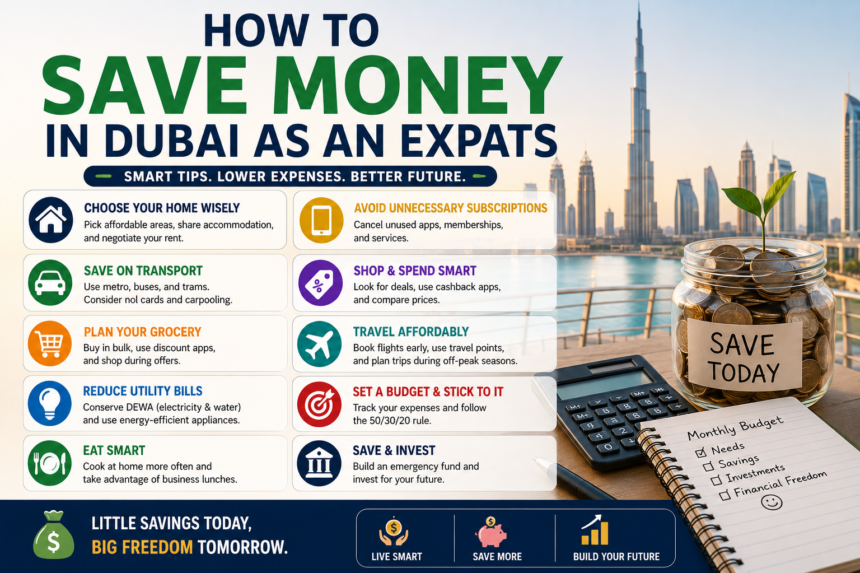
20 Smart Tips For 2026: How to Save Money in Dubai as an Expats
Dubai is one of the world’s most exciting cities for expatriates. It offers excellent career opportunities, modern infrastructure, international schools, luxury shopping, world-class restaurants and an extraordinary lifestyle. However, living in Dubai as an expat can also become expensive if you do not carefully manage your income and daily expenses.
- Is Dubai Expensive for Expats?
- 1. Choose Your Accommodation Carefully
- 2. Create a Monthly Dubai Budget
- 3. Use Dubai’s Public Transportation
- 4. Reduce Your Taxi and Ride-Hailing Expenses
- 5. Cook at Home More Often
- 6. Shop for Groceries Strategically
- 7. Take Advantage of Discounts and Loyalty Programs
- 8. Reduce Food Delivery Costs
- 9. Reduce Unnecessary Subscriptions
- 10. Save Money on Utilities
- 11. Be Smart About Shopping
- 12. Enjoy Dubai’s Free and Low-Cost Attractions
- 13. Plan Your Holidays Carefully
- 14. Build an Emergency Fund
- 15. Save Money Before You Spend It
- 16. Avoid Lifestyle Inflation
- 17. Choose Your Bank Accounts and Financial Products Carefully
- 18. Be Careful With Credit Cards
- 19. Increase Your Income, Not Just Your Savings
- 20. Set Clear Financial Goals
- How Much Should an Expat Save in Dubai?
- Sample Monthly Budget for an Expat in Dubai
- Biggest Money-Wasting Habits in Dubai
- How to Save Money in Dubai Without Sacrificing Your Lifestyle
- 30-Day Money-Saving Challenge for Dubai Expats
- Final Tips for Saving Money in Dubai as an Expat
The good news is that you do not need to sacrifice your quality of life to save money in Dubai. With the right approach to rent, transportation, groceries, dining, shopping, entertainment, utilities and personal budgeting, it is possible to enjoy the city while building meaningful savings.
Whether you are a new expat moving to Dubai or someone who has lived in the UAE for years, developing good financial habits can make a significant difference. This guide explains how to save money in Dubai as an expat and provides practical strategies that can help reduce unnecessary spending while allowing you to enjoy the best of the city.
Is Dubai Expensive for Expats?
Dubai can be expensive, but the actual cost of living depends heavily on your lifestyle. Housing is usually one of the biggest expenses, followed by transportation, food, education, healthcare, entertainment and personal spending.
An expat living in a luxury apartment, eating at restaurants frequently, using taxis every day and shopping regularly will naturally spend much more than someone who chooses affordable accommodation, cooks at home and uses public transportation.
This means that saving money in Dubai is less about avoiding everything enjoyable and more about making smarter choices with your money.
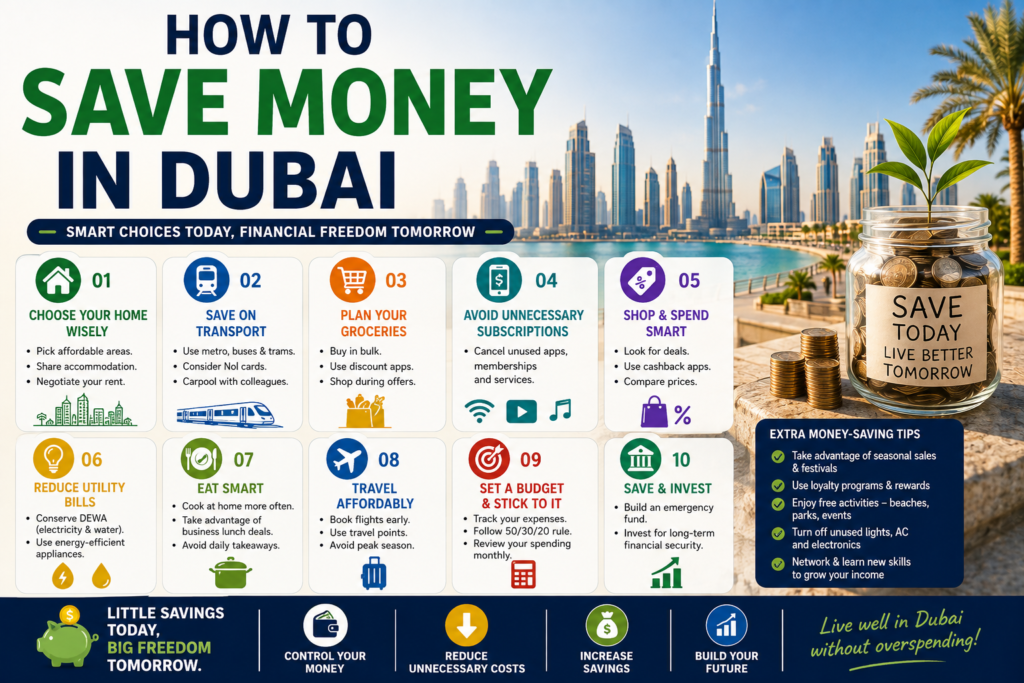
Your first step should be understanding where your income goes each month.
Common major expenses include:
- Rent and housing
- Electricity and water
- Internet and mobile phone
- Groceries
- Transportation
- Eating out
- Entertainment
- Shopping
- School fees
- Healthcare
- Insurance
- Travel
- Personal expenses
Once you identify your largest expenses, you can focus your savings efforts where they will have the greatest impact.
1. Choose Your Accommodation Carefully
Rent is often the largest expense for expats living in Dubai, so choosing the right accommodation can make a major difference to your monthly budget.
Living in the most famous areas of Dubai can be attractive, but premium locations often come with higher rents. Areas such as Downtown Dubai, Dubai Marina, Palm Jumeirah and some waterfront communities can cost significantly more than more affordable residential neighbourhoods.
Before signing a rental contract, compare different areas based on both rent and commuting costs.
Consider:
- Monthly or annual rent.
- Distance from your workplace.
- Public transportation access.
- Parking costs.
- Utility expenses.
- Building maintenance.
- Grocery and shopping access.
- Community facilities.
- School distance if you have children.
Sometimes paying slightly more for an apartment close to your workplace can actually save money because you spend less on transportation and commuting time.
On the other hand, choosing an affordable neighbourhood with good Metro or bus access can significantly reduce your overall living expenses.
Consider Shared Accommodation
For single professionals, sharing accommodation can be one of the most effective ways to reduce housing costs.
Instead of paying for an entire apartment, you may share the rent and utilities with roommates. However, always ensure that your accommodation arrangement complies with applicable tenancy and housing regulations.
For families, sharing accommodation may not be practical, so choosing a suitable family-oriented neighbourhood with reasonable rent may be a better strategy.
2. Create a Monthly Dubai Budget
One of the simplest ways to save money in Dubai is to create a realistic monthly budget.
Many people know their salary but do not know exactly how much they spend each month. Small expenses can accumulate quickly.
Create categories for:
- Housing
- Utilities
- Food
- Transportation
- Shopping
- Entertainment
- Travel
- Savings
- Investments
- Emergency expenses
Track your spending for at least one or two months. This will show you where your money is actually going.
For example, you might discover that frequent food deliveries, coffee purchases, taxi rides and online shopping are consuming a significant portion of your disposable income.
Once you identify these expenses, you can make adjustments without dramatically changing your lifestyle.
A simple budgeting approach
You can divide your income into:
- Essential expenses
- Savings and investments
- Lifestyle and entertainment
- Emergency funds
The exact percentage does not need to follow a particular rule. Your budget should reflect your salary, rent, family responsibilities and financial goals.
3. Use Dubai’s Public Transportation
Transportation can become expensive if you rely on taxis or private cars every day.
Dubai has an extensive public transportation network that includes the Metro, buses, tram, taxis and marine transport. For people who live and work near Metro stations, public transportation can significantly reduce commuting costs.
Consider using public transport for:
- Daily commuting.
- Shopping trips.
- Weekend activities.
- Airport journeys where practical.
- Meetings in areas connected by public transport.
A Nol card can make using public transportation more convenient.
If you need a car occasionally, compare the cost of renting a vehicle, using ride-hailing services or taking taxis rather than automatically purchasing a car.
Think About the Total Cost of Owning a Car
Car ownership involves much more than the purchase price.
You may need to pay for:
- Fuel.
- Insurance.
- Registration.
- Maintenance.
- Parking.
- Salik or other road-related costs.
- Repairs.
- Depreciation.
If you live near your workplace and public transportation is convenient, you may find that you do not need a car every day.
4. Reduce Your Taxi and Ride-Hailing Expenses
Taxis are convenient, but using them regularly can have a major impact on your monthly budget.
Instead of taking a taxi for every short journey, combine different transportation options.
For example:
Metro + short taxi ride can sometimes be considerably cheaper than taking a taxi for the entire journey.
You can also:
- Share rides with colleagues where practical.
- Walk for short distances when weather permits.
- Use public transportation for regular commutes.
- Group errands together.
- Compare transportation options before travelling.
Convenience is valuable, but you should decide when it is worth paying for.
5. Cook at Home More Often
Eating out is one of the easiest ways to overspend in Dubai.
The city has an enormous restaurant and food-delivery culture. From affordable local restaurants to luxury dining venues, there are options for almost every budget.
The problem is that frequent restaurant meals and delivery orders can quickly become expensive.
Cooking at home does not mean you have to stop eating out completely.
Instead, consider:
- Preparing breakfast at home.
- Packing lunch for work.
- Cooking dinner several times a week.
- Preparing meals in batches.
- Taking homemade snacks to work.
- Limiting food-delivery orders.
Even replacing several restaurant meals each week with home-cooked food can create meaningful monthly savings.
6. Shop for Groceries Strategically
Groceries are another area where small savings can add up.
Dubai has many supermarkets, hypermarkets, local grocery stores and online grocery services. Prices can vary depending on the store, brand and promotions.
Before shopping:
- Make a grocery list.
- Set a weekly food budget.
- Compare prices.
- Look for supermarket promotions.
- Buy frequently used products in economical quantities.
- Choose store brands where quality is suitable.
- Avoid buying unnecessary items simply because they are discounted.
However, buying in bulk is not always cheaper. Check the price per kilogram, litre or unit rather than simply choosing the largest package.
You can also reduce food waste by planning meals before shopping.
7. Take Advantage of Discounts and Loyalty Programs
Dubai has numerous promotional offers, loyalty programs and discount platforms.
Before making a purchase, check whether a legitimate discount is available.
Potential savings can come from:
- Supermarket loyalty programs.
- Restaurant promotions.
- Cinema offers.
- Credit-card rewards.
- Retail loyalty programs.
- Seasonal sales.
- Membership discounts.
- Cashback programs.
However, there is an important rule:
Never spend AED 500 simply to save AED 50.
A discount only saves money if you actually needed the product or service.
8. Reduce Food Delivery Costs
Food delivery can quietly become a major expense.
The cost is not always limited to the food itself. Depending on the service and order, you may also encounter delivery fees, service charges and other costs.
If you regularly order food online, establish a monthly delivery budget.
You could also:
- Cook more meals at home.
- Order larger meals and save leftovers where appropriate.
- Choose restaurants offering better-value meals.
- Avoid ordering simply because you are bored.
- Compare the final checkout price rather than the advertised meal price.
Saving even a modest amount on delivery several times per week can add up over a year.
9. Reduce Unnecessary Subscriptions
Subscriptions are easy to forget because they are often automatically charged.
Review your bank or card statements and identify recurring payments for:
- Streaming services.
- Fitness memberships.
- Apps.
- Cloud storage.
- Gaming services.
- News platforms.
- Food memberships.
- Online shopping programs.
Ask yourself:
Did I use this service during the past month?
If the answer is no, consider cancelling it.
You can also rotate subscriptions. Instead of paying for multiple entertainment services every month, use one or two and switch occasionally.
10. Save Money on Utilities
Utility bills can vary considerably depending on your apartment, household size, season and consumption.
Air conditioning is particularly important in Dubai’s hot climate.
You can reduce unnecessary electricity consumption by:
- Turning off lights when leaving a room.
- Using energy-efficient appliances.
- Avoiding unnecessarily low air-conditioning temperatures.
- Closing doors and windows properly.
- Turning off electronics when not needed.
- Using appliances efficiently.
- Reporting leaks promptly.
Water conservation can also help reduce household consumption.
Small daily habits may not seem significant, but they can make a difference over an entire year.
11. Be Smart About Shopping
Dubai is famous for shopping, and the city’s malls make it easy to spend money.
Before purchasing something, ask:
Do I need it, or do I simply want it because it is on sale?
Create a waiting period for expensive non-essential purchases. For example, wait 24 hours or several days before buying something expensive.
You may discover that the desire to purchase it disappears.
Smart shopping habits include:
- Compare prices before buying.
- Wait for seasonal sales.
- Use loyalty points.
- Avoid impulse purchases.
- Set a monthly shopping limit.
- Buy quality products that last.
- Avoid shopping simply for entertainment.
Remember that the cheapest product is not always the best value. A durable product that lasts for years may be financially better than repeatedly replacing cheaper alternatives.
12. Enjoy Dubai’s Free and Low-Cost Attractions
You do not need to spend large amounts of money every weekend to enjoy Dubai.
The city offers many activities that can be free or relatively inexpensive.
Depending on the season and location, you can enjoy:
- Public beaches.
- Parks.
- Walking areas.
- Dubai Creek.
- Outdoor markets.
- Cultural districts.
- Community events.
- Free exhibitions.
- Public spaces.
- Hiking and outdoor destinations outside central Dubai.
Instead of automatically choosing an expensive brunch, hotel activity or shopping trip every weekend, mix paid activities with low-cost experiences.
This allows you to enjoy Dubai without constantly increasing your entertainment budget.
13. Plan Your Holidays Carefully
Many expats travel frequently from Dubai because of the city’s international connectivity.
Travel can become a significant expense, particularly if you take several international trips every year.
You can reduce travel costs by:
- Booking flights early when practical.
- Comparing different travel dates.
- Travelling during less expensive periods.
- Using legitimate loyalty rewards.
- Comparing hotels and alternative accommodation.
- Setting a separate travel fund.
- Planning annual holidays in advance.
Avoid putting an expensive holiday on a credit card without having a repayment plan.
A travel fund allows you to enjoy holidays without disrupting your monthly budget.
14. Build an Emergency Fund
Saving money is not only about cutting expenses. It is also about protecting yourself against unexpected costs.
An emergency fund can help with situations such as:
- Unexpected medical expenses.
- Job changes.
- Emergency travel.
- Vehicle repairs.
- Temporary loss of income.
- Unexpected household expenses.
The appropriate emergency-fund size depends on your circumstances, but many people aim to build enough savings to cover several months of essential expenses.
Keep emergency savings separate from your everyday spending account so that you are less tempted to use the money for shopping or entertainment.
For expatriates, an emergency fund can be particularly important because employment and residency arrangements may be connected.
15. Save Money Before You Spend It
One of the most effective financial habits is to pay yourself first.
Instead of waiting until the end of the month to see what money remains, transfer a predetermined amount into savings shortly after receiving your salary.
For example:
Salary → Savings → Essential expenses → Lifestyle spending
rather than:
Salary → Spending → Spending → Spending → Whatever remains becomes savings
The second approach often results in very little being saved.
Automating your savings can make the process easier.
16. Avoid Lifestyle Inflation
A common problem for successful expats is lifestyle inflation.
You receive a salary increase and immediately upgrade:
- Your apartment.
- Your car.
- Your phone.
- Your restaurants.
- Your holidays.
- Your shopping habits.
As a result, your income increases but your savings do not.
Instead, when your income rises, consider directing a portion of the increase toward:
- Emergency savings.
- Investments.
- Retirement planning.
- Debt repayment.
- A future property purchase.
- Education.
- Long-term financial goals.
You can still improve your lifestyle, but do it deliberately rather than automatically.
17. Choose Your Bank Accounts and Financial Products Carefully
Banking costs can also affect your finances.
Review your account terms and understand:
- Minimum balance requirements.
- Monthly charges.
- International transfer fees.
- Currency conversion charges.
- ATM fees.
- Credit-card annual fees.
- Rewards and cashback conditions.
If you send money to family outside the UAE, compare legitimate remittance providers and exchange rates rather than automatically using the first available option.
When selecting a financial product, focus on the total cost, not just promotional rewards.
18. Be Careful With Credit Cards
Credit cards can be useful when used responsibly, especially when they provide legitimate rewards or cashback.
However, carrying an unpaid balance can quickly undermine your savings goals because interest and fees may accumulate.
A good rule is:
Use a credit card as a payment tool, not as additional income.
Before using a credit card, make sure you have a realistic plan to pay the balance.
Also avoid spending extra simply to earn rewards.
If a card gives you cashback but encourages you to spend thousands of dirhams unnecessarily, you are not actually saving money.
19. Increase Your Income, Not Just Your Savings
Cutting expenses is important, but there is a limit to how much you can reduce your spending.
Increasing your income can potentially have a much larger long-term impact.
Depending on your profession and circumstances, you might consider:
- Developing new professional skills.
- Negotiating your salary.
- Pursuing promotions.
- Freelancing where legally permitted.
- Building professional connections.
- Learning technology-related skills.
- Starting a legitimate business where permitted.
- Exploring better employment opportunities.
Dubai’s diverse economy provides opportunities across industries such as technology, finance, tourism, logistics, healthcare, real estate, professional services and e-commerce.
The best financial strategy combines expense management with income growth.
20. Set Clear Financial Goals
Saving without a goal can become difficult.
Instead, give your money a purpose.
Your goals might include:
- Building an emergency fund.
- Buying a home.
- Starting a business.
- Supporting your family.
- Paying for children’s education.
- Saving for retirement.
- Building an investment portfolio.
- Planning a major international trip.
Write down the goal and establish a target amount.
For example:
Goal: Emergency fund
Target: Six months of essential expenses
Monthly contribution: Fixed amount after salary
A specific goal makes it easier to resist unnecessary spending.
How Much Should an Expat Save in Dubai?
There is no universal savings percentage that works for every expat.
Someone earning a high salary with employer-provided housing and no children may be able to save considerably more than a family paying rent, school fees and other major expenses.
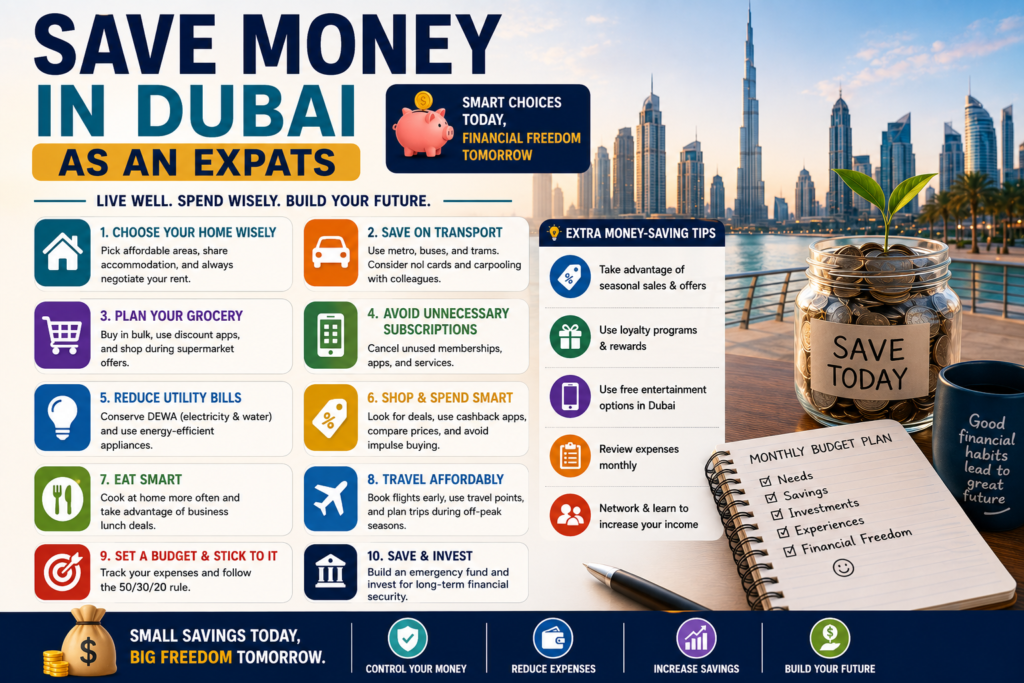
Instead of copying someone else’s savings target, calculate your own savings rate:
Savings Rate = Monthly Savings ÷ Monthly Take-Home Income × 100
Then work on improving the percentage over time.
If you currently save 5%, focus on reaching 8% or 10%. If you already save 20%, consider whether you can increase it further without sacrificing your quality of life.
The important thing is consistency.
Sample Monthly Budget for an Expat in Dubai
A hypothetical budget might look like this:
| Expense Category | Suggested Budget Approach |
|---|---|
| Rent | Largest fixed expense; choose carefully |
| Utilities | Track monthly consumption |
| Groceries | Set a weekly limit |
| Transportation | Use public transport where practical |
| Dining | Establish a fixed monthly amount |
| Entertainment | Mix free and paid activities |
| Shopping | Set a discretionary limit |
| Savings | Transfer automatically after payday |
| Emergency Fund | Build gradually |
| Investments | Allocate according to your financial plan |
The exact amounts will vary substantially depending on salary, family size, accommodation and lifestyle.
The key is to make savings a planned expense rather than whatever is left at the end of the month.
Biggest Money-Wasting Habits in Dubai
Expats can lose significant amounts of money through habits that seem harmless individually.
Common examples include:
- Ordering food several times a week.
- Taking taxis for short journeys.
- Renting a luxury apartment unnecessarily.
- Shopping during every mall visit.
- Paying for unused subscriptions.
- Buying expensive coffee every day.
- Upgrading phones frequently.
- Using credit cards without a repayment plan.
- Taking expensive holidays without planning.
- Buying discounted products that were never needed.
- Increasing lifestyle spending after a salary increase.
The solution is not to eliminate everything enjoyable.
Instead, identify the three or four habits that cost you the most money and change those first.
How to Save Money in Dubai Without Sacrificing Your Lifestyle
Saving money does not mean living an unhappy life.
You can still:
- Eat at restaurants.
- Travel.
- Visit attractions.
- Go to the beach.
- Enjoy Dubai’s nightlife.
- Shop occasionally.
- Take holidays.
- Meet friends.
The difference is that you should decide how much you can afford to spend before spending it.
For example, instead of eating out five times every week, you might choose two restaurant meals and prepare the rest at home.
Instead of spending every weekend at expensive entertainment venues, you could alternate between paid experiences and free outdoor activities.
This approach allows you to enjoy Dubai while maintaining financial discipline.
30-Day Money-Saving Challenge for Dubai Expats
If you want to improve your finances quickly, try a simple 30-day challenge.
Week 1: Track Everything
Record every dirham you spend.
Do not judge your spending yet. Simply collect the information.
Week 2: Cut Three Expenses
Identify three unnecessary expenses and reduce or eliminate them.
Examples:
- Food delivery.
- Unused subscriptions.
- Frequent taxi rides.
Week 3: Optimize Your Major Costs
Look at your largest expenses, particularly:
- Rent.
- Transportation.
- Food.
These areas usually provide the greatest potential for savings.
Week 4: Automate Your Savings
Set up a regular transfer into a dedicated savings account after receiving your salary.
At the end of the month, review your results and create a new budget based on what you learned.
Final Tips for Saving Money in Dubai as an Expat
If you want to remember only the most important recommendations, focus on these:
- Choose affordable accommodation.
- Live reasonably close to work.
- Use public transportation whenever practical.
- Cook at home regularly.
- Plan your grocery shopping.
- Limit food delivery.
- Compare prices before buying.
- Cancel unused subscriptions.
- Take advantage of legitimate discounts.
- Enjoy free and low-cost activities.
- Create a monthly budget.
- Build an emergency fund.
- Save automatically after payday.
- Avoid unnecessary credit-card debt.
- Control lifestyle inflation.
- Look for ways to increase your income.
- Set clear long-term financial goals.
Conclusion: How to Save Money in Dubai as an Expats
Learning how to save money in Dubai as an expat does not require giving up the lifestyle that attracted you to the city in the first place. The key is to understand your expenses, prioritize your financial goals and make deliberate decisions about where your money goes.
Housing should be one of your first considerations because rent can have a major effect on your monthly budget. Transportation, dining, groceries and entertainment are also areas where small changes can produce meaningful savings. Using public transportation, cooking at home, limiting food delivery, comparing prices and taking advantage of legitimate discounts can all help reduce everyday expenses.
At the same time, saving money should not be limited to cutting costs. Increasing your income, building an emergency fund and developing a long-term investment strategy can help strengthen your financial position.
Most importantly, avoid comparing your lifestyle with other expats. Dubai makes it easy to see luxury cars, expensive restaurants, designer shopping and premium experiences every day. You do not need to match someone else’s spending habits to enjoy living in the UAE.
A successful financial plan is one that allows you to live comfortably today while preparing for tomorrow.
Whether you are a new expat, a young professional, a family or a long-term UAE resident, the most effective strategy is simple: spend intentionally, save consistently and increase your earning potential over time.
With disciplined budgeting and smart everyday choices, you can enjoy everything Dubai has to offer while still building meaningful savings and working toward long-term financial freedom.
Do follow us on Instagram
Read More – Ultimate Guide on How to Save Money in Dubai