


12 Gulf Road Trips That Reveal a Completely Different Arabia
The Gulf is often explored through airports, luxury hotels and modern city centres, but some of the region’s most memorable experiences begin after you leave the skyline behind.
- Why Road Trips in Gulf Are Worth Experiencing
- 1. Dubai to Hatta, UAE
- 2. Dubai to Fujairah, UAE
- 3. Dubai to Khor Fakkan
- 4. Muscat to Sur, Oman
- 5. Muscat to Jabal Akhdar, Oman
- 6. Muscat to Jabal Shams
- 7. Oman Wadi Road Trip
- 8. Muscat to A’Sharqiyah Sands
- 9. Saudi Arabia: Jeddah to AlUla
- 10. Saudi Arabia: Jeddah to Taif and Al Baha
- 11. Jeddah to Abha and Jazan
- 12. Saudi Arabia: Qassim to Hail and AlUla
- Best Gulf Road Trips at a Glance
- Which GCC Country Is Best for Road Trips?
- Car or SUV: What Do You Actually Need?
- Gulf Desert Driving Is Different From Highway Driving
- Check Rental-Car Cross-Border Rules
- International Driving Permits and Licence Rules
- Best Time for Road Trips in Gulf
- Saudi Arabia and Oman Have Regional Weather Differences
- Road-Trip Essentials
- Fill the Tank Before Remote Sections
- Download Maps Offline
- Do Not Drive Tired
- Watch for Animals
- Mountain Driving Requires Patience
- Plan Fewer Stops Than You Think
- A Perfect Five-Day Oman Road Trip
- A Perfect Two-Day UAE Road Trip
- A Saudi Road Trip Needs More Time
- Road Trips for Couples
- Road Trips for Families
- Road Trips for Photographers
- Common Gulf Road-Trip Mistakes
- FAQs About Road Trips in Gulf
- Conclusion
Road Trips in Gulf can take travellers from Dubai’s skyscrapers into rugged mountains, from Muscat along turquoise coastlines, across Saudi Arabia’s enormous deserts and through remote villages that feel completely different from the region’s famous urban centres.
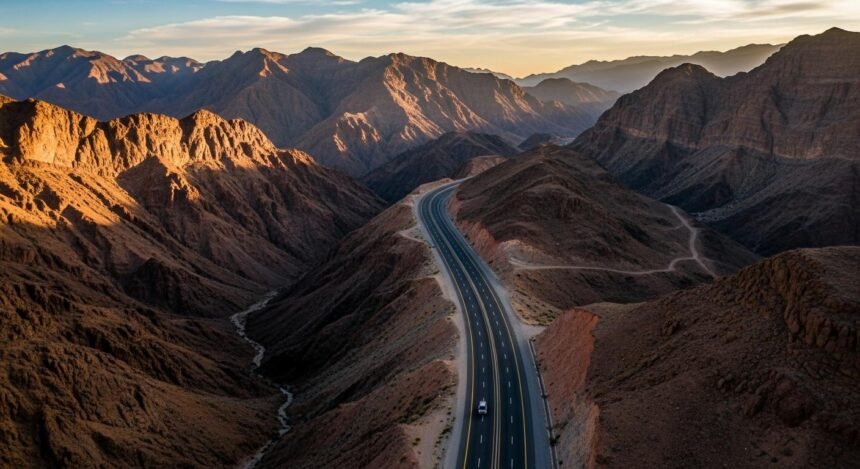
The geography is one of the biggest surprises. Within the GCC, travellers can encounter deserts, mountain passes, wadis, beaches, historic towns, dramatic rock formations and modern highways stretching toward the horizon.
Dubai Tourism’s 2026 road-trip guide specifically encourages visitors to explore the emirate by car, while official tourism itineraries in Oman and Saudi Arabia highlight long-distance routes connecting mountains, deserts, heritage villages and coastal landscapes.
For travellers who enjoy freedom, spontaneous stops and changing scenery, the road can become as important as the destination.
Why Road Trips in Gulf Are Worth Experiencing
Flying between major Gulf cities is convenient.
Driving reveals everything between them.
Instead of seeing only airports and urban centres, a road trip introduces you to:
- desert highways,
- mountain villages,
- smaller towns,
- traditional markets,
- coastlines,
- farms,
- archaeological landscapes,
- local restaurants.
That slower movement gives travellers a better sense of scale.
Saudi Arabia alone is enormous. Oman changes dramatically between coast, desert and mountains. The UAE can shift from futuristic cityscape to Hajar Mountain scenery within a relatively short drive.
The strongest Gulf road trips are therefore not simply transportation.
They are part of the travel experience.
1. Dubai to Hatta, UAE
One of the easiest road trips for first-time Gulf visitors is Dubai to Hatta.
Hatta sits in the Hajar Mountains and offers a completely different environment from central Dubai.
Dubai Tourism recommends the destination for mountain adventures, biking and outdoor experiences, while its current driving map directs travellers from Dubai toward Hatta using the E102 and E44 routes.
The journey introduces a gradual landscape change.
Dubai’s towers disappear.
Open desert takes over.
Then the mountains begin appearing.
Once in Hatta, travellers can explore:
- Hatta Dam,
- kayaking,
- mountain biking,
- hiking,
- heritage attractions,
- viewpoints.
Visit Dubai even offers a two-day Hatta itinerary for travellers who want to stay rather than immediately return to the city.
Best for: First-time road trippers, couples and families.
2. Dubai to Fujairah, UAE
The journey from Dubai toward Fujairah demonstrates how geographically varied the UAE can be.
The drive heads east toward the Hajar Mountains before eventually reaching the Gulf of Oman coast.
Unlike Dubai’s flat urban environment, the eastern UAE introduces:
- rocky mountains,
- winding roads,
- beaches,
- smaller settlements,
- coastal scenery.
The route can work particularly well for a weekend escape.
Spend the day exploring the coast, stay overnight near the beach and return to Dubai the following day.
Best for: Mountains, beach lovers and weekend escapes.
3. Dubai to Khor Fakkan
Khor Fakkan is another strong east-coast destination.
The attraction comes partly from the journey.
Roads toward the eastern coastline pass through mountain landscapes before eventually opening toward the sea.
The combination of:
mountain + highway + blue coastline
creates one of the most visually impressive drives in the UAE.
Travellers can spend time along the waterfront, visit viewpoints or continue exploring surrounding mountain areas.
Best for: Photography and scenic drives.
4. Muscat to Sur, Oman
Oman is arguably one of the GCC’s strongest road-trip destinations.
One classic journey follows the coast southeast from Muscat toward Sur.
Official Oman tourism itineraries highlight stops such as Bimmah Sinkhole, Wadi Shab and the historic coastal area of Qalhat along this route.
This makes it perfect for travellers who do not want to spend the day simply driving.
Possible stops include:
- Bimmah Sinkhole,
- Wadi Shab,
- coastal viewpoints,
- Qalhat,
- Sur.
The route combines mountains and sea.
That alone separates it from the stereotypical image of Gulf travel as endless desert.
5. Muscat to Jabal Akhdar, Oman
For mountain lovers, Jabal Akhdar belongs near the top of the list.
The area is known for dramatic peaks, villages and agricultural terraces.
Oman’s official self-drive itineraries highlight villages such as Sayq and Al Ain, as well as the area’s famous terrace gardens and seasonal roses.
The mountain environment can be significantly cooler than lower elevations.
That makes it especially appealing during appropriate seasons.
However, mountain access can involve specific vehicle requirements, so travellers should check current road and vehicle rules before leaving.
Best for: Mountains, hiking and photography.
6. Muscat to Jabal Shams
Jabal Shams provides another spectacular Oman mountain trip.
Official Oman itineraries connect the route with attractions such as Nakhal, Wadi Bani Awf, Bilad Sayt and eventually Jabal Shams.
The landscape becomes increasingly dramatic.
Rocky cliffs and deep valleys replace coastal scenery.
Travellers can then experience hiking routes such as the well-known Balcony Walk in the Jabal Shams area.
This is better suited to travellers who enjoy active holidays rather than simple sightseeing.
7. Oman Wadi Road Trip
Oman’s wadis deserve their own road-trip theme.
Wadi Dima Wa’ttayeen, for example, stretches from the Al Sharqiyah Expressway through mountain terrain containing villages, palm groves, springs and natural pools.
Other well-known wadi areas include:
- Wadi Bani Khalid,
- Wadi Shab,
- Wadi Bani Awf.
Official Oman itineraries frequently combine them with mountain roads and desert destinations.
For travellers unfamiliar with wadis, weather awareness is essential.
Flash flooding can make normally accessible areas dangerous.
Check current conditions before entering remote valleys.
8. Muscat to A’Sharqiyah Sands
For a classic desert experience, travellers can drive from Muscat toward the A’Sharqiyah Sands region.
Oman’s tourism platform describes A’Sharqiyah Sands as one of the country’s major golden-dune landscapes.
A common itinerary combines:
Muscat → Wadi Bani Khalid → A’Sharqiyah Sands
Official self-drive itineraries use exactly this type of combination, linking clear wadi pools with enormous desert dunes.
That makes the journey especially memorable because the landscapes change rapidly.
Best for: Desert camps and overnight road trips.
9. Saudi Arabia: Jeddah to AlUla
Saudi Arabia has some of the GCC’s most ambitious long-distance road-trip possibilities.
One of the most appealing combines the Red Sea region with AlUla.
Official Visit Saudi itineraries include routes passing through western and northwestern destinations before reaching AlUla, where travellers can explore Hegra, the Old Town and Elephant Rock.
AlUla’s sandstone formations create one of the most dramatic road-trip landscapes in the region.
Travellers should allow several days rather than treating the journey as a simple day trip.
Saudi distances are enormous.
That is part of the experience.
10. Saudi Arabia: Jeddah to Taif and Al Baha
This route reveals a side of Saudi Arabia many international visitors do not expect.
The journey begins near the Red Sea before climbing toward higher-elevation landscapes.
Current Visit Saudi itineraries connect Jeddah with Taif and Al Baha, highlighting Taif’s cooler mountain atmosphere and Al Baha’s forests and heritage villages.
This journey can combine:
- coastal city experiences,
- mountain roads,
- traditional markets,
- forests,
- historic villages.
Best for: Travellers wanting cooler mountain landscapes and local culture.
11. Jeddah to Abha and Jazan
For a longer southern Saudi adventure, consider travelling through Jeddah, Abha and Jazan.
Visit Saudi currently promotes an eight-day itinerary combining Jeddah’s coast with Abha’s highlands, Rijal Alma, Jazan, Wadi Lajab and the Fifa Mountains.
The geographical contrasts are striking.
Jeddah offers Red Sea scenery.
Abha brings cooler mountain conditions.
Jazan introduces tropical-looking valleys, islands and dramatic southern landscapes.
This route works best as a multi-day trip.
Trying to cover it too quickly would mean spending most of the holiday inside the car.
12. Saudi Arabia: Qassim to Hail and AlUla
Another fascinating inland Saudi route connects Qassim, Hail and AlUla.
A current Visit Saudi itinerary includes approximately 290km from Qassim to Hail and another roughly 380km from Hail to AlUla.
The route combines:
- historical houses,
- traditional markets,
- forts,
- ancient rock carvings,
- desert landscapes,
- Hegra,
- AlUla Old Town.
For travellers interested in history, it can be far more rewarding than simply travelling between modern cities.
Best Gulf Road Trips at a Glance
| Route | Best For | Suggested Time |
|---|---|---|
| Dubai to Hatta | Mountains and adventure | 1–2 days |
| Dubai to Fujairah | Mountains and coast | 1–2 days |
| Dubai to Khor Fakkan | Scenic driving | 1 day |
| Muscat to Sur | Coast and wadis | 2–3 days |
| Muscat to Jabal Akhdar | Mountains | 1–2 days |
| Muscat to Jabal Shams | Hiking and scenery | 2 days |
| Oman wadi route | Nature | 2–4 days |
| Muscat to A’Sharqiyah Sands | Desert | 2 days |
| Jeddah to AlUla | Heritage and desert | Multi-day |
| Jeddah to Taif and Al Baha | Mountains and culture | 3–5 days |
| Jeddah to Abha and Jazan | Southern landscapes | 5–8 days |
| Qassim to Hail and AlUla | Heritage road trip | 4–6 days |
Which GCC Country Is Best for Road Trips?
There is no single winner, but different countries have different strengths.
Oman
Probably the strongest choice for travellers wanting maximum natural variety within a manageable road-trip itinerary.
Saudi Arabia
Best for long-distance exploration and enormous changes in landscape.
UAE
Excellent for shorter trips and travellers who want high-quality roads combined with mountains, desert and coast.
Qatar
Better suited to compact road trips and day drives because of its smaller size.
Bahrain
Works well for relaxed short drives rather than multi-day cross-country expeditions.
Kuwait
Suitable for urban and desert-focused drives, particularly shorter itineraries.
Car or SUV: What Do You Actually Need?
You do not automatically need a 4×4 simply because you are taking a Gulf road trip.
A normal sedan can handle many established highways.
You may need a suitable 4×4 for:
- certain mountain areas,
- desert tracks,
- off-road wadis,
- remote unpaved roads.
Never take a standard rental car into soft dunes simply because other SUVs are doing it.
Off-road desert driving requires knowledge, suitable tyres, recovery equipment and an appropriate vehicle.
Rental terms may also prohibit it.
Gulf Desert Driving Is Different From Highway Driving
There is an important distinction.
Driving through the desert on a paved highway is normal road travel.
Driving across open dunes is off-roading.
Do not confuse the two.
A dramatic road-trip photograph does not require driving deep into remote sand without experience.
There are countless paved Gulf routes offering excellent desert scenery.
Check Rental-Car Cross-Border Rules
This is critical for travellers planning to drive between GCC countries.
Do not assume that a rental car from Dubai can automatically be taken into Oman or Saudi Arabia.
Cross-border travel may require:
- written rental-company permission,
- additional insurance,
- vehicle documents,
- border authorisation,
- valid visas.
Some companies do not allow cross-border use at all.
Check before booking the vehicle, not at the border.
International Driving Permits and Licence Rules
Driving eligibility depends on:
- nationality,
- licence-issuing country,
- residency,
- destination country,
- rental-company requirements.
Some visitors may be able to use their home-country licence.
Others may need an International Driving Permit alongside the original licence.
Because these requirements differ across GCC states, verify the current official rules for every country included in your itinerary.
Best Time for Road Trips in Gulf
For most routes, approximately October through April provides the easiest conditions.
Cooler weather improves:
- hiking,
- desert stops,
- outdoor meals,
- mountain exploration,
- sightseeing.
Summer driving is still possible.
The car may be air-conditioned.
But a vehicle breakdown in extreme heat creates much greater risk.
Summer road trippers should carry extra water and avoid unnecessary exposure in remote locations.
Saudi Arabia and Oman Have Regional Weather Differences
Do not think of Gulf weather as identical everywhere.
Abha can be considerably cooler than Riyadh.
Oman’s mountain regions differ from Muscat.
Salalah develops a very different landscape during khareef.
High elevation changes both temperatures and driving conditions.
Check the weather for the actual route rather than the nearest major city.
Road-Trip Essentials
Always carry:
- Water
- Phone charger
- Power bank
- Offline map
- Identification
- Driving documents
- Insurance information
- Basic first-aid kit
- Sunglasses
- Snacks
For remote journeys, add more water than you think you will need.
Fill the Tank Before Remote Sections
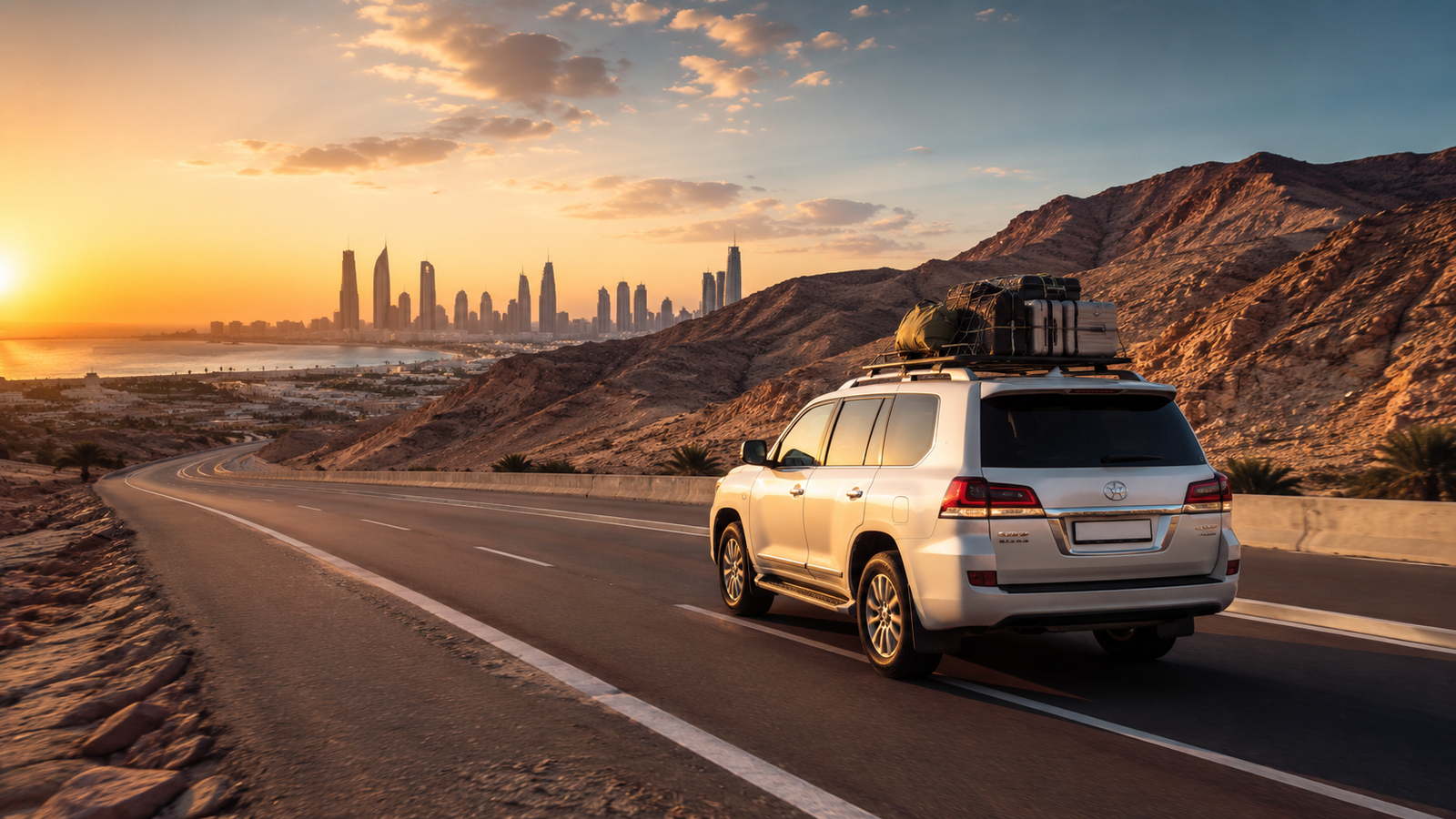
Fuel stations are common along major Gulf roads.
Remote regions can have longer gaps.
Before entering:
- mountains,
- desert stretches,
- rural areas,
fill the tank.
Do not build a road-trip strategy around reaching the fuel station with two kilometres of range remaining.
A half tank in the city can become uncomfortable surprisingly quickly in an unfamiliar remote region.
Download Maps Offline
Mobile connectivity is generally strong across the GCC, but remote mountains and desert regions can still produce weaker reception.
Download navigation maps before leaving.
Save:
- hotel location,
- fuel stops,
- border posts,
- emergency locations.
This is particularly useful in Oman and Saudi Arabia where road trips can cover much greater distances.
Do Not Drive Tired
Long, smooth highways can create a false sense of ease.
A driver may feel fine for several hours and then suddenly become fatigued.
Stop regularly.
Share driving where possible.
If you begin struggling to keep your eyes open, stop.
No itinerary is important enough to justify driving exhausted.
Watch for Animals
Remote roads can involve animals crossing unexpectedly.
Depending on the region, travellers may encounter:
- camels,
- goats,
- livestock.
Night driving requires particular caution.
A camel on a dark road is much more difficult to see than most visitors expect.
Reduce speed in areas where animals may be present.
Mountain Driving Requires Patience
Roads in Hatta, Oman and southern Saudi Arabia can involve bends and elevation changes.
Do not treat them like racetracks.
Maintain distance.
Brake smoothly.
Use designated stopping areas for photographs.
Never stop around a blind mountain bend simply because the view looks impressive.
Plan Fewer Stops Than You Think
One common road-trip mistake is adding too much.
A map makes attractions look close together.
Actual travel involves:
- parking,
- meals,
- photographs,
- walking,
- check-in,
- unexpected delays.
Three meaningful stops are usually better than eight rushed ones.
The road itself should remain enjoyable.
A Perfect Five-Day Oman Road Trip
One possible structure is:
Day 1: Muscat
Explore the city and prepare the vehicle.
Day 2: Muscat → Bimmah Sinkhole → Wadi Shab → Sur
This mirrors several destinations included in official Oman self-drive itineraries.
Day 3: Sur → Wadi Bani Khalid → A’Sharqiyah Sands
Official itineraries commonly combine these landscapes.
Day 4: Desert → Nizwa
Explore inland cultural attractions.
Day 5: Nizwa → Mountain region → Muscat
Return through the dramatic Hajar landscape.
A Perfect Two-Day UAE Road Trip
Day 1
Dubai → Hatta
Explore the dam, mountain scenery and outdoor attractions.
Stay overnight.
Day 2
Hatta → east-coast mountain route → Fujairah or Khor Fakkan → Dubai
This creates mountain, desert and coastal experiences within a relatively compact trip.
A Saudi Road Trip Needs More Time
Saudi Arabia should not be approached like the UAE.
The distances are much greater.
A strong multi-day journey could combine:
Jeddah → Taif → Al Baha → Abha → Jazan
Visit Saudi currently promotes similar routes through western and southern Saudi Arabia, combining coast, mountains and heritage destinations.
For northern heritage landscapes, another option is:
Qassim → Hail → AlUla → Medina → Jeddah
A current tourism itinerary uses much of this sequence.
Road Trips for Couples
Good choices include:
- Dubai to Hatta,
- Muscat coastal route,
- Jabal Akhdar,
- AlUla,
- southern Saudi highlands.
Couples may value slower itineraries.
One scenic hotel, a good road and two meaningful stops can be more memorable than covering hundreds of kilometres every day.
Road Trips for Families
Families should prioritize:
- manageable driving times,
- reliable rest stops,
- toilets,
- food,
- safe attractions.
Hatta works well for a short family journey.
Oman can work brilliantly for older children who enjoy nature.
Saudi Arabia is better when families allow enough days for large distances.
Build in breaks.
Children rarely appreciate a six-hour drive simply because the adults like the scenery.
Road Trips for Photographers
The Gulf offers some extraordinary road-trip photography opportunities.
Strong locations include:
- Oman mountain passes,
- Jabal Akhdar,
- Jabal Shams,
- Hatta,
- Saudi sandstone landscapes,
- AlUla,
- Red Sea coastline,
- desert highways.
The best light is often around:
sunrise
and
late afternoon
But photograph safely.
Never stand in an active road simply because it looks empty.
Common Gulf Road-Trip Mistakes
Avoid these:
- Planning too many kilometres each day
- Entering dunes without off-road experience
- Ignoring rental cross-border restrictions
- Driving tired
- Not carrying enough water
- Leaving the city with little fuel
- Depending completely on mobile data
- Driving mountain roads too fast
- Ignoring weather warnings
- Stopping dangerously for photographs
- Assuming every rental car can cross a border
- Underestimating Saudi driving distances
Good road trips feel relaxed because preparation happened before departure.
FAQs About Road Trips in Gulf
What are the best Road Trips in Gulf?
Popular choices include Dubai to Hatta, Dubai to Fujairah, Muscat to Sur, Jabal Akhdar, Jabal Shams, Oman’s wadi routes and Saudi journeys through AlUla, Taif, Al Baha, Abha and Jazan. Official tourism itineraries across the UAE, Oman and Saudi Arabia actively promote many of these routes.
Which Gulf country is best for a road trip?
Oman is especially strong for mountains, wadis, desert and coastal routes within one itinerary. Saudi Arabia offers larger-scale multi-day road trips, while the UAE is ideal for shorter scenic drives.
Is Dubai to Hatta a good road trip?
Yes. Visit Dubai specifically promotes Hatta as a two-day mountain destination and provides official driving directions from Dubai.
Can I drive from Dubai to Oman in a rental car?
Potentially, but not automatically. The rental company must permit cross-border travel, and additional documents or insurance may be required. Confirm all requirements directly with the rental company and relevant authorities before travelling.
Do I need a 4×4 for Oman?
Not for every route. Major highways and many tourist destinations can be reached on paved roads. Certain mountain, desert or off-road routes may require an appropriate 4×4. Official Oman itineraries specifically identify some mountain routes as 4WD experiences.
What is the best season for Gulf road trips?
October through April generally provides more comfortable conditions for outdoor stops, although mountain and regional weather can vary.
Is Saudi Arabia suitable for road trips?
Yes, but distances can be substantial. Visit Saudi currently offers multi-day itineraries connecting Jeddah, AlUla, Taif, Abha, Jazan and other destinations, illustrating how well the country suits longer overland journeys.
What should I pack for a Gulf road trip?
Water, charging equipment, driving documents, offline maps, sun protection, snacks and basic emergency supplies should be part of every journey.
Conclusion
The best Road Trips in Gulf reveal a region far more geographically diverse than the image many international visitors have in mind.
Leave Dubai and Hatta’s mountain scenery soon replaces the skyline. Continue toward the UAE’s eastern coast and the Hajar Mountains meet the sea. Visit Dubai actively promotes road trips and mountain adventures as part of exploring the emirate beyond its urban centre.
Oman takes the experience even further.
Official tourism itineraries combine Muscat, coastal highways, Wadi Shab, Wadi Bani Khalid, A’Sharqiyah Sands, Jabal Akhdar and Jabal Shams, creating journeys where the landscape can change completely in only a few hours.
Saudi Arabia offers road trips on an entirely different scale. Routes can connect Jeddah with AlUla or continue south through Taif, Al Baha, Abha and Jazan, moving between the Red Sea, mountains, historic villages and vast inland landscapes.
That variety is what makes Gulf road travel special.
The region is not simply a collection of modern cities surrounded by desert.
It contains mountain roads, coral coastlines, fertile wadis, ancient heritage landscapes, forests, dunes and highways stretching across some of Arabia’s most dramatic scenery.
You can fly between Gulf cities quickly.
But when you drive, you discover everything that exists between them.
And for many travellers, that journey becomes the part they remember most.
follow us on Instagram
Read More – Family Holidays in Gulf: 12 Amazing Ideas for Families