


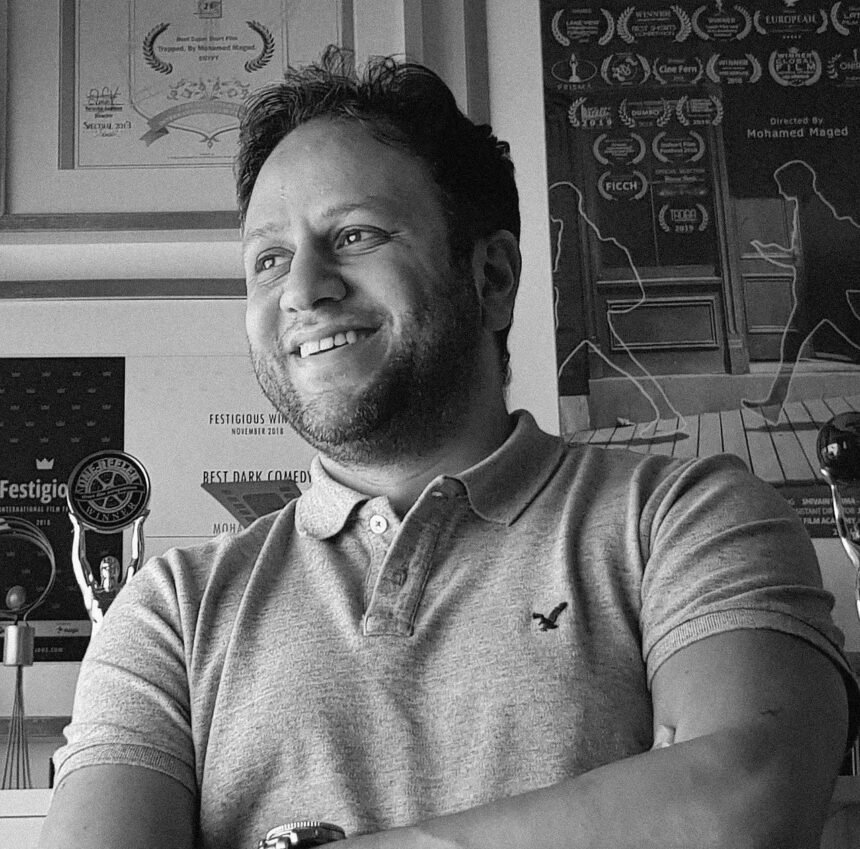
From A Love Of Cinema To A Creative Career
For Mohamed Maged, filmmaking is not simply about pointing a camera at a subject and recording what happens. It is about understanding people, emotions, culture, movement and the small details that can turn an ordinary moment into a memorable story.
- Building A Multidisciplinary Creative Identity
- Education That Strengthened His Creative Vision
- Trapped Became An Early International Milestone
- Bringing Cinematic Storytelling Into Advertising
- The Silverados Takes His Vision Further
- Mohamed Maged Creating Stories That Feel Human
- Looking Beyond The Region
- Success Measured Beyond The Awards
- The Next Chapter Is About Growth
Based in Kuwait, Mohamed has built a career across filmmaking, creative direction, advertising, writing, design and animation. Today, he is the Co Founder and Chief Creative Officer of DASH Group Media and Film Production, where his work brings together commercial creativity and the cinematic language of filmmaking.
His journey began with a fascination for visual storytelling and the emotional power of cinema. Instead of limiting himself to one creative discipline, he explored several areas of the industry. That experience eventually became one of his greatest strengths as a director because it allowed him to understand what happens both in front of and behind the camera.
His professional profile and industry records describe a career spanning advertising, animation, television commercials, films and creative direction across the Middle East.
Building A Multidisciplinary Creative Identity
The path to becoming a filmmaker was not built around directing alone. Mohamed spent years working with different forms of creative communication, including design, animation, writing and advertising.
Each discipline gave him another way to understand storytelling.
Design taught him to think visually. Writing helped him understand the importance of structure and emotion. Animation developed his sense of movement and visual imagination. Advertising taught him how to communicate an idea quickly while still creating an emotional connection.
Together, these experiences helped Mohamed develop a broader perspective on filmmaking.
For him, a successful film is the result of many creative elements working together. Performance, cinematography, art direction, sound, editing, writing and visual design all have a role in shaping what an audience eventually experiences.
That multidisciplinary mindset has become an important part of his creative identity and continues to influence the way he approaches both commercial and narrative projects.
Education That Strengthened His Creative Vision
Mohamed’s professional growth has also been supported by a strong foundation in cinema education.
He studied at the Academy of Arts in Egypt, where he completed his cinema studies and later pursued postgraduate education in filmmaking and cinema studies. His education then continued internationally at the New York Film Academy in Los Angeles, where he studied filmmaking.
He also studied at the Lee Strasberg Theatre and Film Institute in New York, gaining further exposure to performance and the craft of acting.
These experiences gave Mohamed opportunities to learn filmmaking in different creative environments while exposing him to international approaches to cinema and storytelling. His professional biography confirms his studies at the Academy of Arts, New York Film Academy and Lee Strasberg Theatre and Film Institute.
Rather than treating education as the final stage of his development, Mohamed appears to have used it as a foundation for continuous learning.
That approach remains visible in the way he speaks about creativity today.
Trapped Became An Early International Milestone
One of the important early chapters of Mohamed’s filmmaking journey was Trapped, a short film created during his time at the New York Film Academy in Los Angeles.
The project became more than an exercise in filmmaking. It travelled internationally and received selections and recognition at film festivals in countries including Italy, Turkey, Greece and Japan.
The story of Trapped is significant because it represented an early opportunity for Mohamed to take an idea beyond the classroom and place it in front of international audiences.
The film also demonstrated an important quality that has continued throughout his career. Mohamed has never treated filmmaking as something that should remain restricted to one market or one audience.
His ambition has always been connected to creating work that can communicate across cultures.
That desire has become even more relevant as his career has developed in the Gulf region.
Bringing Cinematic Storytelling Into Advertising
One of the most interesting aspects of Mohamed’s career is the space he occupies between filmmaking and advertising.
Commercial projects are often expected to communicate a product or message within a limited amount of time. Mohamed approaches that challenge through the perspective of a filmmaker.
Instead of treating advertising only as a sales message, he looks for ways to build atmosphere, emotion and character into the work.
This approach is particularly visible in his commercial filmmaking, where brand communication can become a cinematic experience.
His work through DASH Group reflects this direction, combining production, creative thinking and filmmaking to develop projects for brands and audiences across the region.
For Mohamed, the strongest branded content is not necessarily the work that feels most like advertising. It can be the work that audiences genuinely want to watch because the story, emotion or visual experience gives them a reason to stay.
The Silverados Takes His Vision Further
A major recent milestone in Mohamed’s career has been The Silverados, a cinematic commercial film created for Chevrolet Alghanim in Kuwait.
The project explored the Chevrolet Silverado through the lives of the people behind the wheel, challenging a familiar perception and presenting another side of the vehicle and its drivers. Mohamed served as creative and film director, bringing a narrative approach to the commercial.
The project went on to receive two Silver Telly Awards, including recognition for directing and automotive work. It was also selected by the Berlin Commercial Festival in both commercials and branded content and craft direction categories.
For Mohamed, however, recognition is not simply about collecting awards.
The bigger achievement is seeing work produced in the Middle East reach international platforms and compete alongside projects from around the world.
That perspective reveals something important about his ambitions. He is not only interested in building a successful career inside the Gulf. He wants stories created in the region to travel further.
Mohamed Maged Creating Stories That Feel Human
At the heart of Mohamed’s creative philosophy is a simple idea. Stories should feel human.
Technology can improve production. Cameras can become more advanced. Editing tools can become faster. Artificial intelligence and digital platforms can continue changing how creative work is produced.
But Mohamed believes that tools alone cannot create meaningful work.
Perspective matters.
Taste matters.
The ability to understand people matters.
That belief has become increasingly important in an industry where technology is making creative production more accessible. As more people gain access to powerful tools, the difference often comes from the person using them and the story they are trying to tell.
For Mohamed, filmmaking remains connected to emotion, culture and human experience.
Looking Beyond The Region
Today, Mohamed’s ambitions extend beyond creating successful projects in Kuwait or the wider Middle East.
He wants to continue developing as a filmmaker and creative director while creating projects capable of reaching international audiences.
He is particularly interested in narrative filmmaking and in exploring collaborations across different countries and creative communities.
At the same time, his connection to the Middle East remains central to his vision.
Rather than seeing regional identity as a limitation, Mohamed views culture and local perspectives as valuable creative material. Stories rooted in specific places can still have universal meaning when they are told with honesty and emotional clarity.
That balance between regional identity and international ambition could become one of the defining elements of his next chapter.
Success Measured Beyond The Awards
Over the course of his career, Mohamed’s films and commercial projects have earned recognition through numerous international and regional festivals and competitions. His work has received more than 85 international awards and nominations.
Yet his own perspective on success is less focused on numbers.
For Mohamed, every project is another opportunity to improve.
There are successful productions, difficult productions, unexpected opportunities and moments of uncertainty. Creative careers rarely move in a straight line, and his journey reflects that reality.
One of the strongest lessons he has taken from the experience is that talent may open a door, but consistency and curiosity are what keep a person moving forward.
That philosophy has allowed him to remain focused on the process rather than becoming defined by one project or one award.
The Next Chapter Is About Growth
Mohamed is now entering a stage where experience, ambition and international exposure are coming together.
His focus remains on creating cinematic work, developing narrative projects, expanding international collaborations and finding new ways to connect brands with audiences.
But perhaps the most important part of his journey is his refusal to become too comfortable with what he already knows.
His advice to emerging creatives is simple. Do not wait for the perfect opportunity. Start with the resources available, develop the idea, learn continuously and surround yourself with people who challenge your thinking.
That philosophy reflects Mohamed’s own journey.
From Egypt to international filmmaking education, from creative disciplines to directing, from an early short film to internationally recognised commercial work, his career has been shaped by curiosity and persistence.
For Mohamed, the camera is ultimately only a tool.
The real power lies in having something meaningful to say and finding a creative way to make people feel it.
Follow Mohamed Maged on Instagram
Read More – How Hind Noussier Turned Dentistry Into a Modern Smile Art