


Business Opportunities in Kuwait for Entrepreneurs and Investors in 2026
Business Opportunities in Kuwait are expanding as the country moves toward economic diversification, greater private-sector participation and long-term development under Kuwait Vision 2035.
- Business Opportunities in Kuwait for Entrepreneurs and Investors in 2026
- 1. Information Technology and Software Development
- 2. Artificial Intelligence Businesses
- 3. Cybersecurity Services
- 4. Healthcare Businesses
- 5. Medical Equipment and Healthcare Supplies
- 6. Logistics and Warehousing
- 7. E-Commerce Businesses
- 8. Digital Marketing and Content Businesses
- 9. Renewable Energy Businesses
- 10. Construction and Infrastructure Services
- 11. Education and Professional Training
- 12. Food and Restaurant Businesses
- 13. Tourism, Hospitality and Entertainment
- 14. Financial Technology and Business Services
- 15. Manufacturing and Industrial Businesses
- Small Business Opportunities in Kuwait
- Online Business Opportunities in Kuwait
- Business Opportunities for Foreign Investors
- Can Foreigners Own 100% of a Business in Kuwait?
- KDIPA Investment Licensing
- Long-Term Residency for Investors
- Kuwait Vision 2035 and Business Growth
- Business Opportunities in Kuwait’s Industrial Sector
- The Growing Importance of Sustainability
- Corporate Tax and Business Planning
- How to Choose the Right Business Opportunity
- Challenges of Starting a Business in Kuwait
- Why 2026 Is Important for Kuwait’s Business Environment
- Future of Business Opportunities in Kuwait
- Final Thoughts on Business Opportunities in Kuwait
For decades, Kuwait’s economy has been strongly associated with oil. Energy remains extremely important, but the country’s future economic strategy extends well beyond hydrocarbons.
Kuwait wants to develop a more diversified and sustainable economy, strengthen infrastructure, improve healthcare, develop human capital and increase the private sector’s role in economic activity.
This transformation creates opportunities for entrepreneurs, international companies, investors and specialised service providers.
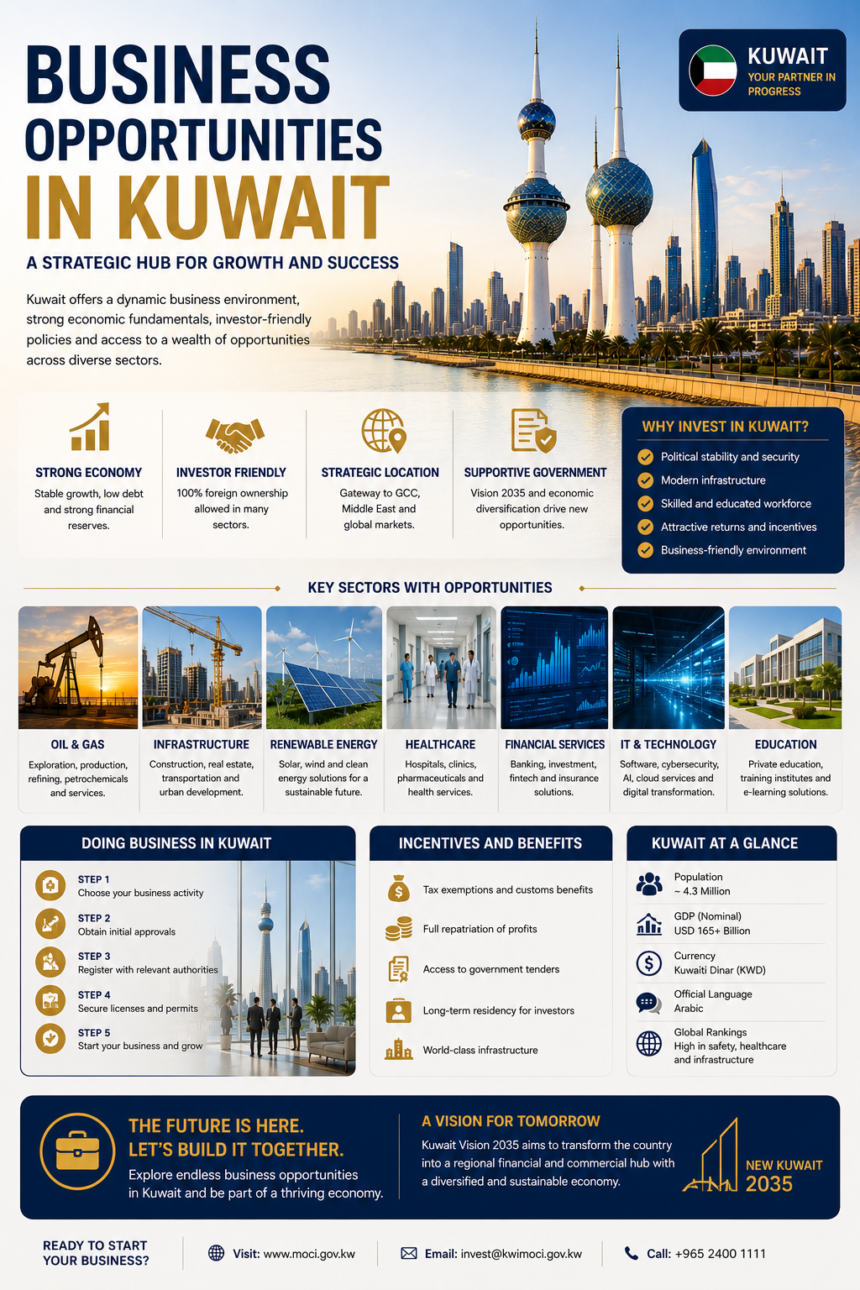
The Kuwait Direct Investment Promotion Authority identifies several sectors connected with Vision 2035 as investment opportunities, including infrastructure and construction, renewable energy, education, industrial oil and gas, healthcare, housing and urban development, banking and financial services, logistics, transportation, tourism, media and technology.
For entrepreneurs, this creates a useful starting point.
The strongest opportunities may not necessarily be completely new industries.
Many will come from solving problems created by economic growth itself.
Companies need technology.
Infrastructure projects need suppliers.
Consumers need convenient services.
Healthcare providers need equipment.
Businesses need cybersecurity.
Retailers need digital marketing.
Growing industries need skilled workers and professional training.
This guide explores some of the most promising Business Opportunities in Kuwait in 2026 and explains where entrepreneurs and investors may find long-term potential.
Business Opportunities in Kuwait for Entrepreneurs and Investors in 2026
Kuwait Vision 2035 aims to transform the country into a regional financial and commercial hub supported by a competitive private-sector-led economy.
That makes private business increasingly important to the country’s development.
Kuwait’s advantages include relatively strong purchasing power, established banking infrastructure, strategic Gulf location, oil wealth, physical and digital infrastructure and access to a young population familiar with technology.
However, entrepreneurs should not assume that entering the market automatically guarantees success.
Kuwait is competitive.
Customers have high expectations.
Business regulations must be understood.
Foreign ownership rules depend on how the business is structured.
Successful companies will need a clear market gap, strong execution and products or services that solve genuine problems.
1. Information Technology and Software Development
Technology is one of the clearest business opportunities in Kuwait.
Businesses and government institutions increasingly depend on digital systems.
This creates demand for companies offering:
Software development
Mobile applications
Cloud services
Business automation
ERP implementation
Artificial intelligence solutions
Data analytics
IT consulting
Systems integration
Web platforms
SaaS products
Digital transformation services
Kuwait’s investment authority specifically identifies IT, software development and technology as a Vision 2035 targeted sector.
The opportunity is especially attractive for companies that can help traditional businesses modernise operations rather than simply selling generic technology products.
2. Artificial Intelligence Businesses
Artificial intelligence is moving from experimentation toward practical business use.
Companies are increasingly interested in using AI to improve customer service, productivity, marketing, data analysis and internal operations.
This can create opportunities for businesses providing:
AI consulting
Business automation
AI customer support
Arabic AI solutions
Data analytics
AI-powered marketing
Document automation
Predictive analytics
Industry-specific AI software
Employee AI training
The strongest AI businesses will likely focus on measurable business problems.
A company does not need an AI product simply because AI is popular.
It needs AI if the technology saves time, reduces costs, improves decisions or creates better customer experiences.
3. Cybersecurity Services
More digital activity means more cybersecurity risk.
Banks, retailers, healthcare organisations, energy companies and other businesses need stronger protection for their systems and customer information.
Entrepreneurs with technical expertise can explore services such as:
Cybersecurity consulting
Network security
Cloud security
Penetration testing
Security audits
Compliance support
Managed security
Employee cybersecurity training
Incident response
Security monitoring
Cybersecurity can be particularly attractive because it creates recurring business relationships.
Companies need security continuously, not only once.
4. Healthcare Businesses
Healthcare is another important opportunity.
High-quality healthcare is one of the major pillars of Kuwait Vision 2035, and healthcare is listed by KDIPA among its targeted investment sectors.
Business opportunities can extend far beyond opening a hospital.
Entrepreneurs can consider:
Specialist clinics
Diagnostic centres
Home healthcare
Medical equipment
Healthcare software
Telemedicine technology
Rehabilitation
Physiotherapy
Elderly care
Medical training
Healthcare recruitment
Medical supplies
Preventive healthcare
Healthcare technology can be especially interesting because it combines two major development areas: healthcare and digital transformation.
5. Medical Equipment and Healthcare Supplies
Hospitals and clinics require continuous supplies.
This creates business-to-business opportunities for distributors and specialised suppliers.
Products may include:
Diagnostic equipment
Hospital furniture
Laboratory supplies
Protective equipment
Medical consumables
Rehabilitation equipment
Dental equipment
Medical technology
Healthcare software
Home-care equipment
The opportunity is not simply importing products.
Businesses that provide installation, training, maintenance and after-sales support can build stronger relationships with healthcare providers.
6. Logistics and Warehousing
Kuwait’s strategic Gulf location makes logistics an important sector.
KDIPA identifies storage and logistics services among Vision 2035 investment opportunities.
Businesses can explore:
Warehousing
Cold storage
Last-mile delivery
Freight services
Supply-chain technology
Inventory management
E-commerce fulfilment
Food logistics
Pharmaceutical logistics
Fleet management
Customs support
B2B delivery
E-commerce growth can create additional demand for fast and reliable fulfilment.
Businesses increasingly need logistics partners capable of handling inventory, packaging, delivery and returns efficiently.
7. E-Commerce Businesses
Consumers have become increasingly comfortable purchasing products online.
This creates opportunities for specialised e-commerce businesses.
Potential categories include:
Fashion
Beauty
Home products
Electronics
Speciality food
Children’s products
Fitness products
Pet supplies
Gifts
Local brands
Premium products
Niche imported goods
However, starting another generic online store is unlikely to be enough.
Successful e-commerce businesses need differentiation.
That could come from exclusive products, faster delivery, superior customer service, strong branding or a specialised niche.
8. Digital Marketing and Content Businesses
As companies compete online, demand for digital marketing continues to grow.
Business opportunities include:
Social media management
Video production
SEO
Performance advertising
Content marketing
Influencer campaigns
Brand strategy
Website development
E-commerce marketing
Arabic content production
Corporate communications
Media and marketing is itself included among Kuwait’s targeted investment sectors.
The strongest agencies will increasingly need to demonstrate results.
Businesses want leads, sales, engagement and measurable growth rather than simply a large number of social media posts.
9. Renewable Energy Businesses
Renewable energy is another sector directly identified by KDIPA as a Vision 2035 investment opportunity.
Kuwait’s climate creates significant solar-energy potential.
Business opportunities can develop around:
Solar technology
Energy efficiency
Smart building systems
Energy management
Renewable-energy consulting
Maintenance
Energy monitoring
Industrial efficiency
Sustainability consulting
Green technology
The Public Authority for Industry also identifies renewable energy production among Kuwait’s prioritised industrial activities.
As sustainability becomes more important to governments and businesses, companies capable of reducing energy use can find growing demand.
10. Construction and Infrastructure Services
Kuwait is pursuing major infrastructure and development projects.
This creates opportunities not only for large construction companies but also for smaller specialised businesses supporting major projects.
Opportunities include:
Engineering consulting
Project management
Building materials
MEP services
Safety services
Facilities management
Construction technology
Equipment rental
Maintenance
Interior fit-outs
Environmental consulting
Surveying
Infrastructure and construction are explicitly listed by KDIPA among the country’s targeted investment sectors.
Smaller companies can participate in this ecosystem by becoming specialist suppliers or subcontractors rather than trying to compete directly with major contractors.
11. Education and Professional Training
Economic diversification requires skilled people.
This creates opportunities in education and training.
Potential businesses include:
Professional training
Technology courses
AI training
Cybersecurity education
Language training
Leadership programmes
Corporate training
Technical certification
Vocational education
Digital skills programmes
Executive education
Online learning
Education and training is another sector highlighted by KDIPA.
Training businesses should focus on skills employers genuinely need.
Courses linked to employment outcomes will have stronger value than generic programmes without practical application.
12. Food and Restaurant Businesses
Kuwait has a strong dining culture.
Restaurants, cafés and food delivery are important parts of everyday social life.
Entrepreneurs can explore:
Speciality cafés
Healthy food
Cloud kitchens
Premium desserts
Regional cuisine
International concepts
Meal subscriptions
Corporate catering
Food trucks
Bakery concepts
Delivery-only brands
However, food businesses can be highly competitive.
A good menu is not enough.
Location, pricing, branding, service, delivery quality and customer retention all matter.
Entrepreneurs should test demand before investing heavily in expensive premises.
13. Tourism, Hospitality and Entertainment
Tourism, hotels and entertainment are included among Kuwait’s Vision 2035 targeted investment sectors.
Potential opportunities include:
Boutique hospitality
Event management
Family entertainment
Tour experiences
Corporate travel services
Hospitality technology
Restaurant concepts
Cultural experiences
Event production
Premium concierge services
Entertainment technology
Businesses should think beyond international tourism.
Kuwait’s resident population also creates demand for weekend entertainment, dining and family activities.
A successful leisure concept can therefore serve both residents and visitors.
14. Financial Technology and Business Services
Kuwait has an established financial system and significant consumer purchasing power.
Banking, financial services and insurance are among KDIPA’s targeted sectors.
Fintech businesses can explore:
Payment technology
Accounting software
Business financial management
Insurtech
Compliance technology
Financial analytics
SME financial tools
Digital invoicing
Expense management
Investment technology
Regtech
Businesses operating in regulated financial activities must understand licensing requirements before launching.
Professional legal and regulatory advice is particularly important in this sector.
15. Manufacturing and Industrial Businesses
Manufacturing represents another opportunity as Kuwait seeks greater economic diversification.
The Public Authority for Industry currently identifies several prioritised industrial activities, including petrochemicals and chemicals, food industries, medical industries and renewable-energy production.
Potential opportunities include:
Food processing
Medical supplies
Packaging
Industrial components
Chemical products
Building materials
Recycling
Renewable-energy equipment
Specialised manufacturing
Local production can reduce dependence on imports while creating jobs and supporting supply chains.
Industrial businesses naturally require greater capital and regulatory planning than many service businesses.
Small Business Opportunities in Kuwait
Not every entrepreneur needs millions of dinars.
Smaller businesses can find opportunities by solving specific consumer or business problems.
Examples include:

Digital marketing agencies
Cleaning services
Maintenance services
Online stores
Corporate gifting
Photography
Video production
Business consulting
Food concepts
Event services
Mobile applications
Training businesses
Graphic design
E-commerce support
Technology consulting
The advantage of many service businesses is lower initial capital compared with industrial or infrastructure projects.
However, entrepreneurs should still verify licensing requirements before operating.
Online Business Opportunities in Kuwait
Digital businesses can reduce the need for expensive physical premises.
Potential models include:
E-commerce
Online education
Digital agencies
Software products
Content businesses
Online consulting
Subscription services
Marketplace platforms
B2B software
Digital media
Online businesses still need proper licensing and legal compliance.
Operating through social media does not automatically remove business-registration requirements.
Business Opportunities for Foreign Investors
Foreign investors need to pay particular attention to business structure.
Kuwait’s Foreign Direct Investment framework provides a route under which qualifying investors can establish investment entities with up to 100 percent foreign ownership through KDIPA.
The investment authority currently provides licensing pathways for establishing a Kuwaiti company, opening a branch of a foreign parent company or establishing a representative office.
The process involves an initial proposal, business plan, formal application and establishment stage.
KDIPA says feedback on the initial application request is generally provided within three business days, while approval or refusal of a completed investment application is provided within 30 working days.
This route is particularly relevant to larger foreign investors bringing technology, expertise, employment and economic value into Kuwait.
Can Foreigners Own 100% of a Business in Kuwait?
Under Kuwait’s direct investment framework, qualifying foreign investors can obtain up to 100 percent ownership through a KDIPA-licensed investment entity.
However, this should not be interpreted as meaning every foreign entrepreneur can automatically open any type of company with full ownership.
The proposed activity, structure and investment must satisfy applicable requirements.
Some activities are also excluded or restricted.
Foreign entrepreneurs should obtain professional legal advice based on their exact business model before committing capital.
KDIPA Investment Licensing
For larger foreign investors, KDIPA can play an important role.
Its current licensing process includes four main stages.
First comes the proposal.
The investor identifies the investment entity and proposed economic activity.
Second comes the business plan.
This includes project, technical, labour, equipment and financial information.
Third comes formal application and decision.
Finally, approved investors proceed through establishment and licensing procedures.
The business plan is therefore important.
Investors need to demonstrate not only how they will make money but what economic value the investment can create in Kuwait.
Long-Term Residency for Investors
Kuwait introduced an important investor development in 2026.
Eligible foreign investors and certain key executives in KDIPA-licensed companies can now qualify for residency permits of up to 15 years.
The framework applies to defined categories including owners, partners, approved senior executives and eligible immediate family members, subject to the applicable requirements.
Among the stated eligibility requirements, qualifying KDIPA-licensed entities must maintain investment value of at least KD5 million and capital of at least KD1 million for approved activities, maintain active operations and satisfy prescribed Kuwaiti employment requirements.
This does not create automatic long-term residency for every business owner.
But for qualifying large investors, it provides greater long-term certainty.
Kuwait Vision 2035 and Business Growth
Vision 2035 is central to understanding where future opportunities may develop.
The country’s objective is to build a diversified and sustainable economy in which the private sector plays a larger role.
Its priorities include infrastructure, healthcare, human capital, government effectiveness and economic diversification.
For entrepreneurs, this creates a useful strategic principle:
Look for businesses that support national transformation.
Technology that improves productivity.
Training that develops skills.
Healthcare services that increase capacity.
Renewable-energy solutions that improve sustainability.
Logistics that strengthen trade.
Infrastructure services that support development.
These businesses align commercial opportunity with wider economic priorities.
Business Opportunities in Kuwait’s Industrial Sector
Industrial development is particularly interesting because it can create local economic value.
Kuwait’s Public Authority for Industry identifies petrochemicals, food industries, medical industries and renewable-energy production among priority industrial activities.
Local manufacturing can support import substitution.
It can also create skilled employment, develop suppliers and transfer technical knowledge.
For international manufacturers, Kuwait may also provide access to the broader Gulf region.
However, industrial investments require careful feasibility studies.
Energy, land, logistics, labour, machinery and regulatory costs must all be evaluated.
The Growing Importance of Sustainability
Sustainability is becoming increasingly relevant to Kuwait’s business environment.
In July 2026, UNDP Kuwait and AmCham Kuwait held a private-sector dialogue focused on innovative financing for economic diversification, including thematic bonds, sukuk and sustainability-linked finance.
The discussion reflects a broader shift.
Businesses are increasingly being expected to combine financial performance with environmental and social responsibility.
This creates opportunities for:
Sustainability consulting
ESG reporting
Energy efficiency
Green construction
Environmental technology
Waste management
Renewable energy
Sustainable finance advisory
Companies developing expertise now may benefit as sustainability expectations become stronger.
Corporate Tax and Business Planning
Tax planning should be part of any serious investment decision.
Kuwait has implemented a Domestic Minimum Top-up Tax for qualifying multinational enterprise groups under the OECD Pillar Two framework.
The rules apply to multinational groups meeting the relevant global revenue threshold and are designed to ensure an effective minimum tax rate of 15 percent.
The Ministry of Finance states that implementation applies for financial years beginning on or after January 1, 2025.
This is particularly relevant to large multinational businesses rather than ordinary small entrepreneurs.
Foreign investors should obtain qualified tax advice before choosing their business structure.
How to Choose the Right Business Opportunity
Do not choose a business simply because the industry is growing.
A growing industry can still contain unsuccessful companies.
Before investing, answer several questions.
Who is the customer?
What problem are you solving?
Who are the competitors?
Why would customers choose you?
What licences are required?
How much capital is needed?
How long before the business becomes profitable?
Can the business scale?
What happens if customer acquisition costs increase?
What skills does the team need?
A strong opportunity sits at the intersection of market demand, founder capability and commercial feasibility.
Challenges of Starting a Business in Kuwait
Entrepreneurs should also understand the challenges.
These can include:
Licensing requirements
Foreign ownership restrictions outside applicable routes
Competition
Commercial rents
Recruitment
Customer acquisition
Finding local market knowledge
Regulatory compliance
Building trust
Cash-flow management
Success in another country does not guarantee success in Kuwait.
Consumer behaviour, regulations and business relationships can differ.
Market research should therefore happen before significant investment.
Why 2026 Is Important for Kuwait’s Business Environment
Kuwait is in a period of economic transition.
The country is working to move from heavy oil dependence toward a more diversified economic model.
The IMF’s 2026 assessment describes Kuwait as beginning a transition toward a more dynamic and diversified economy, while emphasising the importance of structural reform and improving the business environment.
At the same time, the private sector is becoming increasingly important to diversification.
This combination of reform, investment and private-sector development can create opportunities for businesses capable of solving real economic problems.
Future of Business Opportunities in Kuwait
The strongest long-term opportunities are likely to emerge where several trends overlap.
Technology plus healthcare.
AI plus financial services.
Logistics plus e-commerce.
Renewable energy plus construction.
Education plus digital technology.
Manufacturing plus healthcare.
Sustainability plus finance.
These combinations can produce businesses with stronger competitive advantages than generic products or services.
The future Kuwait economy will increasingly need companies capable of combining specialised industry knowledge with modern technology.
Final Thoughts on Business Opportunities in Kuwait
Business Opportunities in Kuwait in 2026 extend far beyond the country’s traditional oil industry.
Technology, healthcare, logistics, infrastructure, renewable energy, education, financial services, tourism, manufacturing and digital businesses all have potential as Kuwait moves toward Vision 2035.
Official investment policy supports this direction.
KDIPA specifically identifies infrastructure and construction, renewable energy, education, healthcare, housing, finance, logistics, transportation, tourism, media and technology among the sectors targeted under Kuwait Vision 2035.
Foreign investors can also explore the KDIPA framework, which can allow qualifying investments to operate with up to 100 percent foreign ownership.
For larger qualifying investors, the introduction of residency permits of up to 15 years in 2026 provides another sign that Kuwait is seeking to strengthen its environment for long-term international investment.
But opportunity should never replace research.
Before investing, understand the customer.
Study the competition.
Verify licensing.
Calculate operating costs.
Understand ownership rules.
Build a realistic financial plan.
And choose a business that solves a genuine market problem.
Kuwait’s transformation will create opportunities, but the strongest businesses will be those that contribute something valuable to that transformation.
For entrepreneurs and investors prepared to combine market knowledge, technology, specialised expertise and disciplined execution, Kuwait can offer meaningful opportunities as its private-sector economy continues to develop.
Follow us on Instagram
Read More – Jobs in Kuwait: 15 Amazing Career Opportunities for 2026