

Best Gulf Cities for Young Professionals: Where to Live and Build Your Career
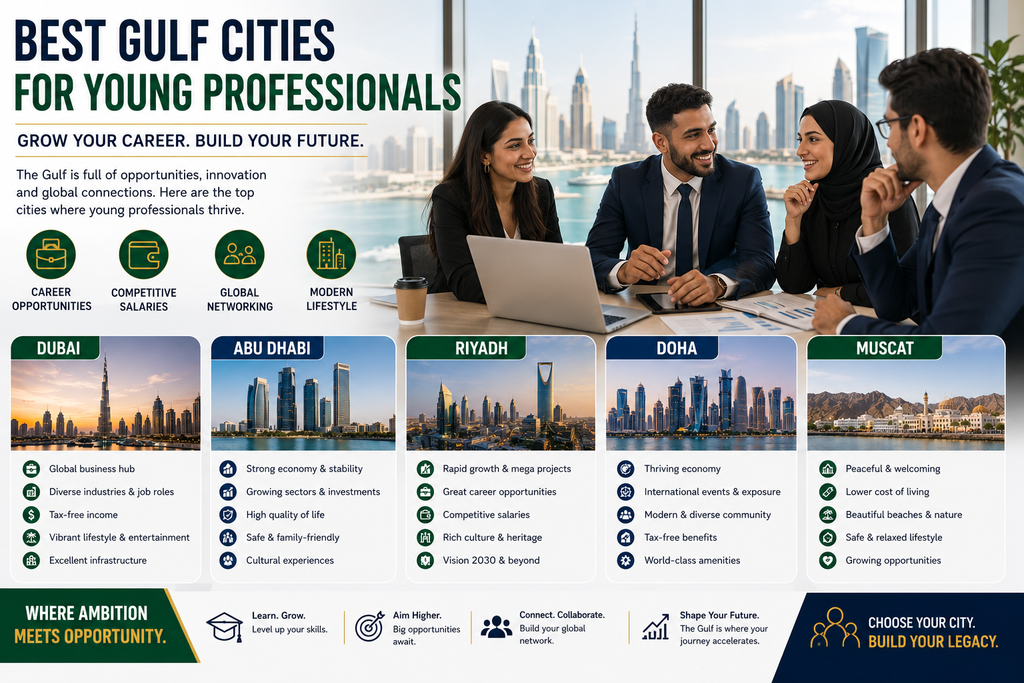
The Gulf has become one of the most interesting regions in the world for young professionals looking to build international careers.
- Best Gulf Cities for Young Professionals at a Glance
- 1. Dubai, UAE
- Why Dubai Works So Well for Young Professionals
- 2. Riyadh, Saudi Arabia
- Riyadh Metro Is Changing Daily Life
- 3. Abu Dhabi, UAE
- Dubai vs Abu Dhabi for Young Professionals
- 4. Doha, Qatar
- 5. Manama, Bahrain
- 6. Jeddah, Saudi Arabia
- 7. Muscat, Oman
- 8. Kuwait City, Kuwait
- 9. Sharjah, UAE
- 10. Al Khobar, Saudi Arabia
- Best Gulf Cities for Young Professionals by Career
- Which Gulf City Is Best for Fresh Graduates?
- Best Gulf Cities for Networking
- Best Gulf Cities for Social Life
- Best Gulf City Without a Car
- Most Affordable Gulf Cities for Young Professionals
- Where Should Young Professionals Live in Dubai?
- Where Should Young Professionals Live in Riyadh?
- How Much Salary Does a Young Professional Need?
- What Young Professionals Should Check Before Moving
- Best Gulf Cities for Young Professionals: Final Ranking
- Which Gulf City Is Best for You?
- Final Thoughts on the Best Gulf Cities for Young Professionals
Dubai remains a major destination for finance, technology, real estate, hospitality, aviation and entrepreneurship. Riyadh is attracting professionals through Saudi Arabia’s enormous economic transformation. Doha combines modern infrastructure with opportunities in energy, aviation and finance, while cities such as Abu Dhabi, Manama and Muscat offer different combinations of career growth, lifestyle and affordability.
But finding the Best Gulf Cities for Young Professionals requires looking beyond job vacancies.
A city may offer an impressive salary but expensive housing. Another may have fewer jobs but provide a much better work-life balance. Some professionals want nightlife and networking opportunities, while others prefer affordable housing, shorter commutes and the ability to save more each month.
For young professionals in their 20s and 30s, the ideal Gulf city usually combines career opportunities with social life, transportation, housing choices, international communities and the possibility of building a stronger professional network.
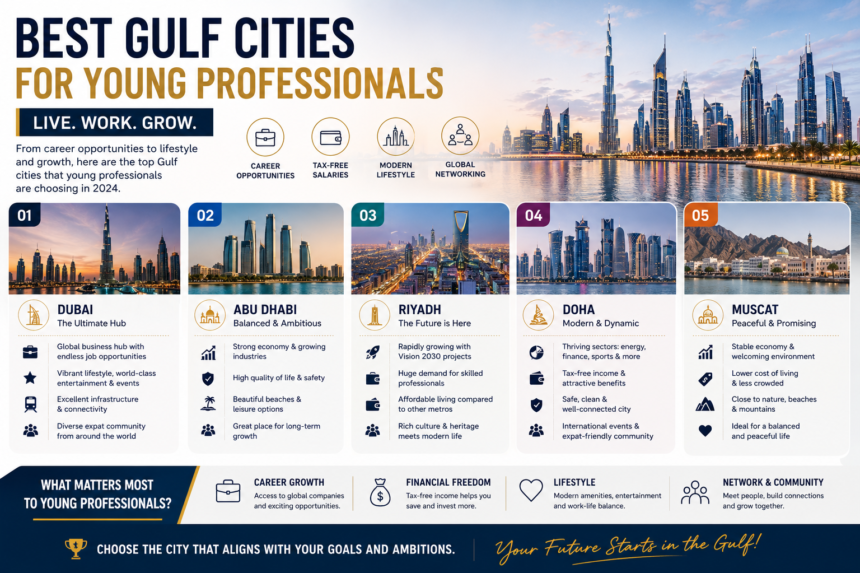
Here are 10 Gulf cities worth considering in 2026.
Best Gulf Cities for Young Professionals at a Glance
The right city depends heavily on your industry and lifestyle.
| City | Best For | Career Market | Social Life | Public Transport | Cost Level |
|---|---|---|---|---|---|
| Dubai | Overall opportunity | Excellent | Excellent | Excellent | High |
| Riyadh | Rapid career growth | Excellent | Rapidly growing | Very good | Medium to high |
| Abu Dhabi | Stability and professional careers | Excellent | Very good | Good | High |
| Doha | Balanced professional life | Very good | Good | Excellent | Medium to high |
| Manama | Finance and fintech | Good | Very good | Developing | Moderate |
| Jeddah | Tourism and coastal lifestyle | Very good | Very good | Developing | Moderate |
| Muscat | Work-life balance | Good | Relaxed | Developing | Moderate |
| Kuwait City | Finance and energy | Good | Moderate | Bus-focused | Moderate |
| Sharjah | Affordable UAE living | Good | Moderate | Good connections | Lower than Dubai |
| Al Khobar | Energy professionals | Very good | Good | Car-oriented | Moderate |
Dubai offers perhaps the broadest combination of jobs, networking and lifestyle, but it is also one of the most expensive choices.
Riyadh is becoming increasingly attractive for professionals prioritising rapid career progression, while cities such as Muscat and Manama may appeal more to people who want a smaller and potentially more affordable environment.
1. Dubai, UAE
Dubai is the obvious starting point for any discussion about the Best Gulf Cities for Young Professionals.
Few cities in the region offer the same combination of international companies, startups, global connectivity, professional networking and entertainment.
Dubai’s economy extends far beyond tourism.
Young professionals can find opportunities across finance, technology, digital marketing, real estate, aviation, logistics, consulting, hospitality, healthcare, e-commerce, media and professional services.
The city also attracts entrepreneurs and freelancers.
Free zones, startup communities, business events and international conferences make networking part of everyday professional life.
For someone early in their career, that can be extremely valuable.
Meeting a potential employer, client, investor or business partner can happen through formal conferences, coworking spaces, industry events or even social communities.
Dubai also has a highly international population, which makes moving there relatively straightforward for many expatriates.
English is widely used professionally and socially.
The downside is cost.
Housing in desirable areas can be expensive, particularly in neighbourhoods such as Downtown Dubai, Dubai Marina, Business Bay and DIFC.
Young professionals often reduce housing costs by choosing JLT, Barsha Heights, Dubai Silicon Oasis, JVC or shared accommodation.
Dubai is best for people who want maximum opportunity and are comfortable with a competitive, fast-moving environment.
Why Dubai Works So Well for Young Professionals
Transportation gives Dubai another major advantage.
Young professionals living near Dubai Metro can potentially avoid buying a car altogether.
The Metro connects important employment districts and residential areas, while buses, Dubai Tram, taxis and shared mobility services extend the network.
Dubai’s RTA reported approximately 348.1 million journeys across public transport, shared mobility and taxis during the first half of 2026 alone.
That infrastructure matters when choosing where to begin a career.
Living near a Metro station can reduce both commuting costs and the amount of time spent in traffic.
Dubai also provides an enormous social environment.
Restaurants, beaches, gyms, sports clubs, concerts, networking events and nightlife make it relatively easy for newcomers to meet people.
For ambitious professionals willing to manage the higher living costs, Dubai remains arguably the Gulf’s strongest all-round career city.
2. Riyadh, Saudi Arabia
If Dubai is the established Gulf career hub, Riyadh is the city changing fastest.
Saudi Arabia’s Vision 2030 transformation has created enormous investment across technology, finance, consulting, construction, tourism, entertainment, real estate, hospitality and infrastructure.
International businesses are increasing their presence in the Saudi capital.
For young professionals, this creates something particularly valuable: the opportunity to join industries and organisations while they are expanding.
Professionals working in consulting, engineering, project management, technology, finance, marketing, hospitality and construction may find especially interesting opportunities.
Riyadh is also developing as a regional corporate centre.
That can provide exposure to major projects and responsibilities relatively early in someone’s career.
The lifestyle has changed considerably as well.
Restaurants, entertainment districts, sporting events, concerts, cultural experiences and new developments have expanded the city’s social environment.
Riyadh may therefore appeal to young professionals who care more about career acceleration than having the most established expat lifestyle.
Riyadh Metro Is Changing Daily Life
One historical disadvantage of Riyadh was its dependence on cars.
That is changing.
The Riyadh Metro has transformed public transportation across the capital, creating a six-line network connecting major parts of the city.
Expansion is continuing.
In January 2026, authorities awarded an 8.4-kilometre extension of the Red Line toward Diriyah, including five additional stations.
For young professionals, better public transportation can significantly change where they choose to live.
Areas near Metro stations may become increasingly attractive to people who do not want every journey to depend on a private vehicle.
Riyadh’s biggest strength is opportunity.
Its challenge is adapting to a city undergoing extremely rapid growth.
For ambitious professionals comfortable with change, that can be part of the attraction.
3. Abu Dhabi, UAE
Abu Dhabi provides a different experience from Dubai.
The UAE capital is highly international and economically powerful, but daily life generally feels calmer.
Career opportunities are particularly strong in energy, finance, government-linked organisations, technology, healthcare, aviation, culture and professional services.
Abu Dhabi is also home to major investment organisations and multinational companies.
For young professionals interested in institutional careers rather than only startups and fast-moving private businesses, the city can be extremely attractive.
Lifestyle is another advantage.
Abu Dhabi has beaches, restaurants, malls, cultural attractions and entertainment, but generally without the same intensity as Dubai.
Saadiyat Island has developed into a major cultural district, while Yas Island provides entertainment, events and leisure attractions.
Young professionals can therefore build serious careers while maintaining a somewhat calmer daily routine.
Dubai vs Abu Dhabi for Young Professionals
The choice between Dubai and Abu Dhabi comes down largely to personality and industry.
Dubai is generally stronger for people seeking maximum private-sector variety, networking, nightlife and entrepreneurship.
Abu Dhabi can be stronger for people working in energy, government-linked organisations, finance and institutional sectors.
Dubai also has the stronger rail-based public transportation network.
Abu Dhabi, however, may appeal to professionals who prefer less hectic surroundings.
A useful way to think about the difference is:
Dubai: opportunity, networking and excitement.
Abu Dhabi: stability, professional growth and balance.
Both remain among the strongest cities in the Gulf for international professionals.
4. Doha, Qatar
Doha offers young professionals something the larger Gulf cities sometimes struggle to provide: compactness.
Qatar’s capital has modern infrastructure, international businesses, excellent aviation connectivity and a substantial expatriate population, but it is geographically more manageable than Dubai or Riyadh.
Career opportunities are particularly relevant in energy, aviation, engineering, healthcare, education, hospitality, finance and professional services.
Qatar’s energy industry remains an important source of high-level professional employment.
Qatar Airways and the country’s wider aviation ecosystem create another major employment sector.
Doha also has an excellent Metro system.
For professionals who live and work near suitable stations, everyday commuting can be straightforward without complete dependence on a car.
The city has restaurants, hotels, museums, sports facilities, beaches and entertainment, although the overall selection is naturally smaller than Dubai.
For young professionals who want strong infrastructure without the intensity of a much larger city, Doha can offer an attractive middle ground.
5. Manama, Bahrain
Manama is sometimes overlooked when young professionals compare Gulf cities.
That can be a mistake.
Bahrain has a long history as a regional financial centre, and Manama continues to provide opportunities across banking, finance, fintech, professional services, technology and hospitality.
The city is significantly smaller than Dubai or Riyadh.
That creates both advantages and disadvantages.
There are fewer total job opportunities, but professionals may find it easier to build close industry networks.
Bahrain has also developed a growing fintech ecosystem.
For young professionals interested in financial technology, digital payments, banking and startup environments, Manama deserves serious consideration.
Lifestyle is another attraction.
The city offers restaurants, cafes, entertainment and a substantial expatriate community without requiring the same lifestyle budget as premium areas of Dubai.
Bahrain’s connection with Saudi Arabia through the King Fahd Causeway also strengthens its position within the wider regional economy.
For professionals who want a smaller Gulf city with a social atmosphere and established financial sector, Manama can be a strong choice.
6. Jeddah, Saudi Arabia
Jeddah offers a very different Saudi experience from Riyadh.
Located on the Red Sea, the city has traditionally been one of Saudi Arabia’s most internationally connected commercial centres.
Its coastal location gives everyday life a different character.
The Corniche, waterfront developments, restaurants and Red Sea activities contribute to a lifestyle that can feel more relaxed than the capital.
Career opportunities exist across logistics, hospitality, tourism, retail, aviation, healthcare and professional services.
Saudi Arabia’s tourism expansion is particularly relevant.
As investment continues across Red Sea tourism and hospitality projects, Jeddah can serve as an important professional gateway to the western part of the Kingdom.
Young professionals interested in tourism, hotels, events and destination development may therefore find growing opportunities.
Jeddah is best suited to someone who wants access to Saudi Arabia’s expanding economy but prefers a coastal environment over Riyadh’s inland megacity lifestyle.
7. Muscat, Oman
Not every young professional wants the fastest possible city.
Some want balance.
Muscat is one of the Gulf’s strongest choices for professionals who value natural surroundings, manageable urban life and a slower pace.
Oman’s capital sits between mountains and the sea, giving it a completely different visual identity from skyscraper-heavy Dubai or Doha.
Career opportunities are smaller in scale but exist across tourism, hospitality, logistics, energy, education, healthcare and professional services.
For someone whose main objective is earning the highest possible salary or rapidly changing employers, Muscat may not be the first choice.
For someone who values work-life balance, outdoor activities and a less intense environment, it can be extremely attractive.
Weekends can involve beaches, mountains, wadis, hiking and road trips rather than only malls and urban entertainment.
Housing can also provide better value than premium areas of Dubai, although salaries may differ.
Muscat demonstrates why the best career city is not always simply the city with the biggest economy.
8. Kuwait City, Kuwait
Kuwait City remains an important professional centre in the northern Gulf.
The country’s economy has traditionally been closely connected with energy, government and finance, but opportunities also exist in consulting, healthcare, education, retail and professional services.
For young professionals working in banking, energy or related industries, Kuwait can provide attractive employment packages.
The city has a large expatriate community, which can make settling in easier.
Its lifestyle is more understated than Dubai.
Restaurants, malls, cafes and social gatherings play an important role in entertainment.
Public transportation is still primarily bus-based, meaning many professionals find owning or using a car more convenient.
Kuwait City may therefore appeal more to someone focused on earnings and career experience than someone choosing a Gulf destination primarily for nightlife or urban entertainment.
9. Sharjah, UAE
Sharjah provides an interesting alternative for young professionals who want access to the UAE’s job market without necessarily paying central Dubai housing prices.
The city has its own employment opportunities across education, healthcare, government, culture, manufacturing and business.
However, many residents also commute toward Dubai.
Housing can be more affordable than in Dubai’s premium districts, which is one of Sharjah’s biggest attractions.
The trade-off is commuting.
Traffic between Sharjah and Dubai can become heavy during peak periods.
A lower rent is not always a better deal if several hours each week are spent travelling.
Young professionals should therefore compare the location of their workplace before choosing Sharjah purely for affordability.
For people working in Sharjah itself, the equation can be much more attractive.
The city also provides a more culturally focused and generally quieter environment than Dubai.
10. Al Khobar, Saudi Arabia
Al Khobar deserves more attention from professionals working in energy and industrial sectors.
Located in Saudi Arabia’s Eastern Province, the city sits within the wider Dammam metropolitan area and close to Dhahran.
The region is closely connected with Saudi Arabia’s energy industry.
That makes it particularly relevant for engineers, energy specialists, consultants, project managers and professionals working with industrial companies.
Al Khobar also has a strong waterfront identity.
The Corniche, restaurants and relatively manageable city scale can make everyday life appealing.
Bahrain is accessible via the King Fahd Causeway, creating another lifestyle advantage for residents of the Eastern Province.
The job market is naturally more specialised than Dubai or Riyadh.
But for someone working in the right sector, Al Khobar can provide a very strong combination of career opportunities and lifestyle.
Best Gulf Cities for Young Professionals by Career
Industry should be one of the first factors considered when choosing a city.
| Career | Best Gulf Cities |
|---|---|
| Finance | Dubai, Abu Dhabi, Riyadh, Manama |
| Technology | Dubai, Riyadh, Abu Dhabi |
| Consulting | Dubai, Riyadh, Abu Dhabi, Doha |
| Energy | Abu Dhabi, Doha, Al Khobar, Kuwait City |
| Engineering | Riyadh, Doha, Abu Dhabi, Al Khobar |
| Real estate | Dubai, Riyadh, Abu Dhabi |
| Hospitality | Dubai, Riyadh, Jeddah, Doha |
| Aviation | Dubai, Doha, Abu Dhabi |
| Marketing and media | Dubai, Riyadh |
| Fintech | Dubai, Riyadh, Abu Dhabi, Manama |
| Tourism | Dubai, Riyadh, Jeddah, Muscat |
| Entrepreneurship | Dubai, Riyadh, Abu Dhabi, Manama |
A professional should ideally choose the city where their industry is expanding rather than simply moving to the Gulf’s most famous destination.
Which Gulf City Is Best for Fresh Graduates?
Fresh graduates face a different challenge from experienced professionals.
They need opportunities to learn.
A slightly lower-paying job with strong training, mentorship and exposure may be more valuable than a higher salary in a role with limited development.
Dubai provides access to a large range of industries and international employers, making it attractive for graduates.
However, competition can be intense.
Riyadh is increasingly interesting because expanding organisations need new talent across numerous industries.
Young Saudi professionals and international hires are working across sectors being transformed under Vision 2030.
Abu Dhabi can be attractive for structured graduate programmes in major institutions.
Doha can also provide strong early-career opportunities, particularly in aviation, energy, hospitality and professional services.
The first question should therefore be:
Where can I learn fastest?
Salary matters, but skills developed during the first five years of a career can have a much larger long-term impact.
Best Gulf Cities for Networking
Dubai is difficult to beat for professional networking.
The city hosts conferences, exhibitions, startup events, investment gatherings, industry dinners and business communities throughout the year.
DIFC, Dubai Internet City, Dubai Media City, Expo City and numerous free zones create concentrated professional ecosystems.
Riyadh is rapidly catching up.
Major international conferences and investment events increasingly bring executives, founders and professionals into the Saudi capital.
For professionals targeting Saudi Arabia specifically, networking in Riyadh can be extremely valuable.
Abu Dhabi provides a more institutional networking environment around finance, investment, technology, energy and government-linked industries.
Manama can be particularly useful in finance and fintech because its smaller professional community can make repeated industry interaction easier.
Networking quality ultimately depends more on your sector than the total number of events.
Best Gulf Cities for Social Life
For young professionals, work is only part of the equation.
Moving to a new country without an existing network can be difficult, so opportunities to meet people matter.
Dubai has the broadest social ecosystem.
Residents can find everything from running clubs and padel groups to beach communities, professional networking events, brunches, concerts and nightlife.
Manama also has a lively social environment relative to its size.
Jeddah’s coastal character and expanding entertainment scene provide another interesting option.
Riyadh’s social environment has developed dramatically and continues to add restaurants, festivals, sporting events and entertainment destinations.
Doha provides plenty of restaurants, hotels and organised activities but on a smaller scale.
Muscat appeals to a different personality.
Social life often revolves more around outdoor activities, road trips, beaches and smaller communities.
Best Gulf City Without a Car
Dubai is one of the strongest choices for a young professional who does not want to buy a car immediately.
Living near Dubai Metro can provide access to major employment and lifestyle districts.
Good areas for Metro-oriented living include parts of:
- Dubai Marina
- JLT
- Barsha Heights
- Business Bay
- Downtown Dubai
- Deira
- Bur Dubai
Doha is another strong option because of its modern Metro network.
Riyadh has improved dramatically following the launch of its Metro system, although the city’s enormous geographic scale means first-and-last-mile transport remains important.
Other Gulf cities generally become easier with access to a car.
This matters financially.
A slightly more expensive apartment close to work or public transport may ultimately cost less than cheaper accommodation that requires car payments, fuel, insurance and daily parking.
Most Affordable Gulf Cities for Young Professionals
Affordability needs to be measured against salary.
A cheap city with limited career opportunities is not automatically better.
Muscat can provide attractive value for professionals who find a good role there.
Manama can also offer a lower-cost alternative to Dubai while maintaining a professional financial and business environment.
Sharjah can reduce housing costs for UAE professionals, although commuting expenses need to be considered.
Riyadh has historically offered housing advantages compared with Dubai, although rapid population and business growth has placed increasing pressure on desirable residential areas.
Dubai remains one of the easiest cities in which to overspend.
Young professionals moving there should establish a monthly savings target immediately rather than allowing lifestyle spending to absorb every salary increase.
Where Should Young Professionals Live in Dubai?
Choosing the right neighbourhood can dramatically change the Dubai experience.
Dubai Marina suits professionals who prioritise restaurants, nightlife, beach access and Metro connectivity.
JLT provides a similar location with a more residential atmosphere.
Business Bay works particularly well for professionals employed around Downtown, DIFC and central Dubai.
Barsha Heights can offer practical Metro access and comparatively affordable apartment options.
JVC has become extremely popular because of its large residential supply, although Metro access remains less convenient than in communities directly along the Red Line.
The best neighbourhood is usually not the most fashionable one.
It is the neighbourhood that gives you the best combination of rent, commute and lifestyle.
Where Should Young Professionals Live in Riyadh?
Riyadh is enormous, making location especially important.
A cheap apartment far from the office can result in a difficult daily commute.
Young professionals should therefore identify their workplace before signing a long-term lease.
Areas around major commercial districts and Metro connections are becoming increasingly attractive.
Professionals working around King Abdullah Financial District may prioritise northern Riyadh, while others may choose communities according to office location and transport access.
As the Metro network develops further, proximity to stations is likely to become increasingly important.
How Much Salary Does a Young Professional Need?
There is no useful single Gulf-wide salary number.
A comfortable salary depends on the city, housing expectations and employment package.
Someone earning a moderate salary with company accommodation can potentially save more than someone earning significantly more while renting alone in Downtown Dubai.
Instead of asking only whether the salary sounds high, calculate:
Monthly salary
minus
Rent + utilities + transport + food + insurance + lifestyle + debt
equals
real monthly saving potential
Do the calculation before accepting an offer.
If possible, aim to keep housing from consuming an excessive share of income.
Sharing accommodation during the first year can also help young professionals build savings while learning which neighbourhood they actually prefer.
What Young Professionals Should Check Before Moving
A Gulf job offer should be evaluated as a complete package.
Important factors include:
- Basic salary
- Housing allowance
- Health insurance
- Transport allowance
- Annual flights
- Bonus
- Annual leave
- Working hours
- End-of-service benefits
- Visa costs
- Probation conditions
- Relocation support
Also research the actual office location.
A company may advertise itself as being in Dubai, Riyadh or Doha, but the specific district can dramatically affect rent and commuting decisions.
Best Gulf Cities for Young Professionals: Final Ranking
There is no completely objective ranking because career goals vary.
However, for a young international professional looking at the overall combination of career opportunity, networking, lifestyle and future growth, a practical 2026 ranking is:
| Rank | City | Main Strength |
|---|---|---|
| 1 | Dubai | Best overall combination |
| 2 | Riyadh | Career growth and transformation |
| 3 | Abu Dhabi | Stability and high-value industries |
| 4 | Doha | Infrastructure and balanced lifestyle |
| 5 | Manama | Finance, fintech and affordability |
| 6 | Jeddah | Tourism and coastal lifestyle |
| 7 | Muscat | Work-life balance |
| 8 | Kuwait City | Energy and finance |
| 9 | Sharjah | Affordable UAE alternative |
| 10 | Al Khobar | Energy-sector careers |
The ranking should not replace individual career research.
A petroleum engineer may reasonably rank Al Khobar or Abu Dhabi above Dubai.
A fintech professional may find Manama far more interesting than Muscat.
A hospitality professional may prefer Dubai, Riyadh or Jeddah.
A consultant may see exceptional opportunities in Riyadh.
Your industry changes the ranking.
Which Gulf City Is Best for You?
Choose Dubai if you want the broadest job market, international networking, social life and established public transportation.
Choose Riyadh if career acceleration, major projects and participation in Saudi Arabia’s transformation matter most.
Choose Abu Dhabi if you want strong professional opportunities with a calmer lifestyle.
Choose Doha if you prefer modern infrastructure and a compact international city.
Choose Manama if you work in finance or fintech and prefer a smaller environment.
Choose Jeddah if you want Saudi career opportunities combined with a Red Sea lifestyle.
Choose Muscat if work-life balance and outdoor living matter more than chasing the largest job market.
Choose Kuwait City if your career is connected with energy, finance or established professional sectors.
Choose Sharjah if you want access to UAE opportunities while prioritising more affordable housing.
Choose Al Khobar if your career is closely connected with energy, engineering or Saudi Arabia’s Eastern Province.
Final Thoughts on the Best Gulf Cities for Young Professionals
The Best Gulf Cities for Young Professionals are not necessarily the cities offering the highest salaries.
The strongest destination is the one that helps you build both your career and your life.
Dubai remains the most complete all-round choice in 2026. It combines an enormous international business ecosystem with professional networking, entertainment, global aviation links and one of the Gulf’s strongest public transport networks. The trade-off is higher housing costs and intense competition.
Riyadh is perhaps the most exciting alternative for ambitious professionals. Saudi Arabia’s economic transformation is generating opportunities across finance, consulting, technology, tourism, entertainment, construction and other industries. For someone who wants to participate in a rapidly expanding market, Riyadh deserves serious consideration.
Abu Dhabi offers a more balanced environment, particularly for professionals in finance, investment, energy, technology and government-linked industries.
Doha provides a compact and highly developed alternative with excellent infrastructure and opportunities in specialised sectors.
Manama, Jeddah, Muscat, Kuwait City, Sharjah and Al Khobar each offer their own advantages.
The smartest approach is therefore not asking which Gulf city is universally best.
Ask which city is best for your profession, salary, lifestyle and next five years.
A young professional who chooses based on those four factors is far more likely to build a successful Gulf career than someone who moves simply because a city is famous.
Do follow us on Instagram
Read More – Underwater Activities in Dubai: Amazing Ultimate Adventure Guide