


Best Gulf Cities for Families: Where to Live, Study and Build a Better Life
Moving to the Gulf with children is very different from relocating as a single professional.
- Best Gulf Cities for Families at a Glance
- 1. Abu Dhabi, UAE
- Why Abu Dhabi Works for Families
- 2. Dubai, UAE
- Family-Friendly Communities in Dubai
- 3. Doha, Qatar
- Why Doha Appeals to Families
- 4. Muscat, Oman
- Living in Muscat With Children
- 5. Riyadh, Saudi Arabia
- Riyadh Is Becoming Easier to Navigate
- 6. Manama, Bahrain
- 7. Jeddah, Saudi Arabia
- 8. Sharjah, UAE
- 9. Kuwait City, Kuwait
- 10. Al Ain, UAE
- Best Gulf Cities for Families by Priority
- Best Gulf City for International Schools
- Best Gulf City for Family Activities
- Best Gulf City for Safety and Peace of Mind
- Best Gulf Cities for Family Healthcare
- Best Gulf City for Families Without a Car
- Most Affordable Gulf Cities for Families
- What Families Should Compare Before Moving
- Best Gulf Cities for Families: Final Ranking
- Abu Dhabi vs Dubai for Families
- Dubai vs Doha for Families
- Riyadh vs Dubai for Families
- Final Thoughts on the Best Gulf Cities for Families
A young professional may choose a city based primarily on salary, career opportunities and social life. Parents have a much longer checklist. Schools need to be considered before signing a rental contract. Healthcare matters more. The distance between home, school and work can shape the entire family routine, while parks, beaches, children’s activities and community facilities become much more important.
Fortunately, Gulf cities have developed considerably as family destinations.
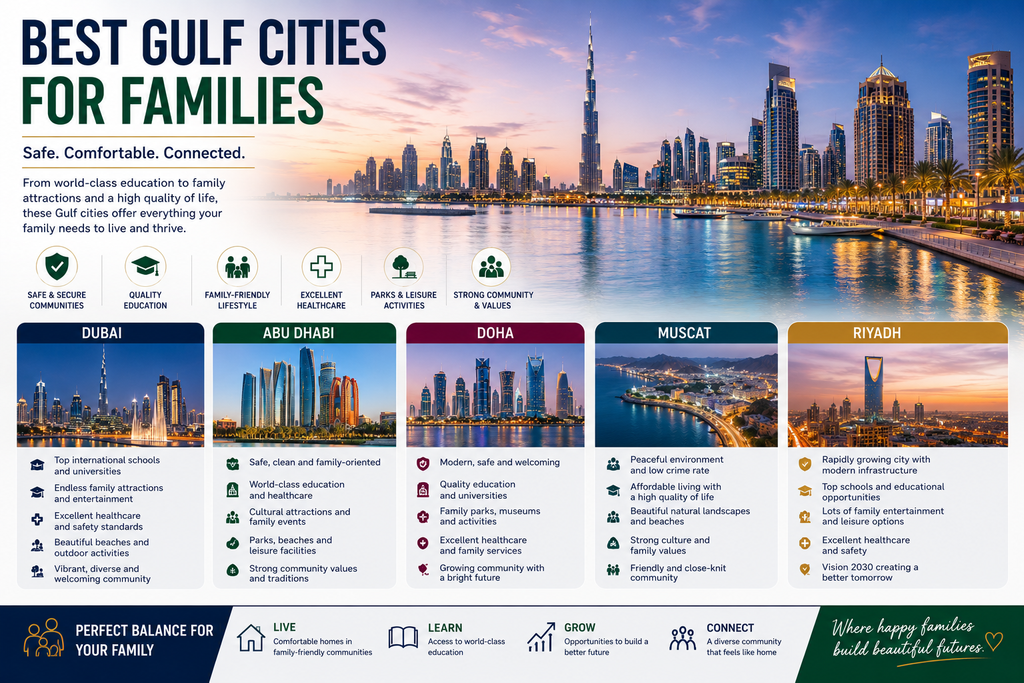
Dubai offers one of the region’s largest selections of international schools and master-planned residential communities. Abu Dhabi combines strong professional opportunities with a calmer lifestyle. Doha provides modern infrastructure within a relatively compact city, while Muscat attracts families looking for more space, nature and a slower pace.
Riyadh is changing rapidly as Saudi Arabia invests in transport, entertainment, education and new residential developments. Manama provides a smaller and potentially more manageable alternative, while Jeddah combines family life with a distinctive Red Sea setting.
So which are the Best Gulf Cities for Families in 2026?
The answer depends on budget, employment package, children’s ages and preferred lifestyle.
Here are 10 cities worth considering.
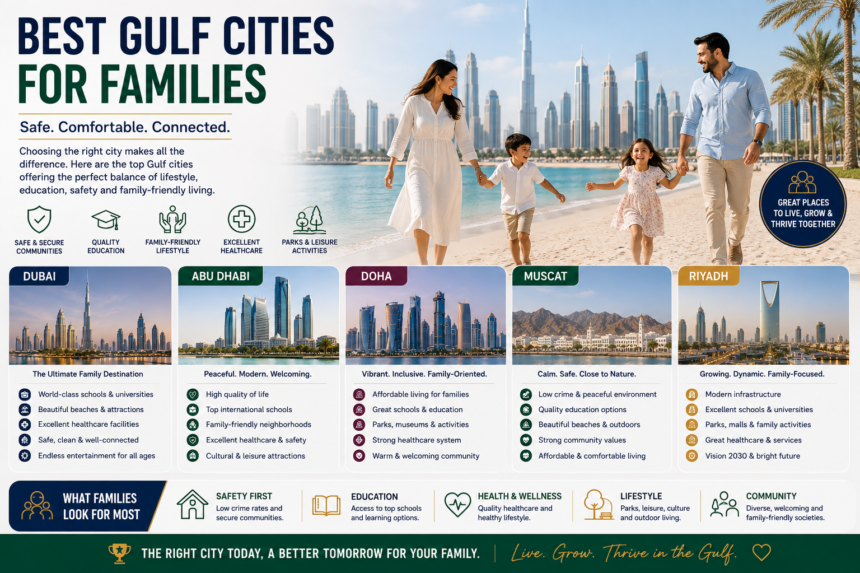
Best Gulf Cities for Families at a Glance
Families should compare cities differently from professionals moving alone.
A high salary can quickly lose its advantage if rent and school fees consume most of the household income.
| City | Best For | International Schools | Family Lifestyle | Cost Level | Overall Family Appeal |
|---|---|---|---|---|---|
| Abu Dhabi | Overall family balance | Excellent | Excellent | High | Excellent |
| Dubai | School and lifestyle choice | Excellent | Excellent | High | Excellent |
| Doha | Compact family living | Very good | Excellent | Medium to high | Excellent |
| Muscat | Relaxed lifestyle and nature | Good | Excellent | Moderate | Excellent |
| Riyadh | Career growth and new communities | Very good | Rapidly improving | Medium to high | Very good |
| Manama | Smaller-city family life | Good | Very good | Moderate | Very good |
| Jeddah | Coastal Saudi lifestyle | Good | Very good | Moderate | Very good |
| Sharjah | Affordable UAE family living | Very good | Excellent | Lower than Dubai | Very good |
| Kuwait City | Established expat families | Good | Good | Moderate | Good |
| Al Ain | Quiet family lifestyle | Good | Excellent | Moderate | Very good |
The ranking is deliberately not based on salary alone.
For families, the quality of the employment package can be more important than the city itself.
Housing allowance, school-fee support, family medical insurance and annual flights can completely change the financial calculation.
1. Abu Dhabi, UAE
Abu Dhabi deserves serious consideration as one of the Best Gulf Cities for Families.
The UAE capital combines high-quality infrastructure with a lifestyle that generally feels calmer than Dubai.
Families have access to international schools, hospitals, beaches, parks, cultural attractions, sports facilities and residential communities designed around everyday family life.
The city also provides strong professional opportunities.
Energy, finance, investment, aviation, healthcare, technology and government-linked organisations employ a large international workforce.
This makes Abu Dhabi particularly attractive to parents who want serious career opportunities without necessarily living in the Gulf’s busiest city.
Residential choice is another advantage.
Families can choose between apartment living and villa communities depending on their budget and workplace.
Areas such as Khalifa City can appeal to families looking for more residential space, while Yas Island combines modern housing with entertainment and leisure.
Saadiyat Island offers beaches, cultural attractions and premium residential developments.
Al Reem Island provides high-rise apartment living relatively close to central Abu Dhabi.
The right choice depends heavily on school and office location.
Why Abu Dhabi Works for Families
One of Abu Dhabi’s strongest characteristics is balance.
The city offers major attractions without making entertainment the centre of everyday life.
Families can spend weekends at beaches, parks, museums, Yas Island attractions or simply within their residential communities.
Abu Dhabi’s cultural offering has also expanded substantially.
Saadiyat Cultural District gives families access to internationally significant museums and cultural institutions.
Yas Island provides the opposite kind of entertainment, with theme parks and family attractions.
This creates variety without requiring families to leave the emirate every weekend.
Abu Dhabi also performs strongly in broader quality-of-life assessments. Its combination of safety, healthcare, purchasing power and infrastructure makes it especially attractive to households planning a longer Gulf stay.
2. Dubai, UAE
Dubai offers more family choices than almost any other Gulf city.
That is both its biggest advantage and one of its biggest challenges.
Parents can choose from an enormous range of residential communities, schools, nurseries, healthcare providers, sports academies, parks and children’s activities.
Dubai’s private-school market is particularly extensive.
Families can find British, American, International Baccalaureate, Indian and other curricula across the city.
This variety is extremely useful for international families who want their children to continue a curriculum they were already studying before moving.
The Knowledge and Human Development Authority regulates Dubai’s private education sector and publishes school information that parents can use when comparing options.
The difficulty is cost.
Premium schools can be expensive, and families with two or three children may find education becoming one of their largest annual expenses.
That makes employer-provided school allowances particularly valuable.
Family-Friendly Communities in Dubai
Dubai has several residential communities built specifically around family life.
Arabian Ranches remains one of the best-known examples, offering villas, parks, schools and community facilities.
Dubai Hills Estate has become another major family destination, combining apartments and villas with parks, schools, shopping and recreation.
The Springs and Meadows provide established low-density communities, while Mirdif remains popular with families wanting larger homes and a more traditional residential environment.
Al Barsha provides convenient access to schools and central parts of Dubai.
JVC attracts families looking for comparatively accessible housing and newer residential stock.
Families should resist the temptation to choose their home before confirming school arrangements.
In Dubai, the morning school journey can completely change the experience of a neighbourhood.
A beautiful villa becomes much less attractive if parents spend hours each week driving children across the city.
The practical rule is simple:
Choose the school first, then choose the neighbourhood.
3. Doha, Qatar
Doha is an excellent option for families who want modern Gulf infrastructure without the scale of Dubai or Riyadh.
Most of Qatar’s expatriate population, employment and major services are concentrated around the capital.
This makes Doha comparatively easy to understand when relocating.
Families can find international schools, healthcare, malls, parks, museums, sports facilities and residential compounds without dealing with the distances associated with much larger cities.
Doha’s international-school market includes British, American, International Baccalaureate, Indian and other curricula.
The market is smaller than Dubai’s, but families still have considerable choice.
Popular schools can have waiting lists, so parents should begin researching before relocating whenever possible.
School location should also influence the choice of neighbourhood.
Popular family residential areas include The Pearl-Qatar, Al Waab and other established communities around Doha.
Why Doha Appeals to Families
Doha’s compactness is a major advantage.
Parents can build a routine around home, work, school and activities without necessarily crossing an enormous metropolitan area every day.
The Doha Metro also improves mobility across key parts of the city.
Families have access to attractions such as museums, parks, waterfront areas, shopping centres and sporting facilities.
Qatar’s climate means indoor entertainment becomes particularly important during summer, and the city provides extensive air-conditioned family infrastructure.
The quality of an employment package matters enormously in Doha.
An employer that provides housing, family health insurance and school-fee assistance can turn Qatar into an extremely attractive financial proposition.
Without those benefits, international schooling and premium housing can still be expensive.
4. Muscat, Oman
Muscat offers something fundamentally different from Dubai, Doha and Riyadh.
It feels closer to nature.
Mountains form a dramatic backdrop to the city, while beaches and the Gulf of Oman provide easy access to the coast.
For families who prefer outdoor weekends and a slower pace of life, Muscat can be one of the Gulf’s most appealing choices.
The city has international schools, hospitals, shopping centres and family services, but its overall atmosphere is less intense than the region’s largest commercial centres.
This can be particularly attractive for parents with younger children.
Weekends can involve beach trips, mountain drives, hiking, wadis and short trips outside the city.
Oman’s geography creates opportunities for children to experience nature in ways that can be harder in heavily urbanised Gulf cities.
Muscat also performed strongly in 2026 regional quality-of-life data, helped by factors including safety, comparatively lower living costs and shorter commute indicators.
Living in Muscat With Children
Housing can provide more space for the money compared with premium areas of Dubai or Abu Dhabi, although salaries can also be different.
International-school choice is smaller than Dubai’s, so families should research education before accepting an employment offer.
Transportation is another consideration.
Having a car is highly useful for family life in Muscat.
The city is spread along the coast, and many weekend activities outside Muscat are easiest to reach by road.
For parents whose employment allows them to choose lifestyle over maximum career-market size, Muscat can offer an excellent family environment.
5. Riyadh, Saudi Arabia
Riyadh is one of the Gulf cities changing most rapidly.
Saudi Arabia’s economic transformation has brought new companies, international professionals, residential developments, restaurants, entertainment and major infrastructure projects to the capital.
This transformation affects family life as well as employment.
International schools serve Riyadh’s substantial expatriate community, while new residential projects and established compounds provide different housing choices.
Compounds have traditionally been particularly popular with international families because they can combine accommodation with swimming pools, sports facilities, children’s play areas and community activities.
Newer residential developments are expanding the alternatives.
Riyadh’s biggest attraction for many families, however, may begin with the parents’ careers.
The city is generating opportunities across consulting, finance, construction, technology, healthcare, tourism, hospitality and professional services.
A strong employment package can include benefits that substantially improve family finances.
Riyadh Is Becoming Easier to Navigate
Transportation has historically been one of Riyadh’s biggest challenges.
The city is enormous and has traditionally depended heavily on private cars.
The Riyadh Metro has changed that picture.
Its development provides families and professionals with an alternative way to move across important parts of the capital.
However, many families will still find a car useful, particularly for school runs and neighbourhoods not directly connected to rail.
Location therefore matters enormously.
Families should try to keep home, school and workplace within a manageable geographic area.
A cheaper villa on the opposite side of Riyadh may not be a good bargain if it creates a difficult daily commute.
6. Manama, Bahrain
Manama provides a smaller Gulf-city experience.
Bahrain has a long-established expatriate community, particularly connected with finance, professional services, energy and hospitality.
For families, the country’s relatively compact geography can be convenient.
Living in Bahrain means many destinations are closer together than they would be in a sprawling city such as Riyadh.
International schools serve different expatriate communities, while residential areas range from apartments to villa compounds.
Families also have access to malls, restaurants, beaches, sports facilities and cultural attractions.
Manama may particularly appeal to parents who want a Gulf lifestyle without the scale and cost associated with premium parts of Dubai.
Bahrain also has the advantage of being connected to Saudi Arabia through the King Fahd Causeway.
This gives families relatively easy access to the Eastern Province for trips and expands the regional lifestyle possibilities.
7. Jeddah, Saudi Arabia
Jeddah is one of the most distinctive family cities in Saudi Arabia.
Its Red Sea location gives it a different atmosphere from Riyadh.
The waterfront, Corniche and coastal lifestyle become important parts of everyday recreation.
Families can spend time outdoors during suitable weather, explore waterfront destinations or use Jeddah as a base for wider Red Sea travel.
The city also has established international schools and a large expatriate community.
Career opportunities are particularly relevant across logistics, aviation, tourism, hospitality, healthcare, retail and professional services.
Saudi Arabia’s tourism expansion is likely to keep western Saudi Arabia economically important.
For families considering Saudi Arabia but uncertain about the pace of Riyadh, Jeddah can provide an interesting alternative.
It combines access to the Kingdom’s large economy with a more coastal lifestyle.
8. Sharjah, UAE
Sharjah can be an excellent family destination, particularly for households that want to remain in the UAE while controlling housing costs.
The emirate has a strong cultural and educational identity.
Families can find schools, universities, museums, parks, waterfront areas and residential neighbourhoods that feel noticeably different from central Dubai.
Housing can also be more accessible than equivalent family accommodation in some of Dubai’s most desirable communities.
This is particularly valuable for larger families requiring three or four bedrooms.
Sharjah also offers many child-focused attractions and cultural experiences.
Its family-oriented environment appeals to parents who prefer a quieter lifestyle.
The biggest challenge is commuting.
Many people live in Sharjah but work in Dubai.
Peak-hour traffic between the two emirates can make this arrangement tiring.
Families should therefore calculate commute time before choosing Sharjah simply because the rent appears cheaper.
For parents working in Sharjah itself, the city becomes considerably more attractive.
9. Kuwait City, Kuwait
Kuwait City has supported international families for decades.
The country’s expatriate population has created established communities, schools and services for residents from numerous nationalities.
International and private schools provide different curricula, while healthcare infrastructure includes both public and private options.
Families can choose residential areas according to workplace, school and budget.
Salmiya is one of the most internationally familiar parts of Kuwait, while areas such as Jabriya, Salwa and Sabah Al-Salem can also appeal to families.
Entertainment is generally more understated than in Dubai.
Family life often revolves around restaurants, shopping centres, waterfront areas, social gatherings and organised children’s activities.
During the cooler months, outdoor life becomes considerably easier.
Kuwait can be particularly attractive when the employment package includes housing, education or other family benefits.
10. Al Ain, UAE
Families comparing Gulf cities should not automatically assume they need to live in a capital or major commercial hub.
Al Ain offers an alternative.
Located in Abu Dhabi emirate, the city is known for greenery, lower-density development and a much quieter atmosphere than Dubai or central Abu Dhabi.
For families, this can be a major advantage.
Homes can provide more space, traffic is generally less intense than in the UAE’s largest cities, and the overall pace can feel more manageable.
Schools, healthcare and everyday shopping are readily available.
Jebel Hafeet and the surrounding landscapes also provide easy access to outdoor activities.
The main limitation is employment.
Al Ain does not have the enormous private-sector job market of Dubai or Abu Dhabi.
It is therefore most attractive to families who already have secure employment in or around the city.
For teachers, healthcare professionals, university staff and others with suitable roles, Al Ain can provide one of the UAE’s calmest family lifestyles.
Best Gulf Cities for Families by Priority
Different households will produce different rankings.
| Family Priority | Strong Choices |
|---|---|
| Best overall balance | Abu Dhabi, Dubai |
| Widest school choice | Dubai |
| Quiet family lifestyle | Muscat, Al Ain |
| Compact city | Doha, Manama |
| Career opportunities for parents | Dubai, Riyadh, Abu Dhabi |
| More affordable UAE option | Sharjah, Al Ain |
| Coastal lifestyle | Abu Dhabi, Jeddah, Muscat |
| Major family attractions | Dubai, Abu Dhabi |
| Nature and outdoor weekends | Muscat, Al Ain |
| Rapidly developing lifestyle | Riyadh |
| Smaller Gulf environment | Manama, Muscat |
| Strong public transport | Dubai, Doha, Riyadh |
This table should be treated as a starting point rather than a fixed ranking.
The quality of a particular job offer can change everything.
Best Gulf City for International Schools
Dubai has a major advantage in school choice.
Its private education market includes hundreds of schools covering numerous curricula.
Parents can choose between British, American, International Baccalaureate, Indian and other educational systems.
That variety is especially useful for internationally mobile families.
If a child has already spent several years in a British curriculum, parents may prefer continuity rather than changing education systems simply because they moved countries.
Abu Dhabi also provides strong international-school options.
Doha has a smaller but established market with several highly regarded schools.
Riyadh, Jeddah, Muscat, Manama and Kuwait City also provide international education, but the depth of choice varies.
School availability should always be confirmed before signing a housing contract.
Best Gulf City for Family Activities
Dubai probably offers the widest selection.
Families can choose from beaches, waterparks, theme parks, indoor play centres, museums, aquariums, desert activities and sporting facilities.
Abu Dhabi is also exceptionally strong.
Yas Island alone provides several major family attractions, while beaches, museums and outdoor spaces add variety.
Doha offers museums, parks, waterfront areas and family entertainment in a more compact setting.
Muscat provides fewer large-scale commercial attractions but compensates with natural experiences.
Families can explore beaches, mountains and wadis or take weekend road trips around Oman.
Jeddah’s Red Sea setting provides another outdoor-oriented alternative.
The best city therefore depends on whether a family prefers commercial entertainment or natural experiences.
Best Gulf City for Safety and Peace of Mind
Safety is one of the reasons families are attracted to Gulf countries.
Cities across the UAE, Qatar, Oman, Bahrain and Saudi Arabia generally perform strongly in perceptions and indices related to personal safety.
Abu Dhabi performs particularly strongly in international city safety comparisons.
Dubai also combines a high sense of personal security with extensive infrastructure.
Muscat’s quieter environment can be reassuring for families, while Doha offers a controlled and comparatively compact urban lifestyle.
Parents should still follow normal precautions.
A city’s overall safety does not remove risks connected with road traffic, swimming pools, extreme summer heat or children using digital services.
Family safety is broader than crime statistics alone.
Best Gulf Cities for Family Healthcare
Abu Dhabi and Dubai have particularly extensive private healthcare sectors.
Families can access large hospitals, specialist clinics, paediatric services and maternity care.
Doha also has substantial healthcare infrastructure relative to its population.
Saudi Arabia’s major cities provide large public and private hospital networks, while healthcare investment continues across the Kingdom.
Muscat, Manama and Kuwait City also provide established medical services.
For expatriates, however, the more important issue is often insurance.
Before accepting a job, parents should examine exactly what the family policy covers.
Check whether children and spouses are included and whether the insurance provides access to the hospitals you actually want to use.
Maternity, dental care, specialist consultations, prescriptions and chronic-condition treatment may have separate limits.
Best Gulf City for Families Without a Car
Dubai is one of the easiest options if the family chooses its neighbourhood carefully.
The Metro, Tram, buses and taxis provide extensive connectivity.
However, a family living in a villa community far from rail may still find a car necessary.
Doha is another strong option because its Metro connects many important parts of the capital.
Riyadh’s Metro has significantly improved public transport, although the scale of the city means cars remain useful for many households.
Abu Dhabi has a substantial bus and taxi network but does not yet offer the same Metro-based lifestyle as Dubai.
Muscat and Kuwait City are generally easier for families with access to a car.
The lesson is that transport depends as much on neighbourhood as city.
Most Affordable Gulf Cities for Families
There is no universal cheapest city because salaries and benefits vary enormously.
Muscat can offer attractive housing value relative to some of the Gulf’s premium markets.
Manama can also provide a lower-cost alternative for families who find suitable employment.
Sharjah may help UAE families reduce housing expenses compared with premium Dubai neighbourhoods.
However, school fees can still significantly affect the household budget.
Riyadh’s rapid growth has also changed its housing market, meaning families should not rely on outdated assumptions that accommodation will automatically be inexpensive.
Instead of comparing rent alone, calculate the complete annual family budget.
What Families Should Compare Before Moving
A family relocation should begin with the employment contract, school and housing rather than lifestyle photographs on social media.
Before accepting an offer, compare:
- Annual take-home salary
- Housing allowance
- School-fee allowance
- Family health insurance
- Annual flight allowance
- Nursery or childcare costs
- Residence visa costs
- Transportation
- School transport
- Utility bills
- Annual leave
- End-of-service benefits
- Spouse employment possibilities
- Distance between school and workplace
School allowance deserves particular attention.
For a family with several children, this benefit can be worth a substantial amount every year.
Best Gulf Cities for Families: Final Ranking
There is no scientifically perfect ranking, but based on the overall combination of education, healthcare, safety, housing choices, family activities, employment opportunities and everyday lifestyle, a practical shortlist looks like this:
| Rank | City | Biggest Family Advantage |
|---|---|---|
| 1 | Abu Dhabi | Best overall balance |
| 2 | Dubai | Unmatched choice of schools and activities |
| 3 | Doha | Compact and modern family lifestyle |
| 4 | Muscat | Peaceful living and nature |
| 5 | Riyadh | Career growth and expanding family infrastructure |
| 6 | Manama | Manageable size and established expat community |
| 7 | Jeddah | Red Sea family lifestyle |
| 8 | Sharjah | Family-oriented UAE living and housing value |
| 9 | Kuwait City | Established schools and expat communities |
| 10 | Al Ain | Quiet, spacious family lifestyle |
The ranking can change completely according to individual circumstances.
A family receiving free accommodation and school fees in Doha may find Qatar financially better than Dubai.
Parents employed in Riyadh with a strong package may achieve a better standard of living than they would with a higher headline salary elsewhere.
A family prioritising nature may rank Muscat first.
That is why personal priorities matter more than a generic ranking.
Abu Dhabi vs Dubai for Families
This is one of the most difficult comparisons.
Dubai provides more choice.
There are more entertainment options, an enormous school market and a greater variety of residential communities.
Its public transport network is another advantage.
Abu Dhabi provides a calmer alternative.
Families still have excellent schools, healthcare, beaches, attractions and professional opportunities, but the city can feel less hectic.
Choose Dubai if variety and connectivity matter most.
Choose Abu Dhabi if balance and a calmer pace are more important.
Neither is automatically better.
Dubai vs Doha for Families
Dubai has the larger education and entertainment ecosystem.
Doha is considerably smaller and can feel easier to manage.
Dubai provides more residential communities and career options but also creates more opportunities to spend money.
Doha can offer a more compact routine, particularly when school, home and workplace are reasonably close.
Employment benefits become especially important in this comparison.
A strong Qatar package including housing and education can make Doha extremely attractive.
A family funding everything independently may value Dubai’s much broader range of housing and schooling choices.
Riyadh vs Dubai for Families
Dubai has the more established international expat ecosystem.
Riyadh has the momentum.
Families moving to Dubai enter a city that has been building international schools, communities and expatriate services for decades.
Families moving to Riyadh are entering a city undergoing enormous transformation.
For parents working in industries benefiting from Saudi Arabia’s expansion, Riyadh may provide stronger career opportunities.
For families prioritising an established international lifestyle and wider entertainment choice, Dubai remains difficult to beat.
Final Thoughts on the Best Gulf Cities for Families
Choosing the Best Gulf Cities for Families is ultimately about balance.
Abu Dhabi stands out because it combines career opportunities, strong infrastructure, healthcare, education, beaches and family entertainment without quite the same intensity as Dubai.
Dubai remains exceptional for choice.
Few Gulf cities can match its combination of international schools, residential communities, healthcare providers, family attractions and transport infrastructure.
Doha provides a smaller and more manageable alternative.
Muscat offers families a completely different experience built around nature, space and a slower pace.
Riyadh is increasingly important as Saudi Arabia’s transformation creates new careers, residential communities, entertainment and transport infrastructure.
Manama, Jeddah, Sharjah, Kuwait City and Al Ain each offer advantages for particular families.
But parents should avoid choosing a city based on rankings alone.
Start with the job offer.
Then investigate schools.
After that, choose a home close enough to both school and work to create a manageable daily routine.
Finally, calculate what the family can actually save after rent, education, healthcare, transport and everyday expenses.
The best Gulf city for a family is not necessarily the richest, biggest or most famous.
It is the city where parents can build their careers while children have the education, stability, community and quality of life they need to grow.
Do follow us on Instagram
Read More – Best Gulf Cities for Young Professionals: 10 Powerful Choices in 2026