


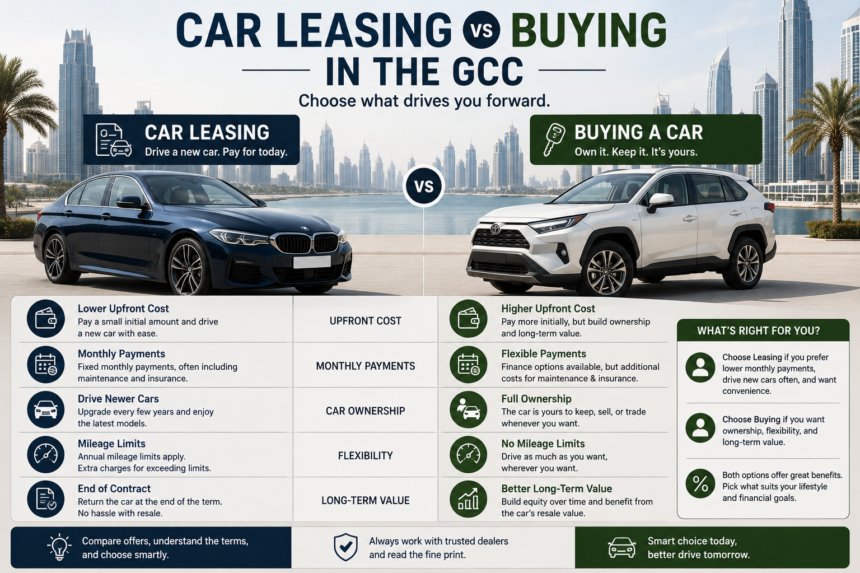
Car Leasing vs Buying in the GCC: Which Is Better for Expats?
For many expatriates moving to the Gulf, getting a car becomes an important decision within the first few weeks or months. Public transport has expanded considerably in cities such as Dubai, Doha and Riyadh, but private vehicles remain extremely useful for commuting, family life, shopping and travelling between different parts of the region.
- Car Leasing vs Buying in the GCC at a Glance
- 1. Start With How Long You Expect to Stay in the Gulf
- 2. Compare the Real Monthly Cost, Not Just the Advertised Payment
- 3. Leasing Can Require Less Money Upfront
- 4. Buying Gives You an Asset
- 5. Leasing Can Make Maintenance Much Easier
- 6. Mileage Limits Can Make or Break a Lease
- 7. Buying Gives You More Freedom
- 8. Depreciation Is the Buyer’s Problem
- 9. Leasing Makes Changing Cars Easier
- 10. Early Termination Is a Major Lease Risk
- 11. Insurance Needs to Be Compared Carefully
- 12. End-of-Lease Condition Charges Need Attention
- Car Leasing vs Buying in the UAE
- Car Leasing vs Buying in Saudi Arabia
- Car Leasing vs Buying in Qatar
- Car Leasing vs Buying in Oman
- Car Leasing vs Buying in Bahrain
- Car Leasing vs Buying in Kuwait
- Car Leasing vs Financing: Do Not Confuse Them
- The 3-Year Cost Test
- Which Option Fits Your Lifestyle?
- Hidden Costs to Check Before Leasing
- Hidden Costs to Check Before Buying
- Leasing for Families: Does It Make Sense?
- Leasing for Young Professionals
- When Leasing Makes More Sense
- When Buying Makes More Sense
- 10 Questions to Ask Before Signing a Car Lease
- 10 Questions to Ask Before Buying
- Car Leasing vs Buying in the GCC: Which Is Cheaper?
- Car Leasing vs Buying in the GCC: Final Verdict
Once you decide that you need a vehicle, another question appears: should you lease a car or buy one?
At first, leasing can look attractive because it reduces the responsibilities associated with ownership. Depending on the agreement, registration, maintenance and other services may be included, while changing vehicles at the end of the contract can be relatively straightforward. Buying requires a larger financial commitment, but you own an asset that can eventually be sold and you generally have greater control over how long you keep it.
The correct choice depends heavily on how long you expect to remain in the Gulf. A professional arriving in Dubai on a two-year assignment has different needs from a family that has lived in Riyadh for eight years. Someone who changes cars frequently may value leasing, while another resident may prefer buying a reliable vehicle and keeping it for many years.
This guide compares Car Leasing vs Buying in the GCC through 12 important differences, helping residents across the UAE, Saudi Arabia, Qatar, Kuwait, Bahrain and Oman decide which option fits their budget, lifestyle and long-term plans.
Car Leasing vs Buying in the GCC at a Glance
Before calculating every expense, it helps to understand the basic difference. With a conventional purchase, you acquire the vehicle and eventually own it outright, subject to any financing arrangement. With leasing, you normally pay for the right to use the vehicle according to a contract while ownership remains with the leasing company unless the agreement specifically includes a route to ownership.
| Factor | Leasing | Buying |
|---|---|---|
| Initial cash requirement | Usually lower | Usually higher |
| Vehicle ownership | Leasing company | Buyer |
| Monthly payment | Fixed by contract | Loan payment or none if cash |
| Maintenance | May be included | Owner responsibility |
| Insurance | May be included depending on contract | Owner arranges |
| Mileage | Often limited | No contractual mileage limit |
| Customisation | Usually restricted | Greater freedom |
| Early exit | Can involve charges | Vehicle can generally be sold |
| Depreciation risk | Mostly lessor’s concern | Owner carries risk |
| Resale responsibility | Usually none | Owner must sell/trade |
| Long-term asset | Usually no | Yes |
| Best for | Convenience and shorter stays | Longer-term ownership |
This comparison makes leasing look easier and buying look better for long-term value, but the actual decision depends on the contract and your circumstances.
1. Start With How Long You Expect to Stay in the Gulf
Your expected residency period should be one of the first questions you answer. Expatriate careers can change quickly, and someone arriving for a specific project may not know whether they will remain for one year, three years or a decade.
Leasing can be attractive when your future is uncertain because you do not need to worry about eventually selling the vehicle. However, the lease term itself matters. Signing a long contract and then leaving the country early can create termination costs, so flexibility should never be assumed without reading the agreement.
Buying becomes easier to justify when you expect to remain for several years. The initial registration, financing and depreciation become less painful when spread across a longer ownership period, particularly if you choose a reliable model with good resale demand.
Quick Decision
Staying for a short or uncertain period? Leasing deserves serious consideration.
Staying for several years? Compare buying carefully because long-term ownership may provide better value.
Not sure how long you will stay? Avoid signing either a long lease or an expensive car loan until your plans become clearer.
2. Compare the Real Monthly Cost, Not Just the Advertised Payment
A low monthly number is one of the easiest ways for a vehicle offer to attract attention. Unfortunately, comparing lease and purchase payments alone can give a misleading picture.
A lease payment may include certain services, but there could also be an upfront payment, mileage restrictions, excess-use charges or fees when the vehicle is returned. A financed car payment builds ownership over time, but the owner must usually account separately for insurance, registration, maintenance, tyres and repairs.
The better calculation is:
Leasing Cost = Initial Payment + Monthly Lease + Excluded Services + Potential Mileage/Return Charges
Buying Cost = Down Payment + Finance Cost + Insurance + Registration + Maintenance + Depreciation – Resale Value
This makes the comparison much more realistic.
If a lease costs slightly more each month but includes substantial maintenance and administrative services, the convenience may justify the difference. If you intend to keep a purchased car for many years after completing the loan, ownership may eventually become considerably cheaper.
3. Leasing Can Require Less Money Upfront
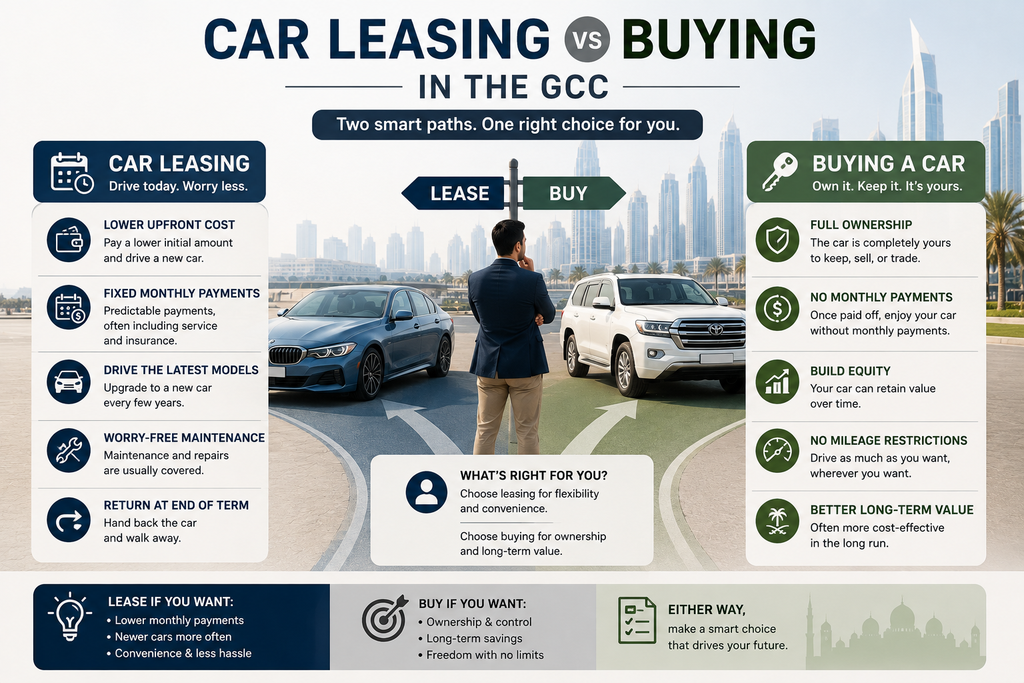
Buying a vehicle can require a significant amount of cash, particularly when financing involves a down payment. Insurance, registration and other initial costs can add further pressure on a newcomer who is simultaneously paying for accommodation, deposits, furniture and relocation expenses.
Leasing can reduce this initial burden. Depending on the provider and contract, the upfront requirement may be smaller than purchasing a comparable vehicle.
This can make leasing particularly attractive during the first year of Gulf residency. New expats often want to preserve savings until they understand their real monthly expenses and job stability.
However, lower upfront cost should not be confused with lower total cost. A vehicle can be easier to access through leasing while still costing more over several years.
The objective should be to compare the complete contract rather than choosing whichever option requires less money today.
4. Buying Gives You an Asset
The biggest financial difference is simple: when you purchase a vehicle, it becomes your asset once all financing obligations are satisfied. When you finish a conventional lease and return the vehicle, you generally do not own it.
That does not automatically make buying superior because cars depreciate. A vehicle normally becomes less valuable as it ages and accumulates kilometres.
The important advantage is resale value. If you purchase a vehicle and later sell it, part of your original expenditure comes back to you.
For example, imagine two residents spend similar amounts each month for several years. One eventually returns the leased vehicle with no ownership interest, while the other owns a car that can still be sold.
That remaining value can significantly change the long-term calculation.
Ownership Advantage
With buying, your equation eventually becomes:
Purchase Cost – Resale Value = Effective Vehicle Cost
With a conventional lease:
Lease Payments + Applicable Charges = Cost of Using the Vehicle
This is one reason buying often becomes more attractive when the vehicle will be kept for a long period.
5. Leasing Can Make Maintenance Much Easier
Convenience is one of leasing’s strongest advantages. Depending on the package, scheduled maintenance and certain other vehicle-related services may be included.
For a busy professional, this can be valuable. Instead of worrying about unexpected servicing expenses or finding a reliable workshop, the driver follows the process provided by the leasing company.
Buying places these responsibilities on the owner. During the first few years, a new vehicle may have warranty protection and relatively predictable maintenance, but expenses generally increase as the car ages.
Gulf conditions make maintenance particularly important. Extreme summer heat places additional stress on tyres, batteries, air-conditioning systems and cooling components.
A resident who dislikes dealing with vehicle maintenance may therefore reasonably choose leasing even if the financial calculation is slightly more expensive.
Convenience has value. The question is how much you are willing to pay for it.
6. Mileage Limits Can Make or Break a Lease
This is one of the most important sections of any lease agreement.
Many leasing arrangements establish how many kilometres the vehicle can be driven during the contract. Exceeding the agreed mileage can result in additional charges.
This may not be a problem for someone with a short commute, but Gulf driving distances can become substantial. A Riyadh resident may travel long distances across the city every day, while residents of Oman or Saudi Arabia may regularly make intercity journeys.
Before signing, estimate your annual mileage realistically.
Estimate Your Mileage
| Driving Pattern | What to Consider |
|---|---|
| Short urban commute | Leasing mileage may be comfortable |
| Long daily commute | Check annual limit carefully |
| Frequent intercity travel | Buying may provide more freedom |
| Regular GCC road trips | Lease cross-border and mileage rules matter |
| Weekend-only driving | Lease allowance may be more than enough |
Do not calculate only your journey to work. Include school runs, shopping, weekend travel, airport trips and holidays.
A lease that looks affordable can become much less attractive if your actual driving significantly exceeds the contracted allowance.
7. Buying Gives You More Freedom
Ownership provides flexibility that lease contracts usually cannot match. Once you own the car, you can decide how much to drive it, when to sell it and how long to keep it.
You may also have greater freedom to make permitted modifications or accessories according to local laws.
Lease agreements usually contain more restrictions because the vehicle must eventually be returned to its owner. Modifications may be prohibited, and the vehicle may need to meet specific condition requirements when the contract ends.
This distinction matters for people who treat their vehicle as more than basic transportation. Someone who enjoys off-road driving, vehicle modifications or very high annual mileage may find ownership much more suitable.
For someone who simply wants reliable transport from home to work with minimal involvement, leasing can be easier.
8. Depreciation Is the Buyer’s Problem
Depreciation is one of the largest hidden costs of car ownership. A new vehicle begins losing value after purchase, and the rate differs considerably between brands and models.
Popular vehicles with strong regional demand may retain value relatively well. Less popular models, expensive luxury vehicles and cars with poor market reputation can lose value much faster.
When you buy, you carry that depreciation risk.
When you lease conventionally, the leasing company generally carries the vehicle’s long-term resale risk, although depreciation is naturally reflected in how the lease is priced.
Quick Example
Imagine you buy a car for the equivalent of 100,000 in local currency and sell it several years later for 55,000.
Your depreciation cost is approximately 45,000, before considering financing, insurance and maintenance.
That is why the purchase price alone tells you very little about the true cost of ownership.
A slightly more expensive model with excellent resale value can sometimes cost less to own than a cheaper model that depreciates rapidly.
9. Leasing Makes Changing Cars Easier
Some drivers enjoy changing vehicles every few years. They value new technology, updated safety systems, modern interiors and the reliability of newer cars.
Leasing fits this behaviour naturally. Once one contract ends, the driver can potentially move into another vehicle rather than advertising, negotiating and selling the old car.
Buying can still work for people who change vehicles frequently, but depreciation and transaction costs become more important. Selling a relatively new vehicle every two or three years can be expensive because much of its depreciation occurs during the earlier years.
If you normally keep cars for seven or eight years, buying deserves serious consideration.
If you want a different new car every few years and prioritise convenience over ownership, leasing can be attractive.
10. Early Termination Is a Major Lease Risk
One of the most important questions for an expatriate is: What happens if I leave the country early?
A job loss, company transfer, family decision or better opportunity elsewhere in the GCC can suddenly change your plans.
A purchased vehicle can generally be sold, although an outstanding loan or finance agreement must be settled according to its terms.
A leased vehicle is controlled by a contract. Ending that agreement early may involve fees or other financial obligations.
Before signing any lease, specifically ask:
- What is the early termination charge?
- Can another person take over the agreement?
- What happens if my residence visa is cancelled?
- What happens if I lose my job?
- Can I upgrade or downgrade during the contract?
- Is there a notice period?
- Are there administrative charges?
For expatriates, these questions can be more important than the advertised monthly payment.
11. Insurance Needs to Be Compared Carefully
Insurance can significantly affect the total cost of either option.
Some leasing packages include insurance, while others require the customer to arrange or pay for it separately. The type and level of coverage can also differ.
When purchasing, the owner is responsible for ensuring that the vehicle meets local insurance requirements. In the UAE, for example, official vehicle-registration procedures require vehicle insurance before registration. The UAE’s official platform also requires registration before a vehicle can legally be driven on public roads.
Saudi Arabia similarly requires valid insurance for electronic vehicle ownership transfer through its official Absher process.
When comparing lease offers, do not simply ask whether “insurance is included.” Check what type of coverage is provided, the excess or deductible, accident procedures and whether additional drivers are covered.
12. End-of-Lease Condition Charges Need Attention
Returning a leased vehicle is not always as simple as handing over the keys.
The leasing company may inspect the vehicle for damage beyond normal wear and tear. Depending on the contract, charges could apply for body damage, wheel damage, interior problems, missing equipment or other issues.
This makes the definition of “normal wear and tear” important.
Before accepting the vehicle, photograph its condition. Keep service records and report damage according to the contract.
When the lease is approaching its end, inspect the car yourself before returning it so there are no surprises.
Buying removes this particular concern because you decide when and in what condition to sell the vehicle. However, damage will still reduce resale value, so owners do not completely escape the financial impact.
Car Leasing vs Buying in the UAE
The UAE has a highly developed automotive market with conventional ownership, financing, short-term rentals and long-term leasing all widely available. This gives residents considerable flexibility when choosing how to obtain a vehicle.
Buying is relatively straightforward for eligible residents. Official UAE guidance states that a vehicle must be registered before it can legally be driven, with insurance and applicable technical inspection forming part of the registration process. Dubai’s RTA also provides extensive digital vehicle services.
For residents expecting to stay several years, buying a popular model with strong resale demand can be financially attractive. The UAE has a large used-car market, which makes eventually selling many mainstream vehicles relatively straightforward.
Leasing can be especially useful for newcomers, professionals on fixed-term assignments and people who want a newer car without managing resale.
The large number of available options also means UAE residents should compare several lease packages rather than accepting the first monthly price advertised.
Car Leasing vs Buying in Saudi Arabia
Saudi Arabia’s size makes vehicle ownership particularly relevant. Riyadh residents can accumulate significant mileage simply through normal commuting, while intercity travel can add thousands of kilometres annually.
That makes mileage allowances extremely important when considering a lease.
Saudi Arabia also has a formal legal framework for finance leasing. Under the Kingdom’s Finance Lease Law, ownership of a leased asset can potentially be conveyed to the lessee according to the contractual arrangement, including structures where ownership follows completion of agreed payments.
This means residents should distinguish between a conventional operating-style vehicle lease and a finance lease that may ultimately lead to ownership.
For residents buying a vehicle, Saudi Arabia provides electronic ownership-transfer services through Absher. The official process requires conditions including valid vehicle registration, technical inspection and insurance.
Long-term Saudi residents who drive substantial distances may find buying attractive because there is no contractual mileage limit. Shorter-term professionals may value the convenience of leasing, provided the contract allows enough kilometres.
Car Leasing vs Buying in Qatar
Qatar’s relatively compact geography can make leasing particularly convenient for expatriates who do not expect to remain long term. Daily driving distances may also be manageable for many Doha residents, although this varies greatly according to workplace and lifestyle.
Someone arriving on a one-year assignment may prefer predictable monthly transport costs and minimal responsibility for eventual resale. A resident expecting to stay for several years should compare the accumulated lease payments with the cost of purchasing and later selling a vehicle.
Resale value matters here as it does elsewhere. Choosing a model with strong local demand can reduce the effective cost of ownership.
Before leasing, check annual mileage, maintenance coverage, insurance and early termination. Before buying, calculate registration, insurance, maintenance and expected depreciation.
Car Leasing vs Buying in Oman
Oman creates a different vehicle-use pattern because residents may combine normal Muscat commuting with long-distance road trips, mountain journeys and travel to other parts of the country.
Drivers covering significant distances should examine lease mileage allowances particularly carefully.
Vehicle type matters as well. Someone who frequently explores areas requiring suitable four-wheel-drive capability may want greater freedom over the vehicle they use and how long they keep it.
Buying can therefore be attractive for established residents who know exactly what vehicle suits their lifestyle.
Leasing can still work well for professionals who mainly drive within Muscat and prefer predictable maintenance arrangements without worrying about eventual resale.
Car Leasing vs Buying in Bahrain
Bahrain’s compact size can make annual mileage relatively manageable for many residents, which can work well with certain leasing arrangements.
Professionals who expect to remain for only a few years may appreciate the simplicity of leasing. The ability to use a vehicle without planning its eventual resale can be particularly useful for expatriates on fixed assignments.
Buying may provide better value for families and long-term residents who intend to keep the same vehicle for several years.
People who regularly drive between Bahrain and Saudi Arabia should pay particular attention to cross-border conditions. A leased vehicle may require permission or specific documentation for international travel, so this should be confirmed before signing.
Car Leasing vs Buying in Kuwait
Kuwait’s car-oriented lifestyle makes reliable private transportation important for many residents. Daily commuting, shopping and family activities frequently involve driving, making the total cost of vehicle access an important household expense.
Leasing can provide convenience for residents who want predictable vehicle arrangements and do not want to deal with resale.
Buying can be attractive for longer-term residents, particularly when choosing reliable models with widely available parts and strong resale demand.
As elsewhere in the GCC, extreme summer conditions make maintenance important. Buyers need to budget for tyres, batteries, air conditioning and other maintenance, while lessees should understand which of these costs are included in their contract.
Car Leasing vs Financing: Do Not Confuse Them
Leasing and financing are often discussed together, but they are not the same thing.
When you finance a car purchase, you borrow money to acquire the vehicle and make repayments according to the finance agreement. Once the obligations are completed and any applicable security interest is released, the vehicle belongs to you.
With a conventional lease, you are paying to use a vehicle owned by another party.
A finance lease can sit somewhere between these models because the contract may provide a path to eventual ownership.
Know What You Are Signing
| Arrangement | Who Ultimately Owns the Car? | Typical Goal |
|---|---|---|
| Cash purchase | Buyer | Immediate ownership |
| Car finance | Buyer after obligations completed | Spread purchase cost |
| Conventional lease | Leasing company | Pay for vehicle use |
| Finance lease / lease-to-own | Depends on contract | Potential eventual ownership |
| Short-term rental | Rental company | Temporary transport |
Never choose based only on what the salesperson calls the product. Read the contract and understand who legally owns the vehicle at each stage.
The 3-Year Cost Test
A simple comparison can help you evaluate offers.
Imagine you are comparing the same type of car for three years.
Leasing
Calculate:
Upfront Lease Cost + 36 Monthly Payments + Insurance Not Included + Excess Mileage + Potential Return Charges
Buying
Calculate:
Down Payment + 36 Finance Payments + Insurance + Registration + Maintenance – Vehicle Value After 3 Years
The second calculation is frequently forgotten.
If you buy a car, you still own something after three years. Its resale value should be deducted when comparing the economic cost.
This does not guarantee buying will win. Financing costs, depreciation and maintenance can still make leasing competitive.
But without including resale value, the comparison is incomplete.
Which Option Fits Your Lifestyle?
Use this quick decision table as a starting point.
| Your Situation | Option Worth Considering First |
|---|---|
| New to the GCC | Leasing |
| Staying less than two years | Leasing |
| Unsure about job stability | Flexible lease/rental |
| Staying long term | Buying |
| Drive very high mileage | Buying |
| Want a new car every few years | Leasing |
| Hate dealing with maintenance | Leasing |
| Want an asset to resell | Buying |
| Want maximum vehicle freedom | Buying |
| Have limited upfront cash | Leasing may be easier |
| Want to modify the vehicle | Buying |
| Frequently relocate internationally | Leasing/flexible rental |
This is not an absolute rule. A particularly good lease offer or a very expensive financing package can change the calculation.
Hidden Costs to Check Before Leasing
The monthly payment is only the beginning of a lease comparison. Before signing, request a complete explanation of what is and is not included.
Pay particular attention to:
- Initial payment or deposit
- Annual mileage allowance
- Excess-kilometre charge
- Insurance coverage
- Insurance excess
- Scheduled maintenance
- Tyres
- Battery replacement
- Registration
- Roadside assistance
- Replacement vehicle during repairs
- Additional driver fees
- Accident charges
- Early termination
- Cross-border travel
- End-of-contract damage assessment
If the salesperson cannot clearly explain one of these areas, ask for the answer in writing before signing.
Hidden Costs to Check Before Buying
Ownership has its own expenses, and ignoring them can make buying appear cheaper than it really is.
The purchase budget should account for financing costs where applicable, insurance, registration, servicing, tyres, batteries, repairs and depreciation.
Luxury vehicles deserve particular attention. A used premium vehicle may have an affordable purchase price while retaining expensive servicing, parts and insurance.
The strongest buying decision is therefore not simply finding the lowest purchase price. It is choosing a vehicle whose total ownership cost fits comfortably within your budget.
Leasing for Families: Does It Make Sense?
Families can benefit from leasing when they want a dependable newer vehicle without dealing with long-term maintenance and resale.
A family that expects to remain in the Gulf for only two or three years may prefer leasing a suitable SUV or crossover and returning it before relocating.
However, family driving can generate substantial mileage through school runs, activities, shopping and weekend travel. The annual mileage allowance therefore needs careful calculation.
Families staying long term may find ownership more economical, particularly if they purchase a reliable vehicle and keep it after the financing period ends.
The longer a dependable purchased car remains in service without major repairs, the stronger the financial case for ownership can become.
Leasing for Young Professionals
Young professionals often value flexibility more than ownership. During the first years of a Gulf career, changing jobs, cities or countries is relatively common.
Leasing can provide access to a newer vehicle without tying up as much capital in a depreciating asset. Maintenance packages can also simplify life for someone focused primarily on work.
However, a young professional who expects to remain long term and is comfortable purchasing a reliable used vehicle may save considerably compared with repeatedly leasing new cars.
The best decision depends on whether convenience or long-term cost matters more.
When Leasing Makes More Sense
Leasing deserves serious consideration when flexibility and convenience are your priorities. It can be particularly suitable for newcomers who are still determining whether the Gulf will become a long-term home.
It may work well when you have predictable annual mileage, want a newer vehicle, dislike maintenance administration and do not care about owning the car at the end.
Leasing can also help someone preserve capital for other priorities rather than using a large amount for a vehicle purchase.
The contract is the key. A flexible, well-priced lease with appropriate mileage and strong included services can be very useful. A restrictive lease with expensive early termination and low mileage can become frustrating.
When Buying Makes More Sense
Buying becomes increasingly attractive as your expected ownership period grows.
Long-term residents who purchase reliable vehicles and keep them for several years can spread depreciation and transaction costs across a much longer period. Once financing ends, the absence of a monthly car payment can become a major financial advantage.
Ownership is also useful for high-mileage drivers because there is no lease company charging for exceeding an annual allowance.
People who want full control over the vehicle, expect to travel extensively or simply prefer owning an asset may also find buying more suitable.
The strongest buyers are those who can afford the purchase without damaging their emergency savings or creating an uncomfortable monthly finance burden.
10 Questions to Ask Before Signing a Car Lease
Never sign based solely on the monthly payment displayed in an advertisement. Ask these questions first:
- What is the complete upfront payment?
- How many kilometres are included each year?
- What is the excess-mileage charge?
- Is comprehensive insurance included?
- Is scheduled maintenance included?
- Who pays for tyres and batteries?
- Can I take the vehicle outside the country?
- What happens if I terminate early?
- What damage charges can apply when I return it?
- Is there any option to purchase the vehicle later?
A good leasing provider should be able to answer these clearly and show where the conditions appear in the contract.
10 Questions to Ask Before Buying
Buying requires a different set of questions:
- How long will I realistically keep the vehicle?
- Can I comfortably afford the down payment?
- What is the total finance cost?
- How much will insurance cost?
- What are expected annual maintenance expenses?
- Does this model have strong GCC resale demand?
- How quickly does it typically depreciate?
- Are parts and servicing widely available?
- Can I afford unexpected repairs?
- What could the vehicle realistically be worth when I sell?
These questions shift the focus away from the showroom price and towards long-term ownership value.
Car Leasing vs Buying in the GCC: Which Is Cheaper?
There is no universal answer because lease pricing, financing rates, vehicle depreciation, mileage and resale value vary considerably.
For short stays, leasing can be financially reasonable because it removes the need to buy and then quickly resell a vehicle. Convenience also has economic value when someone is relocating internationally.
For longer periods, buying frequently becomes more compelling because the owner retains resale value and may eventually spend several years driving without monthly finance payments.
The cheapest option is not always the best option either. Some residents willingly pay more for leasing because predictable costs and reduced administration make life easier.
The correct comparison is therefore total cost plus convenience, not simply monthly payment versus monthly payment.
Car Leasing vs Buying in the GCC: Final Verdict
The easiest way to decide is to think about three things: time, mileage and flexibility.
If you are new to the GCC, uncertain how long you will stay and want a newer vehicle with fewer maintenance responsibilities, leasing can be an excellent starting point. Just make sure the contract provides enough mileage and reasonable early-exit conditions.
If you expect to remain for several years, drive substantial distances and want to recover some value when you eventually sell the vehicle, buying deserves stronger consideration.
Families may find buying increasingly attractive as their stay becomes permanent, while professionals on fixed assignments can benefit from the convenience of leasing. High-mileage drivers should be particularly cautious with leases, while people who change cars frequently may appreciate them.
Most importantly, never make the decision based on the monthly payment alone. Calculate insurance, maintenance, registration, depreciation, resale value and contract charges before comparing the two options.
The best decision is not necessarily the cheapest vehicle today. It is the arrangement that gives you the right combination of cost, convenience and flexibility for the years you actually expect to live in the Gulf.
follow us on Instagram
Read More – Buying a Used Car in the Gulf: 15 Essential Checks Before You Buy