



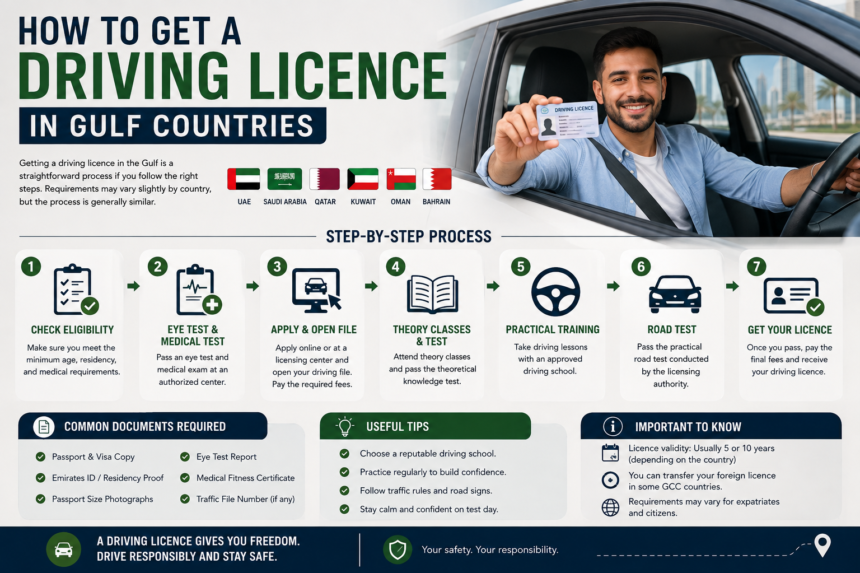
How to Get a Driving Licence in Gulf Countries as an Expat
Getting a driving licence can be one of the most important tasks after moving to the Gulf. A car can make everyday life considerably easier, particularly for residents who commute to work, have children, live outside major public transport networks or regularly travel between different parts of a city.
- Driving Licence in Gulf Countries: Quick Comparison
- 1. First Confirm That You Are Eligible
- 2. Check Whether Your Existing Licence Can Be Exchanged
- 3. Prepare Your Documents
- 4. Complete the Eye Test
- 5. Open a Traffic File or Learner Record
- 6. Register With an Approved Driving School
- 7. Learn the Local Traffic Rules
- 8. Pass the Theory Test
- 9. Complete Practical Driving Lessons
- 10. Pass Parking and Internal Assessments
- 11. Take the Final Road Test
- 12. Pay the Licence Issuance Fee
- 13. Getting a Driving Licence in the UAE
- 14. Getting a Driving Licence in Saudi Arabia
- 15. Getting a Driving Licence in Qatar
- Getting a Driving Licence in Oman
- Getting a Driving Licence in Bahrain
- Getting a Driving Licence in Kuwait
- Can You Convert an Indian Driving Licence in the Gulf?
- How Long Does Getting a Gulf Driving Licence Take?
- How Much Does a Driving Licence Cost in Gulf Countries?
- 7 Ways to Improve Your Chances of Passing
- Foreign Licence Exchange vs Full Driving Test
- Common Mistakes New Expats Make
- Your Gulf Driving Licence Action Plan
- Final Thoughts on Getting a Driving Licence in Gulf Countries
However, there is no single GCC driving licence. The UAE, Saudi Arabia, Qatar, Kuwait, Bahrain and Oman operate their own licensing systems, and the process can vary according to your nationality, residency status, age and existing driving licence. Some foreign licence holders may qualify for direct exchange or simplified procedures, while others need lessons and theoretical and practical tests.
This difference is particularly important for expatriates. Advice from a friend may not apply to you simply because you live in the same city. Two residents with licences from different countries can sometimes face different procedures.
This guide explains how to get a Driving Licence in Gulf Countries, what documents you may need, how foreign licence conversion works and what to expect from the testing process across all six GCC countries.
Driving Licence in Gulf Countries: Quick Comparison
Before looking at each country individually, this table explains the general structure residents are likely to encounter.
| Country | New Residents Can Apply? | Foreign Licence Exchange Possible? | Testing May Be Required? |
|---|---|---|---|
| UAE | Yes | Yes, for eligible licences | Yes |
| Saudi Arabia | Yes | Recognition/exemptions can apply | Yes |
| Qatar | Yes | Depends on licence/status | Yes |
| Oman | Yes | Yes, for eligible licences | Yes |
| Bahrain | Yes | Yes, recognised countries | Yes |
| Kuwait | Yes, subject to eligibility | GCC licence exchange available | Yes |
The exact requirements are not identical, and eligibility rules can change. Always check the relevant traffic authority before beginning your application.
1. First Confirm That You Are Eligible
Before registering with a driving school or paying application fees, confirm whether you are eligible to obtain a licence in your country of residence.
Age is one of the first requirements. In the UAE, for example, the minimum age for a car and light-vehicle driving licence is 18. Oman also allows residents aged 18 and above to obtain a learner’s permit for light vehicles.
Residency is another major factor. Visitors and residents are treated differently in many GCC licensing systems. A tourist may be permitted to drive temporarily using an accepted foreign or international licence, while a person who becomes a resident may need to obtain the country’s local driving licence.
Your occupation, residency category or existing licence can also affect the process in some countries.
Check These Before Applying
- Your residency status
- Minimum age requirement
- Valid national identification or residence card
- Whether your profession affects eligibility
- Whether your foreign licence is recognised
- Whether direct exchange is available
- Whether an eye or medical test is required
Checking these conditions first can prevent you from paying for unnecessary lessons or starting the wrong application process.
2. Check Whether Your Existing Licence Can Be Exchanged
If you already hold a valid driving licence from another country, do not immediately register for a complete driving course.
First check whether your licence qualifies for exchange.
Several GCC countries allow certain foreign licences to be converted or replaced without requiring the applicant to complete the entire learning process again. Eligibility usually depends on the country that issued your licence and whether that licence remains valid.
Oman, for example, has an official procedure for exchanging eligible foreign licences. Applicants need a valid licence issued by an eligible country and must meet other conditions.
Bahrain similarly provides licence replacement for recognised countries.
The UAE also allows some expatriate residents to exchange valid licences issued by eligible countries.
Your First Decision
Already have a foreign licence?
→ Check exchange eligibility first.
Licence qualifies?
→ Follow the conversion procedure.
Licence does not qualify?
→ Begin the normal learning and testing process.
This single check can potentially save substantial time.
3. Prepare Your Documents
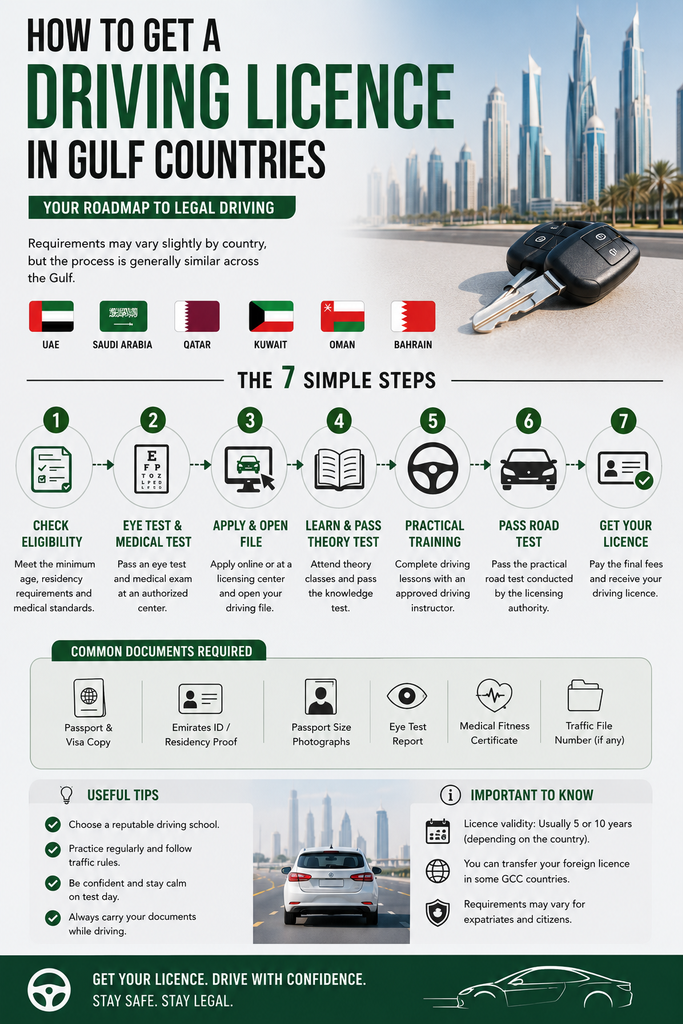
Documentation varies between GCC countries, but several items appear regularly across licensing procedures.
Residents should organise their identification and existing driving documents before starting the process. The name and personal information on your documents should be consistent to avoid administrative delays.
A typical application may involve:
| Document | Why It May Be Needed |
|---|---|
| Passport | Identity verification |
| Residence ID | Proof of legal residency |
| Existing driving licence | Exchange or driving-history assessment |
| Passport-size photographs | Licence/application records |
| Eye-test result | Fitness to drive |
| Learner permit | Required during learning process |
| Application form | Formal licence request |
| Medical information | Required in some procedures |
| Employer/sponsor documents | May apply in certain cases |
Not every country requires every document in this table. Use it as a preparation checklist rather than a universal GCC document list.
4. Complete the Eye Test
Vision testing is one of the most common requirements in Gulf driving-licence procedures.
The purpose is straightforward: authorities need to confirm that applicants have sufficient eyesight to drive safely.
In the UAE, an eye-test report is among the documents required when opening a traffic file for learning to drive. Oman also requires a valid eye-test result for issuing a new driving licence, while Bahrain requires applicants converting recognised foreign licences to pass a vision test.
If you normally wear glasses or contact lenses, use them during the test and provide accurate information.
Do not treat the eye test as a minor administrative formality. Safe driving depends heavily on being able to identify vehicles, pedestrians, signals, signs and hazards at appropriate distances.
5. Open a Traffic File or Learner Record
Applicants who need to learn from the beginning usually need an official learner record, traffic file or equivalent authorisation before lessons begin.
The UAE’s official guidance states that learners need to open a traffic file with the relevant local traffic authority. Documents can include passport and Emirates ID copies, photographs and an eye-test report.
Oman has a specific driving learner’s permit service for Omanis and residents who meet the applicable age requirement.
Other GCC systems follow their own administrative procedures.
Think of this stage as officially entering the licensing system. Once the appropriate learner status has been created, you can proceed with training and testing according to local rules.
6. Register With an Approved Driving School
If your foreign licence cannot be exchanged and you need training, the next stage is generally enrolling with an approved or authorised driving school.
Do not choose a driving school only because it advertises the cheapest package. Training quality, lesson availability, test scheduling and location can make a significant difference to the overall experience.
Before enrolling, ask about:
- Total course price
- Number of lessons included
- Theory training
- Practical training
- Internal assessments
- Test booking procedure
- Retest charges
- Weekend/evening availability
- Female instructor availability if required
- Additional lesson charges
Some applicants require more training than others, particularly if they have never driven before.
Learning properly is more important than completing the minimum possible number of lessons.
7. Learn the Local Traffic Rules
Even experienced drivers should study local traffic rules before taking the theory test.
Gulf road systems share many internationally familiar signs and safety principles, but local regulations, road markings, penalties and driving environments still differ.
Theory training generally prepares applicants for areas such as traffic signs, lane discipline, road markings, speed limits, safe following distances, pedestrian safety, emergency situations and defensive driving.
Theory Topics Worth Mastering
Road signs: Know warning, regulatory and information signs.
Lane discipline: Understand when and how to change lanes safely.
Roundabouts: Learn the applicable lane and priority rules.
Safe distance: Know why following distance changes with speed and weather.
Pedestrians: Understand crossings and right-of-way responsibilities.
Weather: Learn how fog, rain and dust affect safe driving.
Do not memorise questions only to pass the exam. These rules become much more important once you begin driving independently.
8. Pass the Theory Test
Applicants following the full licensing route normally need to demonstrate knowledge of traffic laws before progressing through the practical stages.
The format differs by country and authority, but computer-based testing is common in modern licensing systems.
Questions may assess traffic signs, safe driving, road behaviour and hazard awareness.
If you fail, do not treat it as a disaster. Review the topics you found difficult before attempting the test again.
A strong understanding of theory also makes practical lessons easier because your instructor does not need to repeatedly explain basic road rules while teaching vehicle control.
9. Complete Practical Driving Lessons
Practical lessons are where theoretical knowledge becomes actual driving ability.
A beginner normally starts with fundamental vehicle control before progressing to real road situations. Depending on the system, training may include parking, lane changes, junctions, roundabouts, braking, highway driving and emergency awareness.
Experienced foreign drivers who are required to take lessons should avoid becoming overconfident. Driving habits developed elsewhere may not match what local examiners expect.
Skills You Should Be Comfortable With
- Starting and stopping smoothly
- Mirror checks
- Correct indicator use
- Lane changes
- Maintaining safe distance
- Parking
- Junctions
- Roundabouts
- Speed control
- Pedestrian awareness
- Emergency braking
- Following road signs
Your objective should not be to perform these actions only during the test. They need to become normal habits.
10. Pass Parking and Internal Assessments
Parking is one of the areas that creates the most anxiety for new drivers.
Depending on the country and training system, applicants may need to demonstrate different manoeuvres before progressing to the final road test.
The exact assessment format varies, but learners should become comfortable controlling the vehicle slowly and accurately rather than relying entirely on cameras and sensors.
Parking Practice Checklist
☐ Mirror positioning
☐ Steering control
☐ Reverse movement
☐ Parking within marked boundaries
☐ Observation before moving
☐ Safe use of indicators
☐ Controlled braking
☐ Awareness of surrounding vehicles
Modern technology is helpful, but good drivers should understand vehicle positioning even without advanced parking assistance.
11. Take the Final Road Test
The road test is the stage most applicants worry about, but its purpose is to confirm that you can drive safely without constant instructor assistance.
Examiners typically observe your overall behaviour rather than looking for one impressive manoeuvre.
They want to see that you can control the vehicle, observe traffic, follow signs, maintain appropriate speed, use mirrors and indicators and make safe decisions.
Common Mistakes to Avoid
- Forgetting mirror checks
- Changing lanes without proper observation
- Driving unnecessarily slowly
- Exceeding the speed limit
- Poor lane positioning
- Incorrect indicator use
- Following another vehicle too closely
- Hesitating excessively at safe opportunities
- Ignoring pedestrians
- Becoming distracted after one small mistake
If you make a minor mistake, continue concentrating. Do not assume the test is already lost and allow one error to create several more.
12. Pay the Licence Issuance Fee
Once all required tests and conditions are completed, the final administrative stage generally involves paying the applicable licence issuance fee.
Fees vary significantly according to the country, licence type, applicant and sometimes validity period.
Avoid comparing licence costs based only on the final card issuance fee. Someone completing the full process may also pay for the eye test, learner permit, driving school, lessons, tests and retests.
Think in Terms of Total Cost
Total Licence Cost = Application + Eye Test + Learner Permit + Lessons + Tests + Retests + Final Licence Fee
Someone eligible for direct licence exchange may therefore spend considerably less than a first-time learner.
13. Getting a Driving Licence in the UAE
The UAE provides clear pathways for both new drivers and eligible foreign licence holders.
Citizens and expatriate residents who need a new licence generally take lessons through registered driving institutes and pass the required tests. For cars and light vehicles, the minimum age is 18.
Applicants learning from the beginning need to open a traffic file with the relevant authority. Typical documents include passport and Emirates ID copies, photographs and an eye-test report.
Some expatriate residents can exchange an existing valid foreign driving licence if their licence meets the applicable recognition requirements.
UAE Process at a Glance
Check eligibility → Eye test → Check foreign licence exchange → Open traffic file if required → Driving school → Theory → Practical training → Tests → Licence
The responsible authority depends on the emirate. Dubai residents, for example, use the Roads and Transport Authority system, while other emirates have their relevant licensing channels.
14. Getting a Driving Licence in Saudi Arabia
Saudi Arabia allows citizens and residents to complete the procedures required to obtain a legal driving licence.
Official guidance for expatriates describes a process that can include registering for driving lessons, completing the required theoretical and practical training and passing the relevant tests under the supervision of the General Traffic Department.
Foreign or international licence holders recognised by the competent authority may qualify for exemptions from testing according to the applicable rules.
Applicants can also use the Absher ecosystem for relevant government and traffic services.
Saudi Licence Path
Resident → Existing licence checked → Driving school if required → Theory/practical requirements → Tests or applicable exemption → Licence issuance
Residents should verify their individual requirements before paying for a complete training package because recognition of an existing licence can change the process.
15. Getting a Driving Licence in Qatar
Residents holding a Qatar Residence Permit can apply for a Qatar driving licence.
The process can differ depending on the foreign licence held by the applicant. Some residents may qualify for a different pathway based on their existing licence, while others may need training and testing.
Qatar’s official government information distinguishes between temporary, international and full driving licences. A resident should therefore avoid assuming that a licence used while visiting Qatar remains the correct document after residency begins.
For non-Qataris, the full driving licence is generally issued with a five-year validity under the official guidance.
Important Qatar Rule
Visitor driving arrangements and resident driving arrangements are not the same thing.
Once you become a resident, check the requirements for obtaining the appropriate Qatar licence.
Getting a Driving Licence in Oman
Oman provides separate official procedures for learner permits, new driving licences and exchange of eligible foreign licences.
Residents aged 18 and above can obtain a learner’s permit for light vehicles if they meet the applicable requirements.
Applicants pursuing a new licence must complete the required tests. Current official guidance states that issuing a new driving licence requires passing the final driving test and having a valid eye-test result.
Foreign residents with eligible overseas licences may instead apply for an exchange. Oman requires the foreign licence to be valid and issued by an eligible country, together with other required documents.
Oman Route Finder
| Your Situation | Likely Route |
|---|---|
| Never driven before | Learner permit → training → tests |
| Foreign licence not eligible | Normal licensing route |
| Eligible valid foreign licence | Exchange route |
| Visitor | Separate temporary visitor rules apply |
| Resident | Local resident licensing rules apply |
Checking exchange eligibility before starting lessons can save considerable time.
Getting a Driving Licence in Bahrain
Bahrain provides an official licence-replacement service for licences issued by recognised countries.
Applicants using the recognised-country replacement route need a valid original foreign licence and ID and must satisfy conditions including the vision test. Bahrain’s government currently lists the service cost at BHD 25, including the eye-test and initial licence issuance components.
If your licence does not qualify for direct replacement, you may need to follow the applicable learning and testing process.
Bahrain also offers evaluation of foreign driving licences, which can help determine how an overseas licence is treated.
Bahrain Quick Tip
Do not assume your licence is either accepted or rejected based on nationality alone. Use the official evaluation/replacement system to establish the correct route.
Getting a Driving Licence in Kuwait
Kuwait’s licensing system deserves particularly careful attention because expatriate eligibility conditions can be more restrictive than in some other GCC markets.
The official Kuwait Government Online service states that private driving licences can be issued to Kuwaitis and non-Kuwaitis provided the applicable conditions are satisfied.
For the normal private-licence process, official guidance lists a learner’s driving licence, proof of passing theoretical and practical tests and blood-type documentation among the required items, along with the relevant administrative and medical procedures.
Kuwait also provides a direct replacement service for valid licences issued by GCC member states. Non-Kuwaiti residents using this route must hold valid residency and meet the required documentation conditions.
Kuwait Checklist for Expats
Before registering for lessons, verify:
- Your current residency status
- Current expatriate eligibility conditions
- Whether your existing licence qualifies for exchange
- Required learner permit
- Medical requirements
- Theory test requirements
- Practical test requirements
- Required documents
Do not rely on old expatriate forum posts because eligibility rules are particularly important in Kuwait.
Can You Convert an Indian Driving Licence in the Gulf?
This is a common question because the Gulf has a large Indian expatriate population.
The answer should not be treated as one GCC-wide yes or no. Foreign licence recognition is determined separately by each country and can depend on the current approved-country framework and applicant circumstances.
An Indian licence may still be useful as evidence of previous driving experience even when direct exchange is unavailable. However, applicants should never assume that holding an Indian licence automatically removes the need for local training or testing.
The correct approach is:
Choose your GCC country → Check its current recognised/exchangeable licence list → Confirm your eligibility → Begin the appropriate route.
The same principle applies to licences from Pakistan, Bangladesh, the Philippines, Nepal, Sri Lanka and other countries with large Gulf expatriate communities.
How Long Does Getting a Gulf Driving Licence Take?
There is no single answer.
Someone eligible for a straightforward foreign-licence exchange can complete the process much faster than a first-time learner.
A beginner’s timeline depends on driving-school availability, number of required lessons, test appointments and whether any test needs to be repeated.
| Applicant Type | Likely Process |
|---|---|
| Eligible licence exchange | Shortest |
| Experienced driver requiring test | Moderate |
| Beginner | Longer |
| Applicant requiring retests | Longer |
| Busy driving-school period | Potential delays |
Instead of focusing only on obtaining the licence as quickly as possible, concentrate on completing the process correctly. Once issued, you will be driving independently in a road environment that may be very different from your home country.
How Much Does a Driving Licence Cost in Gulf Countries?
Costs differ significantly, which makes a simple country-by-country price ranking misleading.
The final licence fee is only one component. First-time learners can also pay for eye testing, permits, training, theory tests, practical assessments and retests.
Your individual cost is influenced by:
- Country and city
- Driving school
- Number of lessons
- Existing driving experience
- Foreign licence recognition
- Number of test attempts
- Licence category
- Additional training
When comparing driving schools, ask for the complete expected cost, not simply the registration fee.
7 Ways to Improve Your Chances of Passing
Passing is not about memorising a route. Examiners need to see safe and predictable driving.
- Practise mirror checks until they become automatic.
- Learn road signs rather than memorising exam questions.
- Use indicators consistently.
- Maintain proper speed instead of driving excessively slowly.
- Practise parking until you understand vehicle positioning.
- Stay calm after small mistakes.
- Take additional lessons if you are not ready.
Paying for another lesson can feel frustrating, but it is usually cheaper and safer than repeatedly failing tests because you rushed into the examination.
Foreign Licence Exchange vs Full Driving Test
For expatriates, this is often the most important comparison.
| Foreign Licence Exchange | Full Licensing Process |
|---|---|
| Available only to eligible applicants | Available to applicants meeting normal conditions |
| Existing licence required | Previous licence may not be necessary |
| Faster in many cases | Usually takes longer |
| Fewer training requirements | Lessons normally required |
| Eye test may still apply | Eye test generally part of process |
| Recognition depends on country | Theory/practical testing required |
| Lower overall effort | More comprehensive process |
Always investigate the left-hand route before committing to the right-hand route.
Common Mistakes New Expats Make
Many applicants lose time because they begin the process before understanding which licensing route applies to them.
One common mistake is registering for a full driving course without checking foreign-licence exchange eligibility. Another is assuming that an international driving permit permanently replaces the need for a resident licence.
Applicants also sometimes underestimate theory preparation because they already know how to drive. Practical experience does not automatically mean you know local road rules or examination expectations.
Other problems arise from expired documents, incomplete residency records or selecting unofficial sources for important eligibility information.
Government traffic authorities should always be your primary reference.
Your Gulf Driving Licence Action Plan
If the entire process feels complicated, reduce it to seven decisions:
Step 1: Confirm residency and age eligibility.
Step 2: Check whether your existing foreign licence is recognised.
Step 3: Complete the required eye or medical assessment.
Step 4: Open a traffic file or obtain a learner permit if necessary.
Step 5: Complete theory and practical training.
Step 6: Pass the required examinations.
Step 7: Pay the applicable fees and obtain your licence.
Once you know whether you belong on the exchange route or the full-test route, the process becomes much easier to understand.
Final Thoughts on Getting a Driving Licence in Gulf Countries
Getting a Driving Licence in Gulf Countries can initially appear complicated because the GCC does not operate one unified licensing system. Every country maintains its own eligibility requirements, recognised foreign licences, tests, fees and administrative procedures.
For expatriates, the most important first step is checking whether an existing licence can be exchanged. Eligible drivers may be able to avoid much of the standard learning process, while other residents need to complete theory and practical training before taking the final road test.
First-time drivers should not see this longer route as an inconvenience. Gulf cities contain large highways, complicated junctions, busy urban roads and different driving environments. Proper training provides experience that becomes valuable long after the test is completed.
Keep your residency documents current, complete the required vision or medical checks, choose an approved training provider where lessons are required and use official government sources when checking eligibility.
Most importantly, remember that obtaining the licence is only the beginning. Passing the test gives you permission to drive, but becoming a safe Gulf driver comes from experience, patience, defensive driving and a continued understanding of local road rules.
follow us on Instagram
Read More – Car Leasing vs Buying in the GCC: 12 Essential Differences for Expats