



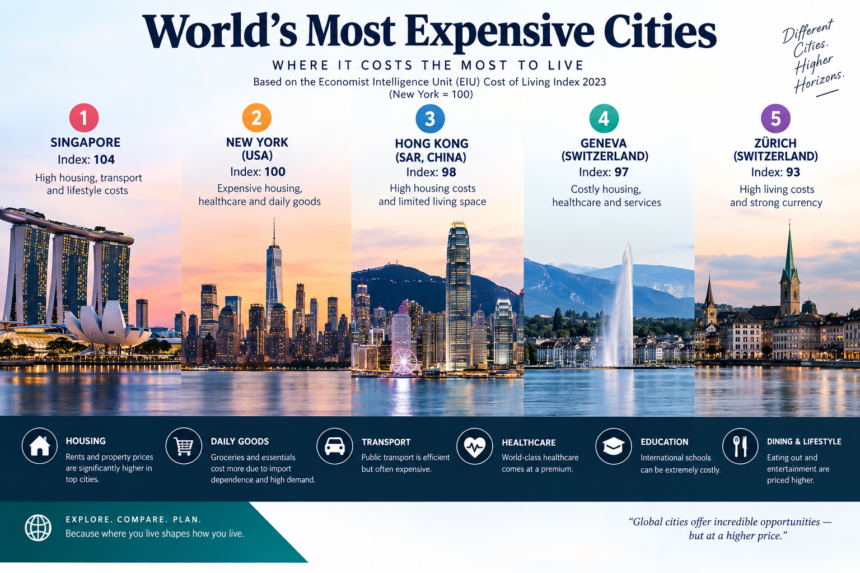
World’s Most Expensive Cities: 2026 Overview
World’s Most Expensive Cities in 2026 include some familiar global financial centres, but the rankings also reveal an important lesson: there is no single universal definition of an expensive city.
- World’s Most Expensive Cities: 2026 Overview
- Understanding Global Cost-of-Living Rankings
- 1. Zurich, Switzerland
- 2. Geneva, Switzerland
- 3. Basel, Switzerland
- 4. Lausanne, Switzerland
- 5. Lugano, Switzerland
- 6. Bern, Switzerland
- 7. Reykjavik, Iceland
- 8. Honolulu, United States
- 9. San Francisco, United States
- 10. Seattle, United States
- New York and the Impact of Housing Costs
- Singapore and Hong Kong for International Expats
- Housing as the Biggest Cost Pressure
- Food and Everyday Living Expenses
- Transportation Costs in Expensive Global Cities
- Healthcare, Education and Family Expenses
- Salaries and Local Purchasing Power
- Expats and Cost-of-Living Allowances
- Dubai and the Middle East Cost-of-Living Picture
- Currency Movements and Global Rankings
- Comparing Cost of Living With Quality of Life
- Budgeting Before Moving to an Expensive City
- Common Mistakes When Comparing City Costs
- Practical Cost-of-Living Comparison Checklist
- Final Thoughts on the World’s Most Expensive Cities
A city can be extremely costly for groceries and restaurants yet become more manageable when local salaries are considered. Another can appear lower in a general consumer-price index but become far more expensive once rent is included. International employees can also face costs that local residents do not experience in the same way, including international-school tuition and expatriate-standard accommodation.
For that reason, different global rankings produce different winners.
Numbeo’s 2026 city index, which compares consumer prices across cities, places Zurich at the top, followed by Geneva, Basel, Lausanne, Lugano and Bern. Switzerland therefore dominates the highest positions in its current cost-of-living measure.
When rent is added to the calculation, however, the picture changes significantly. Numbeo’s 2026 Cost of Living Plus Rent Index places New York first, Zurich second and Geneva third.
Mercer’s most recent publicly available global Cost of Living City Ranking, produced specifically for international employees, creates another picture again. Its 2024 ranking placed Hong Kong first, Singapore second and Zurich third, with rental accommodation playing an important role in the results.
Understanding those differences is essential before declaring any city universally the most expensive place on earth.
World’s Most Expensive Cities: 2026 Overview
For a current 2026 comparison, this article uses Numbeo’s general Cost of Living Index, which measures everyday consumer expenses separately from rent.
The ten highest locations in that 2026 dataset are:
| Rank | City | Country | 2026 Cost of Living Index |
|---|---|---|---|
| 1 | Zurich | Switzerland | 118.5 |
| 2 | Geneva | Switzerland | 116.5 |
| 3 | Basel | Switzerland | 112.4 |
| 4 | Lausanne | Switzerland | 111.5 |
| 5 | Lugano | Switzerland | 110.1 |
| 6 | Bern | Switzerland | 110.0 |
| 7 | Reykjavik | Iceland | 98.9 |
| 8 | Honolulu | United States | 98.2 |
| 9 | San Francisco | United States | 97.6 |
| 10 | Seattle | United States | 90.3 |
Numbeo’s figures are periodically published snapshots based on its cost-of-living database rather than an official government index. They are best used as comparative indicators rather than exact household budgets.
Most expensive cities in 2026
Numbeo Cost of Living Index, excluding rent. Higher values indicate greater consumer costs.03570105140ZurichGenevaBaselLausanneLuganoBernReykjavikHonoluluSan FranciscoSeattle
Understanding Global Cost-of-Living Rankings
Before comparing individual cities, it is important to understand what a ranking is actually measuring.
A general consumer cost index can include groceries, restaurants, transport, utilities and other everyday expenses. Housing may be shown separately.
An expatriate cost-of-living survey can use a different basket because its purpose is often to help companies calculate international employee compensation.
Mercer’s methodology, for example, compares more than 200 goods and services across 226 cities and is specifically designed for international assignees. Housing, transport, food, clothing, household goods and entertainment all contribute to the comparison.
Its 2024 survey used New York as a benchmark and compared currency movements against the US dollar.
That is why one ranking may say Hong Kong is most expensive while another puts Zurich or New York first.
They are answering slightly different questions.
1. Zurich, Switzerland
Zurich sits at the top of Numbeo’s 2026 consumer cost index with a score of 118.5. It also ranks second when rent is added to consumer costs, demonstrating that its high ranking is not produced by one expense alone.
Switzerland’s largest city combines a major financial-services sector with high wages, a strong currency and expensive local services.
Eating out, groceries and personal services can all feel expensive to someone arriving from a lower-cost country.
Zurich’s 2026 Numbeo data gives it a restaurant price index of 121.0 and grocery index of 115.4, illustrating how normal household spending can quickly become significant.
The other side of the story is purchasing power. Zurich’s local purchasing power index is also extremely high, meaning local salaries can partly compensate residents for higher prices.
This distinction matters for expats. A Zurich salary package should not be compared directly with a salary in another country without considering tax, housing and purchasing power.
2. Geneva, Switzerland
Geneva follows closely behind Zurich with a 2026 cost-of-living index of 116.5.
Its economy is shaped by banking, commodity trading, international organisations and multinational employers.
Housing availability can be a particularly important concern for people relocating to Geneva.
Although Numbeo’s general index excludes rent, Geneva moves to third globally in its 2026 cost-of-living-plus-rent comparison.
Food and dining are also expensive. Numbeo’s 2026 restaurant price index for Geneva is 121.8, slightly above Zurich.
Professionals considering an international assignment in Geneva should therefore examine accommodation allowances carefully.
3. Basel, Switzerland
Basel ranks third on Numbeo’s 2026 general city index at 112.4.
The city is internationally important for pharmaceuticals, chemicals and life sciences, attracting highly skilled professionals from around the world.
Its housing costs are lower than Zurich’s or Geneva’s according to Numbeo’s rent index, but everyday consumer prices remain extremely high.
Interestingly, Basel records particularly strong local purchasing power in the 2026 data.
This demonstrates why expats should never look only at prices.
A city can appear extremely expensive in absolute terms while still offering attractive financial conditions to residents earning salaries aligned with the local economy.
4. Lausanne, Switzerland
Lausanne adds another Swiss city to the top of the ranking.
Its 2026 Cost of Living Index stands at 111.5, while its cost-of-living-plus-rent score places it among the world’s highest-cost locations.
Lausanne is smaller than Zurich or Geneva, but expensive Swiss labour, services and everyday goods still influence household costs.
Its position also demonstrates that expensive living in Switzerland is not limited only to the country’s two largest international business centres.
Students and academic professionals should pay particular attention to accommodation because university cities can create additional rental demand in popular areas.
5. Lugano, Switzerland
Lugano ranks fifth in the 2026 Numbeo comparison with an index of 110.1.
Located in Switzerland’s Italian-speaking canton of Ticino, Lugano is associated with financial services, tourism and an attractive lakeside lifestyle.
Restaurants are particularly expensive according to Numbeo’s data, with the city’s restaurant index standing at 125.3.
The city provides another example of why lifestyle expectations need to be considered.
Someone who regularly eats in restaurants, travels and rents centrally may experience a very different personal cost of living from someone with a more local, home-based routine.
6. Bern, Switzerland
Switzerland’s capital completes the country’s extraordinary dominance of the first six positions.
Bern’s 2026 consumer cost index stands at 110.0.
Mercer’s international employee ranking also illustrates Switzerland’s unusual position. In its 2024 top ten, Zurich ranked third, Geneva fourth, Basel fifth and Bern sixth.
This suggests that high Swiss costs are structural rather than limited to one unusually expensive city.
High wages, currency strength, housing constraints and expensive locally delivered services all contribute to the pattern.
For expatriates, compensation should therefore be considered alongside quality of life rather than assessing Switzerland solely through supermarket or restaurant prices.
7. Reykjavik, Iceland
Reykjavik is the first non-Swiss city in Numbeo’s top ten for 2026, with a cost-of-living index of 98.9.
Iceland’s geographic isolation can contribute to higher prices for imported consumer goods.
A relatively small domestic market can also mean less scale in areas such as retail distribution.
For residents, food, dining and everyday purchases can therefore feel expensive compared with many continental European cities.
Housing can add another burden, particularly in areas experiencing strong tourism demand.
International workers considering Iceland should compare the full cost of accommodation and everyday spending rather than focusing only on headline salaries.
8. Honolulu, United States
Honolulu ranks eighth on Numbeo’s 2026 general index and seventh when rent is included.
Hawaii’s geographic location creates unusually high logistics costs because many consumer goods need to travel long distances before reaching the islands.
Housing adds another major expense.
Limited land, strong demand and desirable locations can push accommodation costs far beyond those found in many mainland US cities.
For a professional relocating from the continental United States, Honolulu can therefore produce an unexpected combination of high food, housing and transportation costs.
9. San Francisco, United States
San Francisco has long been associated with high living costs, largely because of housing.
Numbeo’s 2026 data places it ninth on the general consumer index but fourth globally when rent is included.
That difference illustrates why rent needs to be considered separately.
Technology salaries can be very high in the Bay Area, but so can accommodation, childcare, restaurants and other services.
For households with children, the real cost of living can increase substantially once housing, healthcare, childcare and transport are combined.
San Francisco is therefore a useful example of a city where salary numbers that appear extremely generous from overseas may not provide the lifestyle outsiders expect.
10. Seattle, United States
Seattle completes the top ten in Numbeo’s 2026 consumer cost ranking, marginally ahead of Oslo.
The city is a major technology and corporate centre with relatively high professional salaries.
Housing has become a major consideration over years of strong population and employment growth.
Like San Francisco, Seattle demonstrates that expensive cities frequently emerge around concentrations of high-paying industries.
Professional salaries increase the amount some households can spend, which can raise demand for housing and services.
For incoming workers, comparing salary against housing near the workplace is especially important.
New York and the Impact of Housing Costs
One city is conspicuously absent from the top ten general consumer-price ranking: New York.
That does not mean New York suddenly became affordable.
When rent is included, Numbeo’s 2026 ranking places New York first globally, with a Cost of Living Plus Rent Index of 100. Zurich follows at 97.1 and Geneva at 93.6.
Another 2026 estimate from CostLiving puts the monthly budget for a single New York renter at approximately US$5,775, including around US$4,100 for rent in its model. Its methodology differs from Numbeo’s and should therefore be treated as a separate estimate rather than a directly comparable figure.
The lesson is important: ignoring rent can completely change how a city looks.
For someone relocating internationally, housing is often the single most important number in the budget.
Singapore and Hong Kong for International Expats
Singapore and Hong Kong deserve separate attention because they dominate the most widely cited expat-focused ranking.
Mercer’s 2024 Cost of Living City Ranking placed:
- Hong Kong
- Singapore
- Zurich
- Geneva
- Basel
- Bern
- New York
- London
- Nassau
- Los Angeles
Mercer said expensive rental accommodation was an important factor behind Hong Kong and Singapore’s positions.
Numbeo’s 2026 general index produces a different result because it separates consumer costs from rent. Singapore has a cost-of-living index of 87.7 but a much higher rent index of 73.1. Hong Kong’s figures are 75.2 for general living costs and 63.1 for rent.
This difference illustrates why international employees should use a ranking designed for their circumstances rather than relying on one viral top-ten list.
Housing as the Biggest Cost Pressure

Housing can reshape an entire city ranking.
Rent depends on:
- Supply of housing
- Population growth
- Land availability
- Building regulations
- Employment concentration
- International demand
- Interest rates
For expats, the definition of acceptable accommodation can also raise costs.
A corporate employee relocating with children may want a home close to an international school and workplace. That can create a much higher housing budget than the citywide average.
Mercer specifically identified rising housing costs as a significant challenge for multinational employers and internationally mobile employees.
That is why salary negotiations for international assignments often include housing allowances rather than simply increasing base pay.
Food and Everyday Living Expenses
Groceries can create large differences even between two cities with similar rent.
Imported food tends to cost more in markets with long supply chains, small domestic production or high labour costs.
Eating out can create an even larger difference.
Someone cooking at home may experience Zurich differently from a professional eating in restaurants four or five times per week.
Before relocating, build a realistic budget around your actual routine rather than a generic “average person.”
Families should include supermarket spending, school lunches and delivery costs in addition to restaurants.
Transportation Costs in Expensive Global Cities
Transport depends heavily on whether a city allows residents to live comfortably without a car.
Cities with extensive rail and bus networks can reduce private transport costs, even when individual fares are relatively expensive.
Elsewhere, residents may need to consider:
- Car purchase or lease
- Insurance
- Fuel
- Parking
- Tolls
- Maintenance
Location also affects the calculation.
Paying more for a home near the workplace can sometimes reduce transportation expenses enough to justify part of the additional rent.
Cost-of-living comparisons should therefore consider housing and commuting together.
Healthcare, Education and Family Expenses
The world’s expensive cities can become dramatically more costly once children enter the equation.
International families may need to budget for:
- Childcare
- International schools
- Health insurance
- Medical co-payments
- Extracurricular activities
- Larger housing
These expenses are not always reflected fully in general consumer price rankings.
A company relocating an employee with two school-age children may therefore need a much larger package than the same company relocating a single professional.
Education allowances and health insurance can be just as valuable as higher cash salaries.
Salaries and Local Purchasing Power
High prices do not automatically mean poor living standards.
Zurich illustrates this clearly.
Its 2026 Numbeo data shows a cost-of-living index of 118.5 but local purchasing power of 164.4. Basel’s purchasing power is even higher in the same dataset.
This means residents earning local wages may have considerably greater purchasing ability than the raw price figures suggest.
Someone earning a salary from a lower-cost economy without adjustment would experience these cities very differently.
Always compare:
Net income − housing − essential expenses = realistic disposable income
That provides a far more useful comparison than salary alone.
Expats and Cost-of-Living Allowances
International companies frequently use cost-of-living information when designing assignment packages.
Possible benefits include:
- Housing allowance
- School fees
- Health insurance
- Relocation expenses
- Transport allowance
- Home-leave flights
- Cost-of-living adjustment
Mercer’s ranking is specifically designed to support this type of global mobility compensation decision.
An employee offered an overseas assignment should therefore compare the whole package rather than simply converting base salary into another currency.
Dubai and the Middle East Cost-of-Living Picture
Dubai deserves particular attention for Gulf-based readers.
Mercer’s 2024 ranking placed Dubai 15th globally, making it the highest-cost city in the Middle East for international employees in that survey. Abu Dhabi ranked 43rd, Riyadh 90th and Jeddah 97th.
Dubai had moved up three positions from the previous year.
Housing is a major reason the city can become expensive for international professionals, particularly in premium waterfront and central communities.
However, Dubai’s final cost varies significantly according to housing choice.
A professional living in a premium Downtown or Palm Jumeirah property can face a dramatically different budget from someone living in a mid-market community farther from the centre.
Currency Movements and Global Rankings
A city’s position can change even if local prices remain relatively stable.
Why?
Because many international rankings convert prices into a common currency.
If the Swiss franc strengthens against the US dollar, Swiss cities may appear more expensive internationally.
If another country’s currency weakens, its cities may fall sharply in rankings even when residents still experience significant domestic inflation.
Mercer specifically notes that inflation and exchange-rate fluctuations affect international employee purchasing power and cost comparisons.
Rank changes should therefore never be interpreted as proof that daily life suddenly became easier or harder for every resident.
Comparing Cost of Living With Quality of Life
An expensive city can still provide excellent value for a particular person.
Higher living costs may accompany:
- High salaries
- Strong infrastructure
- Public transport
- Safety
- Healthcare
- Education
- Career opportunities
- Clean public spaces
The decision to relocate should therefore combine cost with expected quality of life.
A cheaper city requiring private healthcare, a car and expensive international schooling may not ultimately save as much as the headline ranking suggests.
Likewise, a high-cost European city with excellent public services may eliminate certain private expenses.
Budgeting Before Moving to an Expensive City
Before accepting an international job, calculate a realistic monthly budget.
Include:
| Expense | Details to calculate |
|---|---|
| Housing | Rent, deposit and utilities |
| Food | Groceries and restaurants |
| Transport | Public transport or car |
| Healthcare | Insurance and out-of-pocket costs |
| Education | School or childcare |
| Taxes | Income and local taxes where applicable |
| Insurance | Home, car and other cover |
| Communications | Mobile and internet |
| Travel | Flights home |
| Savings | Emergency and retirement |
| Lifestyle | Entertainment and hobbies |
Then compare the result with net salary, not gross salary.
That final figure tells you much more about affordability than a global ranking.
Common Mistakes When Comparing City Costs
Using only one ranking
Different indexes measure different things.
Ignoring rent
New York demonstrates how dramatically housing can change a ranking.
Comparing gross salaries
Taxes and compulsory deductions matter.
Ignoring family costs
Childcare and school fees can transform a budget.
Assuming higher prices mean lower purchasing power
High local salaries can offset some costs.
Using old rankings as current facts
Currency movements and housing markets can change quickly.
Treating the entire city as one price
Neighbourhood differences can be enormous.
Practical Cost-of-Living Comparison Checklist
Before relocating, compare:
- Net salary
- Rent
- Utilities
- Food
- Transport
- Healthcare
- School or childcare costs
- Taxes
- Currency risk
- Employer allowances
- Savings potential
- Annual flights
- Quality of life
- Career progression
Also check whether the ranking you are using includes housing.
That single methodological detail can completely change the result.
Final Thoughts on the World’s Most Expensive Cities
The World’s Most Expensive Cities in 2026 cannot be reduced to one definitive ranking because “expensive” depends on what is being measured.
Numbeo’s 2026 consumer-cost index places Zurich first, followed by Geneva, Basel, Lausanne, Lugano and Bern, giving Switzerland all six top positions. Reykjavik, Honolulu, San Francisco and Seattle complete its top ten.
Add rent, however, and New York moves to number one, followed by Zurich and Geneva.
Look instead at Mercer’s latest publicly available survey for international employees and Hong Kong ranks first, Singapore second and Zurich third, because the methodology reflects the cost profile of internationally mobile workers and includes rental accommodation.
Those different results are not contradictions.
They show why cost-of-living rankings need context.
For travellers, restaurant and hotel prices may matter most. For an expat, housing and international schools can dominate. For a local employee, salary and purchasing power may matter more than the global price of groceries.
The smartest way to evaluate an expensive city is therefore not to ask only where it ranks.
Look at housing, net salary, everyday spending, family costs, taxes, employer benefits and realistic savings potential together.
That is the difference between knowing that a city is expensive and understanding whether you can actually afford to live there.
Do follow us on Instagram
Read More – Saving Money While Living in Dubai, Doha or Riyadh: 15 Powerful Tips