


Redefining Contemporary Art Through Memory
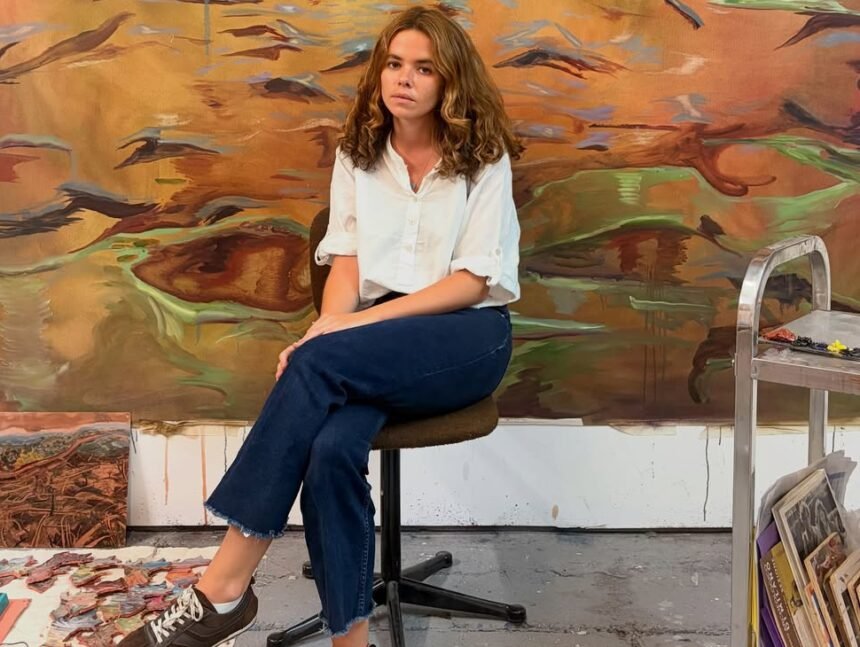
Alessandra Risi Castoldi is building a distinctive artistic identity by bringing together memory, identity, nature, history, and her experience of living between cultures. Born and raised in Lima, Peru, and now connected to the contemporary art scene in London, Risi has developed a painting practice that looks beyond visual beauty. Her work asks viewers to think about where they come from, what they inherit, and how landscapes can carry memories that remain long after people and places change.
- A Journey That Began With a Strong Connection to Painting
- Turning Personal Memory Into Visual Language
- Peru Remains Present Even From London
- Nature Becomes More Than a Beautiful Subject
- Experimenting With Materials and Forms
- From Milan to London and the International Art World
- A New Chapter With Reassemblage
- Building an Artistic Identity That Feels Personal
- Looking Ahead With Curiosity and Purpose
Her journey reflects the experience of a young artist who has moved across countries, educational environments, and artistic traditions while remaining closely connected to her Peruvian background. Through painting, she transforms personal memories and collected images into works that feel both intimate and expansive. Her growing international presence shows how a strong connection to one’s roots can become a powerful foundation for creative exploration.
A Journey That Began With a Strong Connection to Painting
Risi’s relationship with art began in Peru, where she studied at Corriente Alterna between 2016 and 2018. Her early education helped establish the foundation for a practice that would later develop through international study and exposure to different artistic environments.
She continued her education at Nuova Accademia di Belle Arti in Milan, completing her studies between 2019 and 2021. Moving from Lima to Milan gave her the opportunity to encounter new cultural references while continuing to explore the personal experiences that shaped her artistic perspective.
Her journey eventually led her to London and the Royal College of Art, where she studied painting during 2024 and 2025. The experience placed her within one of the world’s most recognised environments for contemporary creative education and further encouraged her to question the relationship between personal history, geography, nature, and representation.
Turning Personal Memory Into Visual Language
At the heart of Risi’s practice is the idea that painting can become a form of communication. Rather than simply reproducing what she sees, she uses painting to investigate what images, objects, landscapes, and memories can mean.
Her research has included personal and family archives, collections of stamps, botanical books, and material connected with scientific research. These references become starting points rather than fixed subjects. She takes familiar material and moves it into a different context, allowing new interpretations to emerge.
This approach gives her work a strong sense of discovery. A botanical image may become part of a larger conversation about history. A fragment of a landscape can suggest questions about belonging. An everyday object can carry memories that extend far beyond its original purpose.
The result is a practice that encourages viewers to look closely while also thinking more deeply about what they are seeing.
Peru Remains Present Even From London
Living in London has not weakened Risi’s relationship with Peru. Instead, distance appears to have made that connection even more important.
Her Peruvian background continues to influence the landscapes, colours, forms, and ideas that appear throughout her work. There is a sense of looking back while simultaneously trying to understand the present. London becomes part of that conversation, creating a meeting point between the place she comes from and the environment in which she now develops her practice.
This feeling of being connected to more than one place is one of the most interesting parts of her journey. Her work does not treat identity as something fixed. Instead, it suggests that identity can evolve through movement, memory, distance, and new experiences.
For Risi, painting becomes a space where these different parts of her life can exist together.
Nature Becomes More Than a Beautiful Subject
Nature is another important element in Risi’s work, but her approach goes beyond traditional representations of landscapes and plants.
Her paintings often explore vegetation, fragmented landscapes, fire, and natural transformation. These elements can become symbols of memory, destruction, renewal, and uncertainty. Her work connects the beauty of the natural world with more complicated questions about history and human intervention.
Her recent work has particularly explored the relationship between fire and regeneration in the context of Peru. Works connected with the Amazonian landscape reflect the tension between environmental vulnerability and the possibility of renewal.
This gives her paintings an emotional quality. They can appear vibrant and energetic at first, but beneath the colour are deeper questions about loss, belonging, change, and the future of the land.
Experimenting With Materials and Forms
One of the defining features of Risi’s development as an artist is her willingness to experiment.
Although oil painting remains central to her practice, she has explored different surfaces and formats, including canvas, copper, matchboxes, and transparent acrylic lightboxes. These choices are not simply technical experiments. The material often becomes part of the meaning behind the work.
Her use of unconventional surfaces allows familiar subjects to appear in unexpected ways. A small object can become a landscape. A transparent surface can suggest water. A fragmented format can communicate ideas about incomplete memories or disrupted histories.
This willingness to move beyond conventional formats shows an artist who is still actively questioning what painting can be and how it can communicate ideas.
From Milan to London and the International Art World
Risi’s artistic journey has also been shaped by international exposure. Her work has appeared in exhibitions and artistic settings across different countries, including Peru, Italy, South Korea, Canada, and the United Kingdom.
Her exhibition history includes appearances connected with Revolver Galeria in Lima, Mucciaccia Gallery in London, MO.CA in Brescia, and other international platforms. Her work has also been presented in connection with Art Basel Miami and other contemporary art environments.
These opportunities demonstrate how her practice has gradually moved beyond a local context. Yet international recognition has not separated her from her original artistic concerns. Instead, it has provided new audiences for the questions that have remained central to her work.
A New Chapter With Reassemblage
One of the more recent developments in Risi’s journey came through Reassemblage, a group exhibition presented in London in February 2026. The exhibition brought together Risi with Roudhah Al Mazrouei and Natalya Marconini Falconer, exploring how landscapes and materials can preserve cultural, personal, and historical memories.
The exhibition offered a natural setting for Risi’s practice because her own work frequently considers how objects and landscapes carry traces of the past.
Her participation reflects an artist moving into an increasingly visible stage of her career, where her ideas are not only being developed in the studio but also placed within wider conversations about memory, migration, nature, and history.
Building an Artistic Identity That Feels Personal
What makes Alessandra Risi Castoldi’s journey particularly engaging is the personal foundation behind her work.
She is not simply creating paintings to produce attractive images. She is using the medium to investigate questions that are connected to her own background and to the wider world around her. Her Peruvian identity, European education, London experience, and interest in nature all become parts of a larger visual language.
Her work demonstrates that an artist does not need to choose between personal history and contemporary practice. Instead, both can strengthen each other.
That balance may become one of the most important aspects of her future development.
Looking Ahead With Curiosity and Purpose
As Risi continues developing her practice, her journey reflects the possibilities that emerge when an artist remains curious about both the past and the present.
From Lima to Milan and eventually London, each stage has added another layer to her understanding of art and identity. Her paintings continue to evolve as she experiments with materials, landscapes, colour, memory, and historical references.
For audiences discovering her work, the appeal lies not only in the visual intensity of her paintings but also in the stories and questions behind them.
Alessandra Risi Castoldi represents a generation of contemporary artists who are using personal history as a starting point for wider conversations. Her journey shows that distance from home can sometimes deepen a person’s understanding of where they come from.
Through painting, she continues to turn that understanding into something viewers can see, question, and feel.
Follow Alessandra Risi Castoldi on Instagram
Read More – Best Places to Visit in Ajman For Perfect Getaway of an Unforgettable Experience