



What Employees Should Check Before Resigning
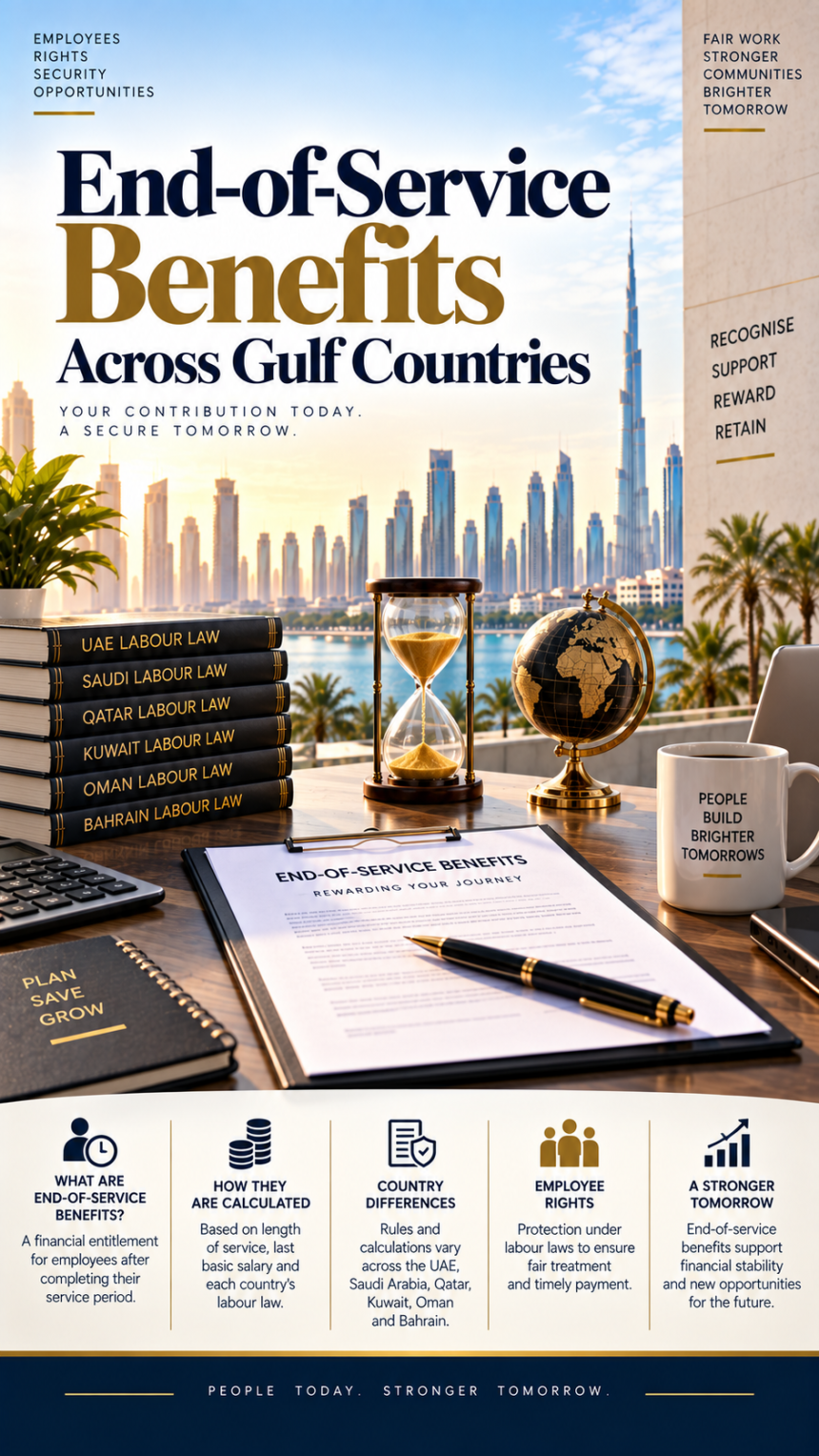
GCC End-of-Service Benefits can represent one of the largest payments an employee receives when leaving a job in the UAE, Saudi Arabia, Qatar, Bahrain, Oman or Kuwait. After several years of service, the amount can become financially significant, particularly for expatriate employees who may not participate in the same retirement systems available to citizens.
- GCC End-of-Service Benefits and the Gulf Employment System
- What End-of-Service Benefits Actually Mean
- GCC End-of-Service Benefits Comparison Table
- 1. Eligibility Rules Differ Between Gulf Countries
- 2. Basic Salary Is Not Always the Calculation Base
- 3. Length of Service Changes the Benefit
- 4. Resignation Can Reduce Benefits in Some Countries
- 5. Employer Termination Can Produce Different Results
- 6. Partial Years Can Still Count
- 7. Unpaid Absence Can Affect Service Calculations
- 8. Pension and Social Insurance Systems Can Change Entitlement
- 9. Savings-Based Systems Are Growing in the Gulf
- 10. Final Salary Is Separate From Gratuity
- 11. Employers May Make Certain Legal Deductions
- 12. Employees Should Keep Their Own Calculation Records
- End-of-Service Benefits in the UAE
- End-of-Service Benefits in Saudi Arabia
- End-of-Service Benefits in Qatar
- End-of-Service Benefits in Bahrain
- End-of-Service Benefits in Oman
- End-of-Service Benefits in Kuwait
- Resignation vs Termination Across GCC Countries
- Basic Salary vs Total Salary in Gratuity Calculations
- Example End-of-Service Calculations
- What Employees Should Check Before Resigning
- Common End-of-Service Benefit Mistakes
- GCC End-of-Service Benefits Checklist
- Final Thoughts on GCC End-of-Service Benefits
However, there is no single GCC gratuity formula.
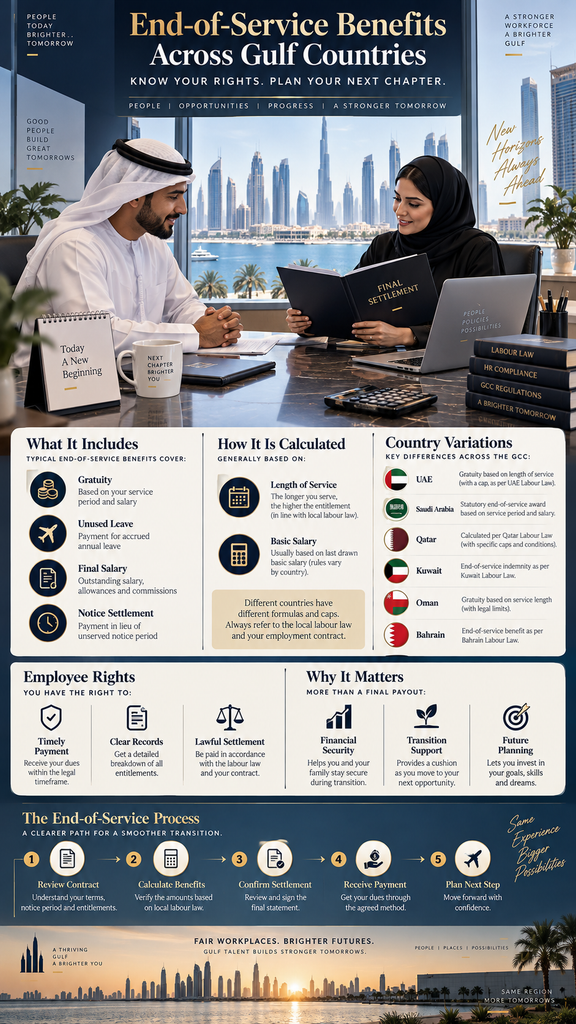
The UAE generally calculates traditional expatriate private-sector gratuity using 21 days of basic salary for each of the first five years and 30 days for each additional year. Saudi Arabia uses half a month’s wage for the first five years and one month’s wage thereafter, but resignation can reduce the amount. Qatar guarantees covered workers at least three weeks of basic wage for every year after qualifying service. Bahrain has moved non-Bahraini private-sector workers into a Social Insurance Organization-administered contribution system, while Oman is preparing a provident model for non-Omani employees as part of its wider Social Protection reform. Kuwait uses another calculation and can reduce the entitlement when an employee resigns from an indefinite contract before reaching specified service thresholds.
This makes end-of-service planning more complicated than simply multiplying salary by years worked.
Employees need to understand which wage counts, how service is measured, how employment ended and whether a pension, social insurance or savings scheme applies.
This guide reflects general private-sector frameworks available from official sources as of September 2026. Domestic workers, government employees, free-zone employees, military personnel, oil-sector workers and other specially regulated categories can follow different rules.
GCC End-of-Service Benefits and the Gulf Employment System
End-of-service benefits developed as an important part of Gulf employment systems, particularly for expatriate workers who would eventually leave the country after completing employment.
In many cases, the payment acts as a form of long-term employment benefit rather than a traditional monthly pension.
That model is now evolving.
The UAE offers employers a voluntary savings-based alternative to traditional gratuity. Bahrain moved non-Bahraini private-sector gratuity into a mandatory monthly contribution model administered by the Social Insurance Organization from March 2024. Oman has legislated a provident system intended to replace traditional employer-paid end-of-service gratuity for non-Omani workers once fully implemented.
Despite these reforms, the central question for employees remains the same:
How much am I entitled to receive when my employment ends?
The answer depends heavily on the country.
What End-of-Service Benefits Actually Mean
End-of-service gratuity is generally a statutory employment payment connected with the employee’s period of service.
It is separate from other amounts that may also become payable when employment ends, such as:
- Outstanding salary
- Unused annual leave
- Notice-period compensation
- Unpaid commission
- Contractual bonuses
- Reimbursable expenses
Employees sometimes receive a “final settlement” containing all these amounts together, which can make it difficult to understand how much represents gratuity.
A proper final settlement should therefore be broken down clearly.
An employee who is owed one month’s salary, unused annual leave and gratuity should be able to identify each component separately.
GCC End-of-Service Benefits Comparison Table
The basic structures differ significantly.
| Country | General Private-Sector Structure |
|---|---|
| UAE | 21 days basic salary per year for first 5 years, 30 days thereafter |
| Saudi Arabia | Half-month wage per year for first 5 years, one month thereafter |
| Qatar | At least 3 weeks basic wage for each year |
| Bahrain | Non-Bahraini scheme: half-month for first 3 years, one month thereafter |
| Oman | Non-covered workers: at least one basic wage for each year |
| Kuwait | Monthly paid: 15 days for first 5 years, one month thereafter |
The table is only the starting point.
Resignation, salary definition, minimum service, maximum benefit and social-insurance coverage can significantly change the result.
1. Eligibility Rules Differ Between Gulf Countries
Not every employee becomes entitled to gratuity from the first day of employment.
The UAE requires a full-time foreign private-sector worker to complete at least one year of continuous service before traditional gratuity becomes payable. Once that threshold has been reached, a proportionate amount is available for additional fractions of a year.
Qatar uses a similar minimum. Article 54 of its Labour Law requires at least one year of employment before the statutory end-of-service gratuity becomes payable.
Saudi Arabia works differently because the basic end-of-service award accrues under its Labour Law, but an employee who resigns before completing two years generally does not receive a resignation-based award. Employees leaving after longer periods receive different proportions depending on service length.
Kuwait also has special resignation thresholds for indefinite contracts.
This means an employee who resigns after eighteen months could receive very different treatment depending on whether they work in Dubai, Riyadh, Doha or Kuwait City.
2. Basic Salary Is Not Always the Calculation Base
One of the most important differences concerns the salary figure used.
In the UAE, traditional gratuity is calculated on the employee’s last basic salary. Housing, transport, utilities and similar allowances are excluded.
In Qatar, the final basic wage is also used as the statutory calculation base.
Oman currently states that the gratuity for workers not benefiting from the Social Protection Law should be calculated using the final basic wage.
Saudi Arabia uses the employee’s last wage, which can be broader than basic salary. The Labour Law permits agreement to exclude certain variable commission, sales percentages and similar fluctuating wage components from the calculation.
Kuwait is another important exception. Its Labour Law defines remuneration broadly to include the basic payment and periodic contractual elements such as allowances, bonuses and benefits, and employee entitlements are generally calculated using the last remuneration received.
This is why using one online calculator for every GCC country can produce incorrect results.
3. Length of Service Changes the Benefit
Most Gulf systems reward longer service through higher accrual rates.
The UAE provides 21 days of basic wage per year during the first five years and 30 days per year thereafter.
Saudi Arabia similarly has two levels:
Years 1 to 5: half a month’s wage per year.
After year 5: one month’s wage per year.
Bahrain uses an earlier transition point for non-Bahraini workers. Its current system calculates half a month’s wage for each of the first three years and one month’s wage for each subsequent year.
Kuwait’s monthly-paid workers generally receive 15 days’ remuneration for each of the first five years and one month’s remuneration for each additional year.
The longer someone remains with an employer, the faster gratuity can therefore accumulate in several Gulf systems.
4. Resignation Can Reduce Benefits in Some Countries
This is one of the most important differences between modern GCC labour systems.
Under Saudi Labour Law, resignation affects the end-of-service award significantly.
If the employee resigns after at least two years but not more than five years of continuous service, they generally receive one-third of the calculated award.
If service exceeds five years but remains below ten, the employee generally receives two-thirds.
After ten years or more, the employee generally receives the full award.
Kuwait also reduces benefits for employees who voluntarily terminate an indefinite contract.
Under Article 53, an employee with at least three but not more than five years generally receives half of the benefit. Between five and ten years, the employee receives two-thirds. Once service exceeds ten years, the full benefit becomes available.
The UAE’s current private-sector system is different. The old resignation-based reductions associated with earlier legislation are not part of the current standard formula. A qualifying foreign full-time employee is generally entitled to the statutory gratuity calculated under Article 51 when service ends, subject to the law’s requirements and permissible deductions.
Employees should therefore check resignation consequences before submitting notice.
5. Employer Termination Can Produce Different Results
The reason employment ends can determine whether the full statutory amount is payable.
Saudi Arabia generally provides the full calculated award where employment ends in circumstances that do not trigger the resignation reduction. Special rules also preserve full entitlement in certain force-majeure circumstances.
Kuwait provides full end-of-service benefits when the employer terminates the contract or a fixed contract expires without renewal, subject to the statutory rules.
Qatar requires the statutory gratuity for qualifying service but also contains serious-misconduct provisions that can affect entitlement in specified circumstances.
Employees should therefore never assume that “termination” automatically means one particular financial result.
The legal reason recorded for the end of employment can matter.
6. Partial Years Can Still Count
Employees frequently resign or finish contracts between annual anniversaries.
Several GCC laws specifically recognise fractions of a year.
In the UAE, once the worker has completed one continuous year, additional partial-year service is included proportionately.
Saudi Arabia also provides proportional entitlement for fractions of a year.
Qatar states that workers are entitled to gratuity for fractions of a year proportionate to the actual period of employment after qualifying for the benefit.
Bahrain’s system similarly recognises fractions of a year, as does Kuwait’s Labour Law.
An employee with seven years and six months of qualifying service should therefore not automatically be calculated as having only seven years.
7. Unpaid Absence Can Affect Service Calculations
Not every calendar day necessarily counts toward gratuity.
The UAE explicitly excludes unpaid absence from the period used to calculate end-of-service gratuity.
This matters for employees who have taken long periods of unpaid leave.
Imagine an employee has technically remained with an employer for five calendar years but spent six months on unpaid leave. The service used for the statutory gratuity calculation may differ from the simple calendar period.
Employees should therefore maintain records of:
- Joining date
- Employment end date
- Unpaid leave
- Contract changes
- Salary changes
Relying entirely on memory several years later can make checking the final calculation difficult.
8. Pension and Social Insurance Systems Can Change Entitlement
End-of-service gratuity should not always be confused with retirement benefits.
In the UAE, Emirati employees working in the private sector generally receive retirement and social-security protection under the applicable pension legislation, while qualifying expatriates use gratuity or the alternative savings scheme.
Qatar also recognises interaction between gratuity and employer retirement schemes. If an employer operates a retirement or similar programme providing a benefit greater than statutory gratuity, the employer is not necessarily required to provide both benefits. If the alternative benefit is lower, the Labour Law includes protections dealing with the difference and employee contributions.
Oman has introduced a comprehensive Social Protection framework for Omanis, including old-age, disability and death insurance. Non-Omanis are being brought into separate protection programmes, including a future mandatory provident scheme intended to replace traditional employer liability for post-implementation service.
Bahrain also distinguishes between its social-insurance system for nationals and the end-of-service system now administered for non-Bahraini private-sector employees.
9. Savings-Based Systems Are Growing in the Gulf
Traditional gratuity systems create a future liability on the employer’s balance sheet. A company may need to pay a large lump sum when an employee leaves after many years.
Several Gulf states are now experimenting with or implementing funded alternatives.
UAE Savings Scheme
The UAE’s voluntary Alternative End-of-Service Benefits System allows participating employers to replace future traditional gratuity accrual with monthly contributions invested through approved funds.
For full-time employees, the employer contributes:
- 5.83% of monthly basic salary for employees who have not completed five years of service
- 8.33% after more than five years of service
Employees receive the employer’s basic contributions together with applicable investment returns.
Bahrain Non-Bahraini Scheme
From March 1, 2024, Bahrain introduced a mandatory Social Insurance Organization system for covered non-Bahraini private-sector employees.
Employers contribute monthly:
- 4.2% of wages during the first three years
- 8.4% in subsequent years
The SIO administers the accumulated end-of-service system rather than leaving the entire future obligation with the employer.
Oman Provident Scheme
Oman’s Social Protection Law creates a mandatory defined-contribution savings system for non-Omani workers that is designed to replace traditional employer-paid gratuity for service after implementation.
Current Social Protection Fund guidance says application dates for the relevant non-Omani programmes will be announced in advance. Until the new system becomes applicable, Labour Law rules remain important for workers outside the Social Protection system.
This transition toward funded savings could become one of the largest long-term changes in GCC employee benefits.
10. Final Salary Is Separate From Gratuity
An employee leaving a company can be owed several amounts at the same time.
Suppose someone resigns on September 20.
Their final settlement might include:
| Payment | Possible Reason |
|---|---|
| September salary | Work already completed |
| Leave settlement | Unused annual leave |
| Commission | Previously earned sales |
| Notice adjustment | Where applicable |
| End-of-service benefit | Statutory gratuity |
| Expense reimbursement | Approved company expenses |
Employees should not allow an employer to describe the entire final settlement as “gratuity.”
The actual end-of-service calculation should be identifiable separately.
Saudi Arabia sets specific final-settlement timelines. When the employer ends the employment relationship, wages and entitlements generally must be settled within one week. If the employee ends the contract, settlement is generally required within two weeks.
The UAE generally requires outstanding wages, other entitlements and gratuity to be paid within 14 days after termination of the contract.
11. Employers May Make Certain Legal Deductions
Gratuity is not necessarily immune from every deduction.
The UAE permits deductions from end-of-service benefits for amounts legally owed by the employee, subject to the applicable rules and procedures.
Qatar’s Labour Law similarly permits an employer to deduct amounts owed by the worker from the gratuity.
Kuwait’s Article 51 also recognises deductions for qualifying loans and credits owed by the worker.
This does not mean an employer can invent deductions.
Employees should ask for a clear final settlement showing:
- Gross gratuity
- Any deduction
- Legal or contractual reason
- Net amount payable
Large unexplained deductions should be questioned before a final settlement is accepted.
12. Employees Should Keep Their Own Calculation Records
Employees should not wait until their final working day to think about gratuity.
Keep copies of:
- Employment contract
- Joining date
- Salary revisions
- Payslips
- Basic salary records
- Unpaid leave
- Resignation or termination notice
- Final settlement documents
A salary increase can materially affect the result when the system uses the last salary.
For example, an employee may have earned AED 8,000 basic salary for several years before receiving an increase to AED 12,000. The UAE’s traditional formula is based on the last basic wage, not an average of every salary earned during the entire career.
Accurate employment records therefore have real financial value.
End-of-Service Benefits in the UAE
The UAE has one of the GCC’s best-known gratuity systems.
A full-time foreign private-sector employee who completes at least one continuous year is generally entitled to traditional end-of-service gratuity calculated using the last basic salary.
The formula is:
First five years: 21 days of basic wage for each year.
After five years: 30 days of basic wage for each additional year.
Partial years are calculated proportionately after the employee has completed the qualifying first year. Total gratuity may not exceed two years’ wage.
Housing, transportation, utilities and similar allowances are not included in the traditional calculation.
UAE Example
Assume:
Basic salary: AED 10,000
Service: 7 years
Approximate traditional calculation:
First five years:
AED 10,000 ÷ 30 × 21 × 5 = AED 35,000
Years six and seven:
AED 10,000 ÷ 30 × 30 × 2 = AED 20,000
Estimated gratuity:
AED 55,000
This simplified example assumes qualifying continuous service without relevant unpaid absence or other complications.
The UAE also offers the voluntary Savings Scheme. Participating employers make monthly investment contributions instead of continuing traditional future gratuity accrual for enrolled workers.
End-of-Service Benefits in Saudi Arabia
Saudi Arabia uses a generous basic accrual formula but applies important resignation reductions.
The standard award is:
First five years: half a month’s wage for each year.
Following years: one month’s wage for each year.
Fractions of a year are calculated proportionately, and the employee’s last wage is used as the basis.
Saudi Resignation Rules
| Continuous Service | General Resignation Entitlement |
|---|---|
| Less than 2 years | Generally none |
| 2 to 5 years | One-third |
| More than 5 but under 10 | Two-thirds |
| 10 years or more | Full benefit |
Special statutory circumstances can preserve full entitlement despite resignation, including qualifying force-majeure situations.
Employees therefore need to calculate both the full theoretical award and the percentage actually payable because of resignation.
End-of-Service Benefits in Qatar
Qatar’s Labour Law provides a comparatively straightforward minimum.
A qualifying worker with at least one year of employment must receive an end-of-service gratuity agreed between the parties, but it cannot be lower than three weeks of remuneration for every year of service.
The last basic wage is used for the statutory calculation, and fractions of a year are included proportionately.
For example, with a basic salary of QAR 9,000:
Daily basic wage = QAR 9,000 ÷ 30 = QAR 300.
Three weeks = 21 days.
Minimum annual gratuity = QAR 6,300 per completed year, before any relevant proportional calculation.
The contract can provide a more generous entitlement than the statutory minimum.
Qatar also recognises employer retirement or similar systems. Where such a system provides a greater benefit than statutory gratuity, the law contains rules preventing unnecessary duplication while protecting the worker if the alternative arrangement is less valuable.
End-of-Service Benefits in Bahrain
Bahrain underwent an important reform in March 2024.
Covered non-Bahraini private-sector workers are now included in a dedicated end-of-service gratuity system administered by the Social Insurance Organization.
Employers pay monthly contributions of:
4.2% during the first three years of the employee’s service.
8.4% during subsequent years.
The benefit structure corresponds to:
First three years: half a month’s wage for every year.
After three years: one month’s wage for every year.
The SIO’s current guidance states that the calculation uses basic salary plus social allowance, if any, rather than all allowances and benefits.
The new system came into force on March 1, 2024. Service completed before the reform remains subject to the earlier Private Sector Labour Law framework.
That earlier law similarly provided half a month’s wage per year during the first three years and one month’s wage thereafter for workers not covered by social insurance.
Employees with service extending across March 2024 may therefore have benefits involving both the historical employer liability and the new SIO-administered period.
End-of-Service Benefits in Oman
Oman’s system is currently going through a major transition.
Under Article 61 of the current Labour Law, workers who are not benefiting from the Social Protection Law must receive end-of-service gratuity of at least one basic wage for each year of service.
Fractions of a year are paid proportionately, and the final basic wage is used for calculation.
This is significantly different from the tiered 15-day, 21-day or half-month formulas used elsewhere in the Gulf.
However, Oman has also legislated a new Provident Scheme under its Social Protection system.
The statutory design makes this defined-contribution system mandatory for non-Omani workers and states that it will replace traditional employer end-of-service gratuity for service covered after implementation. Pre-implementation service remains protected under the previous Labour Law entitlement.
The Social Protection Fund currently explains that implementation dates for the non-Omani programmes will be announced in advance, so employers and workers need to monitor the transition carefully.
Oman is therefore especially important to check at the actual date of employment termination because the system is evolving from employer liability toward funded savings.
End-of-Service Benefits in Kuwait
Kuwait’s private-sector system has several distinctive features.
For monthly-paid workers, the general formula is:
First five years: 15 days’ remuneration for every year.
After five years: one month’s remuneration for every year.
The total statutory benefit for monthly-paid employees is generally capped at one and a half years’ remuneration.
Workers paid daily, weekly, hourly or by piecework follow a different formula of 10 days for the first five years and 15 days for later years, with a one-year remuneration cap.
Kuwait also differs from countries such as the UAE because the statutory concept of remuneration can include more than basic salary. Article 55 includes recurring bonuses, benefits and allowances within the remuneration concept, while Article 62 generally bases employee entitlements on the last remuneration received.
Kuwait Resignation Rules for Indefinite Contracts
| Service | General Entitlement |
|---|---|
| Under 3 years | Generally no Article 53 resignation share |
| 3 to 5 years | Half |
| More than 5 but under 10 | Two-thirds |
| More than 10 years | Full |
By contrast, employer termination and expiry of a qualifying contract can trigger the full statutory benefit.
Resignation vs Termination Across GCC Countries
This is one of the most important comparison points.
| Country | Does Ordinary Resignation Reduce the Standard Benefit? |
|---|---|
| UAE | No standard resignation reduction under current traditional formula |
| Saudi Arabia | Yes, depending on service |
| Qatar | No comparable general tiered resignation reduction |
| Bahrain | Current non-Bahraini SIO scheme is contribution based |
| Oman | Labour Law formula generally based on qualifying service |
| Kuwait | Yes for indefinite contracts depending on service |
The reason employment ends should therefore be established before calculating benefits.
This is particularly important for employees considering resignation shortly before crossing a major service threshold.
A Saudi employee approaching ten years of service, for example, could move from a two-thirds resignation entitlement to full statutory entitlement once the ten-year threshold is met under Article 85.
Likewise, a Kuwaiti indefinite-contract employee’s resignation entitlement changes significantly across the three, five and ten-year thresholds.
Basic Salary vs Total Salary in Gratuity Calculations
Consider an employee with this package:
| Salary Component | Amount |
|---|---|
| Basic salary | 8,000 |
| Housing allowance | 3,000 |
| Transport allowance | 1,000 |
| Monthly total | 12,000 |
Using AED as an example, a UAE traditional gratuity calculation would normally begin with AED 8,000, not AED 12,000.
Qatar and Oman also use basic wage concepts for their statutory formulas.
Kuwait is different because its statutory remuneration definition can include periodic contractual benefits and allowances.
Saudi Arabia also uses a broader wage concept than the UAE’s basic-salary-only model, although specific variable components can be excluded by agreement in circumstances allowed under the Labour Law.
This is why employees should never ask only:
“What is my monthly salary?”
They should know:
“What salary definition does my country’s law use for gratuity?”
Example End-of-Service Calculations
The following simplified examples illustrate why identical salaries and service periods can produce different results.
UAE
Basic salary: AED 9,000
Service: 5 years
21 days × 5 years:
AED 9,000 ÷ 30 × 21 × 5
Approximate gratuity: AED 31,500
Qatar
Basic salary: QAR 9,000
Service: 5 years
Minimum 21 days × 5 years:
QAR 9,000 ÷ 30 × 21 × 5
Minimum statutory gratuity: QAR 31,500
Saudi Arabia
Last qualifying wage: SAR 9,000
Service: 5 years
Half-month × 5:
SAR 4,500 × 5 = SAR 22,500 full theoretical award
If the employee voluntarily resigns at the relevant five-year band, the actual entitlement may be reduced according to Article 85.
The examples are deliberately simplified. Actual calculations may require consideration of partial years, unpaid leave, salary definitions, retirement systems and the legal reason employment ended.
What Employees Should Check Before Resigning
Employees should calculate potential end-of-service benefits before submitting resignation.
Check:
- Exact joining date
- Contract type
- Current basic salary
- Total remuneration where relevant
- Unpaid leave periods
- Number of completed service years
- Resignation reduction rules
- Notice period
- Unused annual leave
- Outstanding bonuses or commissions
- Loans or lawful employer deductions
- Whether a savings or social-insurance scheme applies
Timing can have meaningful consequences.
If an employee is only a few weeks away from completing a major service threshold, understanding that threshold can help them make a better-informed decision.
This should not mean remaining in an unsuitable or unsafe job purely for gratuity. It simply means knowing the financial consequences of the decision.
Common End-of-Service Benefit Mistakes
Using total salary in a UAE calculation is one of the most common mistakes. Traditional UAE gratuity uses basic salary.
Assuming resignation never reduces gratuity is another. Saudi Arabia and Kuwait both demonstrate that resignation can materially reduce entitlement.
Ignoring unpaid leave can also create inaccurate UAE service calculations.
Employees sometimes assume every GCC country uses 21 days per year. Qatar and the UAE may both involve a 21-day concept in important parts of their formulas, but Bahrain, Saudi Arabia, Oman and Kuwait use different structures.
Another mistake is confusing gratuity with the entire final settlement.
Unused leave, unpaid salary and notice compensation are separate items.
Finally, employees should not assume every online calculator has been updated for newer systems such as Bahrain’s March 2024 reform, the UAE Savings Scheme or Oman’s developing Provident Scheme.
GCC End-of-Service Benefits Checklist
Before leaving a Gulf employer, review the following:
- Confirm which labour law applies to you.
- Check whether you fall under a special sector or jurisdiction.
- Confirm your official employment start date.
- Identify your last working date.
- Calculate total qualifying service.
- Deduct unpaid absence where the law requires it.
- Confirm whether the calculation uses basic salary or wider remuneration.
- Check your latest salary revision.
- Determine whether resignation changes the benefit.
- Determine whether termination changes the benefit.
- Check whether a pension system replaces or interacts with gratuity.
- Check whether your employer participates in a savings scheme.
- Review any Bahrain SIO contributions if applicable.
- Monitor Oman’s Provident Scheme if working in Oman.
- Calculate partial-year entitlement.
- Check applicable statutory caps.
- Review outstanding annual leave.
- Confirm unpaid salary.
- Check commission or bonus entitlement.
- Review any employer deductions.
- Request a written final settlement.
- Compare the employer’s calculation with your own.
- Keep copies of contracts and payslips.
- Do not sign a final settlement you do not understand.
- Contact the relevant labour or social-insurance authority if there is a serious disagreement.
A few minutes of record keeping during employment can make a major difference when several years of benefits need to be calculated.
Final Thoughts on GCC End-of-Service Benefits
GCC End-of-Service Benefits remain one of the most important financial protections connected with employment across the Gulf, but the systems are increasingly different.
The UAE continues to use a traditional gratuity model for many expatriate private-sector workers, based on 21 days of basic salary per year during the first five years and 30 days thereafter. At the same time, employers can voluntarily move workers into an investment-based Savings Scheme with monthly employer contributions.
Saudi Arabia uses half a month’s wage per year for the first five years and one month’s wage thereafter, but resignation can reduce the award to one-third or two-thirds before ten years of qualifying service.
Qatar provides qualifying employees with at least three weeks of basic wage for every year of employment and recognises proportionate benefits for partial years.
Bahrain has made one of the region’s biggest structural changes. Since March 2024, covered non-Bahraini private-sector workers have been included in an SIO-administered system funded through monthly employer contributions of 4.2% during the first three years and 8.4% thereafter.
Oman currently provides workers outside the Social Protection system with at least one basic wage for each year of service, while the country’s Social Protection reform is creating a mandatory provident system for non-Omani workers that will ultimately replace traditional gratuity for covered future service.
Kuwait provides monthly-paid employees with 15 days’ remuneration per year for the first five years and one month thereafter, subject to a one-and-a-half-year remuneration cap. It also reduces entitlement when an employee resigns from an indefinite contract before reaching longer service thresholds.
The broader direction across the Gulf is important.
Traditional gratuity depended largely on the employer accumulating a future liability and paying a lump sum when someone left. Newer systems increasingly move toward monthly funding, investment and central administration.
For employees, however, the most useful rule remains simple:
Know your salary base, know your qualifying service, know why the employment is ending and know which country’s law applies before accepting the final settlement.
Those four pieces of information can determine whether an end-of-service calculation is correct or thousands of dirhams, riyals or dinars away from what the employee is actually entitled to receive.
Do follow us on Instagram
Read More – GCC Probation Periods: 12 Essential Rules for Successful Employment