


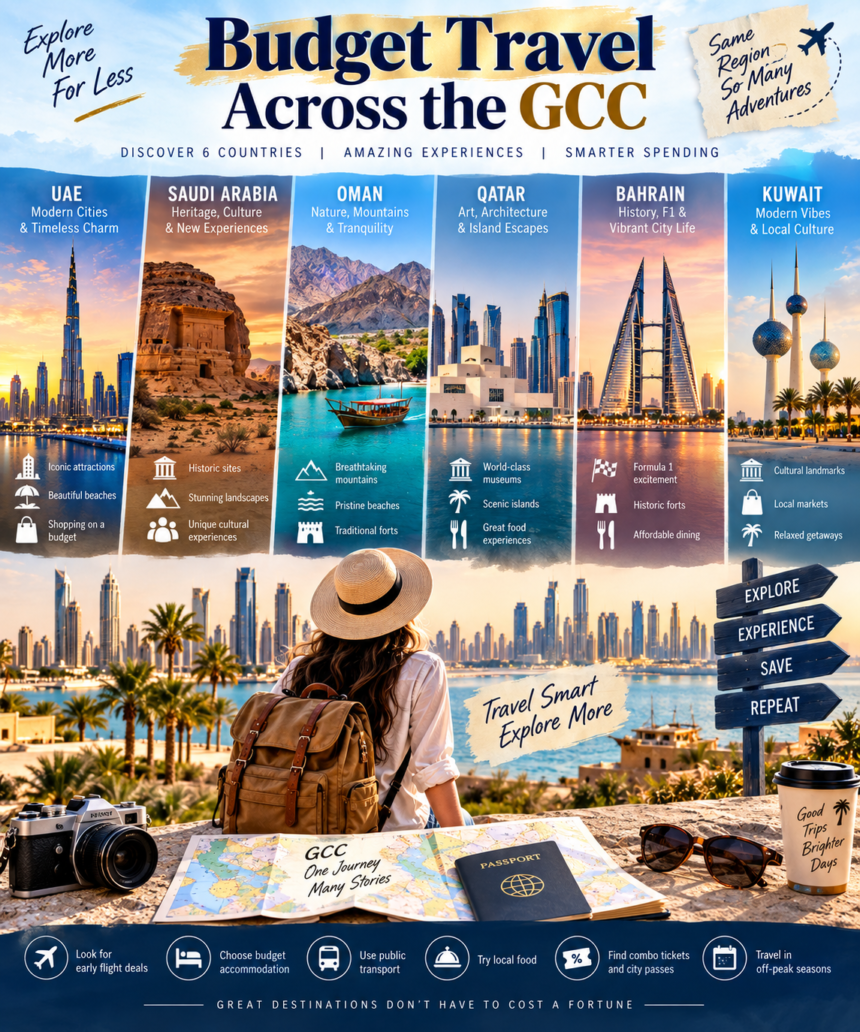
Budget Travel Checklist for the Gulf
The Gulf Cooperation Council is often associated with luxury hotels, expensive restaurants, supercars and premium shopping. That image is real, but it represents only one side of travelling through the region. With careful planning, budget travel across the GCC is much more achievable than many first-time visitors expect.
- Can You Really Travel Around the GCC on a Budget?
- Budget Travel Across the GCC at a Glance
- Choose Fewer GCC Countries Instead of Rushing Through All Six
- Find Cheaper Flights Around the Gulf
- Save Money on Accommodation Across the GCC
- Use Public Transport Whenever Possible
- Budget Travel in the UAE
- Budget Travel in Saudi Arabia
- Budget Travel in Qatar
- Budget Travel in Bahrain
- Budget Travel in Kuwait
- Budget Travel in Oman
- Eat Like a Local to Reduce Travel Costs
- Look for Free and Low-Cost Attractions
- Save Money on Desert and Adventure Experiences
- Visit During the Right Season
- Avoid Expensive Airport Transfers
- Use Travel Passes Only When They Actually Save Money
- How Much Should You Budget for GCC Travel?
- Sample Low-Cost GCC Travel Plan
- Common Budget Travel Mistakes to Avoid
- Budget Travel Checklist for the Gulf
- Final Thoughts on Budget Travel Across the GCC
The GCC includes the United Arab Emirates, Saudi Arabia, Qatar, Bahrain, Kuwait and Oman. Each country has a different transport system, accommodation market and travel style, which means the cheapest strategy in Dubai may not work in Muscat or Riyadh.
Public transport can keep costs remarkably low in some major cities. Dubai has an extensive metro and bus network, Doha’s Metro allows standard-class travel throughout the day for a maximum of QAR 6, while Bahrain’s bus system has a daily fare cap of just 700 fils when using its GO Card.
The real secret is not trying to make every part of the holiday cheap. Instead, save heavily on transport, accommodation and everyday meals so there is room in the budget for one or two memorable experiences.
Can You Really Travel Around the GCC on a Budget?
Yes, but the Gulf should not be approached in exactly the same way as Southeast Asia or parts of Europe. Ultra-cheap hostels, overnight trains and street-food meals costing almost nothing are less common across much of the GCC.
Instead, successful budget travel depends on value planning.
A traveller who stays near public transport, eats at neighbourhood restaurants, chooses free attractions and travels outside major event periods can spend significantly less than someone staying in luxury tourist districts and relying on taxis for every journey.
Dubai’s official tourism authority now publishes dedicated budget guides and even lists free attractions, showing that low-cost travel has become a genuine part of the city’s tourism offering.
Doha follows a similar pattern. Visit Qatar lists more than 20 free things to do, while its Metro gives travellers access to areas including the airport, Souq Waqif, Katara, West Bay and Education City at very low cost.
The key question therefore should not be, “Is the Gulf expensive?” It should be, “Which expenses can I control?”
Budget Travel Across the GCC at a Glance
| Country | Best Budget Strategy | Transport Advantage | Good Low-Cost Experiences |
|---|---|---|---|
| UAE | Stay outside luxury districts | Metro and buses in Dubai | Beaches, souqs, heritage areas |
| Saudi Arabia | Focus on one or two cities | Metro, buses and intercity trains | Corniches, heritage districts, parks |
| Qatar | Build trip around Doha Metro | QAR 6 maximum standard daily Metro fare | Souq Waqif, Katara, Corniche |
| Bahrain | Use buses and short stays | Low daily bus cap | Souqs, Muharraq, Bahrain Fort |
| Kuwait | Use buses for urban journeys | Wide bus coverage | Corniche, markets, cultural areas |
| Oman | Combine buses with selective car hire | Intercity bus routes | Mutrah, beaches, wadis, mountains |
There is no single cheapest GCC country for every traveller. The final cost changes according to season, hotel deals, flights and the number of paid attractions included.
Qatar and Bahrain can be particularly easy for short city-focused trips because public transportation reduces daily movement costs. Oman can offer excellent value for nature-focused travellers, although reaching remote mountains and wadis can increase transport expenses.
Choose Fewer GCC Countries Instead of Rushing Through All Six
One of the biggest mistakes in GCC budget travel is trying to visit every Gulf state during one short holiday.
Distances may look small on a map, but repeated flights, airport transfers, visas, baggage fees and hotel check-ins quickly increase the total cost.
A more economical approach is to build the trip around geographic clusters.
Good budget combinations include:
- UAE and Oman
- Bahrain and eastern Saudi Arabia
- Qatar and Saudi Arabia
- Dubai and Abu Dhabi
- Riyadh and Jeddah
- Muscat and northern Oman
Spending five or six days properly exploring one country can often cost less than visiting three countries in the same period.
It also creates a better experience. Instead of spending half the holiday inside airports, visitors have time to explore markets, neighbourhoods, waterfronts and cultural districts that are often free.
Find Cheaper Flights Around the Gulf
Airfare can become one of the biggest expenses when travelling between GCC countries.
The region has several full-service and low-cost airlines, so compare prices instead of assuming the largest carrier will provide the cheapest ticket. Baggage policies also matter because an inexpensive base fare can become considerably more expensive once checked luggage, meals and seat selection are added.
For regional flights, compare the final checkout price, not simply the first fare displayed.
Flexible travellers should also test several departure airports. Someone travelling between the UAE and Oman, for example, may find very different prices depending on whether they depart from Dubai, Abu Dhabi or Sharjah.
Booking during major events, school holidays, Eid periods or international sporting weekends can also raise prices significantly.
Money-saving flight strategy:
- Search multiple GCC airports.
- Compare cabin-baggage-only fares.
- Avoid unnecessary seat selection.
- Travel midweek when practical.
- Check flight and hotel packages.
- Compare a direct flight against an indirect journey only after adding all costs.
- Avoid booking separate tight connections that could require buying another ticket after delays.
Travellers should also check visa rules before purchasing non-refundable flights because entry requirements differ according to nationality.
Save Money on Accommodation Across the GCC
Luxury resorts dominate Gulf advertising, but travellers do not need to stay in them.
Large cities usually offer everything from serviced apartments and two-star or three-star hotels to affordable international chains. Visit Dubai officially states that the city offers accommodation for different budgets, while Visit Qatar also promotes budget-friendly hotels alongside higher-end properties.
Location is often more important than the hotel’s star rating.
A cheap hotel far from public transport may eventually cost more because of repeated taxi journeys. Paying slightly more for accommodation within walking distance of a metro or major bus route can reduce the total trip cost.
For longer stays, serviced apartments can also be useful because access to a refrigerator, microwave or kitchen makes it possible to prepare breakfast and occasional meals.
| Accommodation Choice | Budget Advantage | Possible Drawback |
|---|---|---|
| Budget hotel | Private room and basic facilities | Smaller rooms |
| Serviced apartment | Kitchen and good for longer stays | Sometimes farther from attractions |
| Hotel near Metro | Saves transport money | Room rate may be slightly higher |
| Shared accommodation | Lowest cost in some cities | Less privacy |
| Resort outside peak season | Occasional strong deals | Food and transport may be costly |
Always calculate the whole-stay cost, including tourism taxes, breakfast, parking and transport.
Use Public Transport Whenever Possible
Transport is where careful planning can produce some of the biggest savings.
Dubai’s public transport network uses the nol system across Metro, buses and other services. With a Silver Card, current standard fares are AED 3 within one zone, AED 5 across two adjacent zones and AED 7.50 for longer journeys. Seven-day passes are also available.
Doha is even easier for visitors staying near its Metro network. Standard travel costs a maximum of QAR 6 per day, and the system connects Hamad International Airport with central Doha and major visitor areas.
Bahrain’s GO Card system currently charges 275 fils for an individual bus journey, with daily spending capped at 700 fils. A seven-day unlimited package costs BHD 3.
These numbers illustrate an important rule: do not automatically open a ride-hailing application every time you leave the hotel.
Budget Travel in the UAE
The UAE can look intimidating to a budget traveller because Dubai and Abu Dhabi contain some of the world’s most expensive hotels and restaurants. However, both cities also offer free public spaces, inexpensive food and efficient transport.
Dubai is easiest when accommodation is located near the Metro.
Neighbourhoods outside the most premium beachfront and Downtown areas can provide better-value hotels while still allowing quick Metro access to major attractions.
Dubai’s official tourism platform recommends numerous free experiences, making it possible to build entire sightseeing days without expensive tickets.
Consider:
- Al Fahidi Historical Neighbourhood
- Dubai Creek
- Traditional souqs
- Public beaches
- Dubai Marina walks
- City neighbourhoods
- Free seasonal events
- Parks and waterfront areas where access is free
Al Fahidi gives visitors a particularly useful glimpse of older Dubai, with traditional lanes, wind towers, cultural spaces and heritage buildings.
Food can also be economical if travellers move away from luxury hotel restaurants. Areas with large South Asian, Arab and Filipino communities have numerous casual restaurants serving filling meals at much lower prices.
Best UAE budget rule: use public transport for ordinary sightseeing and save taxis for journeys that genuinely require them.
Budget Travel in Saudi Arabia
Saudi Arabia’s enormous size means transport planning matters even more than in the smaller GCC states.
Trying to visit Riyadh, Jeddah, AlUla, Madinah and the eastern region within one short trip can create a large transport bill. Budget travellers should instead select one region or two major cities.
Saudi Arabia’s current transport options include Metro systems, public buses, trains, taxis and domestic flights. Visit Saudi specifically highlights the Riyadh Metro as a practical way to travel around the capital.
Visitors can also build itineraries around free public spaces.
Jeddah Corniche stretches for around 30 kilometres and does not require an entrance ticket, while Historic Jeddah’s Al Balad can also be explored without buying general admission.
These kinds of experiences make it possible to balance more expensive attractions with entire low-cost days.
For food, local bakeries, shawarma restaurants, rice restaurants and neighbourhood cafeterias usually offer much better value than dining inside premium hotels.
Saudi Arabia also regularly runs destination campaigns and seasonal offers. For example, Jeddah’s 2026 summer campaign included accommodation, activities, transport and Haramain train discounts during promotional periods. Such deals change frequently, so they should be checked close to the travel date rather than treated as permanent.
Budget Travel in Qatar
Qatar is one of the easiest GCC countries to explore without renting a car if the trip is centred around Doha.
The Doha Metro consists of three main lines and connects major areas including the airport, West Bay, Souq Waqif, National Museum of Qatar, Katara, Education City and Lusail connections.
This creates a major advantage for budget travellers.
Instead of paying for airport taxis and repeated private transfers, visitors can choose accommodation close to a station and use public transport for most sightseeing.
Several attractions and neighbourhoods can also be experienced without significant entrance costs. Visit Qatar’s free-attraction recommendations include Katara Cultural Village and its surrounding areas, with more than 20 free experiences listed overall.
A budget Doha day could combine:
Morning: Souq Waqif and Msheireb
Lunch: Casual local restaurant
Afternoon: Katara or a museum depending on ticket budget
Evening: Corniche walk and skyline views
The Metro’s low daily cost means transport can remain one of the smallest items in the itinerary.
Budget Travel in Bahrain
Bahrain’s compact geography makes it suitable for shorter budget trips.
The country’s public bus system currently operates across a network of routes connecting locations including the airport, Manama, Muharraq and other districts. Recent network information lists 140 buses across 26 routes.
For visitors, the fare structure is especially attractive. Using the GO Card brings single journeys to 275 fils with a daily cap of 700 fils and an unlimited seven-day package priced at BHD 3.
Bahrain also has several cultural locations where the experience is based largely around walking and exploring rather than expensive attractions.
Bahrain Tourism recommends locations such as Bahrain Fort and Manama Souq for visitors interested in heritage and local culture.
Muharraq is another useful area for travellers interested in traditional Gulf architecture, heritage streets and the Pearling Path.
Because Bahrain is relatively compact, a three or four-night stay can provide enough time to see many major areas without constantly changing hotels.
Budget Travel in Kuwait
Kuwait receives less international leisure-tourism attention than Dubai, Doha or Muscat, but that can work in favour of travellers seeking a slower urban experience.
The country’s government says Kuwait Public Transport Company services cover regions and suburbs throughout the country, supported by private bus networks such as CityBus.
Public buses therefore provide an alternative to taking taxis for every urban trip.
Visitors can also spend time exploring waterfront spaces, traditional markets and city districts without building the itinerary entirely around ticketed attractions.
A Kuwait budget trip works best when accommodation and activities are geographically grouped. Because Kuwait City is relatively spread out, repeatedly crossing the city by taxi can quietly become one of the largest daily expenses.
Good budget approach: plan one area per half-day rather than constantly travelling between opposite sides of the city.
Food is another area where spending can be controlled easily. Kuwaiti, Lebanese, Indian and other casual restaurants provide alternatives to premium dining inside shopping malls and hotels.
Budget Travel in Oman
Oman requires a slightly different strategy.
Muscat has buses, but many of the country’s most famous natural attractions are outside the capital. Mountains, wadis and desert areas can require a rental car, tour or private transfer.
Mwasalat operates intercity buses that can significantly reduce costs on suitable routes. For example, its Muscat-area to Sur route currently lists a single fare of OMR 4.500 and a return fare of OMR 8.
Oman’s official tourism guide also specifically identifies buses as useful for budget travel between major cities.
This gives travellers several choices.
Use buses when travelling between accessible cities, then spend money selectively on a car or tour for remote natural attractions.
For a group of three or four people, splitting the cost of a rental car may sometimes provide better value than purchasing several individual tours.
Muscat itself also contains plenty of low-cost experiences, including Mutrah Corniche, traditional markets, beaches and neighbourhood walks.
Eat Like a Local to Reduce Travel Costs
Food can either destroy a GCC travel budget or become one of the easiest places to save.
The difference usually comes down to location.
Restaurants inside five-star hotels, tourist promenades and premium shopping districts can be expensive. Move a few neighbourhoods away and the same city may offer inexpensive cafeterias, bakeries and family restaurants.
Across the GCC, budget-friendly meals commonly include:
- Shawarma
- Falafel
- Manakish
- Grilled chicken
- Biryani
- Kabsa
- Mandi
- Rice and curry meals
- Sandwiches
- Fresh bakery items
- Local breakfast dishes
Another useful strategy is to make breakfast simple.
Buying yoghurt, fruit, bread, cheese and drinks from a supermarket can dramatically reduce the cost of a week-long holiday compared with eating every breakfast inside a hotel café.
However, food should remain part of the travel experience. Saving money does not mean avoiding local cuisine. Instead, choose neighbourhood restaurants where residents actually eat.
Look for Free and Low-Cost Attractions
Budget travellers sometimes focus so heavily on discounted tickets that they overlook attractions requiring no ticket at all.
Many of the Gulf’s most memorable experiences involve public spaces.
Think about sunset on a waterfront, wandering through an old souq, visiting a heritage neighbourhood, walking along a corniche or watching city skylines from a public beach.
Examples include Dubai’s heritage districts, Jeddah Corniche, Doha’s Katara and public art, Bahrain’s traditional markets and Muscat’s Mutrah waterfront. Official tourism sources actively promote free experiences in destinations such as Dubai and Doha.
A simple budget formula works well:
One paid attraction + two free experiences per day.
This prevents the itinerary from becoming boring while keeping entrance-ticket spending under control.
Save Money on Desert and Adventure Experiences
Desert safaris, diving trips, mountain tours and private boat journeys can become some of the most expensive activities in a Gulf itinerary.
They can also become the most memorable, so cutting them completely is not always the right answer.
Instead, choose carefully.
If visiting several countries, there is no need to book a premium desert safari in every destination. Experience the desert properly once, then use free cultural or city attractions elsewhere.
Shared tours are usually cheaper than private tours.
For Oman, sharing a vehicle between several travellers can reduce the per-person cost of mountain or wadi trips. The same idea applies to Qatar’s Inland Sea or UAE desert excursions.
Always compare what is included before choosing the cheapest tour. Transport, meals, equipment and entrance fees can make a slightly more expensive package better value overall.
Visit During the Right Season
Travelling outside peak periods can reduce hotel prices considerably, but Gulf climate needs to be considered.
Summer can bring excellent accommodation promotions, particularly in cities with extensive indoor attractions. Dubai’s tourism platform, for example, ran Dubai Summer Surprises from July 2 to August 30 in 2026 with citywide offers and promotions.
Qatar also promoted summer savings of up to 50% on selected hotels, restaurants and activities through its tourism app during its summer campaign.
However, cheaper summer prices come with an obvious trade-off: intense heat.
If the main goal is museums, malls and indoor attractions, summer can work. For hiking, camping or walking through heritage districts, the cooler months are much more comfortable.
The best budget period is therefore not always simply the cheapest month. It is the cheapest period that still suits the activities you want to do.
Avoid Expensive Airport Transfers
Airport transport can create an unnecessary expense before sightseeing has even started.
In cities with airport rail connections, public transport is often the simplest solution.
Doha’s Red Metro Line connects Hamad International Airport directly with the city network.
Dubai’s Metro also provides convenient airport access from terminals connected to the rail network.
Before travelling, check three things:
- Does the airport have a Metro or public bus connection?
- Is your hotel close to the same transport network?
- Will public transport still be operating when your flight arrives?
If the answer to all three is yes, an airport taxi may not be necessary.
For families with several large bags, however, a taxi divided among four people may sometimes be more practical. Budget travel should focus on value rather than automatically choosing the cheapest possible option.
Use Travel Passes Only When They Actually Save Money
Tourism passes can look attractive because they promise large discounts, but buying one does not automatically save money.
First create your real itinerary.
Then calculate the normal admission cost of only the attractions you genuinely plan to visit. Compare that total with the pass price.
Dubai, for example, offers prepaid attraction-pass options, while Saudi Arabia introduced flexible attraction products such as the Jeddah Beach Flexi Pass in 2026.
A pass makes sense when several included attractions already appear on your itinerary.
It makes little sense when you begin adding activities simply because they are included in the pass.
How Much Should You Budget for GCC Travel?
Exact daily expenses vary too much to give one reliable figure for every traveller. Hotel prices change by city, weekend, exhibition schedule, school holiday and season.
A more useful approach is to divide the daily budget.
| Expense | Lean Budget Approach | Where to Save |
|---|---|---|
| Accommodation | Budget hotel or apartment | Stay near public transport |
| Breakfast | Supermarket or bakery | Avoid hotel buffets |
| Lunch | Casual local restaurant | Eat outside tourist districts |
| Dinner | Local restaurant | Mix cheap and premium meals |
| Transport | Metro or bus | Limit taxis |
| Attractions | 1 paid activity daily | Add free experiences |
| Drinks/snacks | Supermarket purchases | Avoid repeated hotel purchases |
| Intercity travel | Bus/train where practical | Book early |
Accommodation and intercity transport usually create the biggest differences.
Someone staying with friends or family in the GCC can travel surprisingly cheaply, while a solo traveller staying in hotels will naturally need a larger budget.
Sample Low-Cost GCC Travel Plan
For first-time travellers, combining Dubai and Muscat can provide a good balance between modern city experiences and traditional Gulf scenery without trying to cover too many countries.
Days 1 and 2: Dubai
Stay near a Metro station. Explore Al Fahidi, Dubai Creek, souqs and public waterfront areas. Choose only one premium attraction.
Day 3: Dubai
Spend time at a beach or free city attraction, eat in a neighbourhood restaurant and use public transport throughout the day.
Day 4: Travel to Oman
Move to Muscat and check into a modest hotel or apartment.
Day 5: Muscat
Explore Mutrah Corniche, Mutrah Souq and public coastal areas.
Day 6: Oman nature day
Use the money saved during city days for one properly planned mountain, wadi or coastal excursion.
Day 7: Muscat
Keep the final day relaxed and inexpensive with a market, beach or cultural attraction before departure.
This model works because the itinerary alternates inexpensive days with one higher-cost experience rather than spending heavily every day.
Common Budget Travel Mistakes to Avoid
Cheap travel in the Gulf becomes much easier once a few common mistakes are removed.
| Mistake | Why It Costs More | Better Choice |
|---|---|---|
| Staying far from transport | Repeated taxi bills | Stay near Metro or bus routes |
| Booking every attraction | Ticket costs grow quickly | Pick the best one or two |
| Eating only in tourist areas | Higher menu prices | Try neighbourhood restaurants |
| Visiting too many countries | Repeated flight costs | Explore fewer countries deeply |
| Ignoring baggage fees | Cheap flights become expensive | Compare final airfare |
| Renting a car unnecessarily | Fuel, parking and rental costs | Use urban public transport |
| Booking late during events | Hotel prices rise | Check event calendar first |
| Buying attraction passes blindly | Pass may cost more | Calculate individual tickets |
| Travelling without checking weather | Limits free outdoor activities | Match season to itinerary |
A small amount of planning before departure can therefore produce larger savings than hunting for discounts after arrival.
Budget Travel Checklist for the Gulf
Before booking a GCC trip, check the basics in one place:
- Compare several airports and airlines.
- Confirm visa requirements before buying non-refundable flights.
- Check whether accommodation is near public transport.
- Compare hotel prices with all taxes included.
- Research Metro and bus cards before arrival.
- List free attractions before buying paid tickets.
- Check local event dates that could increase hotel prices.
- Keep one flexible day for weather or schedule changes.
- Use supermarkets for water, snacks and breakfast items.
- Choose shared tours instead of private experiences where practical.
- Download transport maps and official tourism apps.
- Keep some local currency for smaller purchases.
- Compare the cost of public transport with a rental car for groups.
- Reserve part of the budget for one special Gulf experience.
The goal is not to spend as little as physically possible. It is to remove expenses that add little value so more of the budget goes towards experiences worth remembering.
Final Thoughts on Budget Travel Across the GCC
Budget travel across the GCC is entirely possible, even in destinations known internationally for luxury.
Dubai becomes more affordable when visitors use the Metro, explore free heritage areas and eat outside premium districts. Saudi Arabia rewards travellers who focus on fewer regions and use public transport where available. Doha stands out for its inexpensive Metro and numerous free attractions, while Bahrain’s low-cost bus network makes short trips easier to manage.
Kuwait offers public bus connections and inexpensive local dining, while Oman rewards travellers who combine affordable intercity transport with selective spending on nature excursions.
The smartest approach is simple: save on what you use every day and spend on what makes the trip special.
Choose an affordable hotel near transport. Eat where local residents eat. Walk through souqs, waterfronts and heritage neighbourhoods for free. Use buses and Metro systems instead of taxis whenever practical. Then use the money saved for the desert safari, mountain journey, museum or cultural experience that you will remember long after the trip ends.
Do follow us on Instagram
Read More – Best Indoor Activities During Gulf Summers: 15 Amazing Escapes