




Why Is There So Much Fog in Dubai Right Now?
Summer may officially be over in the UAE, but anyone stepping outside in Dubai before sunrise might struggle to believe it. The mornings can still feel sticky, visibility can suddenly drop behind thick fog, and even slightly lower temperatures do not always make the weather feel much more comfortable.
- Dubai Humidity and Fog: Why Does It Continue After Summer?
- Why Is Dubai Still So Humid in September?
- Why Is There So Much Fog in Dubai Right Now?
- Why September and October Can Be Especially Foggy
- Why Is Dubai Often Foggiest Early in the Morning?
- Does Fog Mean Cooler Weather Is Finally Coming?
- How Dubai Residents Should Deal With Foggy Mornings
- When Will Dubai’s Humidity Finally Ease?
That is because Dubai humidity and fog do not disappear the moment autumn begins.
The UAE entered astronomical autumn around the September equinox, but the weather changes much more gradually. Temperatures remain high, the Arabian Gulf is still holding enormous amounts of heat accumulated over the summer, and moisture continues to move inland from the sea. At the same time, nights are becoming slightly cooler, creating almost ideal conditions for humidity to rise and fog to form.
The National Centre of Meteorology has previously explained that temperatures begin easing during the second half of September, while relative humidity increases, particularly at night and during the early morning. Current forecasts for late September 2026 continue to show hot daytime conditions alongside humid nights and chances of mist or fog.
So, if summer is technically finished, why does Dubai still feel like a sauna before breakfast? Here is what is happening in the atmosphere.
Dubai Humidity and Fog: Why Does It Continue After Summer?
Astronomically, yes.
The September equinox marks the beginning of autumn in the Northern Hemisphere. In the UAE, that seasonal transition arrived this week, but an astronomical season and the weather people experience on the ground are not exactly the same thing.
Dubai does not move from extreme summer heat into pleasant winter weather overnight.
Instead, September and October act as transition months. Daylight gradually becomes shorter, temperatures start to decrease, and evenings become more comfortable. However, the huge amount of heat stored in the desert, roads, buildings and surrounding sea means the atmosphere takes time to cool.
The National reported on September 22, 2026 that although autumn was beginning, UAE residents should not expect an immediate temperature collapse. More noticeably comfortable conditions typically begin arriving from around mid-October, especially during the evenings and nights.
That means September can create a slightly confusing combination.
| Weather Factor | What Happens in Late September |
|---|---|
| Daytime temperature | Begins declining gradually |
| Night temperature | Falls faster than daytime highs |
| Sea temperature | Remains very warm |
| Relative humidity | Often increases |
| Early morning fog | Becomes more likely |
| Comfortable outdoor weather | Improves gradually through October |
| Winter-style weather | Still several weeks away |
In other words, saying that “summer is over” describes Earth’s position around the Sun more accurately than it describes what Dubai feels like at 7am.
The transition is gradual rather than immediate.
Why does Dubai still feel hot after the equinox?
The UAE’s climate has considerable seasonal lag. Land, concrete and especially seawater do not immediately lose the heat accumulated during months of intense sunshine.
Think about heating a large swimming pool. Even after switching the heater off, the water does not instantly become cold. It releases its stored heat gradually.
The Gulf behaves in a similar way on a much larger scale.
This stored warmth becomes one of the most important reasons Dubai remains humid well after peak summer.
Why Is Dubai Still So Humid in September?
The answer begins with the Arabian Gulf.
Throughout summer, the Gulf absorbs immense quantities of solar heat. By September, its waters remain exceptionally warm even as air temperatures over land begin declining.
Warm water means increased evaporation.
That evaporation sends large quantities of water vapour into the atmosphere. Winds then transport some of this moisture towards Dubai and other coastal parts of the UAE.
The National reported that the UAE’s warm surrounding seas, evaporation and seasonal winds help explain why humidity remains high through September even after astronomical summer ends.
There is another factor that makes the situation seem even more dramatic: relative humidity increases when temperatures fall.
Suppose the amount of moisture in the atmosphere stays almost unchanged overnight. As the temperature drops, the air moves closer to the maximum amount of water vapour it can hold at that temperature.
The relative humidity percentage therefore rises.
Meteorologists from the National Centre of Meteorology have previously explained this exact pattern in the UAE. As temperatures decline in September, relative humidity can increase, particularly overnight and during the early morning.
That is why you might see something like this:
- Afternoon: 39°C with lower relative humidity
- Midnight: 32°C with noticeably higher humidity
- Before sunrise: 27°C to 30°C with humidity approaching very high levels
The air has become cooler, but it can feel far more humid.
Why does humidity sometimes feel worse than extreme heat?
High humidity interferes with the body’s natural cooling mechanism.
Your body cools itself largely through sweat evaporation. When sweat evaporates from your skin, it carries heat away.
But when the surrounding air already contains a large amount of moisture, evaporation becomes slower.
That means your body has a harder time losing heat.
As a result, a humid 35°C morning can sometimes feel more uncomfortable than a hotter but much drier afternoon.
Gulf News notes that UAE humidity can rise above 90 per cent during some overnight and early morning periods, making conditions feel considerably hotter because sweat evaporates less efficiently.
It explains the classic Dubai experience of leaving an air-conditioned building early in the morning and immediately feeling moisture settle on your skin and glasses.
Why Is There So Much Fog in Dubai Right Now?
Humidity is one part of the equation. Fog appears when that moist air cools enough for water vapour to condense into tiny liquid droplets near ground level.
In simple terms, fog is essentially a cloud sitting on the ground.
Dubai and the wider UAE are especially good at producing certain types of early morning fog because several ingredients often come together at exactly the right time.
Warm, moisture-rich air
Moisture arrives from the Arabian Gulf and surrounding waters.
Cooling overnight temperatures
After sunset, land surfaces lose heat through a process called radiative cooling.
Calm or light winds
When winds are not strong enough to mix the atmosphere significantly, cool moist air can remain close to the ground.
Dust and fine particles
Tiny particles suspended in the atmosphere provide surfaces around which water droplets can form.
When air temperature falls close to its dew point, the air becomes saturated and water vapour begins condensing.
If enough droplets form near the surface, visibility drops and fog develops.
Gulf News explains that the UAE frequently experiences radiation fog when humid air from surrounding seas moves inland and then cools overnight. Fine dust particles can also act as condensation nuclei, helping fog droplets form.
How Dubai fog forms
| Stage | What Happens |
|---|---|
| 1 | Warm Gulf waters add moisture to the air |
| 2 | Humid air moves inland |
| 3 | Land begins cooling after sunset |
| 4 | Air near the ground becomes cooler |
| 5 | Temperature approaches the dew point |
| 6 | Water vapour condenses |
| 7 | Tiny droplets remain suspended near ground level |
| 8 | Fog or mist develops |
This is why fog is often at its strongest shortly before or around sunrise.
Once sunlight begins warming the land and the lower atmosphere, the droplets gradually evaporate and visibility improves.
Some fog can disappear relatively quickly. On other mornings, particularly when moisture remains high and winds are weak, low visibility may last well into the morning commute.
Why September and October Can Be Especially Foggy
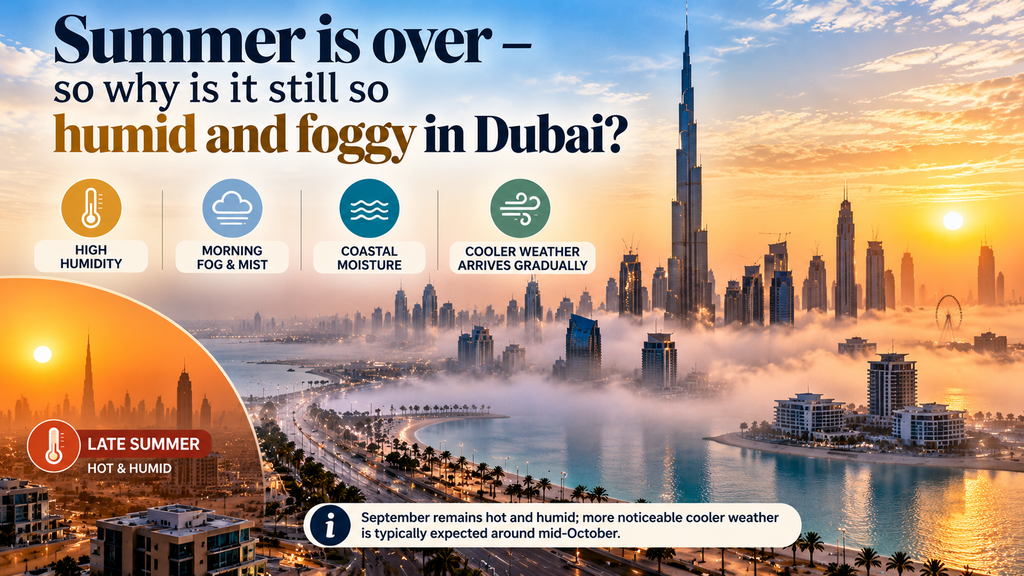
Fog might seem more logical during winter, but the UAE’s transitional months can actually provide an excellent combination of warm seas, humid air and cooler nights.
September is especially interesting because two changes happen at the same time.
The sea remains hot, supplying plenty of moisture.
Meanwhile, nights begin cooling.
That difference helps bring air temperatures closer to the dew point.
Gulf News has reported that fog becomes increasingly common from mid-August onwards and can be particularly frequent from around mid-September through mid-November, with October among the periods when conditions can be especially favourable.
This means the return of fog does not indicate that Dubai is suddenly experiencing unusually cold weather.
In many cases, it is actually part of the transition away from peak summer.
Why doesn’t all that humidity produce rain?
This is a common question.
If the atmosphere contains enough moisture to produce 90 per cent humidity or thick fog, why does Dubai not receive heavy rain every morning?
Because humidity near the surface and rain-producing clouds are two different atmospheric situations.
Fog usually forms within a shallow layer of saturated air close to the ground.
Significant rainfall typically requires much deeper atmospheric processes, including clouds with enough vertical development for droplets or ice particles to grow large enough to fall.
Dubai can therefore experience extremely humid air at ground level while the atmosphere higher above remains unsuitable for meaningful rainfall.
Gulf News notes that the amount of moisture alone does not determine whether rain falls; its distribution and atmospheric movement are also important.
So, heavy humidity does not automatically mean a rainy day is coming.
Why Is Dubai Often Foggiest Early in the Morning?
The timing is closely connected to the daily temperature cycle.
Land surfaces absorb heat during daylight. After sunset, they begin releasing it back into the atmosphere.
As the night progresses, the surface becomes progressively cooler.
Temperatures are generally lowest shortly before or around sunrise.
That is therefore the point when the gap between the actual temperature and the dew point is often smallest.
If the temperature reaches the dew point, condensation begins.
That can produce:
- Dew on cars
- Moisture on windows
- Mist
- Dense fog
- Very low road visibility
Once the sun rises, temperatures begin climbing again.
Warmer air can hold more moisture without becoming saturated, so fog droplets begin evaporating.
This is why one part of Dubai can look almost completely white at 6am and appear bright and clear a few hours later.
Why can fog be extremely localised?
Fog is also remarkably sensitive to local conditions.
One neighbourhood may have dense fog while another part of Dubai several kilometres away remains almost clear.
Factors affecting this include:
- Distance from the coast
- Local wind direction
- Elevation
- Temperature differences
- Nearby open desert
- Moisture availability
- Urban development
- Vegetation
- How quickly surfaces cooled overnight
Fog can also develop more readily in inland areas because land there may cool more efficiently overnight.
That explains why motorists travelling between Dubai and Abu Dhabi, Al Ain or inland communities can suddenly encounter dramatic changes in visibility.
Does Fog Mean Cooler Weather Is Finally Coming?
In a broad seasonal sense, yes, but not immediately.
Foggy mornings during September can be one sign that nights are cooling sufficiently for air temperatures to reach the dew point.
However, that does not mean daytime temperatures are about to fall into winter territory.
The transition normally happens gradually.
The National reported that early-autumn highs can remain close to 39°C, while nighttime temperatures may fall closer to the mid-20s. By early November, conditions typically become significantly cooler, although exact temperatures naturally vary from year to year.
A simplified seasonal progression looks something like this:
| Period | Typical Weather Change |
|---|---|
| Late September | Hot days, humid nights, frequent fog risk |
| Early October | Gradual temperature reduction |
| Mid-October | More noticeable evening comfort |
| Late October | Outdoor season strengthens |
| November | Much more comfortable daytime conditions |
| December | Cooler winter weather established |
The important word is gradual.
There is rarely one morning when Dubai wakes up and summer has completely disappeared.
Instead, there are small milestones: the evening breeze feels slightly cooler, mornings become less oppressive, outdoor dining returns, and eventually daytime temperatures become comfortable enough for extended outdoor plans.
Fog and humidity can exist during much of that transition.
How Dubai Residents Should Deal With Foggy Mornings
The biggest practical problem associated with dense fog is reduced road visibility.
Fog can develop rapidly and, in severe cases, visibility can fall dramatically.
That creates particular problems on high-speed roads where drivers have less time to react to slowing traffic or vehicles ahead.
Authorities regularly issue visibility alerts when dense fog develops.
If you are driving in fog:
- Reduce your speed gradually.
- Leave significantly more distance from the vehicle ahead.
- Use low-beam headlights.
- Avoid using high beams because light can reflect off fog droplets.
- Avoid sudden lane changes.
- Follow electronic speed-limit signs where temporary restrictions are activated.
- Give yourself extra travel time.
- Check official weather and traffic alerts before leaving.
- If visibility becomes dangerously poor, move to a safe location away from active traffic where permitted.
Gulf News notes that UAE authorities advise drivers to reduce speed, increase following distances and use low-beam lights during dense fog conditions.
What about flights?
Dense fog can also affect aviation.
Dubai’s airports operate sophisticated low-visibility procedures, but severe fog can still contribute to delays, altered landing sequences or disruptions depending on conditions.
Passengers travelling early in the morning during a major fog event should therefore check their airline and airport updates before leaving home.
Why do car windows suddenly fog up?
Temperature differences are usually responsible.
Your car’s air conditioning keeps the interior and glass cool. When warm humid outdoor air contacts a colder window surface, moisture can condense.
It is similar to what happens when a cold drink develops droplets on the outside of the glass.
Using your car’s demisting settings and adjusting the air conditioning can normally clear the condensation.
When Will Dubai’s Humidity Finally Ease?
There is no single date when Dubai’s humidity simply switches off.
Moisture levels depend on changing winds, sea temperatures, nighttime cooling and regional weather patterns.
September is often one of the more humid transition periods, and elevated humidity can persist into October and sometimes later.
The bigger improvement usually comes as both air and sea temperatures gradually fall.
That process reduces the amount of evaporation from surrounding waters while creating a generally cooler regional atmosphere.
By the middle and later parts of autumn, Dubai typically begins experiencing the conditions residents wait months for: more comfortable mornings, pleasant evenings and longer periods when outdoor activities feel practical again.
Even then, occasional humid or foggy mornings remain possible.
Dubai is, after all, a coastal city beside an exceptionally warm body of water.
So the next time you step outside on a September morning and wonder why autumn feels suspiciously like summer, the answer is sitting partly offshore.
The Arabian Gulf is still warm, evaporation is still feeding the atmosphere with moisture, and cooler nights are actually helping that moisture turn into mist and fog.
Summer may be over on the astronomical calendar.
Dubai’s atmosphere simply needs a little more time to catch up.
Do follow us on Instagram
Read More – 11 Brilliant Things to Do in Dubai This Weekend, September 25–27