

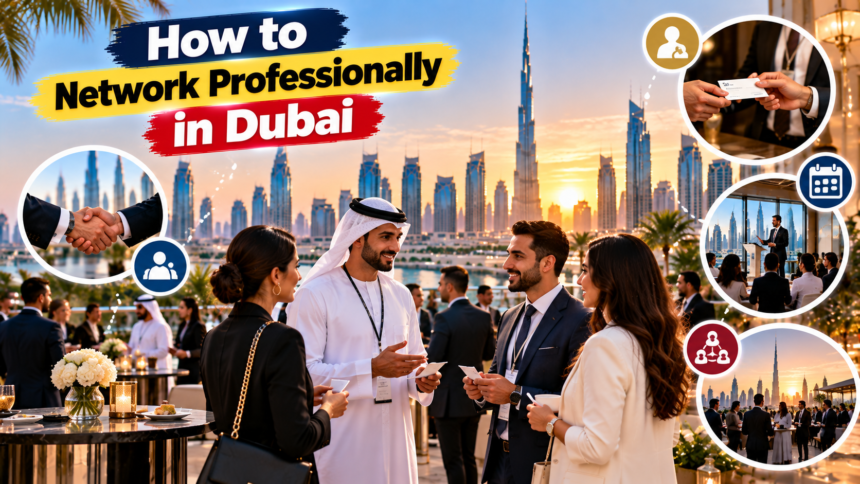
How to Network Professionally in Dubai Without Feeling Transactional
How to network professionally in Dubai is not simply about collecting business cards, attending large events or adding hundreds of people on LinkedIn. Dubai has one of the most internationally connected business environments in the region, but strong professional relationships are usually built through repeated interaction, useful conversations and consistent follow-up rather than one-time introductions.
- How to Network Professionally in Dubai: Quick Guide
- Start With a Clear Networking Goal
- Use Dubai Chamber Business Groups for Industry Connections
- Business Councils Can Help You Build Country-Based Networks
- Attend Industry Events at Dubai World Trade Centre
- Use Conferences for More Than Watching Speakers
- Research Attendees Before the Event
- Build a Strong LinkedIn Profile Before Networking Offline
- Use LinkedIn to Continue Conversations, Not Replace Them
- Improve Your LinkedIn Visibility Before You Need Something
- Attend Smaller Workshops as Well as Large Events
- Explore Dubai’s Startup and Founder Ecosystem
- Use Coworking Spaces Strategically
- Ask for Introductions Instead of Cold Messaging Everyone
- Build Relationships Before Asking for Opportunities
- Learn How to Introduce Yourself in 30 Seconds
- Ask Better Networking Questions
- Listen More Than You Speak
- Do Not Lead With a Sales Pitch
- Exchange Contact Details Naturally
- Follow Up Within One or Two Days
- Use Coffee Meetings to Build Deeper Relationships
- Choose Convenient Meeting Locations
- Be Punctual
- Network Across Nationalities and Industries
- Respect Different Communication Styles
- Use Alumni Networks
- Join Professional Communities Instead of Only Networking Events
- Volunteer Your Expertise
- Attend Career Events if You Are Job Hunting
- Recruiters Should Be Part of Your Network, Not Your Entire Strategy
- Entrepreneurs Should Network Differently From Job Seekers
- Avoid Collecting Contacts Without Building Relationships
- Keep a Simple Networking Tracker
- Do Not Ask for a Job in the First Message
- Do Not Send Your CV Without Context
- Avoid Fake Networking
- Give Before You Ask
- Follow Up Without Becoming Annoying
- Common Professional Networking Mistakes in Dubai
- A 30-Day Dubai Networking Plan
- How Long Does It Take to Build a Professional Network in Dubai?
- How to Network Professionally in Dubai Without Feeling Transactional
The city offers many ways to meet decision-makers, founders, recruiters, investors and professionals from different industries. Dubai Chamber of Commerce operates sector-specific Business Groups and country-specific Business Councils, while Dubai World Trade Centre hosts major international exhibitions and conferences across sectors such as technology, finance, travel, real estate, healthcare and energy.
The challenge is not finding people. It is knowing where to meet the right people, how to start a professional conversation and how to turn a short introduction into a useful long-term connection without sounding overly transactional.
This guide explains practical ways to network in Dubai, including industry events, business councils, LinkedIn, professional communities, conferences, coffee meetings, follow-up messages and common mistakes that can damage your professional reputation.
How to Network Professionally in Dubai: Quick Guide
The most effective networking strategy usually combines online visibility with regular in-person interaction. LinkedIn helps people discover you, industry events introduce you to new contacts, smaller communities create repeated interaction and follow-up turns those introductions into actual professional relationships.
A good network should also be relevant rather than simply large. Knowing 50 professionals who understand your work and would comfortably introduce you to someone else can be far more useful than having thousands of online connections who barely remember your name.
| Networking Channel | Best Use |
|---|---|
| Professional visibility and follow-up | |
| Industry conferences | Meeting people in your sector |
| Dubai Chamber groups | Business and sector relationships |
| Business councils | Country and bilateral business networks |
| Workshops | Smaller, more focused conversations |
| Startup communities | Founders, investors and entrepreneurs |
| Professional associations | Long-term industry connections |
| Coffee meetings | Building deeper one-to-one relationships |
| Alumni networks | Warm introductions |
| Coworking spaces | Repeated informal interaction |
| Career events | Recruiters and employers |
| Volunteering or industry committees | Building trust through contribution |
The strongest approach is to select two or three channels that match your goals and participate consistently rather than attending every event in Dubai.
Start With a Clear Networking Goal
Before attending an event, decide what you are actually trying to achieve. Networking becomes much easier when you know whether you are looking for a job, clients, suppliers, mentors, investors, industry knowledge or simply stronger professional relationships.
Someone searching for a finance role should not use the same networking strategy as a founder looking for investors. Likewise, a marketing freelancer looking for clients needs a different approach from a senior executive trying to build relationships with industry peers.
Define a simple goal for the next three months. It could be meeting 20 professionals in your industry, having five meaningful coffee meetings, attending one relevant event every two weeks or building stronger relationships with people already in your network.
A clear goal helps you choose better events and prevents networking from becoming random social activity.
Use Dubai Chamber Business Groups for Industry Connections
Dubai Chamber of Commerce operates sector-specific Business Groups designed to bring together companies and professionals from the same industry. The Chamber describes these groups as platforms for dialogue, collaboration and engagement between the private sector and government.
Current groups cover sectors including advertising, aviation, automotive, building materials, cybersecurity, accounting and tax, intellectual property, groceries and many others.
These groups can be particularly useful if you are already established in an industry. Instead of attending general networking events where conversations may be unrelated to your work, you can meet professionals who understand the same market challenges.
For entrepreneurs and business owners, they can also provide access to discussions about regulations, industry developments and commercial opportunities.
Business Councils Can Help You Build Country-Based Networks
Dubai Chamber also supports country-specific Business Councils. These groups connect businesses and professionals associated with particular countries and support bilateral commercial relationships.
The current Chamber listing includes councils representing countries and markets such as India, Pakistan, the Philippines, South Africa, Sweden, Switzerland, Turkey, Singapore, New Zealand and many others.
Country-based networking can be useful for newcomers because it provides an immediate point of connection while still creating opportunities to meet people working across different sectors.
However, avoid building your entire Dubai network only around people from your own country. One of the city’s biggest professional advantages is access to an unusually international business community.
Attend Industry Events at Dubai World Trade Centre
Dubai World Trade Centre is one of the city’s main business-event hubs and hosts major exhibitions, conferences and trade shows throughout the year.
Its 2026 calendar includes events covering technology, careers, energy, travel, real estate, healthcare, beauty, aviation and other sectors. Examples include AWS Summit Dubai, Beautyworld Dubai, Airport Show and Global Airport Leaders Forum, WETEX and other major international exhibitions.
DWTC also announced a strong second-half 2026 events calendar featuring major international events and conferences across its venues.
Do not attend every major exhibition simply because it is popular. Choose events where your target employers, clients or industry partners are likely to attend.
Event Selection Checklist
| Question | Yes / No |
|---|---|
| Is the event directly related to my industry? | □ |
| Will decision-makers attend? | □ |
| Are there workshops or smaller sessions? | □ |
| Can I identify speakers or companies in advance? | □ |
| Do I have a clear reason to attend? | □ |
| Can I follow up with people afterwards? | □ |
If most answers are yes, the event is probably worth your time.
Use Conferences for More Than Watching Speakers
Many professionals attend conferences, sit through presentations and leave without speaking to anyone. That means they receive information but miss the main networking opportunity.
A better strategy is to arrive early, stay for networking breaks and speak with people sitting nearby. Ask what brought them to the event or which session they found most useful rather than immediately asking what they can do for you.
Set a realistic target of three to five meaningful conversations per event. That is usually more valuable than trying to introduce yourself to 30 people in one afternoon.
Events such as Seamless Middle East are specifically designed around networking, partnerships and knowledge sharing. The 2026 edition expected more than 25,000 attendees, 800 speakers and 750 exhibitors across areas including e-commerce, payments, retail and fintech.
Large events become much easier when you focus on quality rather than volume.
Research Attendees Before the Event
Networking becomes much more effective when you already know who you would like to meet.
Before attending a conference, review the speaker list, exhibitor directory and event agenda. Search relevant names on LinkedIn and identify people whose work connects with your interests.
Create a short target list rather than trying to meet everyone. You might identify five companies, three speakers and several professionals you would genuinely like to know.
If appropriate, send a short LinkedIn message before the event saying that you will also be attending and would be happy to say hello.
This turns a cold introduction into a much warmer conversation.
Build a Strong LinkedIn Profile Before Networking Offline
People you meet in Dubai will often search your LinkedIn profile soon after the conversation. Your profile therefore acts like a digital business card and should explain clearly what you do.
Your headline should describe your role or expertise rather than only listing your company name. The About section should briefly explain your experience, strengths and professional interests, while your work history should include relevant achievements rather than only responsibilities.
Before attending events, update:
- Professional photo
- Headline
- Current role
- About section
- Skills
- Contact information
- Recent projects
- Relevant achievements
You do not need to turn your profile into a sales page. It simply needs to make it easy for someone to remember why connecting with you makes sense.
Use LinkedIn to Continue Conversations, Not Replace Them
LinkedIn is most useful after a genuine interaction.
Instead of sending hundreds of connection requests to strangers, connect with people you have met at conferences, meetings, workshops or professional communities. Mention where you met so the message has context.
A good connection message is short and specific. For example, you can mention the event, the topic you discussed and that you enjoyed the conversation.
Once connected, do not immediately send a sales pitch or CV unless the person specifically asked for it. Continue the relationship naturally.
The goal is recognition and trust, not instant conversion.
Improve Your LinkedIn Visibility Before You Need Something
Networking becomes harder when the first time someone hears from you is when you need a job, introduction or client.
Post useful professional content occasionally. You can share lessons from your work, industry observations, conference takeaways, project insights or thoughtful comments on relevant developments.
You do not need to become a daily content creator. One useful post every week or two can be enough to remind your network what you work on.
Commenting thoughtfully on other professionals’ posts can also build visibility without requiring you to constantly create original content.
Over time, your name becomes familiar before you ever send a direct message.
Attend Smaller Workshops as Well as Large Events
Large conferences provide access to thousands of people, but smaller workshops often create better conversations because participants spend more time together.
Dubai Chambers specifically promotes workshops, industry forums and networking sessions through its engagement programmes.
Smaller events can make it easier to speak with speakers, organisers and other participants without competing with hundreds of people for attention.
Use a combination of event sizes. Large conferences help you discover people and companies, while small workshops allow stronger relationships to develop.
For professionals who dislike crowded networking events, workshops can be a much more comfortable starting point.
Explore Dubai’s Startup and Founder Ecosystem
Dubai has developed a large ecosystem around founders, technology companies, investors and small businesses.
Dubai SME launched Majlis Al Mustaqbal in April 2026 at Dubai Founders HQ, bringing aspiring entrepreneurs together with industry experts, mentors and government professionals for business-model development, pitch preparation and collaboration.
Programs like this show that founder networking does not only happen at investor conferences. Mentoring sessions, workshops and ecosystem programmes can provide more useful access for early-stage entrepreneurs.
Founders should look for communities where they can contribute before asking for investment. Sharing knowledge, giving introductions or helping another founder creates stronger relationships than immediately pitching every investor you meet.
Use Coworking Spaces Strategically
Coworking spaces can be useful networking environments because the same people return repeatedly. That repetition makes relationship-building much easier than attending a one-off event.
Professionals working remotely can choose a coworking location connected to their sector or business community. Some spaces organise workshops, founder talks, investor sessions or member networking activities.
Do not treat the space like a permanent networking event. People are there to work, so respect their time and allow relationships to develop naturally.
Simple repeated interactions, such as sharing coffee or discussing an event, often create stronger connections than aggressive introductions.
Ask for Introductions Instead of Cold Messaging Everyone
Warm introductions are one of the most effective networking tools.
If someone in your network knows a person you genuinely want to meet, ask politely whether they would feel comfortable introducing you. Explain why the connection makes sense so they can decide whether the introduction is appropriate.
Do not make the person feel obligated. A good request might explain that you are researching a particular sector and would value a short conversation with someone experienced in that area.
Warm introductions work because trust transfers partially from the person making the connection.
They should therefore be used carefully rather than for mass outreach.
Build Relationships Before Asking for Opportunities
One of the quickest ways to damage a networking relationship is asking for too much too quickly.
Meeting someone once does not automatically mean they should recommend you for a job, introduce you to investors or send clients your way.
Start with a smaller interaction. Ask for perspective, share something useful or continue a conversation you already had.
Over time, stronger requests become more natural because the other person understands your character, skills and intentions.
Networking works better when both people know why maintaining the relationship is worthwhile.
Learn How to Introduce Yourself in 30 Seconds
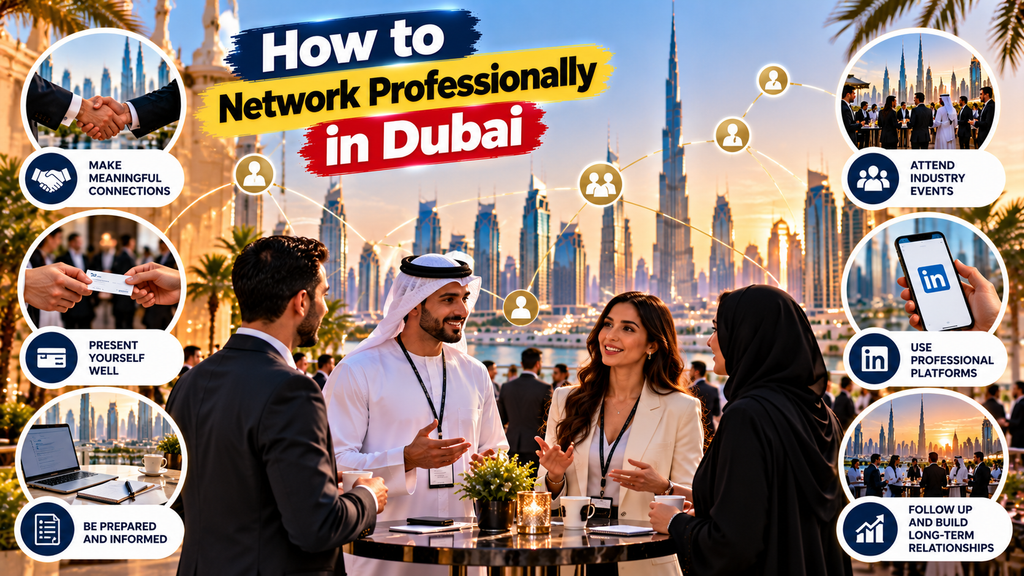
A clear professional introduction makes networking conversations much easier.
Your introduction should answer three questions: who you are, what you do and what type of work or area interests you.
For example, instead of saying, “I work in marketing,” you could explain that you work in digital marketing for hospitality and lifestyle brands across the GCC and currently focus on growth campaigns and content strategy.
30-Second Introduction Structure
| Part | What to Say |
|---|---|
| Name | Who you are |
| Role | What you currently do |
| Expertise | What you are good at |
| Context | Why you are at the event |
| Conversation opener | Ask about the other person |
The final part matters most. A good introduction should create a conversation rather than become a speech.
Ask Better Networking Questions
Generic questions such as “What do you do?” are fine, but better questions usually lead to more memorable conversations.
Ask about the person’s current priorities, what brought them to the event or what changes they are seeing in their industry.
Useful networking questions include:
- What brought you to this event?
- What kind of projects are you focused on right now?
- What changes are you seeing in your industry in Dubai?
- Which part of the market is growing fastest for you?
- How did you move into your current role?
- Which session has been most useful today?
These questions create real discussion without sounding like an interview.
Listen More Than You Speak
Networking is not a competition to deliver the longest introduction.
People usually remember conversations where they felt heard. Ask a question, listen carefully and build your next question from their answer.
Avoid constantly steering the conversation back toward yourself. If someone mentions a challenge in their business, do not immediately interrupt with a sales pitch unless your solution is genuinely relevant and the conversation naturally moves there.
Strong listeners often create better professional impressions than people who aggressively promote themselves.
Do Not Lead With a Sales Pitch
Dubai has a highly active business-development culture, which means professionals frequently receive sales messages.
If every new interaction begins with a pitch, people quickly become defensive.
Build context first. Understand what the person or company actually does before explaining how your service might help.
When there is a genuine fit, a follow-up meeting is usually a better place for a detailed business discussion than a five-minute conversation at an event.
Networking should open doors, not force immediate decisions.
Exchange Contact Details Naturally
Business cards are still used, but LinkedIn and QR-based contact sharing have become increasingly practical.
If the conversation went well, simply ask whether the person would like to connect on LinkedIn or exchange details.
Save a small note after the conversation. Record what you discussed, where you met and anything you promised to send.
Without that note, several conversations from the same conference can quickly become difficult to remember.
Your follow-up becomes much stronger when it references a specific topic rather than saying only, “Great meeting you yesterday.”
Follow Up Within One or Two Days
Networking value is usually created after the event.
Send a short message while the conversation is still fresh. Mention where you met, refer to one specific topic and keep the message focused.
Good follow-up should be easy to reply to. If you discussed an article, report or introduction, send it. If you agreed to have coffee, suggest a simple time window.
Do not send a long company presentation unless the person requested it.
The purpose of the first follow-up is to keep the relationship alive, not close a deal immediately.
Use Coffee Meetings to Build Deeper Relationships
Dubai has a strong business-meeting culture around cafés, hotel lounges and coworking spaces.
Once you have met someone briefly, a 20-to-30-minute coffee can provide enough time to understand each other’s work properly.
Keep the invitation specific. Instead of saying, “We should catch up sometime,” suggest a purpose such as discussing the sector, exchanging ideas or learning more about each other’s work.
Respect the other person’s schedule and keep the meeting within the agreed time unless both of you choose to continue.
Short, useful meetings often lead to future opportunities naturally.
Choose Convenient Meeting Locations
Dubai’s size means meeting location matters.
A coffee that requires someone to drive 45 minutes across the city is a much bigger request than a meeting near their office.
When suggesting a meeting, ask which area is convenient or offer a location near their workplace.
Meeting Location Checklist
| Factor | Why It Matters |
|---|---|
| Close to both people | Reduces travel burden |
| Parking available | Important for drivers |
| Metro nearby | Useful for public transport |
| Quiet enough to talk | Better conversation |
| Easy to find | Prevents delays |
| Reasonable price | Keeps meeting comfortable |
Convenience communicates respect for the other person’s time.
Be Punctual
Dubai business culture can include busy schedules, traffic and back-to-back meetings, so punctuality matters.
Plan extra travel time if you are meeting someone during peak traffic periods. If you realise you will be late, inform the person before the scheduled time rather than arriving silently.
For online meetings, join a few minutes early and test your microphone and camera beforehand.
Reliability in small interactions helps people decide whether they would trust you with larger professional commitments.
Network Across Nationalities and Industries
Dubai’s international population is one of its biggest networking advantages.
If you attend only communities connected to your own nationality, company or industry, you may miss many of the relationships that make Dubai professionally valuable.
Dubai Chamber’s ecosystem reflects this diversity through both industry-specific Business Groups and country-specific Business Councils.
Build a network with multiple layers: people in your own industry, people in adjacent industries, entrepreneurs, recruiters and professionals from different cultural backgrounds.
Cross-industry relationships often create unexpected opportunities.
Respect Different Communication Styles
Dubai workplaces and business communities include people from many cultural backgrounds.
Some professionals communicate very directly, while others prefer more relationship-building before discussing business. Some respond immediately to messages, while others may take several days.
Avoid interpreting every difference as lack of interest. Observe how the other person communicates and adjust appropriately.
Being adaptable does not mean changing your personality. It means recognising that your preferred style is not the only professional style.
This skill becomes particularly valuable in international teams.
Use Alumni Networks
University, school and previous-employer networks can provide warm connections in Dubai.
Search LinkedIn for alumni from your institution who are currently based in the UAE. Do not immediately ask for a job. Introduce yourself, mention the shared background and ask a relevant professional question.
Alumni connections work because there is already some common context. That makes a message feel less random than a cold approach.
Professional associations and former-company communities can work in a similar way.
Join Professional Communities Instead of Only Networking Events
A community differs from a networking event because members interact repeatedly.
This could be an industry association, business group, founder community, professional workshop series or volunteer committee.
Repeated interaction builds familiarity, which is one of the foundations of trust.
Choose communities where you can participate actively. Attend consistently, ask useful questions and contribute when appropriate.
People are more likely to remember someone they have seen five times than someone who introduced themselves once at a crowded event.
Volunteer Your Expertise
One of the strongest ways to network is to become useful.
You might volunteer to speak at a workshop, mentor younger professionals, help organise an industry event or contribute to a committee.
Contribution changes the relationship. Instead of being someone looking for access, you become someone adding value to the community.
This can also demonstrate your expertise much more convincingly than repeatedly telling people how experienced you are.
Choose opportunities where your contribution is genuine rather than treating volunteering as disguised self-promotion.
Attend Career Events if You Are Job Hunting
Professionals looking for employment should include career fairs and industry recruitment events in their networking plan.
Dubai World Trade Centre’s 2026 calendar includes Ru’ya Careers UAE, demonstrating the continued role of large career-focused events in Dubai’s professional ecosystem.
Career events allow candidates to understand which companies are hiring, speak directly with representatives and learn how employers describe their current priorities.
Do not simply hand out CVs. Ask informed questions, learn the recruiter’s name and connect afterwards when appropriate.
A short professional conversation is more memorable than being one of hundreds of resumes submitted without context.
Recruiters Should Be Part of Your Network, Not Your Entire Strategy
Recruitment consultants can be valuable because they understand hiring patterns and may know about roles not widely advertised.
However, relying entirely on recruiters limits your network.
Build relationships with hiring managers, industry peers and former colleagues as well. Many opportunities begin through internal referrals or professional introductions before they reach public job boards.
When contacting recruiters, be specific about the role, sector and seniority you are targeting rather than sending a generic CV with “Please find me a job.”
Clear positioning makes it easier for someone to remember when you are relevant.
Entrepreneurs Should Network Differently From Job Seekers
A founder should not attend events with the same goals as someone searching for employment.
Entrepreneurs need relationships with customers, suppliers, investors, advisors, government ecosystem partners and other founders.
Dubai Chambers says its Business Hub provides access to networking events, country briefings, workshops and business-matching meetings designed to help companies identify growth opportunities and connect with industry leaders.
Founders should prioritise conversations that help them understand the market. A valuable introduction to a potential customer can be more important than meeting a famous investor who has no interest in the sector.
Networking becomes more effective when it follows the company’s actual business priorities.
Avoid Collecting Contacts Without Building Relationships
A phone full of numbers is not automatically a professional network.
If you meet someone once and never communicate again, that connection has very limited value.
Contact vs Relationship
| Contact | Relationship |
|---|---|
| You exchanged details once | You have spoken multiple times |
| They vaguely remember you | They understand what you do |
| No trust has developed | Some trust exists |
| Asking for help feels random | Requests have context |
| Little mutual value | Both sides can contribute |
Your goal should be moving a small number of useful contacts toward genuine relationships rather than continuously adding new names.
Keep a Simple Networking Tracker
Professionals who attend many events can benefit from a simple spreadsheet or notes system.
Track the person’s name, company, where you met, what you discussed, when you followed up and whether there is a logical next step.
| Name | Company | Met At | Topic | Follow-Up |
|---|---|---|---|---|
| ______ | ______ | ______ | ______ | ______ |
| ______ | ______ | ______ | ______ | ______ |
| ______ | ______ | ______ | ______ | ______ |
This does not need to become a complicated CRM.
The purpose is simply to remember relationships and avoid sending the same generic message months later.
Do Not Ask for a Job in the First Message
When job hunting, it can be tempting to connect with a senior professional and immediately ask whether their company has vacancies.
A better approach is to show genuine interest in their work or industry and gradually understand whether there is a relevant opportunity.
If you do want career advice, ask a specific question. For example, you might ask which skills are currently most important in their sector or what someone entering the Dubai market should understand.
If a role becomes available and they know you well enough, the conversation can naturally move toward employment.
Do Not Send Your CV Without Context
Sending a CV to every new contact creates unnecessary pressure.
If someone specifically offers to review or forward your CV, send it promptly and make the document easy to understand.
Otherwise, keep the conversation focused on the relationship.
When sending a CV after an invitation, briefly remind the person which type of role you are targeting. That makes it easier for them to understand where the document might be relevant.
Your contacts should not have to guess what kind of opportunity you want.
Avoid Fake Networking
Professional events sometimes attract people who move rapidly from person to person, delivering the same rehearsed pitch and collecting contact details.
That behaviour is usually obvious.
Slow down enough to have real conversations. If you meet only three useful people at an event, the evening can still be highly successful.
A professional network develops over months and years. Trying to force immediate results can make interactions feel transactional and reduce trust.
Give Before You Ask
Networking becomes much easier when you think about what you can contribute.
You might send a useful article, introduce two people who should know each other, share industry information or recommend a supplier.
The value does not need to be large. Even remembering a conversation and sending something genuinely relevant can strengthen the relationship.
Do this naturally rather than keeping a scorecard of favours.
People generally remember professionals who are helpful without constantly expecting something in return.
Follow Up Without Becoming Annoying
There is a difference between professional persistence and repeated pressure.
If someone does not reply to your first message, wait. A polite follow-up after a reasonable period is fine, but sending multiple messages in a few days usually works against you.
Make each follow-up useful. Instead of writing “Just checking again,” provide context, an update or a clear reason for the message.
If there is still no response, move on gracefully.
A strong professional network should never depend on forcing reluctant connections.
Common Professional Networking Mistakes in Dubai
Many networking mistakes come from focusing too heavily on immediate results.
| Common Mistake | Better Approach |
|---|---|
| Attend every event | Choose relevant events |
| Collect hundreds of cards | Build a few real relationships |
| Start with a sales pitch | Start with conversation |
| Ask for a job immediately | Build context first |
| Talk constantly | Listen and ask questions |
| Send generic LinkedIn requests | Mention where you met |
| Never follow up | Message within 1–2 days |
| Follow up aggressively | Give people space |
| Network only with your nationality | Build diverse relationships |
| Attend once and disappear | Participate consistently |
| Ask for introductions without context | Explain why connection matters |
| Treat people only as opportunities | Build mutual value |
Avoiding these habits makes networking feel more natural and usually produces better long-term results.
A 30-Day Dubai Networking Plan
If you have recently moved to Dubai, a simple 30-day plan can help you build momentum without overwhelming your schedule.
During the first week, improve your LinkedIn profile and identify five professional communities, business groups or upcoming industry events relevant to your work. Follow key companies and professionals so you understand the conversations happening in your sector.
During the second week, attend one event and aim for three meaningful conversations. Connect with the people afterwards and send short personalised follow-up messages.
During the third week, invite one or two relevant contacts for coffee and attend a smaller workshop or community session. Start commenting thoughtfully on industry posts so your online visibility supports your offline networking.
During the fourth week, review which activities produced the strongest conversations and decide where to focus next month.
30-Day Networking Tracker
| Goal | Target |
|---|---|
| Relevant events attended | 2–3 |
| Meaningful new contacts | 10 |
| Follow-up messages | 10 |
| Coffee meetings | 2–4 |
| LinkedIn posts | 2 |
| Useful introductions given | 1–2 |
| Professional communities joined | 1–2 |
Consistency matters far more than hitting every number perfectly.
How Long Does It Take to Build a Professional Network in Dubai?
A useful network rarely appears within a few weeks.
You can meet many people quickly because Dubai has a dense calendar of conferences, exhibitions and business events, but trust develops through repeated interaction.
Dubai Chambers actively provides events, networking opportunities, workshops and industry platforms designed to connect businesses, while major venues such as DWTC host a continuous calendar of professional gatherings.
Give yourself several months rather than several days. Attend consistently, follow up, contribute and allow relationships to develop naturally.
A network becomes valuable when people remember you even when you are not in the room.
How to Network Professionally in Dubai Without Feeling Transactional
Understanding how to network professionally in Dubai starts with changing the goal from collecting contacts to building professional familiarity and trust.
Dubai already provides the infrastructure. Dubai Chamber Business Groups connect professionals within industries, Business Councils build country-based commercial relationships and Dubai World Trade Centre hosts major conferences and exhibitions throughout the year.
Your job is to use those opportunities intelligently. Choose events relevant to your industry, research people before attending, introduce yourself clearly and focus on meaningful conversations instead of trying to meet everyone.
Use LinkedIn to support relationships rather than replace them. Follow up within a day or two, mention what you discussed and give the other person a reason to remember the conversation.
Most importantly, contribute before constantly asking for opportunities. Share knowledge, make useful introductions and become someone people are comfortable recommending.
Networking in Dubai becomes much easier once you stop treating every conversation as a transaction. Build relationships consistently, and the jobs, partnerships, clients and introductions are much more likely to follow naturally.
Do follow us on Instagram
Read More – Most Common Job Interview Questions in the UAE: 15 Essential Questions to Prepare