


Traditional Qatari Foods Worth Trying on a First Visit
The traditional Qatari foods worth trying reveal a cuisine shaped by desert life, maritime trade, family hospitality and centuries of cultural exchange across the Gulf. Qatari cooking brings together rice, meat, fish, wheat, dates, dried lime, cardamom, saffron and slow-cooked stews, creating dishes that are usually aromatic rather than extremely spicy.
- Traditional Qatari Foods Worth Trying at a Glance
- Machboos Is Qatar’s National Dish
- Saloona and Thareed Are Essential Qatari Comfort Foods
- Harees and Madrouba Show the Softer Side of Qatari Cuisine
- Margoog Brings Together Lamb, Vegetables and Wheat Dough
- Balaleet and Ragag Make Qatari Breakfast Worth Exploring
- Luqaimat and Qatari Halwa Are Traditional Sweets Worth Trying
- Gahwa, Karak and Dates Are Part of Everyday Qatari Hospitality
- Qatar’s Food Culture Reflects Trade and Cultural Exchange
- Where to Find Traditional Qatari Food in Doha
- How to Eat Qatari Food Respectfully as a Visitor
- Common Mistakes Visitors Make When Trying Qatari Food
- Traditional Qatari Foods Worth Trying on a First Visit
Visit Qatar identifies Machboos as the national dish of Qatar, made with spiced rice and meat, while other favourites include Saloona, Luqaimat, Balaleet, Margoog and Harees. The country’s food traditions also reflect influences from India, the Levant and North Africa.
For visitors, discovering Qatari cuisine can provide a very different experience from simply eating at Doha’s international restaurants. The city has everything from global fine dining to casual cafés, but traditional meals tell a more direct story about local family life, Ramadan traditions and hospitality.
Souq Waqif remains one of the easiest places for visitors to begin. Visit Qatar specifically highlights traditional local food there, including freshly made ragag bread and home-style meals prepared by Qatari women.
The best approach is not to order five rice dishes and assume they all represent the same food culture. A stronger tasting experience should include rice, stew, wheat, bread, dessert and Arabic coffee so you can understand the different textures and cooking traditions within Qatari cuisine.
Traditional Qatari Foods Worth Trying at a Glance
Qatari food ranges from large family rice dishes to simple breads and sweets eaten with coffee. Some dishes are associated with everyday meals, while others become especially important during Ramadan, weddings and family celebrations.
| Dish | What It Is | Best Known For |
|---|---|---|
| Machboos | Spiced rice with meat, chicken or fish | Qatar’s national dish |
| Saloona | Tomato-based meat and vegetable stew | Everyday comfort food |
| Thareed | Bread layered with meat or vegetable stew | Ramadan meals |
| Harees | Wheat and meat cooked until smooth | Ramadan and celebrations |
| Margoog | Lamb and vegetable stew with wheat dough | Traditional family food |
| Madrouba | Beaten rice porridge with meat or seafood | Qatari comfort food |
| Balaleet | Sweet vermicelli topped with egg | Breakfast and dessert |
| Ragag | Very thin crispy bread | Breakfast and street-style food |
| Luqaimat | Fried sweet dumplings | Ramadan dessert |
| Qatari halwa | Saffron and nut-based sweet | Hospitality and celebrations |
| Gahwa | Arabic coffee | Welcoming guests |
| Dates | Local fruit served with coffee | Hospitality tradition |
This variety matters because Qatari cuisine is much broader than Machboos alone. Visitors who try only the national dish will miss many of the foods that appear regularly in local homes.
Machboos Is Qatar’s National Dish
Machboos, sometimes spelled Majboos or Majbous, is the most important dish for first-time visitors to recognise.
Visit Qatar officially describes it as the country’s national dish, made with rice infused with spices and served with meat. Qatar’s Ministry of Culture also identifies Al-Majboos as a central Qatari meal eaten on ordinary days as well as during holidays, weddings and important occasions.
What is Machboos made from?
The dish normally combines long-grain rice with chicken, lamb, meat or fish. The rice absorbs flavour from the stock and spices during cooking, creating a rich but usually balanced taste.
Common flavours can include cardamom, turmeric, cloves and other spices. Dried black lime, known as loomi, is also important in many Gulf dishes because it adds a deep citrus flavour.
Visit Qatar specifically lists saffron, cardamom and loomi among ingredients closely associated with local cuisine.
Why different Machboos can taste completely different
There is no single recipe followed by every household. Local chef Noof Al Marri told Visit Qatar that family spice mixtures differ enough that she can recognise who prepared a Machboos simply from its aroma.
That makes it worth trying the dish in more than one place.
A home-style restaurant may serve a very different version from a modern hotel restaurant.
Which version should visitors order?
Chicken is probably the easiest introduction, but seafood Machboos can be especially interesting because Doha has deep connections with fishing and the sea.
Visitors travelling in a group can order more than one variation and share them.
Saloona and Thareed Are Essential Qatari Comfort Foods
Rice receives a lot of attention in Gulf cuisine, but Qatari stews are equally important.
Saloona and Thareed both demonstrate how meat, vegetables and aromatic spices are used in everyday cooking.
Saloona
Visit Qatar describes Saloona as a thick tomato-based stew flavoured with cardamom, cloves, ginger and black loomi.
It may contain chicken, meat or fish together with vegetables.
The flavour can be deep and aromatic without necessarily being extremely hot from chilli.
Because it is a stew, Saloona can feel much more like everyday home cooking than a large celebration platter.
Thareed
Thareed combines stew with thin bread.
Visit Qatar’s Ramadan guide describes it as crispy flatbread layered with soup or stew made with lamb, chicken or vegetables.
The bread absorbs the sauce and becomes part of the dish rather than simply being served on the side.
Visit Qatar’s food guide also describes versions containing vegetables such as okra, pumpkin and zucchini, with spices including cinnamon and coriander.
Why Thareed matters during Ramadan
Thareed is strongly associated with Ramadan tables in Qatar. Its combination of bread, vegetables and stew makes it filling while remaining soft and easy to eat after a day of fasting.
Visitors travelling during Ramadan may therefore encounter it more frequently on iftar menus.
Harees and Madrouba Show the Softer Side of Qatari Cuisine
Some traditional Qatari dishes are built around a soft, porridge-like texture rather than separate rice grains.
Harees and Madrouba are two important examples.
Harees
Qatar’s Ministry of Culture identifies Al Harees as one of the most famous traditional foods in Qatari and Gulf cuisine. It is commonly prepared for social occasions, holidays and Ramadan.
The dish is based on wheat cooked slowly with lamb or chicken.
According to the Ministry, the wheat may cook for several hours before the meat is incorporated, with the total preparation taking at least four hours in traditional versions. Ghee is commonly added before serving.
The result is smooth, rich and filling.
Madrouba
Madrouba uses rice rather than wheat.
Visit Qatar describes it as a traditional beaten rice porridge that can include meat or seafood. Local chef Noof Al Marri describes it as a classic Qatari comfort food.
The rice is cooked until it breaks down into a thick texture.
Depending on the family recipe, additional ingredients may include spices, tomato, seafood, meat or vegetables.
Why visitors should try both
Harees and Madrouba may look similar at first, but their base ingredients and flavours are different.
Trying them helps visitors understand that Qatari cuisine includes slow-cooked grain dishes as well as the more familiar rice platters.
Margoog Brings Together Lamb, Vegetables and Wheat Dough
Margoog, also written Margoga or Margooga, is another traditional dish worth trying because it combines stew with pieces of wheat dough.
Visit Qatar describes Margoog as a hearty stew made with lamb, vegetables and whole-wheat pasta-like discs.
At traditional Qatari restaurants, the dough absorbs the sauce while cooking, giving the dish a thick and substantial texture.
Vegetables can vary, but the basic idea remains the same: meat, vegetables and dough are cooked together rather than being served as separate components.
How is it different from Thareed?
Thareed usually uses bread layered with stew.
Margoog cooks the wheat dough within the dish itself.
That difference changes both the texture and the way the sauce is absorbed.
Where can visitors try it?
Visit Qatar recommends Shay Al Shoomos in Souq Waqif for traditional local food and specifically mentions Margoga among its specialties.
Traditional restaurants in Doha may spell the dish differently, so visitors should recognise several versions of the name.
Balaleet and Ragag Make Qatari Breakfast Worth Exploring
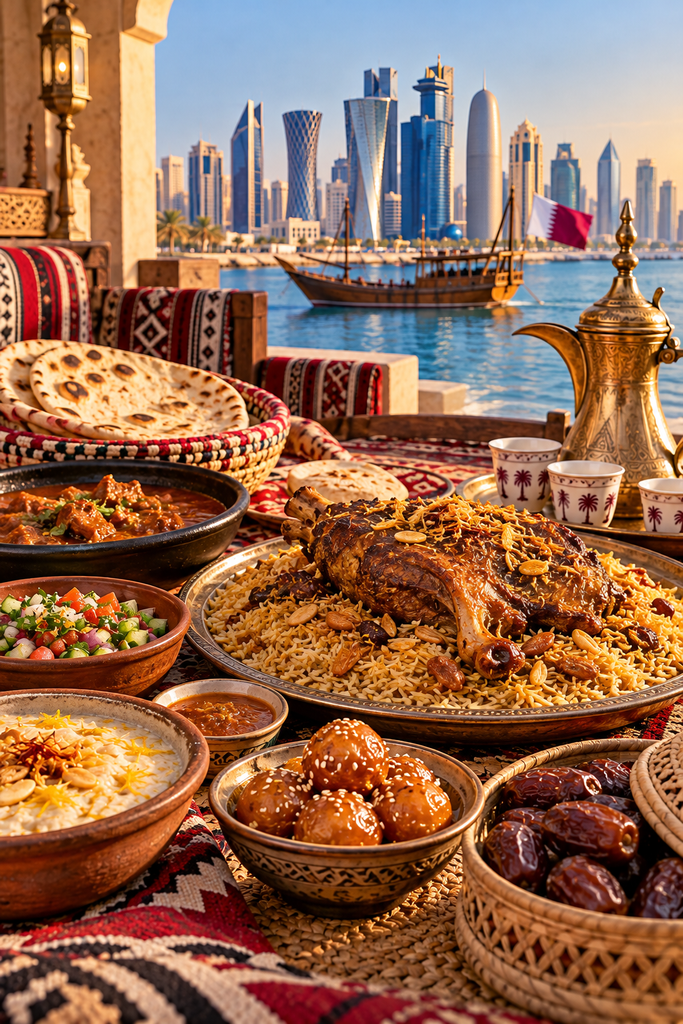
Visitors who only search for traditional food at dinner may miss some of Qatar’s most interesting dishes.
Breakfast is an excellent time to explore local food.
Balaleet
Balaleet combines sweet and savoury flavours in one plate.
Visit Qatar describes it as sautéed vermicelli flavoured with rosewater, cardamom, saffron and turmeric, usually topped with egg.
It can be eaten for breakfast or served as a sweet dish.
The combination may seem unusual to travellers who expect eggs to be entirely savoury, but the contrast is exactly what makes Balaleet distinctive.
Ragag
Ragag is a paper-thin local bread or crêpe with a crisp texture.
Visit Qatar describes it as a popular local snack that can be eaten with cheese, eggs, honey or mahyawa, a strong fish-based condiment.
It is often cooked fresh on a hot surface and is best eaten immediately.
Where should visitors try Ragag?
Visit Qatar specifically recommends the central square in Souq Waqif, where local women prepare traditional food, including fresh Ragag. Shay Al Shoomos is also highlighted for its version.
A simple Qatari breakfast
Visitors could order Balaleet, Ragag, eggs and tea or coffee and share the dishes.
This gives a much broader introduction to local flavours than a standard hotel breakfast buffet.
Luqaimat and Qatari Halwa Are Traditional Sweets Worth Trying
Qatari desserts often combine saffron, cardamom, rosewater, sugar and nuts.
Luqaimat is probably the easiest traditional sweet for first-time visitors to find.
Luqaimat
Visit Qatar describes Luqaimat as deep-fried sweet dumplings flavoured with cardamom and saffron.
The street-food guide adds that the dumplings develop a crisp outer layer and soft centre before being covered with syrup. They are especially popular during Ramadan.
Freshness matters.
Luqaimat are best when they have just been fried rather than after sitting for a long period.
Qatari Halwa
Qatar’s Ministry of Culture records Qatari halwa as part of the country’s culinary heritage.
Its version uses ingredients including sugar, cornstarch, saffron, nuts, rosewater and cardamom, producing an elastic texture that the Ministry notes differs from some neighbouring Gulf varieties.
The dessert may be served during family gatherings and celebrations.
Do not confuse every Gulf halwa
Omani, Bahraini and Qatari halwa can share ingredients while differing in texture and preparation.
For food travellers, comparing regional versions can be particularly interesting.
Gahwa, Karak and Dates Are Part of Everyday Qatari Hospitality
Food culture in Qatar is also about what visitors drink.
Arabic coffee and dates are closely linked to hospitality across the Gulf.
Gahwa
Gahwa is traditional Arabic coffee, typically served in small cups rather than large mugs.
Cardamom is one of the most common flavouring ingredients, and saffron may also be used depending on the preparation.
Guests are often offered dates alongside the coffee, balancing its aromatic bitterness with sweetness.
Why coffee matters culturally
Serving coffee is part of welcoming visitors rather than simply providing caffeine.
At family gatherings, majlis settings and heritage experiences, the way coffee is offered can be as important as the drink itself.
Karak tea
Karak is another major part of Qatar’s contemporary food culture.
It is a strong milk tea influenced by South Asian chai traditions and is widely consumed across the country.
Visit Qatar’s street-food guide notes the popularity of karak shops and describes tea as part of Qatar’s casual local food scene.
Karak is not uniquely Qatari in origin, but it has become deeply embedded in everyday life.
Dates
Dates remain one of the simplest traditional foods visitors can try.
They are served at homes, cultural events, hotels and sometimes alongside Arabic coffee before or after a meal.
Qatar’s Food Culture Reflects Trade and Cultural Exchange
Qatari cuisine developed through both local traditions and contact with neighbouring regions.
Visit Qatar describes its national cuisine as a blend shaped by influences from India, the Levant and North Africa.
This history helps explain why some flavours may feel familiar to travellers from South Asia or other Gulf countries.
Indian influence
The Gulf’s long maritime links with India contributed spices, rice traditions and tea culture.
Karak is one obvious example of how South Asian influence became part of daily Gulf life.
Persian and wider Gulf connections
Rice, dried lime and certain spice combinations appear across several Gulf cuisines.
Visitors may therefore encounter similarities between Qatari, Emirati, Bahraini, Kuwaiti and Saudi dishes.
Levantine influence
Modern Doha also has a very large Levantine food scene.
Visitors should remember that excellent hummus, falafel or shawarma may be popular in Qatar without being specifically traditional Qatari dishes.
Understanding that distinction makes food exploration more accurate.
Where to Find Traditional Qatari Food in Doha
Doha has many international restaurants, so finding local food requires a little more intention.
Souq Waqif is one of the easiest places to start.
Souq Waqif
Visit Qatar repeatedly highlights the souq for traditional Qatari food.
Visitors can find local bread, home-style meals and sweets, particularly around the central areas where Qatari women prepare food.
The surrounding neighbourhood also makes it possible to combine a meal with:
- Market exploration
- Traditional architecture
- Shopping
- Coffee
- Cultural attractions
Shay Al Shoomos
Visit Qatar specifically recommends Shay Al Shoomos in Souq Waqif for local dishes including Margoog and Ragag.
It is particularly associated with traditional breakfast and home-style food.
Look beyond tourist restaurants
Visitors can also find Qatari cuisine in:
- Heritage restaurants
- Family-run restaurants
- Cultural venues
- Local cafés
Ask whether the menu contains traditional dishes rather than simply relying on the phrase “Arabic restaurant.”
National Museum area
Qatari chefs and local food concepts can also be found around cultural destinations. Visit Qatar has previously highlighted local chef Noof Al Marri and her work presenting traditional Qatari flavours in a contemporary setting.
Modern presentation does not necessarily make food less authentic if the recipes and ingredients remain connected to local traditions.
How to Eat Qatari Food Respectfully as a Visitor
Visitors are not expected to know every local dining custom, particularly in modern restaurants.
Simple respect is enough in most situations.
Expect shared dishes
Machboos and other large meals may arrive on communal platters.
If dining with local hosts, wait for them to begin or follow their lead.
Use the right hand in traditional settings
When eating directly by hand, the right hand is traditionally preferred.
If cutlery is provided, visitors can use it normally.
There is no need to imitate traditional eating styles if you are uncomfortable doing so.
Do not over-order
Rice, meat and stew dishes can be generous.
Ask how many people a dish serves before ordering several large mains.
Sharing is often the best way to taste more foods while reducing waste.
Ask what the restaurant recommends
Instead of immediately ordering the most familiar item, ask:
“Which dishes are specifically Qatari?”
This helps distinguish local cuisine from broader Middle Eastern food.
Respect Ramadan dining culture
During Ramadan, dishes such as Harees, Thareed and Luqaimat become especially important on local tables.
Visitors do not need to participate in fasting, but understanding the role these foods play during iftar adds useful cultural context.
Common Mistakes Visitors Make When Trying Qatari Food
One common mistake is ordering only Machboos and assuming that one dish represents the entire cuisine.
Machboos is the national dish, but Saloona, Thareed, Harees, Margoog, Madrouba and breakfast foods reveal very different textures and traditions.
Another mistake is confusing all Arabic food with Qatari cuisine. Shawarma, hummus and falafel are widely available in Doha, but their popularity does not make them specifically Qatari.
Visitors should also avoid skipping breakfast. Balaleet and Ragag are among the easiest traditional foods to try, particularly in Souq Waqif.
Another mistake is assuming expensive restaurants automatically provide the most authentic experience. Simple local cafés and home-style restaurants may offer dishes closer to everyday family cooking.
Finally, food travellers should not expect every Qatari dish to be intensely spicy. Cardamom, saffron, dried lime, cinnamon and other aromatics often provide depth without overwhelming chilli heat.
Traditional Qatari Foods Worth Trying on a First Visit
If your time in Doha is limited, choose dishes that represent different parts of the cuisine rather than ordering several similar meals.
A useful first-time tasting list could include:
| Food Experience | Dish to Try |
|---|---|
| National dish | Machboos |
| Stew | Saloona |
| Ramadan dish | Thareed |
| Wheat dish | Harees |
| Traditional stew | Margoog |
| Comfort food | Madrouba |
| Breakfast | Balaleet |
| Bread | Ragag |
| Sweet | Luqaimat |
| Traditional dessert | Qatari halwa |
| Drink | Gahwa or karak |
| Hospitality | Dates |
This combination gives visitors rice, wheat, bread, meat, vegetables, dessert and traditional drinks within a manageable food experience.
The traditional Qatari foods worth trying demonstrate that Qatar’s cuisine is much broader than the rice platters many visitors initially associate with the Gulf.
Machboos remains essential because Visit Qatar identifies it as the national dish, but Saloona and Thareed reveal the importance of slow-cooked stews, while Harees and Madrouba show how wheat and rice can be transformed into softer comfort foods.
Balaleet and Ragag make breakfast worth exploring, while Luqaimat and Qatari halwa introduce the saffron, cardamom and rosewater flavours found in traditional sweets.
Visitors should also leave room for the everyday side of local culture. A small cup of gahwa with dates or a roadside karak can be just as important to understanding Qatar as an elaborate restaurant meal.
The strongest Qatari food experience therefore combines celebration dishes with ordinary food.
Try Machboos, but also eat Ragag.
Order a traditional stew, but also have Balaleet for breakfast.
Taste Luqaimat while they are fresh.
And when possible, visit Souq Waqif, where local food, markets and Qatari heritage come together in one of Doha’s most accessible cultural settings.
Do follow us on Instagram
Read More – Traditional Omani Dishes You Should Know: A Food Guide for Visitors