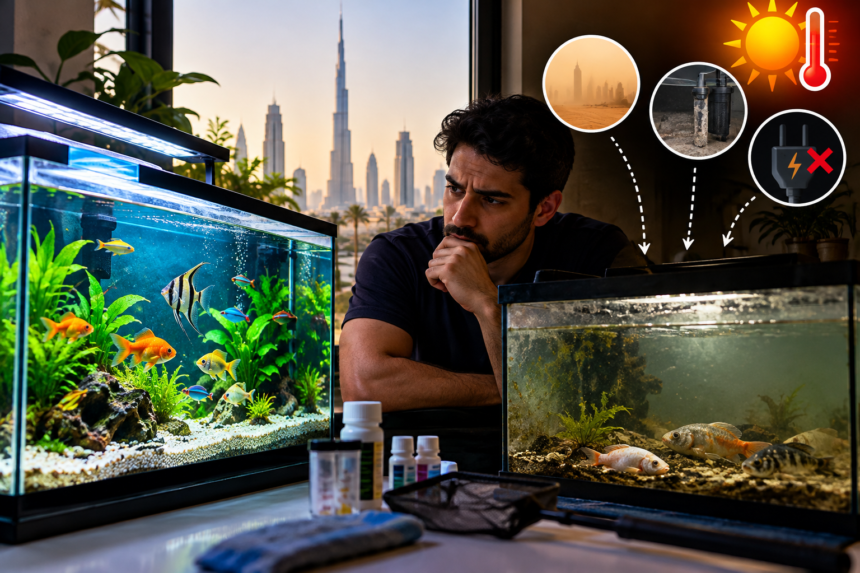
New Tank Syndrome Can Kill Fish Before Beginners Realise Anything Is Wrong
Keeping Fish in the UAE can look surprisingly easy at first. You buy a tank, add water, install a filter, choose a few colourful fish and assume regular feeding will do the rest. The problem is that an aquarium is not simply a decorative container. It is a small biological system, and when one part of that system becomes unstable, problems can develop quickly.
- Keeping Fish in the UAE Starts With Understanding the Nitrogen Cycle
- New Tank Syndrome Can Kill Fish Before Beginners Realise Anything Is Wrong
- UAE Summer Heat Can Become a Serious Aquarium Problem
- A Power Cut Is Really an Oxygen Emergency
- Your Filter Can Become a Problem During a Long Power Outage
- UAE Tap Water Needs to Be Prepared Before It Enters the Tank
- Sudden Water Changes Can Be Worse Than Slightly Imperfect Water
- Overfeeding Can Crash a Tank Faster Than Most Beginners Expect
- Overstocking Makes Every Other Aquarium Problem More Dangerous
- Small Tanks Are Often Harder Than Large Tanks
- Cleaning the Filter Too Well Can Destroy the Tank’s Biological Stability
- Clear Water Does Not Mean Safe Water
- Fish Gasping at the Surface Is an Emergency Signal
- Direct Sunlight Is More Dangerous in the UAE Than Many Owners Realise
- Saltwater Tanks Have Even Less Room for Error
- Buying Fish Without Quarantine Can Introduce Disease to the Entire Aquarium
- Going on Holiday Is When Many UAE Tanks Become Vulnerable
- What to Do When the Tank Is Already Crashing
- Common Mistakes That Cause Aquarium Crashes in the UAE
- Keeping Fish in the UAE: A Practical Prevention Checklist
The UAE also creates some specific challenges. High summer temperatures can push aquarium water warmer than expected, especially if home air conditioning fails or electricity is interrupted. Warm water holds less dissolved oxygen, which can make heat and poor circulation particularly dangerous for heavily stocked tanks. The U.S. Geological Survey confirms that warmer water contains less dissolved oxygen, while fish and beneficial bacteria both depend on that oxygen to survive.
Water chemistry is another issue new owners often underestimate. A tank that looks crystal clear can still contain dangerous levels of ammonia or nitrite. New aquariums need time to develop biological filtration, and veterinary guidance describes “new tank syndrome” as one of the most common causes of fish deaths in newly established aquariums.
The biggest lesson is simple: most aquarium crashes do not happen because fish are inherently difficult to keep. They happen because the invisible systems supporting them were misunderstood, neglected or changed too quickly.
Keeping Fish in the UAE Starts With Understanding the Nitrogen Cycle
The nitrogen cycle is the foundation of a healthy aquarium.
Fish release ammonia through waste and directly through their gills. Left untreated, ammonia can quickly become toxic. Beneficial bacteria living mainly in the filter convert ammonia into nitrite and then convert nitrite into nitrate, which is generally less toxic and can be controlled through water changes and plant growth.
A new tank does not automatically contain enough of these bacteria.
That means adding several fish immediately after filling a brand-new aquarium can create a rapid ammonia spike.
Veterinary guidance says a naturally cycling aquarium often takes around four to six weeks to establish adequate biological filtration. Fish should ideally be added only after ammonia and nitrite have reached zero and the system is stable.
Basic nitrogen cycle
| Stage | What Happens | Risk |
|---|---|---|
| Fish waste and food | Produce ammonia | Highly toxic |
| First bacteria group | Converts ammonia to nitrite | Nitrite is also toxic |
| Second bacteria group | Converts nitrite to nitrate | Safer at controlled levels |
| Water changes/plants | Reduce nitrate | Maintains long-term stability |
This is why a tank can crash even when the water looks clean.
Ammonia and nitrite are invisible.
The only reliable way to know what is happening is to test the water.
New Tank Syndrome Can Kill Fish Before Beginners Realise Anything Is Wrong
One of the most common beginner mistakes is buying a tank and fish on the same day.
The aquarium may look perfect for the first few days, which creates false confidence. Then fish begin breathing heavily, hiding, losing appetite or dying.
PetMD describes new tank syndrome as the most common cause of death in newly set-up fish tanks and explains that the problem occurs when biological filtration has not yet become established. Toxic ammonia and nitrite can rise quickly during this period.
Common warning signs include:
- Rapid breathing
- Gasping near the surface
- Lethargy
- Loss of appetite
- Red or irritated gills
- Sudden deaths
If ammonia or nitrite appears in a stocked aquarium, partial water changes and close monitoring become important.
A complete tank clean is usually not the solution.
In fact, excessively cleaning filter media or replacing all filter material at once can remove much of the beneficial bacterial population and make the biological instability worse.
UAE Summer Heat Can Become a Serious Aquarium Problem
Heat is one of the biggest UAE-specific aquarium risks.
The aquarium itself may be indoors, but its temperature is heavily influenced by room conditions.
During normal operation, home air conditioning may keep a tropical aquarium within a comfortable range. If the AC fails while nobody is home, however, room temperature can rise significantly and the aquarium follows.
Warm water creates two problems simultaneously.
First, fish species have specific preferred temperature ranges. Prolonged temperatures outside that range can cause physiological stress. Second, warm water physically holds less dissolved oxygen than cooler water.
That means heat can create a dangerous combination:
Higher temperature + lower available oxygen + faster fish metabolism
This is particularly important for:
- Heavily stocked tanks
- Large fish
- Marine tanks
- Reef systems
- Tanks with weak surface movement
- Aquariums receiving direct sunlight
Keeping an aquarium beside a sunny window or on a balcony is therefore a bad idea in the UAE.
Temperature should be measured rather than guessed.
A Power Cut Is Really an Oxygen Emergency
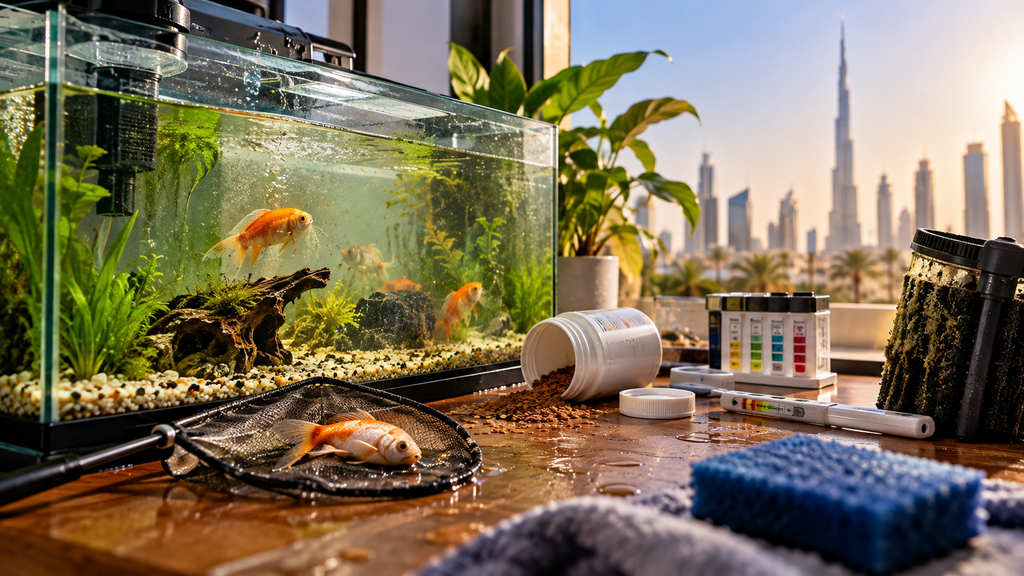
When electricity fails, aquarium lights are usually the least important concern.
The bigger problem is that filtration, circulation, air pumps and possibly chillers stop operating.
Without surface movement, the exchange of oxygen between air and water decreases. Fish and beneficial bacteria continue consuming oxygen, while warm water already holds less of it.
There is no single guaranteed number of hours that every aquarium can survive without power. Risk depends on stocking, species, tank volume, temperature and how much aeration the system had before the outage. Current UAE aquarium guidance similarly recommends judging the fish, temperature and flow rather than relying on a universal “safe” outage duration.
Useful emergency equipment
| Backup Item | Why It Helps |
|---|---|
| Battery air pump | Maintains oxygen and surface movement |
| Power bank/USB air pump | Useful for shorter outages |
| Thermometer | Shows whether heat is becoming dangerous |
| Spare batteries | Keeps emergency aeration running |
| Water test kit | Checks ammonia after the outage |
| Dechlorinator | Allows emergency water changes |
A battery-powered air pump is one of the simplest emergency tools a UAE aquarium owner can keep.
If the fish begin gathering at the surface and breathing rapidly, oxygen may already be becoming inadequate.
Your Filter Can Become a Problem During a Long Power Outage
Filters are usually considered the heart of the aquarium, but a long outage can change what happens inside them.
Beneficial nitrifying bacteria require oxygen.
When circulation stops for an extended period, bacteria within filter media can become oxygen-starved and some may die. A closed canister filter can be particularly vulnerable because stagnant water remains trapped inside with organic waste.
After a significant outage, aquarium owners should not always assume that restarting every device immediately is the safest move.
Inspect the filter first, particularly if the water inside smells foul.
A long outage can also reduce biological filtration capacity, so ammonia and nitrite should be monitored for several days after power returns.
General aquarium guidance recommends reducing feeding and checking water chemistry after an outage because the biological filter may need time to recover.
The filter may restart electrically while the biological system inside it is still damaged.
That distinction matters.
UAE Tap Water Needs to Be Prepared Before It Enters the Tank
Tap water should not normally be poured directly into a fish tank without treatment.
Municipal drinking water may contain disinfectants used to keep water safe for human consumption, and chlorine or chloramine can harm aquarium animals and beneficial bacteria.
Veterinary aquarium guidance recommends using a water conditioner on tap water before adding it to an aquarium.
Water source conditions can also vary after the municipal supply enters a building.
DEWA has historically noted that potable water meets quality standards up to the meter, while water stored in building tanks and internal systems can be affected by maintenance conditions after that point.
For aquarium owners, this means source water should be tested rather than assumed to be identical everywhere.
Useful parameters include:
- pH
- General hardness
- Carbonate hardness
- Chlorine/chloramine treatment
- Nitrate
- Temperature
Do not chase a “perfect” pH number unnecessarily.
Stable water that suits the fish species is generally more important than constantly adding chemicals to force the water toward a specific value.
Sudden Water Changes Can Be Worse Than Slightly Imperfect Water
One of the most dangerous habits in aquarium keeping is correcting every problem aggressively.
Owners see cloudy water or a strange test result and change nearly all the water at once.
That can expose fish to sudden differences in:
- Temperature
- pH
- Mineral content
- Osmotic conditions
Veterinary guidance on new tank syndrome recommends partial rather than excessive water changes and notes that changes should be more gradual when the replacement water differs significantly in pH from the aquarium.
For established tanks, PetMD gives basic maintenance examples of around 10% weekly or 25% every other week, although the correct schedule depends on stocking, tank size and test results.
The objective is consistency.
A stable tank with a sensible maintenance schedule is usually safer than an aquarium that alternates between neglect and aggressive deep cleaning.
Overfeeding Can Crash a Tank Faster Than Most Beginners Expect
Fish often appear hungry whenever somebody approaches the aquarium.
That does not mean they need another meal.
Overfeeding creates excess organic waste. Uneaten food decomposes, fish produce more waste and the biological filter has to process a greater ammonia load.
Veterinary fish guidance identifies overfeeding as a common cause of poor aquarium water quality.
The problem can create a chain reaction:
Too much food → More waste → More ammonia → More bacterial activity → Lower oxygen → Stressed fish
This becomes even more dangerous in a warm UAE aquarium because dissolved oxygen may already be reduced.
A heavily stocked, overfed tank running warm has much less margin for error than a lightly stocked, well-maintained system.
Feed according to the species and observe how much food is actually being consumed.
Food sitting on the bottom is not generosity.
It is future pollution.
Overstocking Makes Every Other Aquarium Problem More Dangerous
Many aquarium crashes begin with one simple decision: adding one more fish.
Then another.
A tank may physically have enough room for several fish to fit inside, but that does not mean the filtration system can safely process their combined waste.
More fish means:
- More ammonia
- More oxygen consumption
- More carbon dioxide
- More competition
- More stress
- Faster nitrate accumulation
Overstocking also reduces the aquarium’s ability to survive emergencies.
During a power cut, for example, a lightly stocked tank generally has a larger oxygen reserve per fish than a crowded aquarium.
Species compatibility also matters.
Two fish may be physically small but completely inappropriate tankmates because of aggression, territorial behaviour or different water requirements.
Stock the aquarium according to adult fish size and biological load, not how small the animals look in the shop.
Small Tanks Are Often Harder Than Large Tanks
Many beginners assume a tiny aquarium will be easier.
Usually, the opposite is true.
A small volume of water changes more quickly.
If too much food enters a 20-litre tank, ammonia concentration can rise rapidly. If the room heats up, water temperature changes faster. If a fish dies unnoticed, decomposition has a much greater impact.
Larger aquariums provide more dilution and thermal stability.
This does not mean everyone needs a huge tank.
It means beginners should avoid choosing extremely small systems simply because they appear easy to maintain.
Small vs larger aquarium
| Factor | Small Tank | Larger Tank |
|---|---|---|
| Temperature stability | Lower | Better |
| Waste dilution | Low | Higher |
| Stocking flexibility | Limited | Better |
| Error tolerance | Low | Higher |
| Initial cost | Lower | Higher |
| Long-term stability | Often harder | Usually easier |
The most forgiving beginner aquarium is often a moderate-sized, lightly stocked tank rather than the smallest option available.
Cleaning the Filter Too Well Can Destroy the Tank’s Biological Stability
This is one of the least intuitive aquarium lessons.
The filter contains waste, so beginners assume it should be scrubbed until perfectly clean.
But the filter also contains beneficial bacteria responsible for converting ammonia and nitrite.
Replacing all biological media or disinfecting the filter can remove those bacteria and trigger a new cycle.
That means a mature tank can suddenly behave like a brand-new aquarium.
When cleaning biological filter media, hobbyists generally avoid using untreated chlorinated tap water directly on the media and avoid replacing all media simultaneously unless necessary.
Instead, mechanical waste can be removed while preserving the biological colony.
If a filter cartridge manufacturer tells you to replace media routinely, consider whether that cartridge also provides biological filtration and how the replacement will affect bacterial stability.
The objective is not to keep filter media visually perfect.
It is to keep water flowing through a healthy biological filter.
Clear Water Does Not Mean Safe Water
This is one of the most dangerous assumptions in fish keeping.
Ammonia is invisible.
Nitrite is invisible.
Nitrate is invisible.
A tank can look perfectly clean while fish are being chemically stressed.
That is why a basic aquarium test kit is more important than many decorative accessories.
Core parameters to monitor
| Parameter | Why It Matters |
|---|---|
| Ammonia | Highly toxic and should be controlled |
| Nitrite | Toxic and indicates incomplete cycling |
| Nitrate | Builds up over time and guides maintenance |
| pH | Sudden changes can stress fish and bacteria |
| Temperature | Directly affects fish and oxygen availability |
PetMD recommends regular testing and increased monitoring when adding fish, changing feeding or adjusting filtration.
If fish begin acting unusually, water testing should be one of the first troubleshooting steps.
Do not immediately medicate the tank without knowing whether water quality is the real problem.
Fish Gasping at the Surface Is an Emergency Signal
Fish occasionally visiting the surface is normal for some species.
Repeated gasping is different.
It can indicate low dissolved oxygen, gill damage, ammonia exposure or another serious problem.
Warm water, overstocking and decaying organic material can all reduce oxygen availability. The USGS notes that oxygen depletion can contribute directly to fish deaths and that warm water holds less dissolved oxygen.
If multiple fish suddenly gather near the surface:
- Check whether filtration and aeration are running.
- Check water temperature.
- Test ammonia and nitrite.
- Increase surface agitation if appropriate.
- Perform a properly conditioned partial water change if water quality is poor.
Do not automatically add medication.
If the real problem is oxygen or ammonia, medication can add additional stress without solving the underlying cause.
Direct Sunlight Is More Dangerous in the UAE Than Many Owners Realise
Placing an aquarium beside a bright window can look attractive.
In the UAE, it can create major temperature problems.
Direct sunlight can heat water unevenly and encourage excessive algae growth.
A tank exposed to intense afternoon sun can also continue warming even when the room air conditioning is operating.
The ideal location is usually:
- Away from direct sunlight
- Away from external doors
- Away from kitchen heat
- On a structurally appropriate surface
- Near safe electrical outlets
- Where maintenance access is easy
Avoid placing tanks outdoors or on balconies unless the system has been specifically designed for those conditions and the species can tolerate the environment.
For most household tropical aquariums, indoor climate stability is a major advantage.
Saltwater Tanks Have Even Less Room for Error
Marine aquariums can be stunning, but they usually demand tighter control than basic freshwater systems.
Reef tanks may rely on:
- Return pumps
- Wave pumps
- Protein skimmers
- Heaters
- Chillers
- Dosing pumps
- Auto top-off systems
- Lighting
A failure in any one of these can affect water chemistry or oxygenation.
Evaporation is also especially important in the UAE.
When water evaporates from a marine tank, salt remains behind, causing salinity to rise unless the evaporated freshwater is replaced.
Owners should therefore monitor salinity and use appropriate freshwater for top-off rather than adding more saltwater automatically.
In a hot environment, evaporation can become substantial.
For reef systems, an auto top-off system and reliable temperature control can significantly improve stability.
Buying Fish Without Quarantine Can Introduce Disease to the Entire Aquarium
A healthy-looking new fish can still carry parasites or infection.
If that fish is added directly to an established community tank, the entire aquarium may be exposed.
Quarantine gives owners time to observe new fish before introducing them to existing livestock.
A simple quarantine setup can include:
- Basic tank
- Mature filter or seeded sponge
- Heater where required
- Aeration
- Hiding structure
The objective is observation, not decoration.
Watch for:
- White spots
- Abnormal breathing
- Clamped fins
- Skin lesions
- Loss of appetite
- Unusual swimming
Disease prevention is usually easier than treating an entire display aquarium after infection has spread.
This is especially important for expensive marine livestock and large established systems.
Going on Holiday Is When Many UAE Tanks Become Vulnerable
Aquarium routines can fall apart when owners travel.
The biggest danger is often not starvation.
Healthy adult fish can generally tolerate short periods without food better than they tolerate overfeeding, equipment failure or overheating.
Automatic feeders can malfunction and release too much food.
A power or AC problem can go unnoticed for days.
A person helping with the aquarium may also feed far more than necessary.
Before travelling:
| Task | Why It Matters |
|---|---|
| Service the tank several days before | Avoid last-minute instability |
| Do not deep-clean immediately before leaving | Prevents accidental biological disruption |
| Portion food in advance | Stops helpers from overfeeding |
| Test backup aeration | Prepares for power failure |
| Check AC and tank temperature | Important in UAE summer |
| Leave emergency instructions | Helps someone respond correctly |
| Arrange periodic checks | Detects leaks or equipment failures |
Do not make major changes the night before a trip.
A stable aquarium is safer than a freshly modified one.
What to Do When the Tank Is Already Crashing
A tank crash can show up as cloudy water, gasping fish, sudden deaths or rapidly rising ammonia.
The first goal is not to make the tank look beautiful again.
The first goal is to protect the surviving fish.
Emergency priorities
| Priority | Action |
|---|---|
| 1 | Check temperature and equipment |
| 2 | Test ammonia and nitrite |
| 3 | Increase aeration |
| 4 | Stop unnecessary feeding |
| 5 | Perform conditioned partial water change if needed |
| 6 | Remove dead livestock quickly |
| 7 | Preserve functioning biological media |
| 8 | Continue daily testing |
Veterinary guidance recommends prompt partial water changes when ammonia or nitrite become elevated and continued monitoring while the biological filter recovers.
Avoid replacing everything at once.
Do not completely sterilise the tank, replace all filter media and add a full new population immediately afterward.
Recovery requires stability.
Common Mistakes That Cause Aquarium Crashes in the UAE
The same mistakes appear repeatedly.
One is adding too many fish before the tank has cycled.
Another is assuming clear water means good water quality.
Overfeeding is also extremely common, especially when several family members feed the fish independently.
Summer creates additional risks. An aquarium may run perfectly for months until the home AC fails while the family is away.
Another mistake is cleaning the filter too aggressively and removing the beneficial bacteria responsible for biological filtration.
Owners also sometimes respond to every problem by adding chemicals.
pH adjusters, algae treatments, medications and water clarifiers can create additional instability when the original issue has not been identified.
Finally, many people spend heavily on decorative lights and livestock but never buy a water test kit or backup air pump.
Those less glamorous items may ultimately save more fish than any decoration in the aquarium.
Keeping Fish in the UAE: A Practical Prevention Checklist
The easiest way to prevent a tank crash is to build redundancy and routine before anything goes wrong.
| Area | Best Practice |
|---|---|
| Tank setup | Fully establish biological filtration |
| Water | Condition tap water before use |
| Testing | Monitor ammonia, nitrite, nitrate and pH |
| Temperature | Use a reliable thermometer |
| UAE summer | Keep tank away from direct sun |
| Oxygen | Maintain strong surface movement |
| Power backup | Keep battery aeration available |
| Stocking | Add fish gradually |
| Feeding | Avoid excess food |
| Filtration | Protect beneficial bacteria |
| Water changes | Use regular partial changes |
| New fish | Consider quarantine |
| Holidays | Arrange reliable tank checks |
| Emergency | Keep dechlorinator and test kit available |
Keeping Fish in the UAE successfully is less about constantly interfering with the aquarium and more about maintaining stability.
The nitrogen cycle needs time to establish. Fish need clean, oxygenated water. Filters need healthy bacterial colonies. Temperature needs to remain within the appropriate range for the species.
The UAE adds another layer because summer heat and loss of air conditioning can rapidly push water temperatures upward. As water warms, its ability to hold oxygen falls, making good circulation and emergency aeration even more important.
New tank syndrome remains another major threat. Veterinary guidance warns that ammonia and nitrite toxicity can quickly harm fish when biological filtration has not matured, with natural cycling often taking several weeks.
The most successful fish keepers therefore do not wait for fish to look sick before checking the tank.
They test the water.
They watch temperature.
They feed carefully.
They avoid overcrowding.
They protect their biological filter.
And in the UAE, they always have a plan for what happens if the electricity or air conditioning suddenly stops.
That preparation is usually what separates an aquarium that stays stable for years from one that looks perfect until, almost overnight, everything crashes.
Do follow us on Instagram
Read More – Dermatologist in Dubai: How to Choose the Right Skin Specialist