PPF for Cars in Dubai: Final Buying Checklist
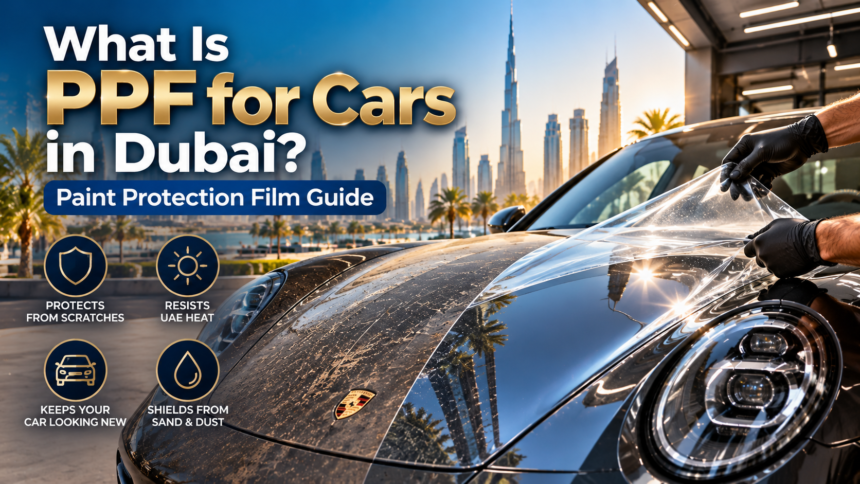
PPF for Cars in Dubai has become increasingly popular among drivers who want to protect factory paint from stone chips, light scratches, road debris, stains and harsh outdoor exposure. PPF stands for Paint Protection Film, a transparent protective film applied over painted vehicle panels to create a sacrificial layer between the original paint and everyday damage.
- What Exactly Is PPF for Cars in Dubai?
- Why PPF Makes Sense in Dubai’s Driving Environment
- How Does Self-Healing PPF Actually Work?
- Full-Body PPF vs Partial PPF: Which Coverage Makes Sense?
- TPU vs Cheap PPF: Why Film Quality Matters
- How Long Does PPF Last on a Car in Dubai?
- Does PPF Protect Against Dubai Sun and UV Exposure?
- PPF vs Ceramic Coating: They Do Different Jobs
- Can PPF Damage the Original Paint When Removed?
- How Much Does PPF Cost in Dubai?
- Installation Quality Matters Almost as Much as Film Quality
- Paint Preparation Before PPF Is Extremely Important
- How to Maintain PPF in Dubai
- Matte and Satin PPF Can Change the Appearance of the Car
- PPF Does Not Make Your Car Damage-Proof
- Common PPF Mistakes Dubai Car Owners Should Avoid
- PPF for Cars in Dubai: Final Buying Checklist
For Dubai drivers, the appeal is easy to understand. Cars are regularly exposed to highway driving, airborne sand, strong sunlight, dust, road debris and frequent washing. A good-quality PPF does not make the vehicle impossible to damage, but it can absorb many of the minor impacts and surface marks that would otherwise reach the clear coat or paint underneath.
Major manufacturers such as 3M describe automotive PPF as protection against stone chips, scratches, stains, road tar, bug damage and harsh ultraviolet exposure. Premium films may also include self-healing top layers that allow light surface marks to disappear when heat reaches the film.
However, buying PPF is not as simple as choosing the cheapest quote. Film quality, installer skill, surface preparation, panel coverage, warranty and aftercare all affect the final result. This guide explains how PPF works, what it can and cannot protect against, how long it may last in Dubai and what to check before paying for installation.
What Exactly Is PPF for Cars in Dubai?
Paint Protection Film is a thin transparent film bonded to the painted surfaces of a vehicle.
Premium automotive PPF is commonly based on polyurethane or similar flexible film technology designed to absorb minor impacts while remaining optically clear. The film sits above the factory clear coat, meaning road debris contacts the PPF first rather than directly striking the paint.
Depending on the product, a modern film may provide:
- Stone-chip resistance
- Scratch resistance
- Stain resistance
- Protection from bug residue
- Resistance to road tar
- UV resistance
- Self-healing of light surface marks
- Gloss or satin appearance
3M’s UAE product range describes PPF as a virtually invisible protective layer that can resist chips, scratches and stains while using heat-responsive self-healing technology for minor marks.
The key idea is that PPF becomes a replaceable protective surface.
If a bumper receives repeated minor road impacts, it is better for the film to absorb those marks than for the original factory paint to suffer permanent chips.
Why PPF Makes Sense in Dubai’s Driving Environment
Dubai has several conditions that can be demanding on exterior paint.
Highway use is one of the biggest reasons drivers consider PPF. Small stones and road debris can hit the front bumper, bonnet, mirrors and front fenders at speed. Even a small chip can become visually obvious on dark paint or premium vehicles.
Dust and sand create another challenge.
Sand itself does not automatically destroy paint simply by sitting on the vehicle, but problems can occur when dusty surfaces are wiped incorrectly. Dragging dry dirt across the paint can create fine scratches or swirl marks.
Strong outdoor sunlight is also relevant.
Premium films are designed to tolerate prolonged exterior exposure. 3M’s technical documentation specifically describes its automotive PPF as being engineered to withstand outdoor weathering, including harsh ultraviolet radiation.
Common Dubai paint risks
| Paint Risk | How PPF Can Help |
|---|---|
| Small stone chips | Film absorbs part of the impact |
| Highway road debris | Adds sacrificial surface protection |
| Light scratches | Self-healing topcoat may reduce minor marks |
| Sand-related abrasion | Protects paint beneath the film |
| Bug residue | Helps reduce direct staining of paint |
| Road tar | Creates protective barrier |
| Sun exposure | Premium films include UV-resistant technology |
| Frequent washing | Helps protect original clear coat |
PPF does not remove the need for careful washing, but it gives the underlying paint an additional layer of protection.
How Does Self-Healing PPF Actually Work?
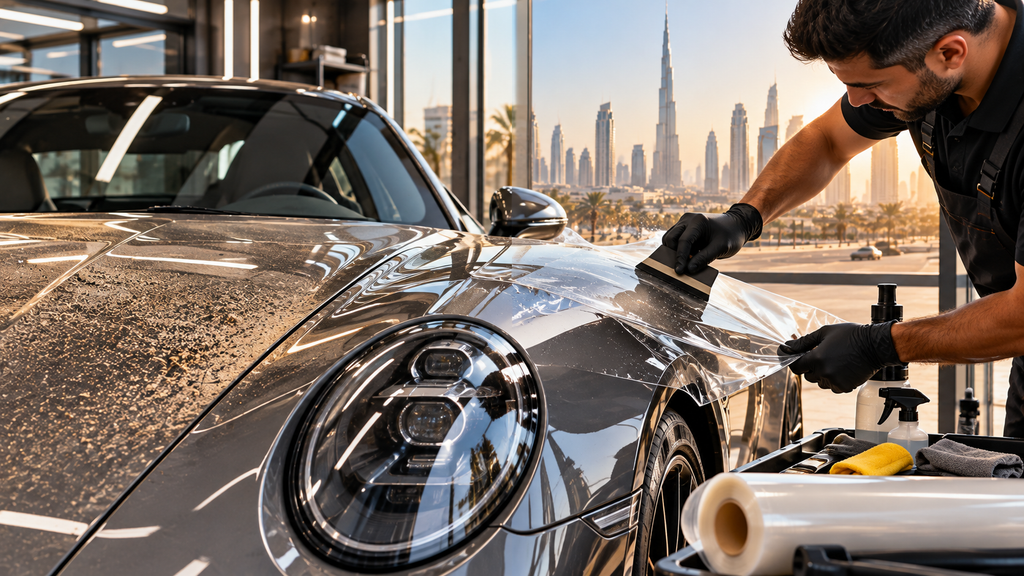
Self-healing is one of the most heavily marketed PPF features.
It does not mean the film can repair every type of damage.
The top layer of premium film uses flexible polymer technology that can recover from very light surface marks and swirl-type scratches when exposed to heat.
That heat may come from:
- Warm ambient conditions
- Sunlight
- Warm water
- Controlled professional heat
3M states that minor scratches can disappear when heat is applied to the film surface. XPEL similarly explains that minor scratches and swirls can self-heal through elastomeric polymer technology.
However, deeper damage is different.
If a sharp object penetrates the film or a stone creates a severe impact, the film may remain damaged and the affected section may need replacement.
Self-healing usually helps with:
- Light swirl marks
- Minor wash marks
- Very shallow scratches
Self-healing does not guarantee repair of:
- Deep cuts
- Torn film
- Severe stone impacts
- Accident damage
- Scratches that penetrate to paint
This distinction is important because some sellers use the phrase “self-healing” as though PPF becomes permanently scratch-proof.
It does not.
Full-Body PPF vs Partial PPF: Which Coverage Makes Sense?
You do not necessarily need to cover the entire car.
Manufacturers offer multiple coverage strategies depending on budget and driving habits. 3M, for example, describes options ranging from small wear-and-tear areas to partial front protection and larger coverage packages.
The highest-risk areas are usually the panels facing forward.
These include:
- Front bumper
- Bonnet
- Front fenders
- Side mirrors
- Headlight surrounds
- Door edges
A full-body installation adds protection to almost every painted exterior panel.
Common coverage options
| Coverage | Typical Areas | Best For |
|---|---|---|
| Small-area protection | Door cups, edges, boot ledge | Basic daily wear |
| Partial front | Bumper + part of bonnet/fenders | Budget protection |
| Full front | Full bonnet, bumper, fenders, mirrors | Highway drivers |
| Full body | Most painted exterior panels | Premium/new vehicles |
Full-front PPF is often a practical compromise because the front of the vehicle receives the majority of high-speed road impacts.
Full-body PPF may make more sense for expensive cars, dark paint, collector vehicles or owners who place a high value on maintaining factory paint condition.
TPU vs Cheap PPF: Why Film Quality Matters
One of the biggest risks in PPF installation is choosing an unknown film only because it is inexpensive.
Premium films generally use higher-quality polyurethane technology, more stable adhesives and better topcoats.
Cheaper products may be more likely to develop problems such as:
- Yellowing
- Haze
- Cracking
- Peeling
- Poor clarity
- Weak self-healing
- Adhesive residue
- Uneven finish
Warranty length can provide one useful indicator of product quality, although warranty terms should always be read carefully.
For example, XPEL lists a 10-year limited warranty on several professional PPF ranges against defects such as yellowing, cracking, blistering and delamination when installed according to the manufacturer’s requirements. 3M also offers products with warranties extending up to 10 years depending on the film series.
Before choosing film, ask for:
- Exact brand
- Exact product series
- Manufacturer warranty
- Warranty registration
- Installer certification
- Written installation invoice
Do not accept vague descriptions such as “German PPF,” “American film” or “premium nano PPF” without an identifiable manufacturer and model.
The brand and series should be verifiable.
How Long Does PPF Last on a Car in Dubai?
There is no universal lifespan for every PPF installation.
XPEL states that automotive PPF generally lasts around five to ten years, depending on product quality, installation, climate, road conditions, driving and maintenance.
Premium manufacturers may back specific products with warranties of up to 10 years.
Actual life in Dubai can depend on several factors.
Film quality
Premium film with strong UV stability and a good topcoat is more likely to remain clear for longer.
Installation
Edges that are poorly prepared may begin lifting earlier.
Parking
A vehicle parked under cover much of the time may experience different long-term exposure from one parked permanently outdoors.
Washing
Aggressive brush washing can scratch the film and damage edges.
Mileage
A vehicle covering high annual highway mileage will face more stone impacts than a low-mileage car.
Maintenance
Bird droppings, tar and other contamination should not be left indefinitely on the film.
A realistic expectation is therefore better than treating the manufacturer’s maximum warranty period as a guaranteed replacement date.
Does PPF Protect Against Dubai Sun and UV Exposure?
Premium PPF can help protect painted surfaces from environmental exposure, but the subject requires some nuance.
Manufacturers design good films to remain stable under ultraviolet radiation rather than quickly yellowing or cracking.
3M’s Series 150 technical documentation states that the film is designed for harsh outdoor weathering including ultraviolet exposure.
At the same time, you should not assume that applying film to half a vehicle will create identical ageing everywhere forever.
PPF itself changes how the protected surface interacts with the environment.
This is one reason owners planning long-term partial coverage should use high-quality, optically stable film and have it professionally removed when replacement becomes necessary.
Premium PPF can help preserve the protected paint from direct environmental contamination, but it should not be marketed as magic permanent UV armour.
The film itself is also a material that ages.
PPF vs Ceramic Coating: They Do Different Jobs
PPF and ceramic coating are often presented as competing products, but they solve different problems.
PPF is a physical film.
Ceramic coating is a thin protective coating applied over the surface.
PPF is stronger for:
- Stone-chip protection
- Physical abrasion
- Light scratch protection
- Sacrificial impact protection
Ceramic coating is stronger for:
- Water behaviour
- Ease of cleaning
- Surface slickness
- Chemical resistance
- Gloss enhancement
| Feature | PPF | Ceramic Coating |
|---|---|---|
| Stone-chip resistance | Strong | Limited |
| Physical thickness | Yes | Very thin |
| Self-healing | Available on premium films | Generally no |
| Hydrophobic behaviour | Product-dependent | Usually strong |
| Can protect against deep impact | Limited, but better than coating | Very limited |
| Ease of cleaning | Good | Very good |
| Cost | Higher | Usually lower |
Some newer PPF products already incorporate hydrophobic topcoats.
XPEL, for example, distinguishes between standard protective film and products with additional hydrophobic surface technology designed to make maintenance easier.
Drivers can also combine PPF and ceramic treatment, but they should understand what each product is contributing before paying for both.
Can PPF Damage the Original Paint When Removed?
High-quality PPF installed on healthy factory paint is designed to be removable.
XPEL states that its PPF can be professionally removed without harming original paint when removal is performed correctly.
However, the condition of the paint underneath matters.
Risk may be higher when PPF has been applied over:
- Poor-quality repainting
- Recently repaired panels
- Weak clear coat
- Existing peeling paint
- Previous body-shop work
If a panel has been repainted, tell the installer.
A reputable studio should inspect the surface before installation and explain any increased removal risk.
Professional removal is also important.
Old film should not simply be pulled aggressively from the vehicle without controlling angle and temperature.
How Much Does PPF Cost in Dubai?
PPF pricing varies widely, so there is no single Dubai price that applies to every vehicle.
Cost depends on:
- Vehicle size
- Coverage area
- Film brand
- Product series
- Installer
- Paint preparation
- Complexity of panels
- Finish type
A local Dubai PPF provider currently advertises starting prices around AED 3,500, but this should be treated only as an indicative market example rather than a standard Dubai rate. Full-body premium installations can cost considerably more depending on the vehicle and product selected.
The better comparison is not simply:
Shop A = AED 4,000
Shop B = AED 7,000
Instead compare what each quote contains.
| Quote Detail | Shop A | Shop B |
|---|---|---|
| Film brand | ||
| Product series | ||
| Coverage | ||
| Warranty | ||
| Paint preparation | ||
| Edge wrapping | ||
| Pattern-cut installation | ||
| Warranty registration |
A cheap quotation using unknown film is not equivalent to an authorised premium-brand installation.
Installation Quality Matters Almost as Much as Film Quality
Even excellent PPF can look poor when badly installed.
Common installation problems include:
- Bubbles
- Contamination under film
- Visible stretch marks
- Poorly aligned edges
- Lifting corners
- Excessive seams
- Knife marks
- Adhesive distortion
Professional installers may use digitally generated patterns that are designed around specific vehicle panels.
3M, for example, supports digital pattern software with thousands of tested vehicle patterns, reducing the need for freehand cutting directly on painted panels.
This is an important question to ask:
“Do you cut the film on the car or use pre-cut patterns?”
Some experienced installers safely use bulk installation methods, but careless hand cutting can create unnecessary risk.
You should also inspect previous work from the same studio.
Look closely at:
- Bumper corners
- Mirrors
- Door edges
- Panel gaps
- Bonnet edges
- Curved areas
A good installation should look clean from normal viewing distance without obvious trapped contamination or lifting film.
Paint Preparation Before PPF Is Extremely Important
PPF does not fix damaged paint.
It covers it.
If swirl marks, water spots, scratches or contamination are present before installation, many of those imperfections may remain visible underneath the film.
A proper preparation process can include:
- Detailed wash
- Decontamination
- Clay treatment where required
- Paint inspection
- Light correction where needed
- Final surface preparation
Brand-new cars may still need preparation.
A new vehicle can arrive with transport contamination, dealership washing marks or small paint defects.
Ask whether paint correction is included in the quotation or charged separately.
Do not automatically pay for aggressive polishing if the paint does not need it.
The goal should be to create a clean, defect-controlled surface before the film is installed.
How to Maintain PPF in Dubai
Premium PPF is relatively easy to maintain, but it should still be washed carefully.
XPEL recommends regular washing with suitable automotive soap, a soft wash mitt and microfiber drying rather than harsh cleaning methods.
Good PPF maintenance habits include:
- Wash regularly
- Remove bird droppings promptly
- Remove bug contamination
- Avoid aggressive brushes
- Use clean microfiber towels
- Avoid directing pressure washers extremely close to film edges
- Inspect lifting edges early
Automatic brush car washes can create swirl marks over time.
Touchless washing may reduce direct scratching, although strong chemicals can still affect surface treatments.
Hand washing with appropriate products generally provides the best control.
Dubai dust also means owners should avoid wiping a dry, dusty car with a cloth.
Rinse or properly wash the surface first so abrasive particles are not dragged across the film.
Matte and Satin PPF Can Change the Appearance of the Car
Not all PPF is designed to remain visually invisible.
Satin or matte PPF can change glossy paint into a more subdued finish while still providing physical protection.
This allows owners to alter appearance without permanently repainting the vehicle.
There are two common uses.
Protecting factory matte paint
Matte vehicle finishes can be difficult to repair because polishing can change the appearance. Satin PPF can help protect the original surface.
Changing glossy paint to satin
A transparent satin film can give standard glossy paint a different finish while keeping the original colour underneath.
XPEL specifically offers satin-type film for surfaces where owners want a lower-gloss appearance.
Colour PPF is another growing category, combining paint protection with a colour-changing effect.
If appearance is being changed significantly, owners should also verify any relevant UAE vehicle-registration requirements before proceeding.
PPF Does Not Make Your Car Damage-Proof
One of the most important things to understand is what PPF cannot do.
It cannot prevent serious accident damage.
A heavy stone can still penetrate film.
A deep key scratch can still cut through.
A parking collision can still dent panels.
PPF is designed primarily for everyday paint protection rather than structural protection.
Think of it as a sacrificial shield against minor to moderate surface damage, not armour.
PPF can help with:
- Small road chips
- Fine scratches
- Minor abrasion
- Bug stains
- Tar contamination
PPF cannot guarantee protection from:
- Major collisions
- Deep vandalism
- Severe impacts
- Dents
- Poor underlying paint
- Every type of chemical damage
Knowing this before installation prevents unrealistic expectations.
Common PPF Mistakes Dubai Car Owners Should Avoid
The first mistake is choosing film only by price.
If the installer refuses to identify the exact film brand and series, that should be a warning sign.
Another mistake is assuming every “10-year PPF” is identical.
The warranty needs to come from a verifiable manufacturer and should clearly explain what is covered.
Owners should also avoid installing PPF over poor paint preparation.
Film will not magically remove scratches already in the clear coat.
Another mistake is ignoring installation quality. Premium film applied badly can still produce disappointing results.
Drivers should also avoid expecting the self-healing layer to repair deep damage.
Finally, do not neglect washing after PPF installation. The car is protected, but contamination still accumulates on the film.
PPF for Cars in Dubai: Final Buying Checklist
Before choosing a PPF package, use this checklist.
| Question | What to Confirm |
|---|---|
| What film is being installed? | Exact manufacturer and series |
| Is it genuine? | Verify packaging/warranty |
| What coverage is included? | Partial, full front or full body |
| What warranty applies? | Written duration and exclusions |
| Is installer authorised? | Verify where possible |
| Is paint preparation included? | Ask what preparation means |
| Are edges wrapped? | Confirm panel-by-panel |
| How is film cut? | Pattern, bulk or both |
| Will badges be removed? | Confirm procedure |
| Is paint correction included? | Avoid surprise charges |
| How should the film be washed? | Obtain aftercare advice |
| Is warranty registered? | Keep proof |
| What happens if an edge lifts? | Confirm after-sales policy |
| How is old film removed? | Ask about future removal |
PPF for Cars in Dubai can be a sensible investment when protecting original paint is a priority, particularly for new, premium or frequently driven vehicles.
Manufacturers such as 3M design modern PPF to resist stone chips, scratches, stains, road contamination and harsh UV exposure, while premium products can also use self-healing technology to reduce minor surface marks.
Good films can also offer meaningful longevity. XPEL says automotive PPF typically lasts around five to ten years depending on conditions, and both XPEL and 3M offer selected products backed by warranties extending up to 10 years.
However, the film name on the invoice is only part of the equation.
A high-quality product needs skilled installation.
The paint must be prepared properly.
Coverage needs to match how the car is driven.
And the owner still needs to maintain the film.
For many Dubai drivers, a full-front installation provides a sensible balance by protecting the bumper, bonnet, mirrors and other areas most exposed to road debris. Full-body PPF becomes more attractive when preserving almost every painted panel matters.
The best way to choose is therefore not to ask only, “How much does PPF cost?”
Ask what film is being used, what it protects, who is installing it, what the warranty covers and how the work will look several years from now.
That is the difference between simply wrapping a car in transparent film and installing a genuine long-term paint-protection system.
Do follow us on Instagram
Read More – Chauffeur Service Dubai: 7 Situations Where a Private Driver Beats Renting a Car