Behind the Scenes of eplanet TV: The Work Viewers Never See
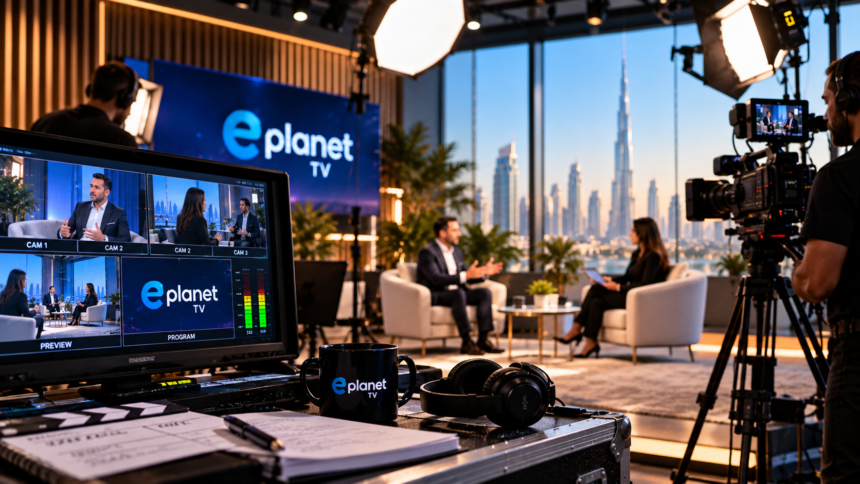
For viewers, an eplanet TV interview may appear simple. A guest sits in front of the camera, an interviewer asks a few questions and, several minutes later, the conversation ends. What audiences do not see is the chain of editorial, technical and production work required before those few minutes can reach a screen.
- eplanet TV Starts With Finding the Right Industry Voices
- Research Happens Before the First Question Is Asked
- Putting Guests at Ease Is Part of the Production Job
- The Camera Is Only One Part of the Technical Setup
- Expo Production Requires a Different Workflow From a Studio
- Producing 80+ Interviews Requires More Than a Camera Crew
- Interviewers Have to Turn Expertise Into Understandable Conversation
- The Work Continues After the Guest Leaves the Camera
- Digital Distribution Gives Expo Conversations a Much Longer Life
- Why Putting More Industry Voices on Camera Matters
- Behind the Scenes of eplanet TV: The Work Viewers Never See
That process became particularly visible during Forex Expo Dubai 2026, held at Dubai World Trade Centre on September 22–23. eplanet TV took its media operation beyond the controlled environment of its studio and turned part of its presence at the Expo into a functioning interview and content-production space. Across the two days, the team recorded more than 80 interviews, generating approximately seven hours of conversations with traders, analysts, educators, executives, introducing brokers, fintech professionals and other voices from the financial sector.
Those numbers reveal the scale of the operation, but they do not explain what made it possible. Every interview required coordination. Guests had to be identified and scheduled. Interviewers needed enough context to ask useful questions. Cameras, framing, sound and lighting had to remain consistent. Production teams had to deal with the noise and movement of a major exhibition while keeping the next conversation ready to begin.
That behind-the-scenes work reflects the wider model eplanet TV is building. The platform describes itself as a multilingual financial media operation combining live market coverage, analysis, professional education, interviews, podcasts, original programming and social content for audiences across the MENA region. Its operation brings financial professionals, analysts, creative teams, producers, studio capabilities and technology together within one integrated media ecosystem.
eplanet TV Starts With Finding the Right Industry Voices
Putting someone in front of a camera begins long before recording.
The first task is deciding who actually has something useful to contribute.
At Forex Expo Dubai 2026, eplanet TV openly invited professionals working across trading, market analysis, fintech, education, brokerage and related areas to share their expertise and perspectives. Its event messaging was not limited to high-profile executives. Traders, analysts, educators, creators, introducing brokers and other active industry professionals were all encouraged to participate.
That approach matters because financial media can become repetitive when the same small group of commentators dominates every conversation.
Different people see the market from different positions.
A trader may focus on execution and volatility.
An economist may look at inflation and monetary policy.
A fintech executive may think about technology and infrastructure.
An educator may focus on how complex ideas are communicated to beginners.
A broker or introducing broker may have a different view of client behaviour and industry change.
eplanet TV’s broader editorial proposition is built around bringing these perspectives together rather than treating financial information as one continuous stream of price updates. Recent coverage around its “Pulse of the Market” concept described the platform’s approach as combining immediate market information with analysis, education and different forms of professional expertise.
What makes someone a useful interview guest?
| Factor | Why It Matters |
|---|---|
| Relevant experience | Gives the discussion real-world grounding |
| Clear point of view | Makes the conversation more distinctive |
| Industry knowledge | Helps move beyond generic comments |
| Current relevance | Connects the interview with what audiences care about now |
| Ability to explain | Makes complex subjects more accessible |
| Different perspective | Adds variety to the wider content library |
The best interview guest is therefore not always the person with the biggest title.
Sometimes it is the person who can explain a complicated idea with unusual clarity.
Research Happens Before the First Question Is Asked
A good interview should not begin with the presenter asking something that could have been learned from the guest’s LinkedIn profile.
Research gives the interviewer enough context to move quickly into substance.
Before a financial-industry conversation, the content team may need to understand:
- The guest’s role
- Their professional background
- Their company
- Their specialist area
- Recent industry developments
- Potential areas of expertise
- Subjects that may be especially relevant to the audience
The purpose is not to script every answer.
In fact, overly scripted interviews can feel unnatural.
The objective is to prepare enough that the interviewer knows where the most interesting conversation might be.
For eplanet TV, this is particularly important because its content spans multiple areas of financial markets. The platform currently publishes and broadcasts material covering forex, commodities, oil, economic developments, trading education and live market analysis, alongside longer-form programmes and interviews.
A presenter speaking with an oil-market specialist therefore needs different preparation from someone interviewing a trading psychologist or fintech founder.
A useful pre-interview brief can include:
| Area | Preparation |
|---|---|
| Guest | Role, company and experience |
| Topic | Main subject of the conversation |
| Current context | Why the topic matters now |
| Opening question | Easy way into the discussion |
| Key questions | Three to five central themes |
| Follow-up possibilities | Points worth exploring if they arise |
| Close | One strong final question |
The preparation creates structure.
The actual interview still needs room to breathe.
Putting Guests at Ease Is Part of the Production Job
Industry experts are not necessarily television presenters.
Someone may understand financial markets exceptionally well and still feel uncomfortable the moment a camera is pointed at them.
That creates another important behind-the-scenes responsibility: helping the guest become comfortable enough to speak naturally.
A rushed guest may worry about where to look.
They may wonder whether they should memorise answers.
They may speak too quickly or become distracted by the surrounding production environment.
A good production process reduces those distractions before recording begins.
That may involve explaining:
- Where the guest should sit or stand
- Which camera to address
- How the interview will flow
- Approximately how long it will last
- Whether answers can be restarted
- What general subjects will be discussed
The interviewer also plays a major role.
An interview should feel like a conversation rather than an examination.
That is especially important in financial media, where technical subjects can easily produce stiff or overly formal answers.
If the guest feels comfortable, the audience is more likely to see the expertise rather than the anxiety of being filmed.
At a busy exhibition, achieving that calm environment becomes more difficult because the guest may have arrived directly from another meeting or may need to leave for another appointment immediately afterwards.
Production therefore has to create a small pocket of focus inside a very busy environment.
The Camera Is Only One Part of the Technical Setup
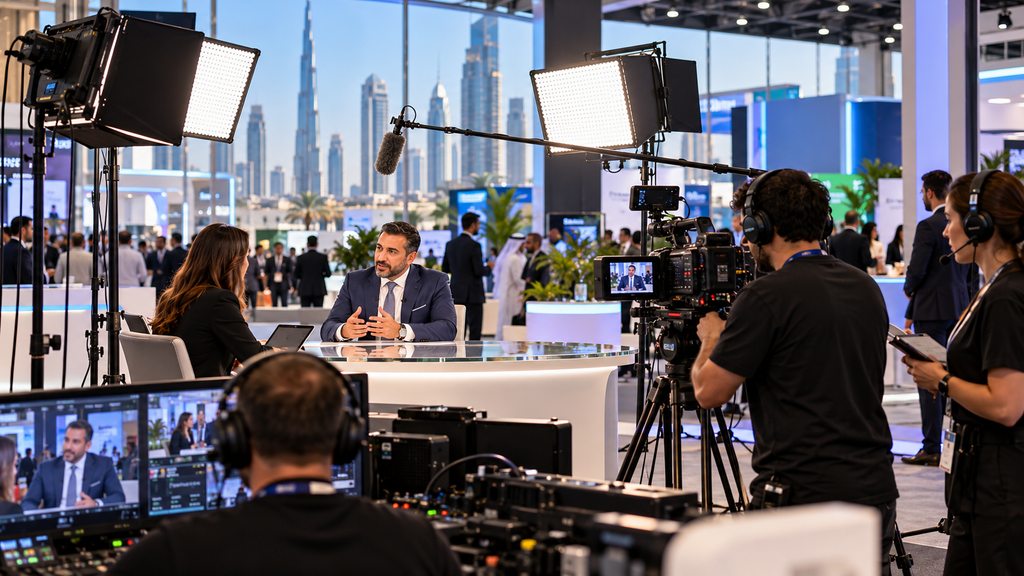
The camera receives most of the attention because it is the most obvious piece of equipment.
But professional interview production depends on several technical systems working together.
At an event like Forex Expo Dubai, the team has to think about:
- Camera placement
- Lens and framing
- Lighting
- Microphones
- Background
- Exposure
- White balance
- Audio levels
- Power
- Storage
- Monitoring
A technically sharp image with poor sound can still produce an unusable interview.
In many cases, audio is the more difficult challenge at an exhibition.
Expo floors contain conversations, announcements, music, nearby presentations and constant movement.
Microphone selection and placement therefore become critical.
Lighting presents a different problem.
The production team needs the guest to look consistent even if the surrounding exhibition lighting is uneven or constantly changing.
What the production team is balancing
| Technical Area | Objective |
|---|---|
| Camera | Consistent, professional framing |
| Lighting | Clear face without harsh shadows |
| Audio | Guest and interviewer remain understandable |
| Background | Visually relevant without becoming distracting |
| Exposure | Skin tones and scene remain balanced |
| Storage | Every recording is captured safely |
| Power | Production can continue without interruption |
The aim is not merely to make the image attractive.
The technical setup should disappear.
If viewers are concentrating on the lighting or struggling to hear the speaker, the technology is getting in the way of the conversation.
Expo Production Requires a Different Workflow From a Studio
eplanet TV describes its wider media operation as being supported by an advanced in-house studio and end-to-end production capability. That controlled environment makes it easier to manage lighting, sound, cameras and scheduling.
An Expo floor is completely different.
The production team does not control what is happening around them.
Guests may be delayed.
Noise levels can change.
A nearby presentation may suddenly begin.
An interview that was expected to take ten minutes may need to finish in five.
Someone interesting may walk past the booth and create an interview opportunity that did not exist on the original schedule.
This requires a combination of planning and improvisation.
At Forex Expo Dubai 2026, the team repeated the interview process more than 80 times over two days. The published behind-the-scenes account describes a continuous rhythm in which one guest finished, the space was reset and another conversation began while Expo activity continued around the team.
Studio vs event production
| Studio | Expo Floor |
|---|---|
| Controlled lighting | Changing ambient conditions |
| Quiet audio environment | Heavy background noise |
| Predictable schedule | Frequent timing changes |
| Fixed set | Temporary production space |
| Guests arrive for one purpose | Guests may have multiple commitments |
| Equipment can remain static | Setup must tolerate constant activity |
The technical standards may be similar.
The operating conditions are not.
That is why event production depends so heavily on teamwork.
Producing 80+ Interviews Requires More Than a Camera Crew
A high-volume interview operation quickly becomes a logistics challenge.
Recording 80 interviews means managing 80 different people, 80 introductions, 80 sets of questions, 80 files and 80 pieces of content that need to be identified correctly afterwards.
Even simple administrative mistakes can create problems.
If a file is not labelled correctly, the editing team may need to spend time identifying the speaker.
If the guest’s name or company is written incorrectly, graphics have to be changed later.
If consent or contact details are missing, publishing can become more difficult.
The production chain therefore extends beyond the crew physically standing behind the camera.
A simplified workflow might look like this:
| Stage | Main Responsibility |
|---|---|
| Guest discovery | Editorial/content team |
| Booking | Coordination team |
| Research | Producer/editorial team |
| Interview preparation | Presenter/producer |
| Technical setup | Production crew |
| Recording | Camera/audio team |
| File management | Production/data team |
| Editing | Post-production |
| Graphics/subtitles | Creative team |
| Publishing | Digital/content team |
| Distribution | Social/platform team |
At Forex Expo Dubai, the volume demonstrates why this coordination matters.
More than 80 interviews producing roughly seven hours of raw conversation is not one piece of content.
It is a library.
Each interview has to move through the rest of the pipeline before the audience sees it.
Interviewers Have to Turn Expertise Into Understandable Conversation
Industry professionals often speak in the language of their profession.
That language can be precise and useful to other specialists but difficult for a wider audience.
Financial markets are particularly full of terms that can create distance between expert and viewer.
The interviewer therefore has another job beyond asking questions: translating the direction of the conversation.
A guest may discuss:
- Liquidity
- Monetary policy
- Leverage
- Volatility
- Brokerage infrastructure
- Algorithmic trading
- Market psychology
- Regulatory change
The interviewer has to judge whether the audience needs clarification.
Sometimes the strongest follow-up is simply:
“What does that mean for the ordinary trader?”
or
“Why should the audience care about that?”
This connects directly with eplanet TV’s stated positioning. Its website describes the platform as focused on making financial markets, emerging trends and complex financial topics easier to understand, while its programming combines market coverage, education and analysis.
That editorial philosophy changes what a good interview looks like.
The objective is not to make the guest sound complicated.
It is to make their expertise useful.
The Work Continues After the Guest Leaves the Camera
For the guest, the interview may be finished once recording stops.
For the production team, that is often only halfway through the process.
Raw footage needs to be reviewed, organised and prepared for publishing.
Depending on the format, post-production can involve:
- Selecting the strongest sections
- Removing unnecessary pauses
- Balancing audio
- Colour correction
- Adding titles
- Adding guest names
- Adding subtitles
- Creating intros and outros
- Exporting different versions
- Producing short clips for social platforms
Financial content also requires editorial awareness.
eplanet TV explicitly identifies itself as a media and educational channel and states that its content is general information rather than individual investment advice. Its website also carries risk warnings around leveraged trading products such as CFDs and notes that guest views are their own.
This distinction matters because financial-media production is not simply entertainment editing.
Context, disclosures and the way claims are presented can also be important.
One interview can become multiple pieces of content
| Original Material | Possible Output |
|---|---|
| Full interview | YouTube or website video |
| Strong answer | Social media clip |
| Short quote | Reel/Short |
| Key takeaway | Graphic or caption |
| Topic discussion | Article angle |
| Several expert comments | Industry compilation |
This is how several minutes in front of a camera can continue generating value long after the physical event ends.
Digital Distribution Gives Expo Conversations a Much Longer Life
An Expo lasts only a few days.
Digital content can remain available for months or years.
That is one of the most important reasons media production adds value to physical industry events.
Forex Expo Dubai created temporary access to dozens of professionals in one place. eplanet TV’s cameras captured those conversations, allowing them to move beyond the people physically standing at Dubai World Trade Centre.
The platform said those interviews would continue reaching audiences through its digital channels after the event, including its online video presence.
This changes the economics of an interview.
Without recording, one conversation might be heard by a small group nearby.
With production and distribution, it can be viewed by people in other countries and discovered later by someone researching the same subject.
eplanet TV already operates across multiple formats, including live shows, original programmes, podcasts, short-form content and digital video. Its current video library includes live market analysis, economic updates and educational programming alongside other finance-focused formats.
An interview therefore does not have to live in only one place.
The same expert insight can be adapted to different viewing habits.
Why Putting More Industry Voices on Camera Matters
Financial media has traditionally depended heavily on anchors, analysts and a relatively small pool of recognised commentators.
Digital production makes it possible to expand that group.
Industry events bring together professionals with experiences that may rarely appear in mainstream coverage.
An introducing broker may have useful observations about client behaviour.
A fintech founder may understand where trading infrastructure is changing.
An educator may see which concepts consistently confuse new traders.
An active trader may have a very different perspective on volatility from an economist.
At Forex Expo Dubai, eplanet TV explicitly created opportunities for these types of professionals to step in front of its cameras. Its promotional messaging invited traders, analysts, educators, content creators, IBs and fintech professionals to share stories, expertise and perspectives.
This does not mean every opinion becomes equally authoritative.
Editorial judgement remains important.
But widening access to the camera can widen the range of experiences available to the audience.
That matters in an industry where markets are influenced by economics, policy, technology, behaviour and regulation at the same time.
Behind the Scenes of eplanet TV: The Work Viewers Never See
The finished interview is the visible part of a much larger system.
Before the guest appears on screen, someone has identified the opportunity, coordinated the timing, researched the subject and prepared the interviewer.
Someone has checked the camera.
Someone has tested the microphone.
Someone has adjusted the light.
Someone is monitoring the recording.
And after the guest leaves, someone still has to organise the file, edit the footage, add graphics, prepare subtitles, publish the interview and distribute it across the right channels.
Forex Expo Dubai 2026 provided a particularly clear example of that process. Over two days at Dubai World Trade Centre, eplanet TV recorded more than 80 interviews and approximately seven hours of industry conversation while operating in the middle of a live exhibition environment.
That production effort also reflects the platform’s wider model. eplanet TV positions itself as a multilingual financial media platform combining market coverage, analysis, education, interviews and original content, supported by financial professionals and an integrated creative and production operation.
The camera therefore represents only one part of what it takes to put an industry voice in front of an audience.
The more important work happens around it.
Editorial teams find the voice.
Producers shape the opportunity.
Interviewers unlock the conversation.
Technical crews make it watchable.
Editors give it structure.
Digital teams give it reach.
When all of those pieces work together, a brief conversation recorded on a busy Expo floor can become something much larger: a permanent piece of industry knowledge available to an audience far beyond the room where it was originally recorded.
Do follow us on Instagram
Read More – PPF for Cars in Dubai: A Complete Paint Protection Film Guide