How the Future of Robotics Around the World Could Change Everyday Life
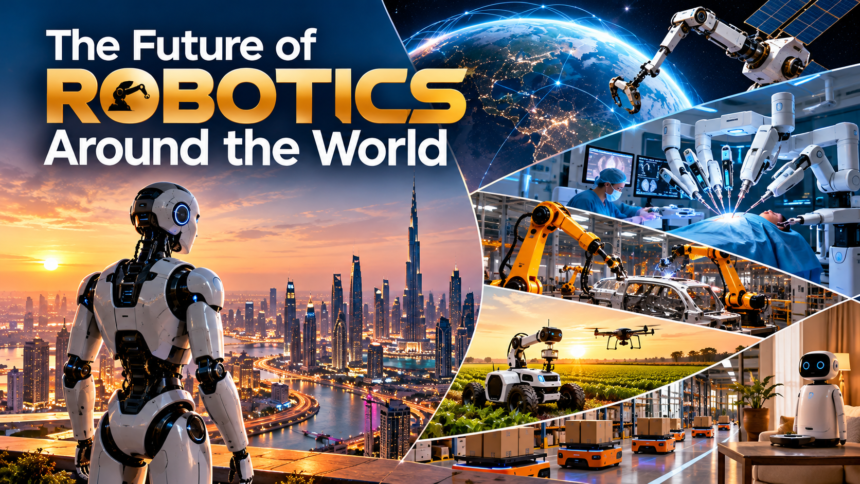
The Future of Robotics Around the World is moving rapidly from isolated factory machines towards intelligent systems that can see, learn, communicate and operate with far greater independence. Robots are no longer limited to welding cars behind safety cages. They are increasingly being used in warehouses, hospitals, farms, homes, laboratories, hotels and public spaces.
- The Future of Robotics Around the World at a Glance
- Artificial Intelligence Is Becoming the Brain of Modern Robots
- Humanoid Robots Are Moving From Demonstrations Into Real-World Testing
- China Is Becoming One of the Most Important Robotics Markets
- The United States Is Focusing Heavily on AI and Humanoid Robotics
- Europe Could Lead in Safe and Industrial Robotics
- Japan and South Korea Will Remain Major Robotics Powers
- India Could Become a Fast-Growing Robotics Market
- Industrial Robots Will Remain the Largest Part of Robotics for Years
- Collaborative Robots Will Work More Closely With People
- Logistics Robots Could Become One of the Largest Service-Robot Markets
- Healthcare Robotics Could Grow Rapidly
- Robots Could Become More Important in Elderly Care
- Agriculture Could Become Far More Automated
- Construction Robots Will Focus on Dangerous and Repetitive Tasks
- Household Robots Will Become Smarter Before They Become Humanoid
- Robots Need Far More Real-World Training Data
- Robotics Could Change the Global Labour Market
- Safety Will Become One of the Biggest Robotics Challenges
- Cybersecurity Will Become a Physical Safety Issue
- Regulation Will Have to Catch Up With More Autonomous Robots
- Humanoid Robots May Not Replace Specialised Robots
- The Future of Robotics Around the World Will Be Uneven
- Robotics Could Become a Major Part of Everyday Life by the 2030s
- What Could Slow the Future of Robotics?
- The Future of Robotics Around the World Is Moving From Automation to Autonomy
The scale of the industry is already significant. According to the International Federation of Robotics, factories worldwide installed more than 600,000 industrial robots in 2025, pushing the global operational stock above 5 million units. The IFR expects installations to continue rising, forecasting around 655,000 new industrial robots in 2026 and approximately 806,000 annually by 2029.
At the same time, professional service robotics is expanding quickly. Global shipments of professional service robots increased by 24% to almost 250,000 units in 2025, while consumer robot sales rose to around 34.2 million units. Surgical robotics is also growing rapidly, and humanoid robots are moving from demonstrations towards real-world pilot programmes.
The biggest change, however, is not simply that more robots are being produced. Artificial intelligence is changing what robots are capable of doing. Generative AI, computer vision, natural-language interaction and increasingly autonomous decision-making are beginning to turn robots from machines that repeatedly follow fixed instructions into systems that can adapt to more complicated environments.
The Future of Robotics Around the World at a Glance
Robotics is developing differently across industries, but several themes are appearing almost everywhere.
| Robotics Area | Main Direction |
|---|---|
| Manufacturing | Smarter, more autonomous industrial robots |
| Humanoid robots | Factory and warehouse pilots |
| Logistics | Autonomous mobile robots and robotic picking |
| Healthcare | Surgical, rehabilitation and hospital robots |
| Agriculture | Harvesting, spraying and crop monitoring |
| Homes | Cleaning and increasingly capable assistants |
| Construction | Inspection, surveying and specialised automation |
| Hospitality | Delivery, cleaning and customer-service robots |
| AI integration | Natural-language commands and autonomous learning |
| Regulation | Greater focus on safety, liability and cybersecurity |
The IFR identifies AI-driven autonomy, IT and operational-technology integration, humanoid testing, safety and labour shortages as five of the most important robotics trends shaping 2026.
Artificial Intelligence Is Becoming the Brain of Modern Robots
Traditional industrial robots are extremely good at repeating the same movement thousands of times.
They are much less capable when their environment changes unexpectedly.
Artificial intelligence is starting to change this limitation.
Modern robotic systems increasingly combine:
- Computer vision
- Machine learning
- Generative AI
- Natural-language processing
- Sensor fusion
- Real-time decision-making
Analytical AI can help robots identify patterns, optimise routes and predict equipment failures.
Generative AI allows robots to learn tasks in simulation, respond to more flexible instructions and work with language or visual commands instead of relying entirely on specialised programming.
The IFR says agentic AI may push this further by combining structured decision-making with generative adaptability, allowing robots to operate with greater independence in complicated environments.
This could eventually make programming a robot feel less like writing industrial code and more like explaining a task to a person.
Instead of programming every movement, a supervisor might simply say:
“Move these packages to the loading area, but separate damaged boxes.”
The robot would then need to understand the goal, identify objects, plan movement and react to obstacles.
That is a much harder problem than conventional automation, but it is also where much of robotics research is heading.
Humanoid Robots Are Moving From Demonstrations Into Real-World Testing
Humanoid robots attract enormous attention because they resemble people and can potentially operate in environments already designed for the human body.
Factories, warehouses, stairs, doors, tools and shelves are all built around human dimensions.
A humanoid robot could theoretically work in these environments without requiring every workplace to be redesigned.
That is the promise.
The reality is still more complicated.
The IFR estimates that around 7,000 full-size humanoid robots were sold globally in 2025 for professional and commercial applications beyond basic research and entertainment. Most current systems remain specialised, and many still depend on human teleoperation for difficult tasks.
The biggest technical challenges include:
- Reliable walking
- Battery life
- Safety
- Hand dexterity
- Manipulating irregular objects
- Cost
- Maintenance
- Speed
Even robotic hands remain difficult to engineer.
Human hands combine strength, touch sensitivity, flexibility and extraordinary precision. Replicating all of those abilities in a durable machine is one of the major unsolved problems in humanoid robotics.
For this reason, humanoid adoption is likely to begin with relatively structured tasks.
Factories and warehouses provide more predictable environments than homes.
A humanoid may initially spend its day:
- Moving containers
- Loading machines
- Carrying components
- Sorting products
- Repeating simple inspection tasks
The vision of a general-purpose household robot capable of cooking dinner, folding laundry and repairing a leaking tap is still much further away.
China Is Becoming One of the Most Important Robotics Markets
China is central to the global robotics story.
The country is already the world’s largest industrial robot market and is increasingly treating AI-powered robotics as a strategic national industry.
The IFR says China was one of the strongest contributors to global industrial robot growth in 2025, with installations rising by around 20%. The country has also incorporated AI-powered robots into its national industrial strategy for the 2026–2030 period.
Chinese companies are developing several important parts of the robotics supply chain, including:
- Humanoid robots
- Lidar
- Cameras
- Motors
- Actuators
- Robot hands
- Batteries
- AI models
In October 2026, Chinese lidar specialist Hesai launched a spatial camera called Kosmo designed specifically to provide 3D environmental information for AI-powered robots. The company is also developing compact actuators for robotic systems.
This highlights an important point.
The future robotics race will not depend only on who builds the finished robot.
It will also depend on who controls the underlying components.
The United States Is Focusing Heavily on AI and Humanoid Robotics
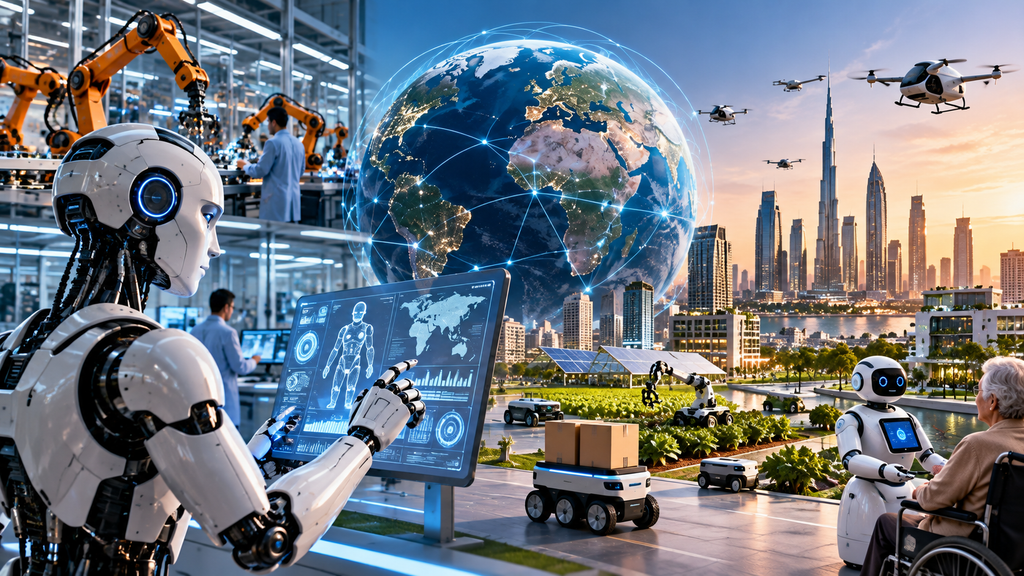
The United States remains another major centre of robotics innovation.
Its strength is particularly visible in AI software, venture-funded robotics companies, logistics automation and humanoid development.
American companies are exploring robots for:
- Factories
- Warehouses
- Retail
- Delivery
- Healthcare
- Home assistance
Tesla continues investing heavily in its Optimus humanoid programme, while companies such as Figure, Agility Robotics and Apptronik are developing their own systems for industrial and commercial applications.
The US also has a powerful advantage through its AI ecosystem.
Companies working on robotics can draw on advanced computing, machine-learning research and large technology platforms.
However, building physical robots creates challenges that software companies do not normally face.
Robots break.
Motors wear out.
Sensors become dirty.
Batteries need charging.
Hardware must operate safely around people.
This is why even companies with enormous AI expertise can find robotics development slow and expensive.
Europe Could Lead in Safe and Industrial Robotics
Europe has a long-established industrial robotics sector, particularly in Germany, Italy and other manufacturing economies.
Its future role may be especially strong in:
- Industrial automation
- Collaborative robots
- Automotive manufacturing
- Precision engineering
- Safety standards
- Industrial software integration
European policymakers are also taking a relatively strict approach to AI governance.
The EU AI Act creates risk-based requirements for AI systems and may increasingly influence robotics as robots become more autonomous and connected to AI models. European regulators have emphasised safety, transparency, monitoring and lifecycle oversight for high-risk AI applications.
This could create additional compliance requirements.
But strict regulation may also help develop trust.
A hospital, factory or government agency may be more willing to deploy robots when certification, accountability and safety responsibilities are clearly defined.
Japan and South Korea Will Remain Major Robotics Powers
Japan has been associated with robotics for decades.
Its industrial base includes major manufacturers of factory robots, motors, sensors and automation systems.
Japan also has a strong incentive to invest in service robotics because of its ageing population.
Robots could increasingly support:
- Elderly care
- Hospitals
- Logistics
- Manufacturing
- Food service
- Cleaning
South Korea similarly combines advanced electronics, automotive production and extremely high levels of industrial automation.
Both countries are well positioned to develop robots that move beyond conventional manufacturing into everyday service industries.
The challenge will be achieving the reliability needed for direct human interaction.
A robot working beside an elderly person or hospital patient needs a very different safety standard from a welding robot operating behind a fence.
India Could Become a Fast-Growing Robotics Market
India’s robotics market is smaller than China’s but expanding quickly.
According to the IFR, industrial robot installations in India rose to approximately 10,500 units in 2025, representing growth of around 15%.
Growth is being driven by sectors such as:
- Automotive manufacturing
- Electronics
- Warehousing
- Pharmaceuticals
- Food processing
- Logistics
India also has a large engineering and software workforce.
That could become an important advantage as robotics increasingly combines mechanical engineering with AI, cloud computing and software.
India may not need to copy the automation models of higher-wage economies exactly.
Instead, robotics adoption could focus first on dangerous, repetitive or precision-heavy tasks where automation creates the strongest productivity gains.
Industrial Robots Will Remain the Largest Part of Robotics for Years
Humanoid robots receive the headlines, but conventional industrial robots will remain the backbone of automation for the foreseeable future.
More than five million industrial robots were operating in factories worldwide in 2025.
These machines perform tasks such as:
- Welding
- Painting
- Assembly
- Material handling
- Machine tending
- Packaging
- Inspection
They are already proven technologies.
The next generation will become more connected and intelligent rather than disappearing.
A robotic arm may use AI-powered vision to recognise different components.
A factory robot may predict when one of its own joints requires maintenance.
Several robots may coordinate automatically according to changing production schedules.
The future factory is therefore likely to combine conventional industrial robots, mobile robots, cobots and potentially humanoids rather than replacing every machine with a human-shaped robot.
Collaborative Robots Will Work More Closely With People
Collaborative robots, usually called cobots, are designed to operate more closely with human workers.
The IFR says around 66,000 new cobots were installed in 2025, representing approximately 11% of industrial robot installations.
Cobots can be useful where full automation is unnecessary.
A worker might handle judgement-heavy tasks while the robot performs:
- Lifting
- Repetitive placement
- Screwdriving
- Packaging
- Machine loading
This combination can increase productivity without completely removing human involvement.
Small and medium-sized manufacturers may also find cobots easier to deploy than large automated production systems.
Future systems will likely become easier to teach.
Instead of specialised robot programming, operators may demonstrate a task physically or describe it in natural language.
Logistics Robots Could Become One of the Largest Service-Robot Markets
Warehouses are particularly well suited to robots.
The environment is structured, tasks are repetitive and speed matters.
Professional service robots already show strong growth in transport and logistics. IFR data shows logistics as one of the leading applications for professional service robotics.
Robots can already:
- Move shelves
- Carry pallets
- Transport bins
- Sort parcels
- Assist picking
- Move goods between workstations
The harder problem is manipulating irregular objects.
Moving a standard warehouse container is relatively easy.
Picking a soft bag, fragile bottle or oddly shaped product is much harder.
Large retailers are spending heavily on this problem.
Walmart, for example, continues investing billions in warehouse automation, but complex tasks such as sorting mixed products still show how difficult it can be to replace human flexibility completely.
The future warehouse will therefore likely involve deep human-robot collaboration rather than completely people-free facilities.
Healthcare Robotics Could Grow Rapidly
Healthcare is one of the most promising areas for robotics.
The IFR reported approximately 8,400 surgical robot units sold in 2025, with surgical robotics becoming a major growth driver in the medical robotics sector.
Robotics can support healthcare in several ways:
- Robot-assisted surgery
- Rehabilitation
- Hospital logistics
- Pharmacy automation
- Patient lifting
- Telepresence
- Disinfection
Surgical robots do not generally perform operations independently.
They usually extend the capabilities of trained surgeons by providing precision, stability and improved control.
Future systems may integrate more AI for:
- Image analysis
- Surgical planning
- Instrument guidance
- Real-time decision support
However, healthcare robotics will face some of the strictest regulation because failures can directly affect patient safety.
Robots Could Become More Important in Elderly Care
Ageing populations are creating strong demand for care workers in countries including Japan, South Korea and parts of Europe.
Robots may help address some of this pressure.
Potential applications include:
- Carrying supplies
- Monitoring movement
- Supporting rehabilitation
- Helping patients stand
- Telepresence
- Medication reminders
However, robots are unlikely to replace human care completely.
Companionship, empathy and medical judgement remain deeply human responsibilities.
The more realistic future is one where robots take over physically demanding or repetitive tasks, allowing carers to spend more time directly with patients.
Agriculture Could Become Far More Automated
Agriculture faces several major challenges:
- Labour shortages
- Water pressure
- Climate change
- Chemical use
- Rising food demand
Robotics can help make farming more precise.
Future agricultural robots may increasingly perform:
- Harvesting
- Weeding
- Targeted spraying
- Crop inspection
- Fruit picking
- Soil monitoring
Computer vision can identify weeds or diseased plants individually.
That could allow a robot to spray only a specific plant rather than an entire field.
Such precision could reduce chemical use while lowering labour requirements.
Harvesting remains more difficult because fruit and vegetables vary in shape, softness and position.
Improved robotic vision and grippers will be critical.
Construction Robots Will Focus on Dangerous and Repetitive Tasks
Construction sites are much less predictable than factories.
Surfaces change.
Weather changes.
People and machinery move constantly.
That makes full automation extremely difficult.
Robotics adoption is therefore likely to focus on individual tasks.
Examples include:
- Bricklaying
- Concrete finishing
- Site scanning
- Surveying
- Inspection
- Demolition
- Repetitive drilling
Drones are already commonly used for inspections and surveying.
Robotic systems could increasingly work alongside construction crews rather than replace them entirely.
Household Robots Will Become Smarter Before They Become Humanoid
Millions of homes already use robotic vacuum cleaners.
Consumer robot sales reached approximately 34.2 million units in 2025, according to the IFR.
The next stage will involve greater intelligence.
Future domestic robots may:
- Recognise rooms
- Identify objects
- Coordinate with smart-home systems
- Learn household routines
- Respond to natural-language instructions
However, general household manipulation remains extremely difficult.
A home contains an enormous number of unpredictable objects.
A robot may need to deal with clothes, glasses, pets, children, stairs and constantly moving furniture.
For this reason, specialised household robots are likely to dominate before general-purpose humanoid assistants become common.
Robots Need Far More Real-World Training Data
AI models can learn from enormous amounts of text and images on the internet.
Robots have a different problem.
They need data about physical interaction.
How much pressure is needed to hold a cup?
How should a hand move around a drawer?
How does a soft object behave when lifted?
This is driving the development of dedicated robotics training environments.
Companies are building so-called robot gyms where machines repeatedly practise physical tasks and collect data. Other firms are collecting large volumes of human-motion and first-person video data to help train robotic AI systems.
This may become one of the most important competitive areas in robotics.
The company with the most capable hardware may not necessarily win.
The company with the best real-world training data may have an equally important advantage.
Robotics Could Change the Global Labour Market
Robots will replace some jobs.
They will also create new ones.
The difficult question is how quickly that transition happens and which workers are affected.
Tasks most vulnerable to automation tend to be:
- Repetitive
- Predictable
- Physically demanding
- Dangerous
Jobs involving judgement, complex communication, creativity or unpredictable environments may change more slowly.
New roles will also appear in:
- Robot maintenance
- Automation engineering
- AI training
- Safety
- Cybersecurity
- Fleet management
The IFR argues that robotics can help address labour shortages while also creating opportunities for workers to move away from repetitive tasks. It emphasises retraining and employee involvement as important parts of successful automation.
The biggest risk may not be that robots eliminate every job.
It may be that workers without access to reskilling opportunities struggle to move into the new jobs created by automation.
Safety Will Become One of the Biggest Robotics Challenges
A robot inside a factory cage is relatively easy to isolate.
A humanoid walking through a warehouse full of people is much more complicated.
Future robots must understand:
- Human movement
- Unexpected obstacles
- Safe force limits
- Emergency stopping
- Personal space
The IFR lists safety and security as one of the industry’s most important current trends.
Standards will become especially important for robots that operate directly alongside the public.
A delivery robot on a pavement or humanoid inside a hospital must behave safely even when a person does something unexpected.
Cybersecurity Will Become a Physical Safety Issue
Connected robots create another risk.
Hacking a normal computer can expose data.
Hacking a robot may also create physical danger.
A compromised system could potentially:
- Stop production
- Move equipment incorrectly
- Disable safety controls
- Access cameras or microphones
- Manipulate industrial processes
The IFR warns that cloud-connected and AI-powered robots increase cybersecurity and data-protection risks.
Future robotics security will therefore need to protect both digital information and physical behaviour.
Factories may eventually treat robot cybersecurity with the same seriousness currently applied to critical infrastructure.
Regulation Will Have to Catch Up With More Autonomous Robots
When a robot simply follows a fixed programmed path, responsibility is relatively clear.
More autonomous AI-powered systems create harder questions.
Who is responsible if a robot makes the wrong decision?
The manufacturer?
The company using it?
The AI developer?
The operator?
Regulators around the world will increasingly need to define:
- Liability
- Testing requirements
- Data protection
- Cybersecurity standards
- Human oversight
- Safety certification
Europe’s AI Act is one example of governments attempting to build risk-based rules around increasingly autonomous AI systems.
Robotics regulation will likely become more important as systems move from factories into public and domestic environments.
Humanoid Robots May Not Replace Specialised Robots
One misconception about robotics is that humanoids will eventually replace every other robot.
That is unlikely.
A warehouse robot does not need legs if wheels are more efficient.
A factory welding system does not need a human-shaped torso.
A surgical robot does not need to walk.
Specialised robots can be:
- Cheaper
- Faster
- More reliable
- More energy-efficient
Humanoids make the most sense where environments are already designed around humans and where flexibility is more valuable than maximum efficiency.
Future robotics will therefore contain many different forms.
The humanoid may become one important category rather than the universal robot.
The Future of Robotics Around the World Will Be Uneven
Robotics adoption will not happen at the same speed everywhere.
High-wage countries may automate rapidly because replacing repetitive labour creates stronger financial incentives.
Countries with younger and lower-cost workforces may adopt robots more selectively.
Infrastructure also matters.
Advanced robotics requires:
- Reliable electricity
- Industrial connectivity
- Technical skills
- Maintenance networks
- Capital investment
This means robotics could widen productivity differences between countries that can deploy automation rapidly and those that cannot.
At the same time, lower robot prices may eventually make advanced automation accessible to smaller economies and businesses.
Robotics Could Become a Major Part of Everyday Life by the 2030s
By the early 2030s, robots are likely to be considerably more visible outside factories.
People may regularly encounter them in:
- Hospitals
- Warehouses
- Airports
- Hotels
- Shops
- Farms
- Construction sites
- Delivery networks
Humanoid robots may become more common in industrial settings, although mass household adoption is less certain.
Industrial robots will become more intelligent.
Service robots will expand into more professions.
And AI will increasingly allow people to communicate with machines through language rather than specialised programming.
The biggest transformation will probably not be one spectacular humanoid robot.
It will be thousands of specialised robotic systems quietly becoming part of everyday infrastructure.
What Could Slow the Future of Robotics?
The industry’s growth is not guaranteed.
Several obstacles remain.
| Challenge | Why It Matters |
|---|---|
| High cost | Delays adoption |
| Reliability | Robots must operate continuously |
| Battery technology | Limits mobile systems |
| Dexterity | Human hands remain difficult to replicate |
| Safety | Critical around people |
| Regulation | Can slow deployment |
| Cybersecurity | Connected robots can be attacked |
| Training data | Physical AI needs enormous datasets |
| Maintenance | Hardware creates ongoing cost |
| Public acceptance | Social trust matters |
The current excitement around humanoid robotics should therefore be viewed with some caution.
Robotics progress is real, but physical systems usually develop more slowly than software.
The Future of Robotics Around the World Is Moving From Automation to Autonomy
The most important change in the Future of Robotics Around the World is the transition from automation towards autonomy.
Traditional robots perform predetermined actions.
Future robots will increasingly interpret their surroundings, understand instructions, make limited decisions and adapt when conditions change.
The global robotics industry is already expanding quickly. More than five million industrial robots were operating in factories in 2025, while annual installations passed 600,000 units for the first time. Professional service robots are also expanding rapidly, and humanoid robots are beginning to move into real-world testing.
Artificial intelligence is accelerating that shift.
The IFR identifies AI autonomy, IT and operational technology convergence, humanoid robotics, workforce shortages and safety as the major forces shaping robotics in 2026.
China, the United States, Europe, Japan, South Korea and increasingly India are likely to play major roles, but they may specialise in different parts of the robotics ecosystem.
Factories will remain the largest robotics environment for years.
Warehouses and logistics will continue growing.
Healthcare could become one of the industry’s most valuable applications.
Agriculture, construction and household robotics will advance as perception and manipulation improve.
Humanoids will attract the most attention, but specialised robots may remain more practical for many tasks.
The question is therefore no longer whether robots will become more common.
They already are.
The more important question is how quickly society can develop the skills, safety rules, infrastructure and economic models required to use them responsibly.
That will determine whether the next generation of robots becomes simply another form of automation or one of the most important technological shifts of the 21st century.
Do follow us on Instagram
Read More – NH Collection Dubai Ibn Battuta Unveils a New Chapter After Major Transformation