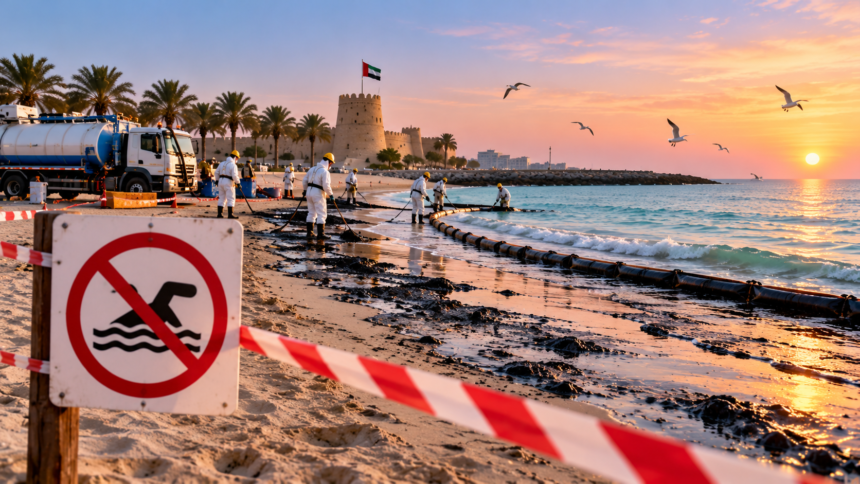
Which Beaches and Coastal Areas Are Affected by the Oil Spill?
Umm Al Quwain beaches closed temporarily on October 23, 2026, after an oil spill from a tanker affected the emirate’s coastline, prompting immediate action from UAE authorities. The Ministry of Climate Change and Environment confirmed that all beaches and coastal areas in Umm Al Quwain would remain closed while specialised teams assess the pollution, conduct cleanup operations and determine when the coastline can safely reopen.
- Umm Al Quwain Beaches Closed: What Happened and Why?
- Which Beaches and Coastal Areas Are Affected by the Oil Spill?
- Are the Oil Spill Odours Dangerous to Residents and Tourists?
- What Visitors, Swimmers and Fishermen Should Do Now
- How UAE Authorities Are Cleaning Up the Oil Spill
- How the Umm Al Quwain Oil Spill Affects Tourism and Travel Plans
- Frequently Asked Questions About Umm Al Quwain Beaches Closed
The precautionary closure affects residents, tourists, fishermen and businesses connected to coastal activities. Visitors planning a beach holiday, swimming trip, fishing excursion or waterfront outing have been advised to avoid the affected areas and follow official instructions.
Authorities also confirmed that unusual petroleum-like odours reported in Sharjah, Ajman and Umm Al Quwain were connected to the marine pollution. However, the ministry reassured residents that these odours did not pose a health risk.
Environmental monitoring teams are examining the coastline while containment and remediation work continues. Officials have not announced a specific date for reopening Umm Al Quwain’s beaches.
In a related precautionary measure, Sharjah authorities also temporarily closed Al Hamriyah Beach. This means travellers should not assume that restrictions are limited exclusively to Umm Al Quwain.
For anyone planning a coastal visit in the northern Emirates, understanding the restrictions, environmental precautions and latest safety advice is essential.
This guide explains what happened, which locations are affected, what visitors should avoid and how to plan around the temporary beach closures.
Umm Al Quwain Beaches Closed: What Happened and Why?
The UAE Ministry of Climate Change and Environment announced the temporary closure on Friday, October 23, after detecting marine pollution originating from an offshore tanker.
The spill was identified through the country’s technical monitoring and environmental assessment system, triggering a coordinated response involving federal and local authorities.
Specialist crews began containing the pollution, identifying affected coastal locations and carrying out cleanup operations.
Oil Spill Incident at a Glance
| Detail | Confirmed Information |
|---|---|
| Incident | Offshore tanker oil spill |
| Announcement date | October 23, 2026 |
| Main affected emirate | Umm Al Quwain |
| Beaches closed | All beaches and coastal areas in Umm Al Quwain |
| Additional precautionary closure | Al Hamriyah Beach, Sharjah |
| Responsible federal authority | Ministry of Climate Change and Environment |
| Response | Containment, cleanup and environmental assessment |
| Reopening date | Not announced |
| Public advice | Avoid restricted coastal areas and follow official instructions |
How Was the Oil Spill Detected?
The ministry confirmed that its technical monitoring and environmental assessment system identified pollution affecting Umm Al Quwain’s beaches.
Environmental monitoring helps authorities detect potential contamination and evaluate changes in marine conditions.
Once the pollution was identified, response teams began operations intended to reduce its spread and protect coastal ecosystems.
The ministry also initiated precautionary coastal surveys to determine how extensively the pollution had affected the shoreline.
What Caused the Oil Spill?
The confirmed incident involved oil escaping from a tanker offshore.
As of the initial announcement, UAE authorities had not publicly identified the vessel or officially established the cause of the leak.
External maritime analysts have suggested that a tanker named Gem No. 2 may be involved, but this identification should not be presented as an official government conclusion.
Similarly, the exact quantity of oil released had not been confirmed in the ministry’s initial statement.
Why Were Beaches Closed?
The decision was precautionary.
Oil contamination may create hazards for beach visitors, swimmers, marine animals and workers involved in coastal activities.
Restricting access allows specialist teams to assess pollution, carry out cleanup operations and reduce unnecessary contact with potentially contaminated areas.
The closure remains dependent on technical assessments rather than a predetermined reopening date.
Which Beaches and Coastal Areas Are Affected by the Oil Spill?
The most important information for visitors is that the Umm Al Quwain closure applies to all beaches and coastal areas across the emirate, not simply one named beach.
The ministry did not announce separate reopening arrangements for individual beaches in its initial statement.
Consequently, visitors should avoid making assumptions about access based on whether a beach appears visibly clean.
Beaches in Umm Al Quwain
Umm Al Quwain is known for its relatively quiet beaches, coastal resorts, mangrove environments and recreational waterfront areas.
Popular coastal destinations include stretches near Kite Beach Centre, Al Sinniyah Island and various waterfront hotels.
However, the closure should be understood as a general restriction affecting beaches and coastal areas, rather than a confirmed list of individually contaminated locations.
Not every beach necessarily has the same degree of pollution, but all fall under the temporary precautionary closure.
Al Hamriyah Beach in Sharjah
Sharjah authorities also announced a temporary closure of Al Hamriyah Beach as a precaution.
This is particularly relevant because Al Hamriyah lies close to Umm Al Quwain, and marine pollution can move with currents and wind conditions.
Visitors should follow announcements from Sharjah’s relevant authorities before planning activities at Al Hamriyah.
What About Beaches in Ajman and Other Emirates?
The ministry confirmed odours in Ajman and Sharjah, but that does not mean every beach in those emirates was closed.
As of the October 23 announcements, the confirmed restrictions concerned Umm Al Quwain’s beaches and coastal areas and Al Hamriyah Beach in Sharjah.
There was no corresponding blanket closure announced for all beaches in Dubai, Abu Dhabi, Ajman or Ras Al Khaimah.
However, beach access can change if new monitoring results require additional precautions.
Beach Closure Status Comparison
| Location | Announced Status | Visitor Advice |
|---|---|---|
| Umm Al Quwain | All beaches and coastal areas temporarily closed | Avoid coastal recreation |
| Al Hamriyah Beach, Sharjah | Temporarily closed | Do not visit until reopened |
| Other Sharjah beaches | No emirate-wide closure announced | Check local instructions |
| Ajman beaches | No blanket closure announced | Monitor official updates |
| Dubai beaches | No spill-related blanket closure announced | Follow local notices |
| Ras Al Khaimah beaches | No blanket closure announced | Check before travelling |
| Abu Dhabi beaches | No spill-related blanket closure announced | Follow local authority guidance |
Status based on announcements and reporting available through October 24, 2026. These are not live beach-opening confirmations.
Are Private Hotel Beaches Included?
The federal announcement uses broad language covering all beaches and coastal areas in Umm Al Quwain.
Travellers should therefore not assume that a private resort beach is exempt.
Hotels may continue offering accommodation, dining or certain indoor facilities, but individual operations have not been universally confirmed.
Before visiting, contact the property to determine which amenities remain available and whether beach-related bookings can be changed.
Are the Oil Spill Odours Dangerous to Residents and Tourists?
One of the most widely discussed aspects of the incident has been the unusual smell reported across parts of the northern Emirates.
Residents in Sharjah, Ajman and Umm Al Quwain reported odours resembling petroleum or fuel.
The Ministry of Climate Change and Environment confirmed that the smells were associated with the tanker oil spill.
What Authorities Said About Health Risks
The ministry stated that the reported odours did not pose a health risk to residents.
This reassurance is important because strong or unfamiliar smells can create understandable concern.
However, the ministry’s statement about airborne odours should not be confused with confirmation that polluted seawater is suitable for swimming.
The beach closures remain in place precisely because the coastline and marine environment require assessment.
Why Can an Offshore Oil Spill Produce Strong Smells?
Petroleum contains different chemical compounds, including some that can evaporate into the atmosphere.
When oil spreads across seawater, certain volatile components may escape into the air.
Wind conditions can then carry these odours towards populated areas, even when the pollution is located offshore.
The intensity of a smell can change depending on several factors:
- Wind direction and speed.
- Air temperature.
- The type of petroleum released.
- Distance from the affected water.
- The quantity and exposed surface area of the oil.
A noticeable odour does not, by itself, establish the concentration of particular substances or whether an individual location is hazardous.
What Should Residents Do?
Residents should follow official environmental and public health guidance rather than relying on social media speculation.
Those experiencing significant symptoms, including breathing difficulties, should seek appropriate medical advice regardless of the ministry’s general reassurance.
Anyone encountering visible oil, contaminated debris or an affected shoreline should avoid direct contact and keep children and pets away.
Common Concerns and Recommended Actions
| Concern | Recommended Action |
|---|---|
| Petroleum-like smell outdoors | Follow official health updates |
| Visible oil on the beach | Avoid contact and leave the area |
| Oil-contaminated seawater | Do not swim or wade |
| Children near affected shoreline | Keep them away |
| Pets exposed to oil | Prevent licking and seek veterinary advice |
| Unexpected physical symptoms | Seek medical assessment |
| Conflicting online reports | Rely on government announcements |
The distinction between reported air-quality reassurance and ongoing marine precautions is essential for understanding the situation accurately.
What Visitors, Swimmers and Fishermen Should Do Now
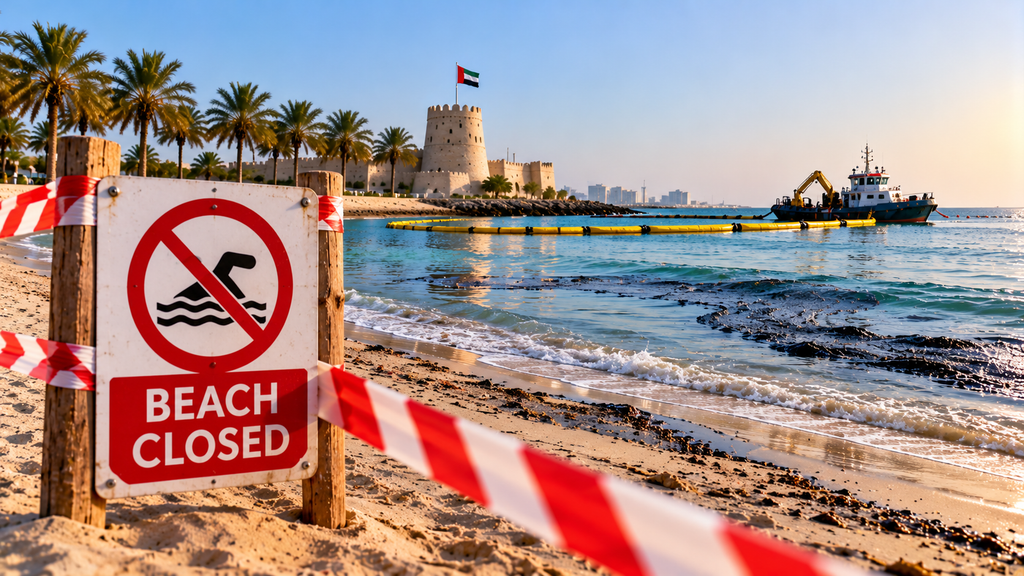
The beach closure affects several kinds of activities, not only traditional swimming or sunbathing.
Fishing, boating, water sports, photography and shoreline recreation may all bring people into contact with restricted locations.
The safest approach is to avoid affected coastal areas until authorised reopening instructions are issued.
For Beachgoers and Swimmers
Anyone planning to swim in Umm Al Quwain should postpone the activity.
Do not enter the water simply because the surface appears clear. Some contamination may not be obvious from the shoreline.
Visitors should also respect temporary barriers, safety signs and instructions from officials.
Taking photographs near an affected shoreline should never involve crossing into restricted areas.
For Fishermen
The Ministry of Climate Change and Environment specifically advised fishermen to avoid fishing in polluted locations and follow the instructions of competent authorities.
This is important because oil spills can affect marine habitats, fishing equipment and the handling of seafood.
Fishermen should not resume operations in restricted locations until the relevant authorities permit them.
The initial announcement did not establish that seafood throughout the UAE was unsafe, and such a conclusion should not be drawn without supporting evidence.
For Boating and Water Sports
Boat operators, kayaking providers, jet-ski businesses and other marine activity organisers should review current restrictions before conducting trips.
Even activities departing from locations outside the main closure area may need route adjustments if affected waters are nearby.
Customers with existing bookings should contact their operators to discuss postponement or alternative arrangements.
For Families With Children
Children may be curious about unusual material washed onto a beach.
Parents should explain that oily patches, unidentified debris and contaminated water must not be touched.
Families with weekend plans can select non-coastal activities until restrictions are lifted.
Visitor Safety Checklist
- Confirm the latest beach status before leaving home.
- Avoid all closed beaches and coastal locations.
- Do not swim or enter affected seawater.
- Keep children and pets away from contaminated material.
- Do not handle oil-covered objects or wildlife.
- Follow marine restrictions if operating a boat.
- Contact tour operators before travelling.
- Report suspected pollution through appropriate official channels.
- Avoid sharing unverified information online.
These precautions help protect visitors while allowing specialist teams to continue their work.
How UAE Authorities Are Cleaning Up the Oil Spill
The response to an oil spill involves several stages, from identifying the affected area to removing contamination and evaluating environmental conditions.
According to the Ministry of Climate Change and Environment, containment, cleanup and remediation operations began in coordination with relevant federal and local authorities.
Containment and Coastal Protection
Containment is intended to limit the movement of oil and reduce the amount reaching sensitive marine environments.
Depending on conditions, specialist teams may use floating barriers, recovery equipment and other suitable methods.
The actual techniques used must be selected according to the type of oil, weather, sea conditions and environmental sensitivity.
The UAE authorities have confirmed containment operations but have not publicly detailed every technique deployed.
Cleaning Affected Shorelines
When oil reaches a beach, removing it can require careful work to avoid causing additional environmental damage.
Cleanup teams may collect contaminated material, assess affected sediments and use appropriate recovery methods.
Not every shoreline can be cleaned in exactly the same way. Sandy beaches, rocky coastlines and mangrove habitats require different approaches.
Protecting Marine Ecosystems
Marine pollution may affect fish, birds, coastal vegetation and other organisms.
Oil can coat surfaces, interfere with certain biological functions and damage sensitive habitats.
The extent of environmental damage depends on the type and quantity of oil, the exposure period and the characteristics of affected ecosystems.
Umm Al Quwain’s coastal environment includes ecologically valuable marine and mangrove areas, making environmental assessment particularly important.
However, the ministry has not yet published a final assessment quantifying ecological damage from this incident.
How Oil Spill Response Usually Progresses
| Response Stage | Main Purpose |
|---|---|
| Detection | Identify potential marine pollution |
| Assessment | Determine location and extent |
| Containment | Limit further spread |
| Recovery | Remove accessible oil |
| Shoreline cleanup | Address contaminated coastal areas |
| Environmental monitoring | Evaluate remaining risks |
| Reopening decision | Confirm appropriate safety conditions |
When Will the Beaches Reopen?
As of October 24, 2026, no confirmed reopening date had been announced in the reports reviewed.
The ministry stated that closures would remain until technical teams completed their assessments and established the necessary safety and environmental protection measures.
Reopening could therefore depend on several factors, including the effectiveness of cleanup operations, pollution levels and the condition of affected coastal habitats.
Visitors should not interpret a reduction in visible oil or unpleasant odours as evidence that authorities have lifted restrictions.
How the Umm Al Quwain Oil Spill Affects Tourism and Travel Plans
Umm Al Quwain attracts residents and tourists seeking a quieter coastal experience than some of the UAE’s larger destinations.
Its beaches, waterfront accommodation, fishing activities and marine recreation contribute to the emirate’s appeal.
Temporary restrictions can disrupt these activities, particularly during weekends and holiday periods.
What Happens to Existing Hotel Bookings?
Travellers with hotel reservations should contact their accommodation provider before arriving.
A beachfront property may still offer rooms, restaurants and indoor facilities, but the availability of beach access, swimming and water sports must be confirmed individually.
Cancellation and rescheduling rights depend on the reservation terms and any applicable consumer protections.
Customers should request written confirmation of any proposed changes.
What About Beach Clubs and Water Activities?
Businesses operating coastal excursions may need to suspend certain activities or adjust their operations.
Visitors should not assume that a booking remains valid simply because no cancellation message has arrived.
Contact the operator directly and ask whether the activity is permitted under current restrictions.
Alternative Activities During the Closure
Visitors who have already arranged accommodation in Umm Al Quwain may consider inland activities, subject to their availability.
Possible alternatives include:
- Visiting museums and cultural attractions.
- Exploring traditional markets.
- Enjoying hotel dining facilities where operational.
- Discovering local restaurants and cafés.
- Taking part in permitted indoor recreational activities.
- Planning cultural excursions in neighbouring emirates.
These options allow visitors to continue enjoying parts of the region without entering restricted coastal areas.
Travel Planning Comparison
| Original Plan | Safer Alternative |
|---|---|
| Swimming in Umm Al Quwain | Postpone until reopening |
| Beach picnic | Choose a permitted inland location |
| Fishing trip | Reschedule with the operator |
| Kayaking excursion | Request postponement or refund information |
| Beachfront hotel stay | Confirm available non-beach amenities |
| Family beach outing | Consider museums or indoor attractions |
| Coastal photography | Visit unrestricted inland viewpoints |
Advice for Visitors Travelling From Dubai or Sharjah
Many visitors travel to Umm Al Quwain for day trips.
Before making the journey, check whether your main planned attraction is affected.
If the purpose of the trip is swimming, beach access or water sports, postponing may be more practical than travelling without confirmation.
For visitors considering other beaches, remember that Al Hamriyah Beach in Sharjah was also temporarily closed as a precaution.
Other beach destinations should be checked individually rather than assuming that every location outside Umm Al Quwain is automatically suitable.
Frequently Asked Questions About Umm Al Quwain Beaches Closed
1. Why are Umm Al Quwain beaches closed?
All beaches and coastal areas in Umm Al Quwain were temporarily closed after a tanker oil spill affected the coastline. The closure allows authorities to carry out environmental assessments, containment and cleanup operations.
2. When did the closure begin?
The Ministry of Climate Change and Environment announced the closure on Friday, October 23, 2026.
3. Which beaches are affected?
The announcement covers all beaches and coastal areas in Umm Al Quwain. Visitors should not assume that individual beaches are exempt unless authorities explicitly confirm access.
4. When will Umm Al Quwain beaches reopen?
No reopening date had been confirmed as of October 24, 2026. Access will depend on the completion of technical assessments and necessary safety measures.
5. Is Al Hamriyah Beach in Sharjah closed?
Yes. Sharjah authorities announced the temporary closure of Al Hamriyah Beach as a precaution related to the oil spill.
6. Are the unusual smells dangerous?
The UAE Ministry of Climate Change and Environment stated that the odours reported in Sharjah, Ajman and Umm Al Quwain did not pose a health risk to residents. This does not mean that contaminated coastal waters are safe for recreational activities.
7. Can people go fishing in Umm Al Quwain?
Fishermen have been instructed to avoid polluted areas and follow the directions of the relevant authorities. Fishing should not resume in restricted locations without permission.
8. Are all UAE beaches closed?
No. The announced closures concerned Umm Al Quwain’s beaches and coastal areas, together with Al Hamriyah Beach in Sharjah. No countrywide beach closure was announced in the reports reviewed.
9. Can tourists still stay in Umm Al Quwain hotels?
The marine closure does not by itself establish that every hotel must stop operating. Travellers should contact their hotel to confirm which facilities and activities remain available.
10. Where should residents check reopening announcements?
Residents should follow announcements from the UAE Ministry of Climate Change and Environment, Umm Al Quwain’s relevant authorities and official local government communications.
Final Thoughts on the Umm Al Quwain Beach Closures
The temporary closure of Umm Al Quwain’s beaches following the October 23, 2026 oil spill highlights the importance of protecting residents, visitors and the marine environment during pollution incidents.
Authorities have begun containment and cleanup operations while environmental specialists assess the extent of the pollution.
Although the ministry has reassured residents that the reported petroleum-like odours do not pose a health risk, restrictions on affected coastal areas remain important.
For tourists and families, the priority is to avoid closed beaches, confirm bookings before travelling and follow the latest official instructions.
Fishermen and marine activity operators should also respect restrictions until authorities provide further guidance.
The reopening of beaches will depend on technical assessments and environmental safety measures rather than a fixed timetable.
Until then, residents and visitors should treat the closure as an essential precaution and avoid assuming that visibly clear seawater is safe.
Umm Al Quwain beaches closed temporarily to allow authorities to manage the incident responsibly, and updated government announcements will determine when normal coastal activities can resume.
Editorial Note: This article reflects information available through October 24, 2026. Beach closures, environmental assessments and reopening arrangements are subject to change. The Ministry of Climate Change and Environment and relevant local authorities remain the primary sources for official instructions.
Publication verification: The October 23 closure and environmental response were reported from the Ministry’s statement by Aletihad and Reuters. Reuters also confirmed the separate Al Hamriyah Beach precautionary closure
To pick up a draggable item, press the space bar. While dragging, use the arrow keys to move the item. Press space again to drop the item in its new position, or press escape to cancel.
Do follow us on Instagram
Read More – Saudi Winter 2026: More Than 1,800 Tourism Experiences Across the Kingdom