Major District Cooling Providers in Dubai: Empower and Tabreed
Step outside in Dubai during the summer, and the importance of air conditioning becomes immediately clear. Inside shopping malls, residential towers, hotels and office buildings, comfortable temperatures are part of everyday life. Yet behind this comfort is an enormous infrastructure industry that most residents rarely see.
- District Cooling in Dubai: How the Technology Actually Works
- Why Dubai Invests in District Cooling Instead of Individual AC Systems
- The Business Model: How District Cooling Companies Make Money
- Empower, Tabreed and the Companies Behind Dubai’s Cooling Infrastructure
- Understanding District Cooling Bills: Capacity, Consumption and Hidden Costs
- Regulation, Energy Efficiency and Environmental Challenges
- The Future of District Cooling in Dubai and Frequently Asked Questions
While some buildings operate individual air-conditioning systems, many large developments rely on centralised plants that produce cooling for entire communities.
This infrastructure is known as District Cooling in Dubai, and it represents an important part of the emirate’s energy and real estate economy.
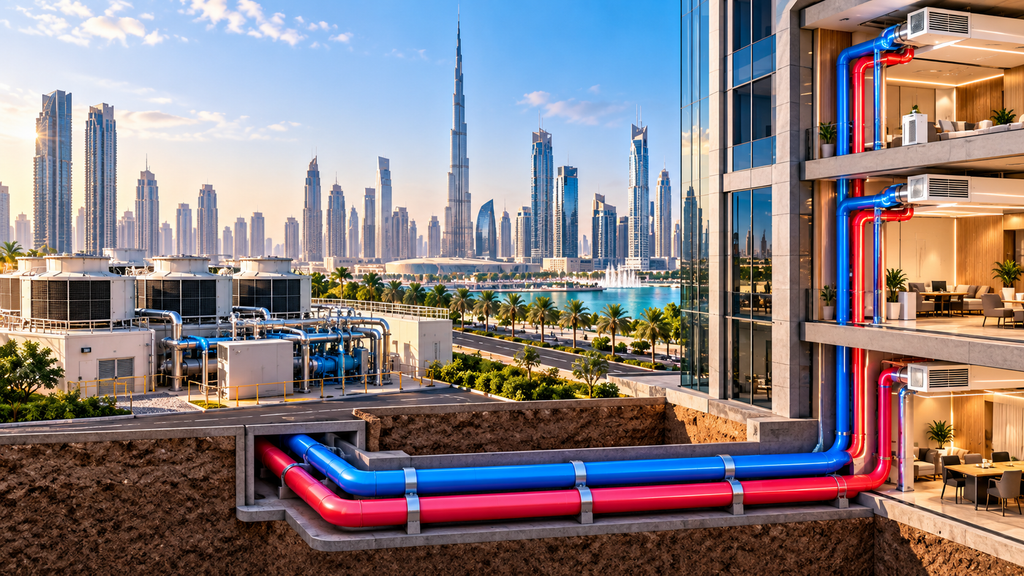
Instead of installing a separate large chiller system in every building, district cooling providers produce chilled water at central facilities and distribute it through underground insulated pipes.
The cold water transfers cooling energy into individual buildings, where internal air-conditioning systems circulate cooled air.
After absorbing heat, the water returns to the central plant to be cooled again.
The arrangement may sound like a straightforward engineering solution, but it supports a substantial business model involving long-term infrastructure investment, utility contracts, electricity consumption, water management and recurring customer payments.
Companies such as Emirates Central Cooling Systems Corporation, commonly known as Empower, have developed extensive networks serving residential, hospitality, commercial and mixed-use developments.
Dubai’s Regulatory and Supervisory Bureau for Electricity and Water states that district cooling now delivers more than 20% of the city’s cooling needs.
The financial scale is equally significant. Empower reported revenue of approximately AED 3.42 billion and net profit after tax of AED 1.004 billion for 2025.
These figures demonstrate that cooling is not merely a building maintenance expense. It is a major infrastructure service with its own investment requirements, commercial arrangements and regulatory framework.
For residents, the financial implications appear through cooling bills, capacity charges and consumption fees.
For property developers and investors, district cooling influences building design, infrastructure planning and long-term operating costs.
Understanding how the system works helps explain one of the less visible businesses supporting Dubai’s rapid urban development.
District Cooling in Dubai: How the Technology Actually Works
District cooling uses a central facility to produce chilled water for multiple buildings.
The system resembles a utility network because cooling energy is generated at one location and distributed to customers through a connected infrastructure system.
Rather than each building operating a full independent cooling plant, several properties share access to centralised equipment.
The Central Cooling Plant
The process begins at a district cooling plant containing industrial chillers, pumps, heat-rejection equipment and control systems.
Chillers remove heat from water, producing a supply of chilled water.
Tabreed’s technical materials illustrate centralised chilled-water production at approximately 4.4°C, although actual operating temperatures can vary between systems.
Large plants may also contain thermal storage facilities that help manage demand throughout the day.
Underground Distribution Pipes
Once chilled, water moves through insulated underground pipelines towards connected buildings.
The insulation limits heat entering the water during transportation.
A district cooling network generally contains supply lines that carry chilled water and return lines that bring warmer water back to the plant.
Network design is important because pumping requirements and heat gains affect overall efficiency.
Energy Transfer Stations
At the building, an energy transfer station commonly uses heat exchangers to transfer cooling energy into the building’s own chilled-water circuit.
The district cooling water and the internal building circuit remain separated in this arrangement.
The building’s air-handling units and fan-coil units then use the internal chilled-water supply to cool indoor air.
Returning Water to the Plant
After absorbing heat, the district cooling water travels back through the return network.
The central plant removes the accumulated heat and circulates the water again.
The process operates continuously to serve changing cooling demand.
The Cooling Process at a Glance
| Stage | What Happens | Main Equipment |
|---|---|---|
| Cooling Production | Water is chilled | Central chillers |
| Distribution | Cold water moves through the network | Insulated pipes and pumps |
| Building Connection | Cooling energy is transferred | Heat exchangers |
| Indoor Cooling | Air is cooled and circulated | Air-handling and fan-coil units |
| Water Return | Warmer water returns to the plant | Return pipelines |
| Cooling Reproduction | Heat is removed again | Central plant equipment |
What Is a Refrigeration Ton?
District cooling capacity is commonly measured in refrigeration tons, abbreviated as RT.
One refrigeration ton represents a cooling rate of approximately 3.517 kilowatts.
It is a measure of cooling capacity, not the physical weight of equipment or water.
Cooling consumption can be measured in refrigeration-ton-hours, which reflects how much cooling energy is used over time.
Understanding these units is important because they frequently appear in cooling contracts and customer bills.
Why Dubai Invests in District Cooling Instead of Individual AC Systems
Dubai’s climate creates significant cooling demand across much of the year.
Large residential communities, commercial towers and shopping centres require reliable cooling infrastructure that can handle changes in temperature, occupancy and building usage.
District cooling can offer advantages when developments have sufficient building density and consistent demand.
Economies of Scale
Centralised infrastructure allows several buildings to share large industrial cooling equipment.
This may improve operating efficiency and reduce the need for extensive individual chiller facilities.
However, centralised systems require major initial investment in plants and distribution networks.
The economics are strongest where demand is sufficiently concentrated to justify that infrastructure.
Energy Efficiency
Large cooling plants can use efficient equipment, sophisticated controls and thermal storage.
Tabreed’s 2025 investor presentation describes district cooling as potentially 50% more energy efficient than certain conventional cooling arrangements.
This is a company-reported comparison, not a universal saving that applies to every building.
Actual performance depends on plant design, the alternative being compared, climate, operating conditions and customer demand.
Space Inside Buildings
Buildings connected to district cooling may avoid installing extensive independent chiller facilities.
This can reduce requirements for certain mechanical plant spaces.
However, developers must still accommodate internal air-conditioning equipment and energy transfer systems.
Reliable Cooling for Large Developments
A properly designed central plant can serve numerous properties through coordinated infrastructure.
Large operators may use redundancy, monitoring systems and maintenance programmes to manage service reliability.
Nevertheless, centralisation introduces infrastructure dependencies, making network resilience and emergency planning important.
District Cooling vs Conventional Building Cooling
| Factor | District Cooling | Building-Level Chiller System |
|---|---|---|
| Cooling Production | Central facility | Equipment serving the building |
| Distribution | External pipe network | Primarily internal network |
| Initial Infrastructure | Large shared investment | Building-specific investment |
| Maintenance | Central plant plus building systems | Building equipment |
| Customer Billing | May involve capacity and consumption charges | Often reflected in electricity and building costs |
| Efficiency | Depends on network and load | Depends on equipment and operation |
| Expansion | Requires network capacity | Requires building-level planning |
Why It Fits Master-Planned Developments
District cooling can be incorporated early into the planning of large communities.
Developers may coordinate roads, pipelines, utility corridors and cooling facilities before individual buildings become occupied.
This helps explain why district cooling is often associated with dense urban developments rather than isolated small properties.
The Business Model: How District Cooling Companies Make Money
District cooling operates as a capital-intensive utility business.
Providers invest substantial funds in physical infrastructure and recover costs through approved commercial arrangements with developers, building owners and customers.
Unlike a retailer selling individual products, a district cooling company manages assets intended to remain operational for decades.
Long-Term Infrastructure Investment
Developing a district cooling network requires financing for land, plant construction, chillers, pipelines, storage systems and electrical equipment.
Some projects are expanded in stages as new buildings connect.
The operator must ensure that sufficient cooling capacity is available to meet contracted demand.
Capacity Charges
A capacity charge is associated with cooling capacity made available to a customer.
The amount is generally based on contracted refrigeration-ton capacity and the applicable approved rate.
This charge can exist even when cooling consumption is relatively low.
It helps explain why some customers receive cooling bills during periods when they use little air conditioning.
Consumption Charges
Consumption charges are linked to the amount of cooling energy actually supplied.
Metering systems measure consumption in relevant units, commonly refrigeration-ton-hours.
A customer using more cooling will generally have a higher consumption component, subject to the applicable tariff and metering arrangements.
Other Approved Charges
Depending on the service agreement and regulatory approvals, additional fees can relate to connection, metering, billing or other authorised services.
Dubai’s regulations require relevant charges and tariffs to be approved under the applicable framework.
Operators cannot simply introduce arbitrary charges outside the approved arrangements.
How Revenue Is Generated
| Revenue Component | What It Covers |
|---|---|
| Capacity Charge | Contracted availability of cooling |
| Consumption Charge | Cooling energy actually supplied |
| Connection Charge | Applicable initial connection costs |
| Metering or Billing Charges | Authorised measurement and account services |
| Other Approved Fees | Specific regulated services |
Why Recurring Revenue Matters
Large infrastructure assets involve substantial upfront investment.
Once buildings connect, service arrangements can generate revenue over an extended period.
However, recurring revenue should not be confused with guaranteed profitability.
Operators must continue paying for electricity, water, financing, maintenance, staff and infrastructure replacement.
The company also faces the risk that development schedules or cooling demand may differ from forecasts.
How the Financial Structure Works
A successful district cooling operation must recover its investment while maintaining reliable service at tariffs permitted by the regulator.
The balance between investor returns, operating efficiency and fair customer charges is central to the sector’s economics.
Empower, Tabreed and the Companies Behind Dubai’s Cooling Infrastructure
Dubai’s district cooling industry includes specialist infrastructure companies that build, operate and maintain cooling networks.
Two important regional names are Empower and Tabreed, although their operating footprints and business arrangements differ.
Empower: Dubai’s Largest District Cooling Operator
Empower was established in 2003 and has become a major part of Dubai’s cooling infrastructure.
The company is publicly listed on the Dubai Financial Market, with Dubai Electricity and Water Authority holding a controlling interest.
According to its 2025 financial results, Empower reported:
| Performance Indicator | Reported 2025 Figure |
|---|---|
| Annual Revenue | AED 3.42 billion |
| Net Profit After Tax | AED 1.004 billion |
| Connected Cooling Capacity | Approximately 1.7 million RT |
| Contracted Cooling Capacity | Nearly 2 million RT |
| Buildings Served | 1,747 |
| District Cooling Plants | 90 |
| Distribution Network | More than 430 kilometres |
These are company-reported figures for 2025, not estimates of the entire Dubai district cooling market. <Cite ref=”turn647670search5″/>
The company continued expanding during 2026. In the first quarter, it added 33,500 RT of connected capacity, while its customer base reached approximately 160,000 across 1,776 buildings. <Cite ref=”turn647670search2″/>
Tabreed: A Regional Infrastructure Operator
Abu Dhabi-headquartered Tabreed is another major player in the UAE’s district cooling sector.
Its operations extend beyond Dubai into other regional markets.
Tabreed’s business combines central plant development, cooling infrastructure operations and long-term customer arrangements.
Its investor materials emphasise the potential benefits of efficient chillers, thermal energy storage and centralised networks.
Why the Industry Is Attractive to Infrastructure Investors
District cooling can provide exposure to long-term urban development and recurring utility demand.
However, investors must also consider financing expenses, regulatory requirements, infrastructure maintenance and electricity costs.
A company’s performance depends on the assets it operates, contracts it holds and its ability to control costs.
The scale of companies such as Empower illustrates the financial importance of a service that remains largely invisible to building occupants.
Understanding District Cooling Bills: Capacity, Consumption and Hidden Costs
For Dubai residents, district cooling is often encountered through a monthly bill rather than through the infrastructure itself.
A frequent source of confusion is the difference between cooling capacity and actual cooling consumption.
Why There May Be Two Main Charges
A district cooling provider maintains equipment and network capacity to serve a property.
The capacity component reflects the cooling capability contracted for that customer or allocated to the unit.
The consumption component reflects measured cooling energy usage.
Dubai’s regulatory framework recognises both components and requires applicable billing information to be disclosed.
Illustrative Monthly Cooling Bill
The following example demonstrates the calculation only. It does not represent an actual Empower, Tabreed or other provider’s approved tariff.
| Billing Item | Hypothetical Calculation | Amount |
|---|---|---|
| Capacity Charge | 3 RT × AED 60 monthly | AED 180 |
| Consumption Charge | 300 RTh × AED 0.60 | AED 180 |
| Billing Fee | Illustrative amount | AED 15 |
| Subtotal | AED 375 |
The example excludes any applicable taxes, deposits or additional authorised charges.
Actual bills depend on contracted capacity, consumption, the provider’s approved tariffs and the relevant service agreement.
Why Capacity Charges Can Continue During Travel
A resident may turn down their cooling usage while travelling but still receive a capacity charge.
This is because capacity billing relates to the availability of contracted cooling rather than exclusively to measured consumption.
Customers should examine their actual agreement to understand which charges continue during low-usage periods.
Who Pays: Tenant or Landlord?
Responsibility depends on the property arrangements, tenancy agreement and service contract.
In some buildings, occupants maintain individual cooling accounts. In others, certain charges may be handled through the landlord or building management.
Tenants should clarify these obligations before signing a lease.
What About Chiller-Free Apartments?
A property advertised as chiller-free generally indicates that the tenant is not separately billed for certain cooling charges under the advertised rental arrangement.
It does not mean that providing cooling has no cost.
The owner or developer may absorb the expense or account for it through the property’s overall financial structure.
The precise meaning should be confirmed in writing.
Questions to Ask Before Renting
- Is cooling billed separately from DEWA electricity?
- Who is responsible for capacity charges?
- What are the approved consumption tariffs?
- Are deposits or account-opening fees required?
- Are there additional metering or billing charges?
- What happens to the account when the tenancy ends?
- Is the apartment advertised as chiller-free, and what does that include?
Dubai’s Regulatory and Supervisory Bureau provides information about cooling charges and accepts eligible customer complaints after the customer has approached the service provider.
Regulation, Energy Efficiency and Environmental Challenges
District cooling involves large financial commitments and infrastructure essential to daily life.
For this reason, Dubai regulates providers, tariffs and billing services.
How District Cooling Is Regulated
Executive Council Resolution No. 6 of 2021 establishes the framework for district cooling services in Dubai.
The Regulatory and Supervisory Bureau for Electricity and Water, commonly called the RSB, oversees relevant technical and economic requirements.
District cooling and billing operators require appropriate permits.
Under the regulatory framework, tariffs and charges are subject to approval by Dubai’s Supreme Council of Energy. <Cite ref=”turn647670search0″/>
The RSB’s tariff documents also address how approved charges must be disclosed to customers. <Cite ref=”turn647670search46″/>
Newer Rules and Penalties
Executive Council Resolution No. 87 of 2025 established fees and fines relating to district cooling services.
These include penalties for operating without required permits or charging unauthorised tariffs.
The framework reinforces the importance of transparency and compliance in a sector providing essential infrastructure. <Cite ref=”turn647670search7″/>
Electricity Demand and Sustainability
Cooling represents almost half of Dubai’s electricity demand, according to the RSB.
That makes improved cooling efficiency an important component of the emirate’s wider energy strategy.
The regulator reports that district cooling supplies more than 20% of the city’s cooling requirements.
Centralised systems can reduce energy consumption when they are designed and operated efficiently, although performance varies across projects.
Thermal Energy Storage
Some district cooling plants use large tanks to store cooling energy.
The system may produce chilled water during lower-demand periods and use the stored cooling energy when demand increases.
This can reduce peak electrical loads and help operators manage plant operation.
Thermal storage is especially relevant in hot climates where electricity demand changes significantly throughout the day.
Water Consumption Challenges
District cooling also creates environmental questions related to water use.
Facilities with cooling towers may consume substantial quantities of water through evaporation and other processes.
Using treated sewage effluent or other suitable recycled water can reduce dependence on potable water.
However, water treatment, cooling-tower management and system maintenance remain important.
Key Sustainability Trade-Offs
| Consideration | Potential Benefit | Challenge |
|---|---|---|
| Centralised Chillers | Efficient large-scale cooling | High initial investment |
| Thermal Storage | Lower peak electricity demand | Storage construction costs |
| Recycled Water | Reduced use of potable water | Treatment and infrastructure |
| Insulated Networks | Centralised energy distribution | Pipe installation and heat gains |
| Advanced Controls | Improved plant performance | Technology maintenance |
District cooling should therefore be assessed on overall energy, water and lifecycle performance rather than described as automatically sustainable in every application.
The Future of District Cooling in Dubai and Frequently Asked Questions
Dubai’s continued urban development is creating demand for infrastructure capable of serving new residential communities, commercial districts and mixed-use projects.
District cooling is likely to remain an important part of planning for sufficiently dense developments.
However, not every project will benefit equally from a centralised network.
Expansion Into New Communities
Empower has announced and developed projects serving locations including Deira Waterfront, Jumeirah Village, Al Sufouh and Dubai Science Park.
Such projects show how district cooling capacity is being integrated into evolving urban districts.
Future expansion will depend on development activity, contractual demand and investment economics.
Smarter Cooling Networks
Digital monitoring and predictive maintenance can help operators identify equipment problems before they cause major disruptions.
Demand forecasting may also improve plant scheduling, pumping efficiency and capacity planning.
These systems can support operational performance but require reliable data and cybersecurity safeguards.
The Role of Renewable Energy
As electricity generation becomes less carbon-intensive, electrically driven cooling systems may benefit from lower associated emissions.
However, actual environmental outcomes depend on electricity sources, efficiency and operational conditions.
Frequently Asked Questions
What is district cooling in Dubai?
District cooling is a centralised air-conditioning system that produces chilled water at a plant and distributes cooling energy to connected buildings through insulated pipelines.
Is district cooling the same as DEWA?
No. DEWA supplies electricity and water, while district cooling providers supply cooling energy under separate arrangements. DEWA is also a major shareholder in Empower.
Why do residents pay capacity charges?
Capacity charges relate to the contracted cooling capability made available to a customer, rather than only the cooling energy consumed.
Is district cooling cheaper than normal air conditioning?
It can offer efficiency and lifecycle cost advantages for suitable developments, but individual customer costs depend on tariffs, system design, operating conditions and contractual arrangements.
Can a tenant avoid district cooling charges?
That depends on the tenancy and service agreements. Residents should confirm billing responsibilities before renting a property.
What does chiller-free mean in Dubai?
It generally indicates that separate cooling charges are not directly passed to the tenant under the advertised arrangement. The precise contractual meaning should be checked.
Who regulates district cooling providers in Dubai?
The Regulatory and Supervisory Bureau for Electricity and Water oversees the sector under Dubai’s regulatory framework.
What is the difference between RT and RTh?
RT measures cooling capacity, while RTh measures cooling energy delivered over time.
Final Thoughts: The Business Behind Dubai’s Cooling Infrastructure
District cooling is one of the less visible industries supporting Dubai’s development.
Behind comfortable apartments, hotels, offices and shopping centres are industrial facilities, extensive underground networks and long-term infrastructure investments.
For operators, the business depends on recovering substantial capital costs while maintaining reliable service and controlling electricity, water and maintenance expenses.
For residents, understanding capacity charges, consumption billing and service agreements is essential to evaluating the real cost of living in a property.
For developers, district cooling presents an infrastructure choice that can influence building design, operating efficiency and long-term financial planning.
As Dubai expands, District Cooling in Dubai will continue to be an important subject for businesses, investors and consumers.
The cooling people experience indoors may feel effortless, but delivering it requires an entire industry working behind the scenes.
Do follow us on Instagram
Read More – How Refurbished Electronics Could Become a Bigger Retail Category in the GCC