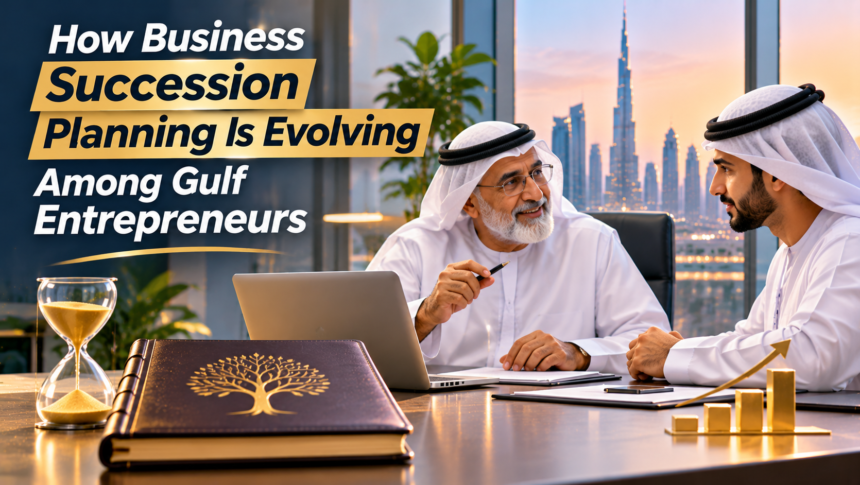
Why Next-Generation Leadership Matters for Gulf Business Growth
Across the Arabian Gulf, many successful companies have been built through generations of entrepreneurial ambition, family commitment, and long-term investment. From established trading houses and manufacturing groups to modern real estate companies, technology startups, and professional services firms, family-owned enterprises have contributed significantly to the region’s economic development. However, as founding entrepreneurs approach retirement and younger generations take on greater responsibilities, an important question is becoming increasingly relevant: how can businesses maintain stability when leadership and ownership change?
- 1. Why Business Succession Planning Is Becoming Essential in the Gulf
- 2. How Gulf Family Businesses Are Moving Toward Professional Governance
- 3. The Growing Influence of Next-Generation Entrepreneurs on Succession
- 4. How UAE and Saudi Regulations Are Supporting Family Business Continuity
- 5. The Role of Family Offices, Wealth Planning, and Ownership Structures
- 6. Challenges Gulf Entrepreneurs Face During Leadership Transitions
- 7. The Future of Business Succession Planning in the Gulf
Business succession planning in the Gulf is evolving beyond the traditional expectation that a founder will eventually transfer control to a son, daughter, or another family member. Entrepreneurs are increasingly considering structured governance, professional management, shareholder agreements, family offices, and formal leadership development programmes.
This transformation reflects wider changes across the United Arab Emirates, Saudi Arabia, Qatar, Kuwait, Bahrain, and Oman. Economic diversification, international expansion, digital transformation, and changing generational expectations are creating more complex business environments.
Succession planning is no longer simply about deciding who will inherit a company. It involves preparing future leaders, protecting business continuity, clarifying ownership rights, and establishing systems that allow organisations to operate effectively beyond their founders.
Understanding these developments reveals why succession planning is becoming an essential part of long-term business strategy across Gulf societies.
1. Why Business Succession Planning Is Becoming Essential in the Gulf
Family-owned companies occupy an important position in Gulf economies, operating across sectors including retail, construction, logistics, hospitality, manufacturing, and financial services.
Many of these businesses developed from entrepreneurial ventures into diversified organisations with multiple subsidiaries, substantial assets, and international relationships.
As enterprises become larger and more complex, leadership transitions require greater preparation.
The Challenge of Founder-Dependent Businesses
In founder-led companies, important decisions may depend heavily on one individual.
The founder may control financial approvals, maintain relationships with major customers, negotiate with suppliers, and determine strategic direction.
Although this concentration of authority can support rapid decision-making during the early stages of a business, it can create vulnerabilities when leadership changes.
If essential information, relationships, and responsibilities are not transferred properly, the organisation may experience operational uncertainty.
Succession planning helps identify these dependencies before they become urgent problems.
The Growing Succession Readiness Gap
Research indicates that many Gulf family businesses recognise the importance of succession but have not completed formal planning.
Lombard Odier’s 2025 GCC Succession Planning Survey found that only 18% of family businesses represented in its research had comprehensive succession plans.
The study surveyed 300 high-net-worth individuals across the UAE, Saudi Arabia, Qatar, Kuwait, and Bahrain during February and March 2025.
Although the findings should not be treated as representative of every GCC enterprise, they highlight a significant gap between confidence in future leadership and formal preparation.
The same research found high levels of confidence among both senior and younger generations regarding future leadership capabilities.
Why Succession Is More Than Inheritance
Inheritance concerns the transfer of assets and ownership interests under applicable legal arrangements.
Business succession also involves determining who will manage operations, make strategic decisions, supervise employees, and represent the organisation.
These responsibilities may be distributed among different individuals.
A family member could inherit shares without becoming Chief Executive Officer, while a professional executive could manage daily operations without owning the business.
Traditional Versus Modern Succession Planning
| Aspect | Traditional Approach | Evolving Approach |
|---|---|---|
| Leadership Selection | Often based on family seniority | Increasing emphasis on competence and preparation |
| Decision-Making | Founder-centred | Board and management structures |
| Ownership Transfer | Primarily inheritance-driven | Structured legal and ownership planning |
| Successor Preparation | Informal family involvement | Mentoring, training, and professional experience |
| Conflict Management | Private family discussions | Documented governance and dispute procedures |
| Business Continuity | Dependent on individual relationships | Formal operational and emergency planning |
These approaches can coexist, and not every traditional family company lacks professional governance.
The broader shift is toward preparing leadership transitions more deliberately.
2. How Gulf Family Businesses Are Moving Toward Professional Governance
One of the most significant developments in succession planning is the growing distinction between family ownership and professional management.
Historically, founders and senior family members often managed both strategic decisions and everyday operations.
However, expanding businesses may require specialised expertise that is not available within the immediate family.
The Role of Professional Management
Professional executives can contribute experience in finance, technology, operations, international expansion, and corporate governance.
Appointing a non-family executive does not necessarily mean that a family loses control of its enterprise.
Shareholders can retain ownership and influence long-term strategy through appropriate governance arrangements while delegating operational responsibilities.
This separation can help businesses develop leadership structures based on clearly defined professional roles.
Why Formal Boards Matter
A board of directors can provide oversight, evaluate organisational performance, and support major strategic decisions.
The board’s legal authority depends on the company’s jurisdiction, legal form, and constitutional documents.
For family businesses, effective boards can help clarify the responsibilities of shareholders and executives.
Independent directors may also contribute external perspectives, although their effectiveness depends on genuine independence, suitable expertise, and access to reliable information.
Family Councils and Family Constitutions
Some enterprises establish family councils to discuss ownership expectations, family participation, and shared long-term priorities.
A family constitution or charter may address matters such as:
- Conditions for employing family members.
- Qualifications required for leadership positions.
- Shareholder communication and voting arrangements.
- Dividend distribution principles.
- Ownership transfers and potential exits.
- Processes for resolving family disagreements.
- Expectations for preparing younger generations.
These documents can support transparency, but their legal effect depends on the relevant jurisdiction and how they interact with corporate documents.
The Importance of Clear Responsibilities
Family relationships and business responsibilities do not always follow the same principles.
A relative may hold an important position within the family without possessing the professional experience required to manage a large organisation.
Succession planning becomes more effective when companies define leadership responsibilities and evaluate potential successors against those requirements.
This can help reduce uncertainty while protecting the interests of employees, shareholders, customers, and business partners.
3. The Growing Influence of Next-Generation Entrepreneurs on Succession
Younger generations are introducing different professional experiences and priorities into Gulf family businesses.
Many potential successors have studied internationally, worked in multinational companies, established independent ventures, or developed expertise in digital technology.
These experiences can influence how they view business growth, management, and organisational culture.
Changing Leadership Expectations
A successor may be interested in transforming an established trading company through e-commerce, automation, or international partnerships.
Another may prefer developing new investment activities rather than managing the family’s existing operations.
These differences can create opportunities for innovation but may also produce disagreements over strategy.
A successful transition requires understanding the interests and capabilities of future leaders rather than assuming they will automatically follow the founder’s career path.
What Research Reveals About Younger Leaders
PwC’s 2024 NextGen survey focusing on Dubai found considerable interest among younger family-business members in emerging technology.
Among those surveyed, 88% expressed personal interest in generative artificial intelligence, while 68% reported knowledge of the technology.
However, only 9% said they were currently involved in applying generative AI within their family businesses.
The research also found that only 39% of Dubai NextGen respondents were certain their family business had a succession plan.
These findings illustrate the difference between younger generations’ potential contributions and their involvement in strategic decision-making.
Developing Successors Through Experience
Future leaders benefit from structured preparation rather than receiving authority solely because of family relationships.
Relevant development activities may include:
- Working in different departments.
- Completing external professional experience.
- Participating in strategic planning discussions.
- Receiving mentoring from experienced executives.
- Managing projects with measurable responsibilities.
- Understanding financial reporting and risk management.
- Developing knowledge of corporate governance.
These experiences help potential successors demonstrate their abilities while gaining familiarity with the organisation.
Not Every Family Member Wants to Lead
An important development in modern succession planning is recognising that ownership and management interests can differ.
Some family members may prefer entrepreneurship, investment, professional careers, or other activities outside the family enterprise.
Succession frameworks should consider these preferences rather than treating participation in management as an obligation.
A business may benefit from maintaining family ownership while appointing appropriately qualified professional leaders.
4. How UAE and Saudi Regulations Are Supporting Family Business Continuity

Legal frameworks are an important part of succession planning because ownership transfers, management responsibilities, inheritance, and shareholder rights must operate within applicable law.
The GCC does not have one unified legal system governing all family-business succession arrangements.
Entrepreneurs must therefore assess the laws relevant to their company’s jurisdiction, structure, and ownership.
The UAE’s Family Businesses Law
The UAE introduced Federal Decree-Law No. 37 of 2022 concerning family businesses.
The legislation provides a framework for eligible family enterprises and includes provisions addressing ownership, governance, and continuity.
It offers mechanisms through which qualifying family businesses can structure relationships and address certain challenges associated with ownership transitions.
However, not every business automatically falls within its scope.
Entrepreneurs must evaluate eligibility, registration requirements, and the interaction between the family-business framework and other applicable laws.
Dubai’s Family Wealth Ecosystem
The Dubai International Financial Centre launched the DIFC Family Wealth Centre in 2023.
The centre supports family enterprises and wealth owners through an ecosystem involving governance expertise, advisory services, and succession planning resources.
Its activities reflect the increasing importance of managing business ownership and family wealth across generations.
However, establishing an arrangement within DIFC does not remove the need to consider the laws governing assets and companies located elsewhere.
Saudi Arabia’s Family Charter Framework
Saudi Arabia’s Companies Law, which entered into force in January 2023, recognises arrangements through which partners or shareholders can establish family charters.
Article 11 provides for charters addressing matters such as family ownership, governance, employment, dividends, share transfers, and dispute resolution.
These arrangements can help families document expectations before disagreements emerge.
The legal effect of individual provisions depends on their compliance with applicable law and the company’s constitutional documents.
Why Cross-Border Ownership Creates Complexity
A Gulf entrepreneur may own a company in one country, property in another, and investments through international entities.
Different legal systems may apply to these assets.
Inheritance rules, corporate law, wills, trusts, foundation arrangements, and taxation can all become relevant depending on individual circumstances.
Entrepreneurs should therefore obtain jurisdiction-specific professional advice rather than assuming a single document can govern every asset.
5. The Role of Family Offices, Wealth Planning, and Ownership Structures
Business succession planning increasingly overlaps with wealth management.
Entrepreneurs may need to address not only the leadership of their operating companies but also the management of investments, real estate, financial assets, and family ownership interests.
This has contributed to growing attention toward family offices and structured wealth-planning arrangements.
Understanding the Role of Family Offices
A family office is an organisational arrangement that supports the management of a family’s financial and related affairs.
Depending on its structure, it may coordinate investment administration, financial reporting, estate planning, governance, and relationships with professional advisers.
Some family offices serve a single family, while others provide services to multiple families.
Not every entrepreneur needs a family office. Smaller businesses may be able to manage succession through appropriate legal documents, professional advisers, and established corporate governance.
The Growth of Family Office Interest
Lombard Odier’s 2025 survey reported that 55% of the high-net-worth individuals surveyed had established a family office.
Among respondents running active family businesses, the figure was 80%.
These results describe the surveyed high-net-worth population rather than the wider GCC business community.
They nevertheless illustrate the importance that some wealthy business families place on structured wealth management.
Separating Ownership, Wealth, and Leadership
A central element of modern succession planning is recognising that different responsibilities require different arrangements.
| Planning Area | Main Objective | Relevant Considerations |
|---|---|---|
| Leadership Succession | Maintain effective business management | Successor selection and executive development |
| Ownership Succession | Transfer or manage equity interests | Shareholder agreements and legal requirements |
| Estate Planning | Address transfer of personal assets | Applicable inheritance and estate laws |
| Family Governance | Establish shared expectations | Family councils and charters |
| Wealth Management | Coordinate assets and investments | Investment oversight and financial reporting |
| Emergency Planning | Protect operations during unexpected events | Delegated authority and contingency arrangements |
These areas are connected, but they should not be treated as interchangeable.
An ownership agreement may clarify share transfers without establishing who will manage the business.
Similarly, appointing a successor does not automatically resolve inheritance or shareholder issues.
6. Challenges Gulf Entrepreneurs Face During Leadership Transitions
Even when families recognise the importance of succession planning, implementing a formal process can be difficult.
Disagreements may arise concerning leadership suitability, distribution of ownership, business strategy, or the timing of a founder’s retirement.
These challenges can become more complex as a company passes from one generation to several branches of an extended family.
Balancing Family Relationships and Business Decisions
Family businesses combine personal relationships with commercial responsibilities.
This can create strong loyalty and long-term commitment, but disagreements may become emotionally difficult.
For example, two family members may have different views about whether the company should expand internationally or preserve its existing business model.
Without agreed decision-making procedures, such disagreements can delay important operational choices.
The Reluctance to Transfer Control
Some founders may find it difficult to delegate authority after spending decades building their enterprises.
Their relationships, reputation, and professional identity may be closely connected to the business.
A gradual transition can help address this challenge.
The founder may begin by transferring selected operational responsibilities while retaining an appropriate strategic or advisory role.
However, the arrangement must provide genuine decision-making authority to the incoming leadership.
Unclear Expectations Among Heirs
Problems can also develop when family members assume that future responsibilities have already been agreed upon.
Informal conversations may create different interpretations concerning ownership and leadership.
Documented procedures can reduce ambiguity.
Common Succession Challenges
| Challenge | Potential Consequence | Possible Response |
|---|---|---|
| Founder Dependence | Operational uncertainty | Gradual delegation and knowledge transfer |
| Family Disagreements | Delayed decisions | Defined governance and mediation procedures |
| Unprepared Successors | Weak leadership transition | Structured development programmes |
| Unclear Share Ownership | Legal and commercial disputes | Appropriate shareholder documentation |
| Different Generational Priorities | Strategic disagreements | Joint planning and regular reviews |
| Cross-Border Assets | Complex legal obligations | Coordinated jurisdiction-specific advice |
| Lack of Emergency Planning | Business interruption | Interim leadership arrangements |
Why Emergency Succession Matters
Succession planning should also address unexpected events.
Illness, incapacity, sudden resignation, or death can require immediate decisions about company management.
An emergency plan may identify temporary decision-makers, authorised signatories, essential records, and procedures for communicating with employees and commercial partners.
These arrangements should comply with applicable corporate and banking requirements.
An emergency successor may not be the same person selected for permanent leadership.
Planning for both situations can improve operational resilience.
7. The Future of Business Succession Planning in the Gulf
The future of succession planning among Gulf entrepreneurs is likely to involve a greater emphasis on formal governance, professional leadership, next-generation development, and coordinated wealth management.
As companies expand into new industries and international markets, ownership transitions may become increasingly complex.
However, effective succession planning does not require every family business to adopt the same structure.
Creating a Practical Succession Framework
Entrepreneurs can begin by assessing how dependent their organisations are on specific individuals.
They should then identify important management roles, potential successors, ownership arrangements, and unresolved legal questions.
The process can be organised into several stages:
- Define the long-term objectives of the family and business.
- Identify critical leadership positions and responsibilities.
- Assess possible internal and external successors.
- Develop training and mentoring arrangements.
- Clarify ownership and shareholder expectations.
- Establish governance and dispute-resolution procedures.
- Review legal, financial, and cross-border considerations.
- Prepare emergency leadership arrangements.
- Communicate the plan to appropriate stakeholders.
- Review and update the framework periodically.
Using Technology to Strengthen Continuity
Digital systems can support succession planning by improving financial reporting, knowledge management, and operational documentation.
Businesses may use secure information systems to record key contracts, management responsibilities, and organisational procedures.
Data analytics can also support strategic planning and performance assessment.
However, succession decisions involve judgement, relationships, and professional capability that cannot be determined solely through automated systems.
Preparing the Next Generation for Change
Future leaders may need expertise in digital transformation, sustainability, international business, cybersecurity, and changing consumer markets.
Developing these skills before a transition can help organisations respond to new commercial conditions.
At the same time, younger generations can benefit from understanding the business relationships, cultural values, and institutional knowledge developed by founders.
Successful succession should therefore involve knowledge moving in both directions.
Succession Readiness Checklist
- Document the company’s ownership and governance structure.
- Identify essential leadership responsibilities.
- Evaluate possible successors objectively.
- Establish professional development opportunities.
- Clarify family employment and management policies.
- Review shareholder and ownership agreements.
- Coordinate estate and business succession planning.
- Create emergency management arrangements.
- Protect essential commercial and financial records.
- Review succession plans as circumstances change.
Measuring a Successful Transition
Succession planning should not be evaluated only by whether a new leader takes office.
The quality of the transition also matters.
Businesses may monitor operational continuity, employee retention, customer relationships, financial performance, governance effectiveness, and the readiness of future management teams.
These indicators can help identify whether the company remains stable during the transition.
Conclusion
Business succession planning in the Gulf is developing from an informal family expectation into a more structured component of corporate governance and long-term financial planning.
As established entrepreneurs prepare to transfer responsibility to younger generations, businesses face important decisions involving leadership, ownership, professional management, and wealth preservation.
Legal developments in the UAE and Saudi Arabia, the expansion of family wealth advisory services, and growing attention to next-generation leadership demonstrate the region’s evolving approach.
However, the success of succession planning depends on practical preparation rather than legislation or documentation alone.
Entrepreneurs must develop capable leaders, clarify responsibilities, address potential disagreements, and ensure that essential business knowledge is transferred effectively.
For family enterprises, succession should not simply preserve the achievements of the founding generation. It should create the conditions for future leaders to adapt, innovate, and build sustainable businesses.
Ultimately, the evolution of business succession planning among Gulf entrepreneurs reflects a broader shift toward combining family legacy with professional governance and long-term organisational resilience.
Do follow us on Instagram
Read More – Why Intellectual Property Protection Matters for Gulf Startups and Creative Businesses