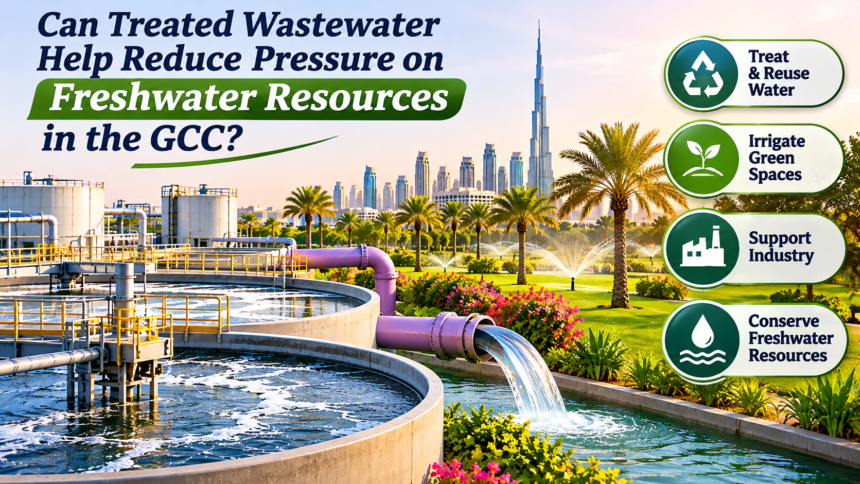
How Treated Wastewater Could Reduce Desalination Dependence in the Gulf
Water scarcity remains one of the most important environmental and economic challenges facing the Gulf Cooperation Council (GCC). Countries such as Saudi Arabia, the United Arab Emirates, Qatar, Kuwait, Oman and Bahrain operate in some of the world’s driest environments, where limited rainfall, high temperatures and growing water demand place considerable pressure on natural freshwater resources.
- 1. Why Freshwater Scarcity Remains a Major Challenge Across the GCC
- 2. How Wastewater Treatment Makes Water Suitable for Reuse
- 3. How GCC Countries Are Expanding Treated Wastewater Reuse
- 4. How Treated Wastewater Could Reduce Agricultural Water Consumption
- 5. The Role of Recycled Water in Sustainable Gulf Cities and Industries
- 6. The Environmental and Economic Benefits of Wastewater Reuse
- 7. What Challenges Must Be Addressed Before Expanding Wastewater Reuse?
- 8. How the GCC Can Build a More Water-Efficient Future Through Reuse
- Conclusion
To maintain reliable water supplies, Gulf countries have invested heavily in desalination plants, groundwater management and modern distribution networks. These systems support residential communities, agriculture, industrial facilities and expanding cities. However, producing additional freshwater is not the only way to strengthen long-term water security.
A resource already available in urban environments could help reduce unnecessary freshwater consumption: treated wastewater in the GCC.
Treated wastewater is water that has undergone treatment to remove contaminants and make it suitable for specified uses. Depending on its treatment quality and applicable regulations, it may be reused for landscape irrigation, certain agricultural activities, industrial processes and other non-drinking purposes.
Instead of discharging all treated wastewater after processing, utilities can recover part of it for productive applications. This approach may reduce demand for desalinated water and groundwater, particularly where high-quality drinking water is currently used for activities that do not require drinking-water standards.
Water reuse is already part of regional water policy. The UAE Water Security Strategy 2036 includes a target to increase treated-water reuse to 95%, while Saudi Arabia’s National Water Strategy supports expanding wastewater treatment and reuse.
However, expanding reuse requires careful planning. Water quality, public health protection, treatment costs, distribution infrastructure and environmental monitoring all influence whether recycled water can be used safely and economically.
For the GCC, treated wastewater represents an opportunity to improve resource efficiency, protect valuable freshwater supplies and develop more resilient water infrastructure. Its long-term contribution will depend on how effectively countries connect wastewater treatment with agriculture, urban planning and industrial demand.
1. Why Freshwater Scarcity Remains a Major Challenge Across the GCC
The GCC faces persistent water challenges because its natural environment provides limited opportunities for freshwater replenishment. Rainfall is generally low and irregular, while high evaporation rates affect surface water and soil moisture.
Groundwater has historically supported agriculture, rural communities and other water requirements. However, extracting groundwater faster than it can be replenished can gradually reduce available reserves and affect water quality.
As populations and economic activities expand, the challenge becomes more complex.
Growing demand from cities and industries
Urban development requires substantial water supplies for households, commercial buildings, public facilities and landscaping.
Hotels, hospitals, shopping centres and industrial facilities also contribute to overall consumption.
In many Gulf cities, water demand is supported by desalination infrastructure that converts seawater into freshwater.
Although desalination is essential for regional water security, it involves energy consumption, infrastructure investment and environmental management.
Reducing avoidable demand for desalinated water could therefore support broader efficiency objectives.
Agriculture and groundwater pressure
Agriculture is another important component of the region’s water balance.
Irrigation can require large volumes of water, particularly in hot environments where evaporation and crop water requirements are significant.
A World Bank report examining the water-energy relationship in GCC countries identifies agriculture as a major contributor to regional water consumption. World Bank
However, agricultural water requirements vary substantially between countries, crops and irrigation systems.
Treated wastewater could potentially replace part of the freshwater or groundwater currently used for suitable irrigation activities.
This substitution would need to follow national water-quality standards and appropriate agricultural practices.
Why water reuse matters
Water conservation programmes often focus on reducing consumption through efficient fixtures, improved irrigation systems and leakage detection.
These measures remain important.
Treated wastewater adds another strategy by providing an alternative supply for uses where drinking-quality water is unnecessary.
For example, a public park may require irrigation water but not necessarily desalinated drinking water.
Using appropriately treated wastewater for this purpose could allow freshwater supplies to be directed toward applications where higher water quality is essential.
Major pressures on GCC water resources
| Water challenge | Main concern | Potential role of treated wastewater |
|---|---|---|
| Limited rainfall | Low natural freshwater replenishment | Provides an additional managed water source |
| Groundwater extraction | Long-term depletion of reserves | May replace suitable irrigation demand |
| Urban expansion | Increasing municipal water requirements | Supports non-potable urban applications |
| Agricultural irrigation | High water consumption | Provides an alternative under controlled conditions |
| Desalination dependence | Energy and infrastructure costs | May reduce demand for desalinated water |
| Industrial development | Growing process-water requirements | Supports suitable industrial applications |
Treated wastewater cannot eliminate water scarcity, but it may help countries make better use of water already circulating through their economies.
2. How Wastewater Treatment Makes Water Suitable for Reuse
Wastewater from homes, commercial facilities and certain industrial activities contains substances that must be removed or controlled before reuse.
These may include organic matter, suspended solids, microorganisms, nutrients, salts and chemical contaminants.
Treatment plants use different processes to improve water quality according to the intended application.
Understanding these treatment stages is essential because not all treated wastewater is suitable for every purpose.
Primary treatment
Primary treatment mainly removes larger solids and settleable materials.
Wastewater typically passes through screening and sedimentation processes that separate some physical contaminants.
This stage is important for subsequent treatment, but primary-treated wastewater alone is generally unsuitable for most applications involving public contact.
Secondary treatment
Secondary treatment uses biological processes to reduce biodegradable organic pollution.
Microorganisms help break down organic material, improving water quality.
Although secondary treatment removes important pollutants, additional treatment may be required to control pathogens, suspended particles or other contaminants for particular reuse applications.
Tertiary and advanced treatment
Tertiary treatment can involve filtration, disinfection and other processes that further improve water quality.
Advanced technologies may include membrane filtration, ultraviolet disinfection, activated carbon and other specialised systems.
Treatment requirements depend on the intended use, the incoming wastewater composition and applicable regulations.
For example, irrigation of a restricted-access landscape may have different requirements from water used in an industrial cooling system.
Matching treatment quality with water use
One of the most important principles of wastewater reuse is that water should be treated to a level appropriate for its intended application.
This approach avoids assuming that every reuse project requires the same treatment system.
The World Health Organization supports risk-based management of wastewater reuse, including appropriate treatment, exposure controls and water-quality monitoring. World Health Organization+1
Wastewater treatment stages and applications
| Treatment level | Main function | Reuse consideration |
|---|---|---|
| Primary | Removes larger solids and settleable material | Usually requires further treatment |
| Secondary | Reduces biodegradable organic pollutants | Additional treatment commonly needed for reuse |
| Tertiary | Improves quality through filtration and disinfection | Can support approved non-potable applications |
| Advanced treatment | Targets additional microbial and chemical contaminants | Used where higher quality is required |
| Potable reuse treatment | Multiple advanced barriers and stringent verification | Requires a dedicated drinking-water safety framework and regulatory approval |
Why monitoring remains essential
Water quality can change because of treatment equipment failures, industrial discharges or operational problems.
Utilities must therefore monitor relevant parameters and maintain appropriate response procedures.
Safe reuse depends not only on the treatment technology installed but also on how effectively the system is operated over time.
3. How GCC Countries Are Expanding Treated Wastewater Reuse
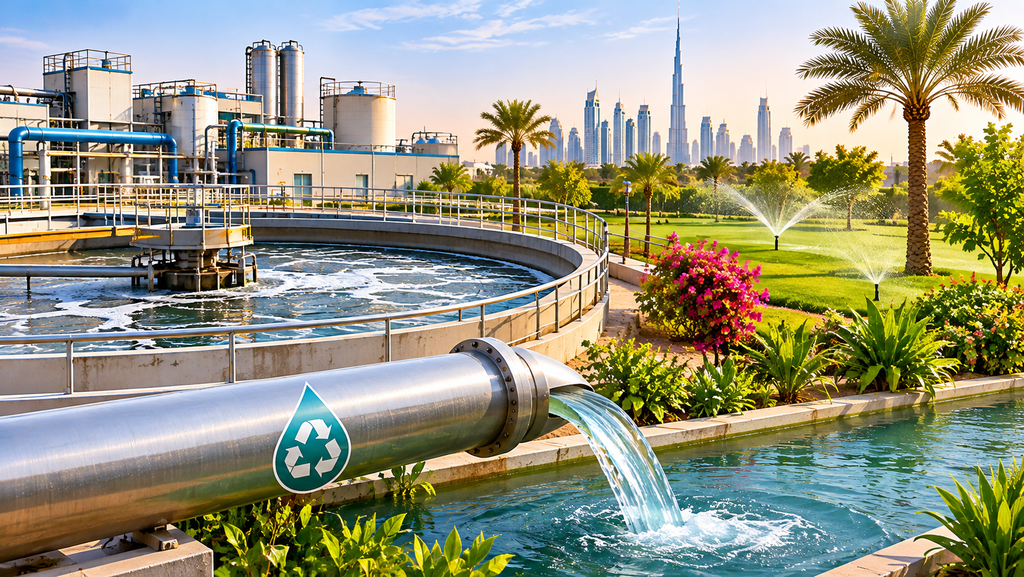
Wastewater recycling is not a new concept in the Gulf.
Several countries already use treated wastewater for landscaping, public greenery and other approved purposes.
However, the scale of reuse, available infrastructure and national strategies differ between GCC members.
United Arab Emirates: Recycled water for urban sustainability
The UAE has incorporated treated wastewater into its broader water security planning.
The UAE Water Security Strategy 2036 includes objectives for reducing overall demand and increasing treated-water reuse.
In March 2025, the Ministry of Energy and Infrastructure reaffirmed a national target of achieving 95% treated-water reuse by 2036. This is a policy target, not a claim that the country has already reached that percentage. Media Center |…
Dubai has also developed extensive infrastructure for recycled water distribution.
Its water reclamation programme supplies reclaimed water for green spaces, landscaping and selected industrial applications.
Dubai’s Government Media Office has documented the use of reclaimed water in applications including central cooling and firefighting. Media Office
These examples demonstrate how wastewater reuse can become integrated into everyday city operations.
Saudi Arabia: Supporting water security and agriculture
Saudi Arabia has identified wastewater reuse as part of its national water strategy.
Its policies address sustainable water management, irrigation efficiency and the development of wastewater treatment infrastructure.
The Ministry of Environment, Water and Agriculture has identified a goal to recycle and reuse more than 70% of treated wastewater. MEWA
Expanding wastewater reuse may help reduce dependence on freshwater for selected agricultural and municipal applications.
However, the practical benefits depend on connecting treatment facilities with suitable users through reliable distribution systems.
Qatar: Reuse in a water-scarce environment
Qatar faces significant freshwater constraints and relies on managed water infrastructure to support urban development.
Treated wastewater can provide an alternative source for appropriate landscaping, agriculture and industrial applications.
Regional studies identify Qatar among GCC countries investigating how wastewater treatment and reuse can contribute to water security.
Oman: Opportunities beyond major cities
Oman has diverse geographical conditions and water management needs.
Treated wastewater could support selected urban landscaping and agricultural activities where treatment quality and distribution infrastructure are suitable.
Decentralised treatment systems may also be worth evaluating in locations where transporting wastewater to distant central facilities is expensive.
Kuwait and Bahrain: Improving resource efficiency
Kuwait and Bahrain face freshwater limitations alongside urban and industrial demand.
Reclaimed water could help support appropriate irrigation and industrial uses, reducing pressure on higher-quality water supplies.
However, safe reuse requires reliable treatment, monitoring and appropriate separation from drinking-water networks.
Regional comparison
| GCC country | Relevant opportunity | Important consideration |
|---|---|---|
| UAE | Landscaping, district cooling and approved industrial uses | Recycled water distribution and quality control |
| Saudi Arabia | Agriculture, greenery and industrial demand | Connecting supply with suitable users |
| Qatar | Urban landscaping and selected irrigation | Treatment reliability and distribution |
| Oman | Municipal and decentralised reuse | Geography and infrastructure costs |
| Kuwait | Agriculture and industrial applications | Water quality and network management |
| Bahrain | Urban greenery and suitable industrial uses | Demand planning and treatment standards |
A GCC Statistical Center publication illustrates that wastewater reuse levels differ significantly across member countries and that substantial potential remains for improved utilisation. GCC Stat
The regional opportunity is therefore not simply to construct additional treatment plants, but to ensure that treated water reaches safe and productive applications.
4. How Treated Wastewater Could Reduce Agricultural Water Consumption
Agriculture represents one of the most promising sectors for appropriate wastewater reuse because irrigation can consume substantial volumes of water.
In arid regions, crops often require irrigation throughout long periods of the year.
Where treated wastewater meets relevant agricultural standards, replacing part of the freshwater supply could reduce pressure on groundwater and desalinated water.
Using reclaimed water for suitable crops
Treated wastewater may be used to irrigate certain crops under controlled conditions.
However, the suitability of a crop depends on water quality, the irrigation method, soil characteristics and national regulations.
Some agricultural applications require more stringent treatment and additional safeguards than others.
A research review published in Nature Reviews Earth & Environment identifies treated wastewater reuse as a potential strategy for supporting agricultural production while reducing freshwater demand, provided effective treatment and monitoring are maintained. Nature
Protecting soil quality
Treated wastewater may contain dissolved salts and nutrients.
Some nutrients can be useful for plant growth, but excessive concentrations may create problems.
In hot climates, evaporation can increase salt accumulation in agricultural soils.
Repeated irrigation with unsuitable water may damage soil structure, reduce crop productivity or affect groundwater.
Farmers and water authorities must therefore monitor salinity, nutrient concentrations and other relevant parameters.
Modern irrigation systems
Efficient irrigation methods can improve how reclaimed water is used.
Drip irrigation, for example, can deliver water close to plant roots while reducing unnecessary application to surrounding areas.
Depending on the crop and system design, subsurface irrigation may also reduce direct contact between irrigation water and above-ground plant parts.
However, irrigation systems must be maintained to prevent blockages and ensure appropriate water distribution.
Agricultural reuse opportunities
| Application | Potential benefit | Main safeguard |
|---|---|---|
| Approved agricultural crops | Reduced freshwater demand | Crop-specific water-quality standards |
| Fodder cultivation | Alternative irrigation supply | Salinity and health-risk management |
| Tree plantations | Productive use of reclaimed water | Soil monitoring |
| Landscaping nurseries | Reduced potable-water consumption | Suitable treatment and irrigation |
| Public greenery | Supports vegetation maintenance | Public exposure controls |
| Managed agricultural projects | More predictable non-potable supply | Reliable treatment and distribution |
Treated wastewater should not be applied to every crop without assessment.
The strongest approach combines water-quality standards, suitable crop selection, efficient irrigation and regular monitoring.
5. The Role of Recycled Water in Sustainable Gulf Cities and Industries
Treated wastewater can support activities beyond agriculture.
Modern urban environments contain several water-consuming systems that do not always require drinking-quality water.
Carefully designed reuse networks can provide water for selected municipal and industrial operations.
Landscape irrigation
Parks, roadside greenery, recreational areas and public landscapes require regular irrigation.
In Gulf climates, this can create considerable demand, especially during hot periods.
Reclaimed water offers a possible alternative to using freshwater for suitable landscaped areas.
Dubai’s recycled water programme demonstrates how dedicated distribution infrastructure can support urban greenery. Dubai Municipality
District cooling systems
District cooling plants supply chilled water to multiple buildings.
Some cooling operations require makeup water to replace losses from cooling towers and related processes.
Appropriately treated recycled water may be suitable for certain cooling applications.
However, water quality must be controlled to prevent scaling, corrosion and biological growth.
Specialised treatment may be necessary depending on the system.
Industrial operations
Industrial facilities may use water for cleaning, cooling and other processes.
Some applications can use reclaimed water, while others require higher purity.
For example, water used in sensitive manufacturing processes may need additional treatment even after municipal wastewater recycling.
Industrial users must therefore evaluate chemical composition and operational requirements.
Building-level reuse
Large developments may investigate wastewater reuse for approved non-potable applications.
These could include landscaping or toilet flushing where permitted by local regulations.
Such systems require separate pipe networks, clear identification, backflow protection and procedures preventing accidental connection with drinking-water supplies.
Decentralised wastewater treatment
Instead of transporting all wastewater to distant central plants, some developments may use smaller treatment facilities near the point of generation.
This could be relevant for large campuses, industrial areas or remote communities.
However, decentralised systems also require reliable operators, monitoring and maintenance.
Research on GCC water sustainability identifies decentralised treatment as a possible way to reduce certain distribution costs when reused water is needed close to its source. PubMed Central (PMC)
Potential urban and industrial applications
| Sector | Possible use | Benefit |
|---|---|---|
| Municipal landscaping | Parks and roadside greenery | Conserves potable water |
| District cooling | Cooling-system makeup water | Reduces demand for higher-quality supply |
| Industry | Approved cleaning or process applications | Improves resource efficiency |
| Large commercial developments | Approved non-potable systems | Supports water conservation |
| Public facilities | Irrigation and other permitted uses | Reduces freshwater consumption |
| Urban redevelopment | Integrated recycled-water infrastructure | Improves long-term water planning |
The greatest benefit may come from planning reuse infrastructure alongside new developments rather than adding separate networks after construction.
6. The Environmental and Economic Benefits of Wastewater Reuse
Wastewater reuse can support environmental sustainability by reducing the amount of freshwater required for suitable applications.
It can also change how cities manage wastewater, transforming part of an existing waste stream into a useful resource.
However, its economic and environmental benefits depend on treatment technology, energy requirements, transport distances and the availability of suitable customers.
Reducing pressure on groundwater
Groundwater is particularly valuable in arid regions because many underground reserves replenish slowly.
Where treated wastewater replaces groundwater used for irrigation, it may reduce the need for extraction.
The actual benefit depends on whether groundwater pumping is reduced rather than simply allowing additional water-intensive development.
Improving desalinated water allocation
Desalination provides essential freshwater supplies across the Gulf.
Using desalinated drinking water for activities that can safely rely on reclaimed water may represent an inefficient allocation of resources.
Water reuse allows utilities to reserve higher-quality water for uses that require it.
However, this does not mean every litre of reclaimed water automatically saves an equivalent litre of desalinated water. The substitution must occur in practice.
Reducing wastewater discharge
Reusing treated wastewater may reduce the quantity of effluent discharged into receiving environments.
This can support environmental management where reuse avoids unnecessary discharge and is carried out safely.
Nevertheless, treatment produces residual materials that still require appropriate management.
Potential financial benefits
Wastewater reuse can create financial opportunities by reducing purchases of freshwater and providing alternative supplies.
However, utilities must pay for treatment, pumping, storage, monitoring and distribution.
Projects with nearby customers may be more economical than those requiring long pipelines.
A World Bank study of the GCC water-energy relationship identifies transport distance between wastewater treatment facilities and potential reuse locations as an important economic constraint. World Bank
Environmental and financial comparison
| Potential benefit | Environmental importance | Economic consideration |
|---|---|---|
| Lower freshwater demand | Protects limited resources | May reduce demand for expensive supply |
| Groundwater substitution | Helps conserve underground reserves | Depends on actual reduction in pumping |
| Reduced wastewater discharge | Can improve resource management | Requires safe reuse infrastructure |
| Urban irrigation | Supports greenery without relying entirely on potable water | Needs distribution networks |
| Industrial reuse | Improves water-resource efficiency | Requires suitable treatment quality |
| Circular resource use | Connects wastewater management with productive use | Depends on customer demand and operating costs |
These benefits make reclaimed water attractive, but each project needs a realistic feasibility assessment.
7. What Challenges Must Be Addressed Before Expanding Wastewater Reuse?
Despite its potential, treated wastewater reuse presents technical, financial and public health challenges.
Water that appears clean may still contain microorganisms, salts or chemical substances requiring further treatment.
A successful reuse programme must therefore prioritise safety.
Public health protection
Microbial contamination remains a major concern when wastewater is insufficiently treated.
Appropriate disinfection, monitoring and exposure controls are essential.
Food-crop irrigation requires particular attention because of potential exposure for agricultural workers and consumers.
The WHO’s risk-based framework supports selecting treatment and additional safeguards according to the specific reuse application. Nature
Emerging contaminants
Wastewater may contain trace pharmaceuticals, household chemicals and other emerging contaminants.
Conventional treatment does not necessarily remove every substance.
A 2026 scientific discussion of treated wastewater reuse in the Middle East and North Africa identifies emerging contaminants as an important consideration for future water management. DOI
The required response depends on the contaminants present, their concentrations and the intended water use.
Infrastructure costs
Recycled water must often travel through dedicated distribution networks.
Constructing pipelines, pumps and storage facilities may require substantial investment.
For some applications, the distance between treatment plants and customers can determine whether reuse is economically practical.
Public acceptance
People may be concerned about using water that originated as sewage.
Transparent communication about treatment standards, approved uses and monitoring can help address misconceptions.
However, public confidence should be built through demonstrated safety rather than promotional claims alone.
Managing salts and soil impacts
Repeated irrigation with water containing excessive salts can affect agricultural soils.
Monitoring and appropriate irrigation practices are therefore essential.
Operational reliability
Wastewater reuse requires dependable treatment and continuous quality control.
If water fails to meet required standards, operators need procedures to stop or divert the supply until the problem is corrected.
| Challenge | Potential response |
|---|---|
| Pathogens | Appropriate disinfection and monitoring |
| Chemical contaminants | Risk-based advanced treatment where needed |
| High salinity | Water-quality assessment and suitable irrigation management |
| High infrastructure costs | Prioritise users near treatment facilities |
| Public concerns | Transparent communication and verified safety |
| Operational failures | Monitoring, alarms and backup procedures |
| Regulations | Follow national and local reuse requirements |
Wastewater reuse should be expanded only where appropriate safeguards can be maintained throughout the system.
8. How the GCC Can Build a More Water-Efficient Future Through Reuse
Expanding treated wastewater reuse requires coordinated planning between utilities, municipalities, agricultural authorities, industrial organisations and property developers.
The opportunity is not limited to increasing treatment capacity. The region must also improve how recycled water is distributed and used.
Planning reuse networks alongside new developments
New residential districts, industrial areas and public infrastructure projects offer opportunities to integrate recycled-water systems during early planning.
Installing dedicated networks during initial construction may be more practical than retrofitting completed developments.
Prioritising applications with clear demand
Water reuse projects should begin with identifying customers who can safely and consistently use reclaimed water.
Potential users include municipal irrigation systems, suitable industrial facilities and approved agricultural operations.
A strong reuse project requires both reliable supply and dependable demand.
Developing clear standards
Authorities should establish or enforce appropriate water-quality requirements for different applications.
Standards should address treatment performance, monitoring, public exposure and operational responsibilities.
Strengthening monitoring technology
Digital sensors, automated sampling and data management systems can support water-quality monitoring.
However, technology must be accompanied by laboratory verification, trained personnel and effective maintenance.
Encouraging efficient irrigation
Reclaimed water should not be treated as an unlimited resource.
Overwatering landscapes or cultivating unsuitable crops may still create environmental problems.
Efficient irrigation and appropriate planting choices remain important.
A practical GCC wastewater reuse roadmap
- Assess wastewater availability: Measure treatment volumes, quality and seasonal variation.
- Identify suitable users: Locate agricultural, municipal and industrial demand.
- Evaluate health and environmental risks: Determine necessary treatment and safeguards.
- Plan infrastructure: Design distribution, storage and backup arrangements.
- Conduct feasibility studies: Compare treatment and delivery costs with alternative water supplies.
- Introduce pilot projects: Test operational performance under local conditions.
- Monitor actual freshwater savings: Measure whether reclaimed water replaces freshwater consumption.
- Expand successful systems: Use demonstrated results to guide future investment.
The importance of measuring results
Water reuse programmes should report more than the total volume of treated wastewater produced.
Useful indicators include the amount actually reused, the freshwater consumption replaced, compliance with water-quality standards and the cost of delivered reclaimed water.
Distinguishing wastewater treatment from actual reuse is essential.
A treatment plant may produce large quantities of suitable effluent, but water security benefits remain limited if that water is not delivered to productive applications.
Conclusion
Treated wastewater offers a practical opportunity to reduce pressure on freshwater resources across the GCC.
By recycling suitable wastewater for irrigation, landscaping, industrial operations and other approved applications, Gulf countries can improve how they manage existing water supplies.
The approach could help reduce dependence on groundwater and desalinated water while supporting more sustainable urban and agricultural development.
The UAE’s water reuse strategy, Dubai’s established recycled-water infrastructure and Saudi Arabia’s national water management priorities demonstrate growing regional interest in this resource.
However, wastewater reuse is not a universal solution.
Public health protection, treatment quality, distribution infrastructure, cost management and environmental monitoring must remain central to every project.
The strongest approach is to combine treated wastewater reuse with efficient irrigation, water conservation, leakage reduction and responsible groundwater management.
Ultimately, treated wastewater could become an increasingly valuable part of GCC water security, helping the region protect limited freshwater resources while supporting long-term economic and environmental sustainability.
Do follow us on Instagram
Read More – Why Climate Risk Assessment Should Become Part of Real Estate Development in the Gulf