The Secret Life of Dugongs in the Arabian Gulf
Beneath the warm waters of the Arabian Gulf lives a remarkable marine animal that many people have never seen. While the region is widely known for its modern cities, desert landscapes and beautiful coastlines, its underwater world is equally fascinating. Among its most extraordinary residents is the dugong, a gentle marine mammal that spends much of its life feeding on underwater plants.
- 1. What Are Dugongs and Why Are They Called Sea Cows?
- 2. Where Do Dugongs Live in the Arabian Gulf?
- 3. The Secret Behind the Dugong Diet and Seagrass Meadows
- 4. How Dugongs Live, Communicate and Travel Underwater
- 5. Mother Dugongs and Their Remarkable Bond With Their Calves
- 6. Why Dugongs Are Important for Marine Biodiversity
- 7. Major Threats Facing Dugongs in the Arabian Gulf
- 8. Dugong Conservation and the Future of the Arabian Gulf
- Conclusion
- Frequently Asked Questions About Dugongs
Commonly known as a sea cow, the dugong is a peaceful animal that depends on healthy seagrass meadows for survival. Its rounded body, unusual appearance and slow movements make it one of the most distinctive creatures found in Gulf waters.
The Arabian Gulf supports the world’s second-largest known dugong population after Australia. Countries such as the United Arab Emirates, Qatar, Bahrain and Saudi Arabia provide important habitats for these marine mammals.
However, despite their importance to marine biodiversity, dugongs remain relatively unknown to many people. Their secret lives reveal an interesting world of underwater feeding grounds, seasonal movements, strong mother-calf relationships and remarkable survival abilities.
Understanding the life of dugongs in the Arabian Gulf can help raise awareness about the importance of protecting the region’s valuable marine ecosystems.
1. What Are Dugongs and Why Are They Called Sea Cows?
The dugong, scientifically known as Dugong dugon, is a large marine mammal belonging to a group of animals called Sirenia. This group also includes manatees, which share several physical and behavioural similarities with dugongs.
Although dugongs spend their entire lives in water, they are not fish. Like dolphins and whales, they breathe air through lungs and must regularly return to the water’s surface.
Dugongs are commonly called sea cows because they spend considerable time grazing on seagrass, much like cows feeding on grass in open fields.
Their bodies are naturally adapted to underwater life. They have paddle-shaped front flippers, a broad body, a downward-facing mouth and a tail resembling that of a whale.
Their unusual mouth structure helps them collect vegetation from the seabed, while their powerful tails allow them to move through the water.
Around 3,000 dugongs live in this area, making it one of the most important habitats for these animals in the world.
Quick Facts About Dugongs
| Feature | Details |
|---|---|
| Scientific name | Dugong dugon |
| Common name | Sea cow |
| Animal type | Marine mammal |
| Animal group | Sirenia |
| Diet | Mainly seagrass |
| Adult body length | Approximately 2.5 to 3 metres |
| Lifespan | Up to around 70 years |
| Natural habitat | Shallow coastal waters |
| Pregnancy period | Approximately 13 to 15 months |
| Young ones | Known as calves |
| Global conservation status | Vulnerable |
| Major threats | Habitat loss, fishing nets and boat collisions |
Despite their considerable size, dugongs are generally peaceful animals. They do not normally hunt other large marine creatures and spend much of their time searching for suitable underwater feeding grounds.
Their gentle nature makes them one of the most interesting members of the Arabian Gulf’s marine wildlife.
2. Where Do Dugongs Live in the Arabian Gulf?
The Arabian Gulf provides important environmental conditions for dugongs. Its shallow coastal waters, sheltered bays and extensive seagrass meadows create suitable habitats for these plant-eating marine mammals.
Unlike whales that travel through deep ocean waters, dugongs are strongly connected to coastal environments where sunlight supports the growth of underwater vegetation.
The southern and western parts of the Arabian Gulf contain some of the most important dugong habitats outside Australia.
Dugongs in the United Arab Emirates
Abu Dhabi is home to internationally significant dugong populations. Many animals live in coastal waters containing extensive seagrass habitats, particularly in the central and western parts of the emirate.
Important conservation areas include the Marawah Marine Biosphere Reserve and Al Yasat Marine Protected Area.
According to an official announcement published in June 2025 by the Abu Dhabi Media Office, the Environment Agency – Abu Dhabi estimated the emirate’s dugong population at more than 3,500 individuals in 2024.
The announcement also reported an increase of more than 20% compared with the agency’s earlier survey results.
Dugongs in Qatar and Bahrain
Qatar and Bahrain provide important feeding and gathering areas for dugongs. The shallow waters surrounding Bahrain’s Hawar Islands and northwestern Qatar are especially valuable.
Scientists have documented unusually large gatherings of dugongs in these waters. These observations demonstrate the international importance of the Arabian Gulf for marine wildlife conservation.
Dugongs in Saudi Arabia
Saudi Arabia’s Arabian Gulf coastline also contains suitable dugong habitats, particularly in shallow coastal areas connected to the southern Gulf.
Protecting these waters is important because dugongs can travel between neighbouring countries while searching for food and suitable environmental conditions.
| Gulf Country | Important Dugong Habitats |
|---|---|
| UAE | Western Abu Dhabi, Marawah and Al Yasat |
| Qatar | Northwestern coastal waters and seagrass habitats |
| Bahrain | Hawar Islands and the Gulf of Salwa |
| Saudi Arabia | Shallow southern and western Gulf waters |
These habitats demonstrate why regional cooperation is necessary. Dugongs do not recognise national boundaries, and their survival depends on healthy marine environments across the wider Arabian Gulf.
3. The Secret Behind the Dugong Diet and Seagrass Meadows
One of the most fascinating aspects of dugong behaviour is its dependence on underwater vegetation.
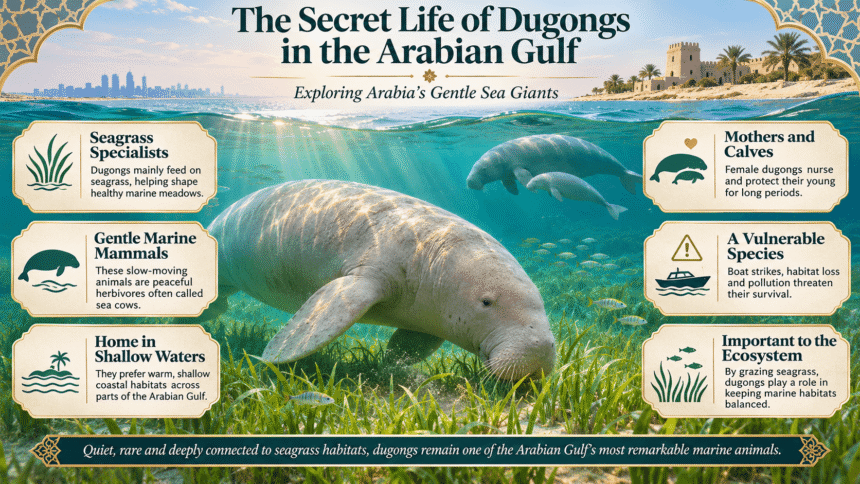
The dugong diet consists mainly of seagrass, a flowering plant that grows beneath the surface of coastal waters. Unlike seaweed, seagrass has roots, leaves and other structures commonly associated with plants growing on land.
Seagrass meadows develop in areas where sufficient sunlight reaches the seabed. These underwater gardens provide food, shelter and breeding grounds for numerous marine species.
Dugongs use their downward-facing mouths to collect seagrass from the ocean floor. They can consume leaves and underground plant parts, depending on the species and conditions of the feeding area.
Dugongs use their front flippers to move along the seabed while feeding on seagrass. As they dig up the leaves, stems, and roots, they leave long, winding tracks in the sand that are about 20–25 cm wide.
As they graze, they sometimes leave visible feeding trails across the seabed. Scientists can study these trails to identify areas where dugongs have recently been feeding.
Why are seagrass meadows important for dugongs?
- They provide the main source of food.
- They support feeding throughout different seasons.
- They create important habitats for mothers and calves.
- They influence the movement of dugong populations.
- They support long-term survival and reproduction.
- They provide feeding grounds shared with other marine wildlife.
Dugongs may travel considerable distances when suitable food becomes difficult to find. Seasonal changes, marine heatwaves and damage to seagrass habitats can influence where they feed.
Healthy seagrass meadows also benefit fish, green sea turtles, crabs and numerous smaller marine organisms.
Another important feature of seagrass is its ability to store carbon in plant material and underwater sediments. This makes seagrass conservation valuable for both marine biodiversity and climate protection.
When a seagrass meadow disappears, the impact extends far beyond the loss of underwater plants. Dugongs may lose access to essential food, while other marine animals can lose shelter and breeding grounds.
Protecting the dugong diet therefore begins with protecting the underwater environment that produces its food.
4. How Dugongs Live, Communicate and Travel Underwater
Although dugongs are large animals, their everyday behaviour remains difficult to observe because they spend most of their lives beneath the water.
They frequently move between feeding grounds, resting areas and locations with suitable water conditions. Their movements depend on factors such as food availability, temperature, tides and human disturbance.
Dugongs must return to the surface to breathe
Unlike fish, dugongs cannot extract oxygen directly from water. They must regularly swim to the surface to breathe through their nostrils.
After taking a breath, they can return underwater and continue feeding or travelling. Their diving abilities allow them to spend several minutes beneath the surface, although dive duration varies according to their activities.
Communication between dugongs
Dugongs communicate using underwater sounds, including chirps, whistles and other vocalisations.
These sounds may help individuals maintain contact, particularly when mothers and calves are moving through waters where visibility is limited.
Scientists continue to study dugong communication to understand how these marine mammals interact with one another.
Why do dugongs sometimes gather in large groups?
Dugongs are often observed alone, in pairs or in small groups. However, the Arabian Gulf is also known for exceptionally large gatherings.
Research published in 2025 in Frontiers in Marine Science examined drone surveys conducted in northwestern Qatar during 2019 and 2020. The research documented gatherings involving more than 1,000 dugongs.
These extraordinary observations highlight the importance of protecting shared feeding grounds and seasonal gathering areas.
Large gatherings may be influenced by:
- Seasonal water temperature changes.
- The availability of suitable seagrass.
- Environmental conditions in coastal waters.
- Movement between preferred habitats.
- Social interactions among individuals.
Dugongs are not permanently restricted to one location. Their ability to travel allows them to respond to changing conditions, but coastal development and heavy marine traffic can make these journeys more difficult.
5. Mother Dugongs and Their Remarkable Bond With Their Calves
Mother dugongs share a very close bond with their young. They spend up to two years caring for a single calf, staying close, feeding it, and protecting it to help it survive.
The relationship between a mother dugong and her calf is one of the most interesting parts of the animal’s secret life.
Unlike many marine species that produce large numbers of offspring, dugongs reproduce slowly. A female usually gives birth to a single calf after a pregnancy lasting approximately 13 to 15 months.
Newborn dugongs are already capable of swimming, but they depend heavily on their mothers for food, protection and guidance.
During the early stages of life, a calf receives milk from its mother while gradually learning to feed on seagrass.
Mother and calf often remain close together while travelling through coastal waters. The young animal must learn how to find feeding grounds, return to the surface for air and respond to possible dangers.
Important stages of dugong reproduction
| Life Stage | Characteristics |
|---|---|
| Pregnancy | Usually lasts around 13 to 15 months |
| Birth | Generally produces one calf |
| Early development | Calf depends heavily on its mother |
| Feeding transition | Gradually begins eating seagrass |
| Independence | Develops over an extended period |
| Time between births | Commonly around 3 to 7 years |
This slow reproductive cycle makes dugongs particularly vulnerable to population decline.
When adult females die because of fishing accidents, boat collisions or other threats, replacing those individuals can take many years.
Food availability can also influence reproduction. When seagrass becomes scarce, females may struggle to obtain enough energy to support pregnancy and care for their calves.
The bond between mother dugongs and their calves is about more than just feeding and protection. Young dugongs also learn important survival skills from their mothers. Since seagrass growth changes with the seasons in the Arabian Gulf, calves learn where to find the best feeding areas, how to dig up seagrass roots, and which routes are safe to travel through.
Protecting healthy feeding grounds is therefore essential for the future of dugong populations in the Arabian Gulf.
6. Why Dugongs Are Important for Marine Biodiversity
Dugongs play a valuable role in the natural environment of the Arabian Gulf. Their feeding activities connect them directly to the health and structure of seagrass ecosystems.
As dugongs graze, they influence underwater vegetation. In some conditions, grazing can encourage the growth of certain seagrass species and change the structure of existing meadows.
Their movements and feeding behaviour also contribute to nutrient cycling within marine environments.
However, the relationship between grazing and seagrass growth depends on local conditions. Excessive grazing or environmental damage can reduce vegetation rather than improve it.
The ecological importance of dugongs
| Ecological Role | Environmental Importance |
|---|---|
| Seagrass grazing | Influences underwater plant communities |
| Nutrient cycling | Helps redistribute nutrients within marine habitats |
| Marine biodiversity | Represents an important part of native wildlife |
| Environmental monitoring | Helps scientists understand changes in coastal habitats |
| Scientific research | Improves knowledge of marine mammal behaviour |
| Environmental education | Encourages greater awareness of marine conservation |
Dugongs can also provide clues about the condition of coastal ecosystems. Areas supporting healthy dugong populations often contain suitable feeding grounds and other important natural resources.
The disappearance of dugongs from a particular location may encourage researchers to investigate changes in seagrass coverage, water quality and human activities.
Their importance extends beyond science. Dugongs also form part of the natural and cultural heritage of the Arabian Gulf.
Archaeological findings near Abu Dhabi suggest that earlier coastal communities used dugongs as a food resource thousands of years ago. These discoveries reveal a long historical connection between people and the region’s marine environment.
Today, protecting dugongs provides an opportunity to preserve this natural heritage for future generations.
7. Major Threats Facing Dugongs in the Arabian Gulf
Despite their ability to survive challenging marine conditions, dugongs face several serious environmental threats.
The International Union for Conservation of Nature (IUCN) classifies the dugong as Vulnerable globally. This means the species faces a high risk of extinction in the wild.
Human activities are responsible for many of the challenges affecting dugong populations.
Loss of seagrass habitats
Coastal construction, dredging and land reclamation can damage underwater vegetation. Construction activities may also increase the amount of sediment in the water, reducing sunlight available to seagrass.
Without suitable feeding grounds, dugongs may be forced to travel farther in search of food.
Entanglement in fishing nets
Fishing nets are particularly dangerous because dugongs must reach the surface to breathe. Animals that become trapped underwater may suffer serious injuries or drown.
Responsible fishing practices and effective fishing regulations can help reduce this risk.
Boat collisions
Growing marine traffic increases the possibility of boats striking dugongs, especially in shallow coastal waters.
Dugongs may be difficult for boat operators to notice until they come close to the surface.
Climate change and marine pollution
Rising seawater temperatures, marine heatwaves and changes in coastal conditions can affect seagrass growth. Oil spills, plastic waste and polluted discharge can also damage marine habitats.
| Major Threat | Potential Impact |
|---|---|
| Coastal development | Destruction of feeding grounds |
| Fishing nets | Accidental capture and drowning |
| Boat collisions | Serious injuries or death |
| Climate change | Changes in seagrass availability |
| Oil pollution | Damage to marine habitats |
| Water pollution | Reduced water quality and vegetation growth |
| Human disturbance | Disruption of feeding and movement |
Addressing these challenges requires long-term planning and cooperation between governments, researchers, fishing communities and coastal businesses.
8. Dugong Conservation and the Future of the Arabian Gulf
The future of dugongs in the Arabian Gulf depends on countries working together to protect their shared waters and seagrass habitats.
The Gulf is home to around 5,800 to 6,000 dugongs, making it the second-largest dugong population in the world after Australia. However, these animals face growing threats from industrial activities, pollution, and environmental changes.
Several Gulf countries have recognised the importance of dugong conservation and introduced measures to protect marine wildlife.
In the UAE, the Environment Agency – Abu Dhabi conducts research through aerial surveys, satellite tracking, genetic studies and investigations into dugong deaths.
These programmes help researchers understand population changes, movement patterns and the environmental challenges affecting the species.
Marine protected areas also provide important opportunities to reduce harmful activities within sensitive habitats.
International cooperation is equally important. The United Nations-supported Convention on the Conservation of Migratory Species of Wild Animals operates a dugong conservation agreement designed to encourage cooperation between countries.
Important steps for protecting dugongs include:
- Protecting existing seagrass meadows.
- Establishing and managing marine protected areas.
- Reducing accidental capture in fishing nets.
- Monitoring marine mammal populations.
- Managing boat speeds in sensitive coastal areas.
- Reducing marine pollution.
- Restoring damaged underwater habitats.
- Encouraging responsible coastal development.
- Educating local communities about marine wildlife.
- Strengthening cooperation between Gulf countries.
Individuals can also contribute by avoiding marine litter, respecting protected areas and maintaining a safe distance from wildlife.
Responsible wildlife tourism can help increase public awareness, provided animals are not chased, touched, fed or disturbed.
Conclusion
The secret life of dugongs in the Arabian Gulf reveals a fascinating underwater world that often remains hidden from everyday life.
From their peaceful feeding habits and remarkable underwater adaptations to their close family relationships, dugongs demonstrate the extraordinary diversity of Arabia’s marine environment.
Their survival depends on healthy seagrass meadows, clean coastal waters and responsible human activities.
As Gulf countries continue to develop their coastal regions, balancing economic progress with marine conservation will become increasingly important.
Protecting dugongs is not simply about saving one remarkable marine mammal. It is about preserving an entire underwater ecosystem that supports biodiversity, environmental health and the natural heritage of the Arabian Gulf.
Through scientific research, regional cooperation and greater public awareness, future generations can continue to discover the fascinating world of these gentle sea giants.
Frequently Asked Questions About Dugongs
Are dugongs found in the Arabian Gulf?
Yes. The Arabian Gulf supports one of the world’s largest dugong populations, particularly in the UAE, Qatar, Bahrain and Saudi Arabia.
Why are dugongs called sea cows?
They are called sea cows because they spend much of their lives grazing on underwater vegetation, especially seagrass.
Are dugongs dangerous to humans?
Dugongs are generally peaceful and do not normally threaten humans. However, they are wild animals and should be observed from a respectful distance.
What do dugongs eat?
Their diet consists mainly of seagrass found in shallow coastal waters.
What is the difference between a dugong and a manatee?
Dugongs have a whale-like tail with two distinct flukes, while manatees have a broad, rounded tail. Dugongs live in marine environments, whereas some manatee species also inhabit freshwater.
How long do dugongs live?
Dugongs can live for approximately 70 years, although many individuals die earlier because of natural or human-related causes.
Are dugongs endangered?
Dugongs are globally classified as Vulnerable by the IUCN. Some regional populations face more serious conservation challenges.
Do follow us on Instagram
Read More – Why Petrol Prices Change Every Month in the UAE