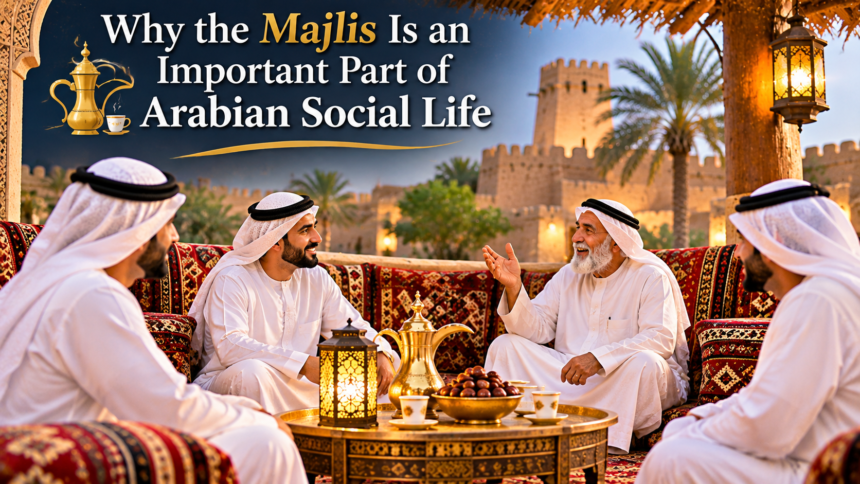
The History and Modern Importance of the Arabian Majlis
Hospitality has always been an important part of Arabian culture. Across the Gulf, welcoming visitors, sharing conversations and maintaining strong community relationships are traditions that have continued for generations. One of the most meaningful expressions of these values is the majlis, a traditional gathering space that remains central to social life in many Arab communities.
- 1. What Is a Majlis and How Did the Tradition Begin?
- 2. Why Hospitality Is at the Heart of Arabian Majlis Culture
- 3. How Traditional Gatherings Strengthen Family and Community Relationships
- 4. The Importance of Storytelling, Poetry and Cultural Education
- 5. How the Majlis Tradition Differs Across Gulf Countries
- 6. How Traditional Arabian Gathering Spaces Reflect Local Architecture
- 7. Why Traditional Gathering Customs Remain Relevant in Modern Society
- 8. Why Preserving the Majlis Matters for Future Generations
- Conclusion: A Living Symbol of Arabian Hospitality
The word comes from Arabic and refers to a place where people sit together. However, its cultural importance extends far beyond a physical room. It represents hospitality, respect, communication and the passing of knowledge between generations.
Historically, these gatherings brought families, neighbours, merchants and community elders together. People exchanged news, discussed local concerns, shared stories and celebrated important occasions. In many communities, they also provided opportunities to settle disagreements and strengthen social relationships.
Today, this tradition remains visible across the United Arab Emirates, Saudi Arabia, Qatar, Oman, Kuwait and Bahrain. Although modern lifestyles have transformed homes and social practices, gathering with family and visitors continues to hold special significance.
In 2015, UNESCO recognised “Majlis, a cultural and social space” as part of the Representative List of the Intangible Cultural Heritage of Humanity. The nomination was jointly submitted by the UAE, Saudi Arabia, Oman and Qatar.
This international recognition highlights the importance of preserving a tradition that connects everyday social interaction with cultural heritage.
Understanding its history helps explain why traditional gathering spaces continue to play a meaningful role in Arabian society.
1. What Is a Majlis and How Did the Tradition Begin?
A majlis is traditionally a place where people gather to exchange ideas, receive guests and maintain social relationships. It may be a dedicated room inside a house, an area within a tent or a separate building used for community meetings.
The term describes both the physical setting and the cultural practice of gathering together.
Origins in Arabian Communities
The tradition developed over many generations, influenced by the social and environmental conditions of the Arabian Peninsula.
In desert communities, welcoming travellers and maintaining relationships with neighbouring families were important aspects of everyday life. Gatherings provided opportunities to exchange practical information about travel routes, trade, weather and local affairs.
In coastal settlements, merchants and residents also came together to discuss business, community matters and shared concerns.
As communities developed, these informal interactions became associated with recognised customs of hospitality and respectful communication.
There is no single historical date marking the beginning of this practice. Its development reflects the experiences of different Arabian communities over centuries.
A Place for Sharing Ideas
Traditional gatherings were not limited to casual conversation.
Depending on the community, respected elders and other local figures could discuss social responsibilities, community concerns and disagreements.
Families also used these spaces to welcome relatives, celebrate occasions and strengthen relationships.
UNESCO describes the tradition as an important setting for exchanging news, discussing issues and transmitting cultural knowledge.
More Than a Physical Room
The most important feature is not the furniture or architectural design.
A simple gathering beneath a shelter may serve the same cultural purpose as an elaborately decorated reception room.
What matters is the interaction between people and the customs surrounding hospitality.
| Traditional Function | Cultural Importance |
|---|---|
| Welcoming guests | Expresses generosity and respect |
| Sharing news | Supports community communication |
| Family discussions | Strengthens relationships |
| Storytelling | Preserves cultural memories |
| Community meetings | Encourages cooperation |
| Learning from elders | Transfers knowledge and experience |
These functions explain why the tradition has survived major changes in Arabian society.
2. Why Hospitality Is at the Heart of Arabian Majlis Culture
Hospitality is one of the strongest values associated with the majlis.
Throughout Arabian history, welcoming visitors has been closely connected with generosity, dignity and social responsibility. Receiving guests warmly demonstrates respect and helps build relationships between individuals and families.
Although customs differ between regions, offering refreshments and creating a comfortable environment remain familiar expressions of this heritage.
The Tradition of Arabic Coffee
Arabic coffee, commonly called gahwa or qahwa, holds a special place in Gulf hospitality.
It is often served from a traditional coffee pot known as a dallah into small cups called finjan.
The preparation and serving of coffee can involve established customs passed down through generations.
Dates are also commonly offered, creating a welcoming environment for conversation.
In 2015, UNESCO recognised Arabic coffee as an element of intangible cultural heritage through a multinational nomination.
The Meaning Behind Serving Coffee
Coffee service is more than providing refreshments.
It can represent attention, courtesy and generosity toward visitors.
In some Gulf traditions, a guest gently shakes an empty cup to indicate that no additional serving is needed.
However, the details of this practice vary between countries and families.
Hosts may also offer tea, water or traditional sweets, depending on the occasion.
Respecting Visitors
Hospitality also involves making people feel comfortable and included.
Guests are usually welcomed with appropriate greetings and offered seating.
Conversations may begin with questions about family, health and everyday life before moving toward other subjects.
These practices strengthen personal connections and demonstrate the importance of treating visitors respectfully.
| Hospitality Element | Cultural Meaning |
|---|---|
| Arabic coffee | Welcome and generosity |
| Dates and refreshments | Care for guests |
| Traditional greetings | Respect |
| Comfortable seating | Consideration |
| Shared conversation | Friendship and understanding |
| Attentive hosting | Recognition of guests |
The enduring importance of Arabian hospitality lies in its ability to make ordinary visits meaningful social experiences.
3. How Traditional Gatherings Strengthen Family and Community Relationships
Strong family relationships are an important feature of social life across the Arabian Peninsula.
Regular gatherings provide opportunities for relatives, friends and neighbours to spend time together, share experiences and maintain contact across generations.
Even as modern technology makes communication easier, meeting in person continues to hold particular cultural value.
Maintaining Family Connections
In many Gulf households, family members gather during weekends, religious celebrations and special occasions.
These meetings allow relatives to discuss important events and remain involved in one another’s lives.
They can be especially meaningful for extended families whose members live in different neighbourhoods or cities.
Children may also develop stronger relationships with grandparents, uncles, aunts and other relatives through regular interaction.
Connecting Different Generations
Older family members often possess valuable knowledge about traditional customs and earlier ways of life.
During social visits, younger people may hear stories about life before modern infrastructure, changing occupations and important family experiences.
Such conversations help connect the present with the past.
They also create opportunities for younger generations to ask questions and understand cultural traditions through personal experiences.
Supporting Community Cooperation
Neighbourhood gatherings may bring together people who share common interests or concerns.
Discussions can involve local events, charitable activities, celebrations or practical community matters.
These interactions may encourage cooperation and strengthen relationships.
However, not every gathering serves an official decision-making purpose. Some exist primarily for friendship and social connection.
Encouraging a Sense of Belonging
Regular interaction can help individuals feel connected to their communities.
For people returning from university or employment abroad, familiar family gatherings may provide a meaningful connection to home.
This sense of belonging is one reason traditional social customs remain important despite rapid urban development.
| Social Activity | Potential Benefit |
|---|---|
| Family visits | Maintains relationships |
| Intergenerational conversations | Preserves experience |
| Neighbourhood gatherings | Encourages cooperation |
| Religious celebrations | Strengthens shared traditions |
| Community discussions | Creates opportunities for dialogue |
| Cultural activities | Supports social participation |
The value of these gatherings comes from meaningful interaction rather than their frequency or formality.
4. The Importance of Storytelling, Poetry and Cultural Education
Before television, smartphones and digital communication became common, oral traditions played an important role in preserving knowledge.
Stories, poetry, family histories and conversations helped people share information and explain their experiences.
The majlis provided a familiar setting for these forms of cultural expression.
Preserving Oral History
Older generations often share memories of traditional occupations, travel, trading activities and family life.
These accounts can provide valuable perspectives on how Arabian communities lived before rapid modernisation.
Such stories may include personal experiences of desert journeys, pearl diving, agriculture or coastal commerce.
Although oral histories are valuable, individual memories should be distinguished from independently verified historical records.
The Importance of Nabati Poetry
Nabati poetry has a longstanding presence in the Arabian Peninsula.
Its themes may explore love, honour, friendship, desert landscapes, personal experiences and social values.
Poetry recitation has historically been associated with gatherings in which listeners appreciate language, rhythm and storytelling.
Through these experiences, younger generations can become familiar with traditional expressions and literary styles.
Learning Through Observation
Cultural education does not always take place in schools.
Children can learn customs by observing how adults welcome visitors, communicate respectfully and participate in conversations.
These experiences may introduce them to appropriate greetings, hospitality practices and social responsibilities.
Such knowledge becomes part of everyday cultural understanding.
Sharing Modern Knowledge
Traditional gatherings are not limited to historical subjects.
Today, participants may discuss education, literature, science, careers and current social developments.
Some cultural institutions organise literary and intellectual sessions that encourage discussion across generations.
These activities demonstrate how an established tradition can continue serving new educational purposes.
| Cultural Activity | Importance |
|---|---|
| Family storytelling | Preserves personal history |
| Nabati poetry | Maintains literary heritage |
| Traditional conversations | Shares cultural knowledge |
| Educational discussions | Encourages learning |
| Historical recollections | Connects generations |
| Cultural performances | Supports artistic expression |
By encouraging the exchange of ideas, these gatherings contribute to the preservation and continued development of Arabian cultural identity.
5. How the Majlis Tradition Differs Across Gulf Countries
Although the majlis is familiar throughout the Arabian Peninsula, its appearance and customs are not identical everywhere.
Different countries and communities have developed their own traditions influenced by local history, family practices and social environments.
United Arab Emirates
In the UAE, dedicated reception spaces remain important features of traditional and contemporary homes.
Families use them to welcome visitors, celebrate occasions and maintain social relationships.
Community gatherings have also historically provided opportunities for residents to exchange information and discuss local concerns.
Abu Dhabi Culture identifies this tradition as an important aspect of Emirati hospitality and cultural heritage.
Saudi Arabia
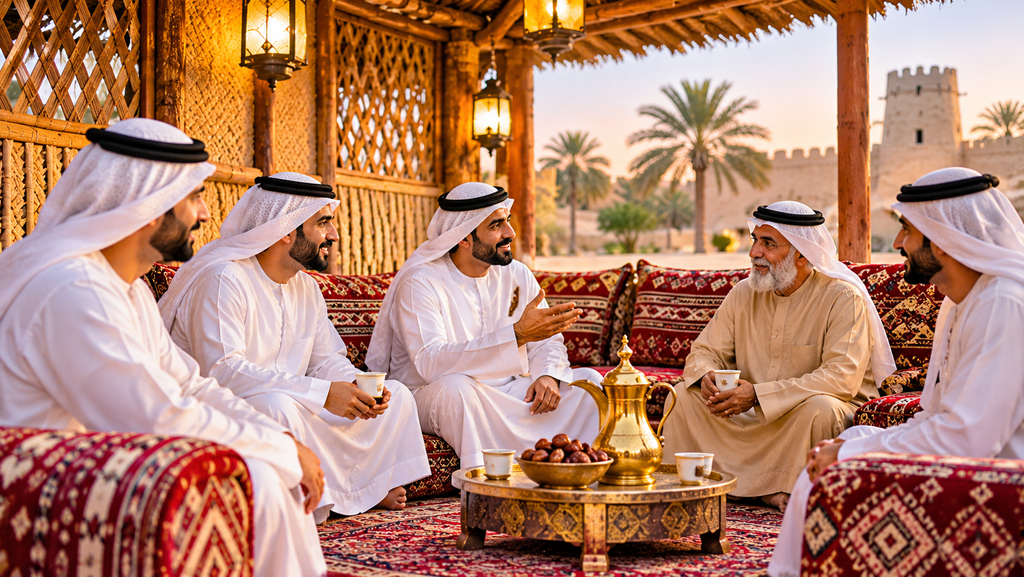
Saudi families maintain various gathering customs that differ across the country’s regions.
Some homes feature traditional floor seating, cushions and carpets, while others use contemporary furniture.
These spaces may host ordinary family visits or formal social occasions.
Regional architectural traditions also influence their appearance.
Qatar
In Qatar, receiving guests is an important element of local hospitality.
Many homes contain dedicated areas for social visits.
Traditional customs may include serving Arabic coffee, dates and other refreshments.
Such gatherings contribute to the preservation of family and community relationships.
Oman
Oman has its own community gathering traditions, including the sabla.
In some communities, these spaces are used for hospitality, meetings and collective activities.
Their role reflects the importance of conversation and social cooperation in Omani culture.
Kuwait
Kuwait is particularly known for the diwaniya.
This institution shares several characteristics with traditional Arabian gathering practices but has its own cultural history.
Diwaniyas can serve as spaces for friendship, family interaction, social discussion and professional networking.
Some are informal, while others involve regular organised meetings.
Bahrain
Bahraini communities also maintain established traditions of welcoming visitors and gathering for social occasions.
The arrangements vary depending on family preferences and local customs.
| Country | Common Tradition | Main Cultural Role |
|---|---|---|
| UAE | Majlis | Hospitality and community interaction |
| Saudi Arabia | Majlis | Family and social gatherings |
| Qatar | Majlis | Guest reception and cultural continuity |
| Oman | Sabla and related gatherings | Community interaction |
| Kuwait | Diwaniya | Social discussion and relationships |
| Bahrain | Majlis | Family and community connections |
These variations demonstrate how shared Arabian values can be expressed through distinct regional customs.
6. How Traditional Arabian Gathering Spaces Reflect Local Architecture
Architecture provides another way to understand the history of hospitality in the Arabian Peninsula.
Traditional reception areas were shaped by climate, available materials, household arrangements and cultural expectations.
Their design varied between desert communities, coastal towns and mountain settlements.
Gathering Spaces in Desert Communities
In some Bedouin communities, receiving visitors formed part of tent life.
Carpets, cushions and portable furnishings could be arranged to provide comfortable seating.
These flexible spaces allowed families to welcome people without requiring permanent buildings.
The emphasis remained on hospitality rather than elaborate decoration.
Reception Rooms in Traditional Homes
As towns and settlements expanded, many households developed designated areas for visitors.
Such spaces allowed guests to be received while maintaining privacy in other parts of the home.
Their size and layout varied according to local architectural traditions and household resources.
In some settings, entrances and circulation areas were arranged to separate guest activities from family living spaces.
Traditional Interior Features
Many older reception areas used carpets, cushions and relatively simple furnishings.
Decorative objects could reflect local craftsmanship or family preferences.
The arrangement of seating encouraged people to face one another and participate in conversations.
However, no single design represented every Arabian community.
Modern Interior Design
Contemporary homes may feature spacious reception rooms with sofas, decorative lighting and carefully selected materials.
Some families retain traditional floor seating, while others combine heritage elements with modern furniture.
Despite these changes, the main social purpose remains familiar.
| Design Feature | Traditional Approach | Modern Approach |
|---|---|---|
| Location | Tent, courtyard or guest room | Dedicated reception area |
| Seating | Carpets and cushions | Sofas or mixed seating |
| Materials | Locally available resources | Modern furnishings |
| Decoration | Traditional textiles and crafts | Contemporary and heritage-inspired designs |
| Hospitality | Coffee and refreshments | Traditional hosting with modern amenities |
| Social purpose | Gathering and conversation | Family and community interaction |
The evolution of reception spaces demonstrates that cultural traditions can adapt to modern architecture without losing their social significance.
7. Why Traditional Gathering Customs Remain Relevant in Modern Society
The Gulf region has experienced significant changes in recent decades.
Modern cities, international businesses, higher education and digital communication have transformed everyday routines.
Yet traditional hospitality continues to provide opportunities for meaningful personal interaction.
Maintaining Face-to-Face Communication
Messages and video calls make it possible to stay connected across distances.
However, physical gatherings offer experiences that digital communication cannot completely reproduce.
Sharing refreshments, listening to stories and spending time together can strengthen personal relationships.
These activities remain important in societies where family and community connections hold considerable cultural value.
Celebrating Religious and Cultural Occasions
During Ramadan, Eid and other celebrations, households may welcome relatives, neighbours and friends.
Special gatherings allow people to exchange greetings, share meals and maintain social traditions.
The customs followed depend on the country, family and occasion.
Women’s Cultural Gatherings
Women have their own established traditions of social gatherings across the Gulf.
These spaces may support family relationships, cultural discussions, education and community activities.
UNESCO recognises women’s participation in the broader heritage of traditional Arabian gathering spaces.
It is therefore inaccurate to describe this culture as exclusively male.
The Role of Younger Generations
Young people continue to participate in family gatherings, although their interests and communication habits may differ from those of older generations.
Discussions may now include technology, business, education and contemporary social issues alongside traditional subjects.
This adaptability helps preserve the practice without requiring every generation to follow identical routines.
Cultural Institutions and Heritage Education
Museums and heritage organisations also introduce visitors to traditional hospitality through exhibitions, workshops and cultural activities.
These programmes help explain the meaning of social customs beyond their decorative appearance.
They may be particularly useful for younger generations and international visitors who want to understand Arabian society.
The continuing relevance of the tradition lies in its ability to connect historical values with contemporary relationships.
8. Why Preserving the Majlis Matters for Future Generations
The majlis is recognised as an important part of Arabian intangible cultural heritage because its value extends beyond buildings and objects.
It represents practices, knowledge and relationships passed from one generation to another.
Preservation therefore involves maintaining the customs associated with welcoming guests and sharing experiences.
UNESCO Recognition
In 2015, the UAE, Saudi Arabia, Oman and Qatar jointly secured UNESCO recognition for the cultural and social tradition.
The inscription highlights its importance in supporting community relationships, oral heritage and intergenerational learning.
It does not mean that every reception room is an individual UNESCO World Heritage Site.
Rather, the recognition concerns the living cultural practice.
Preserving Oral Traditions
One important step is recording stories and experiences associated with historical gatherings.
Researchers and cultural institutions can document local customs, family histories and traditional forms of conversation.
These records may help future generations understand social practices that have changed over time.
Supporting Cultural Education
Schools, universities and museums can introduce young people to Arabian hospitality through educational programmes.
Activities may include demonstrations of Arabic coffee preparation, storytelling sessions and discussions about traditional architecture.
Such programmes can support cultural awareness without presenting every historical custom as unchanged.
Encouraging Inclusive Participation
As social traditions evolve, community organisers can consider the needs of different participants.
Suitable arrangements for older adults, people with disabilities and younger visitors can help make gatherings more accessible.
The purpose is to preserve meaningful interaction while respecting local customs and individual preferences.
Keeping Traditions Alive
Cultural heritage remains meaningful when people continue practising it.
Families can maintain hospitality customs through ordinary visits and celebrations.
Communities can also organise gatherings that encourage discussion, storytelling and shared learning.
A Practical Cultural Preservation Roadmap
- Document historical customs: Record local traditions and their regional differences.
- Preserve oral histories: Collect memories and stories from different generations.
- Encourage cultural education: Introduce young people to traditional hospitality.
- Support intergenerational gatherings: Create opportunities for knowledge sharing.
- Recognise women’s contributions: Document diverse social traditions.
- Maintain heritage practices: Preserve customs associated with welcoming visitors.
- Adapt to contemporary lifestyles: Allow traditional values to remain relevant.
- Strengthen community participation: Encourage meaningful social interaction.
These efforts can help ensure that important cultural practices remain part of Arabian life rather than existing only in historical records.
Conclusion: A Living Symbol of Arabian Hospitality
The majlis remains one of the most meaningful traditions in Arabian social life.
For generations, it has brought people together through hospitality, conversation, storytelling and shared experiences.
From simple desert gatherings to modern reception rooms, its form has changed while its central purpose has remained recognisable.
Across the Gulf, different communities maintain their own customs, including the Omani sabla and Kuwaiti diwaniya.
These regional variations highlight the diversity of Arabian society while reflecting shared values of respect, generosity and personal connection.
The tradition also provides opportunities to preserve oral histories, introduce younger generations to cultural knowledge and maintain relationships in a rapidly changing world.
UNESCO’s recognition further demonstrates its international cultural significance.
Ultimately, traditional Arabian gathering spaces are more than places to receive visitors. They are living expressions of hospitality, community and cultural identity that continue to connect the past with the present.
Do follow us on Instagram
Read More – The Fascinating History of Traditional Arabian Clothing