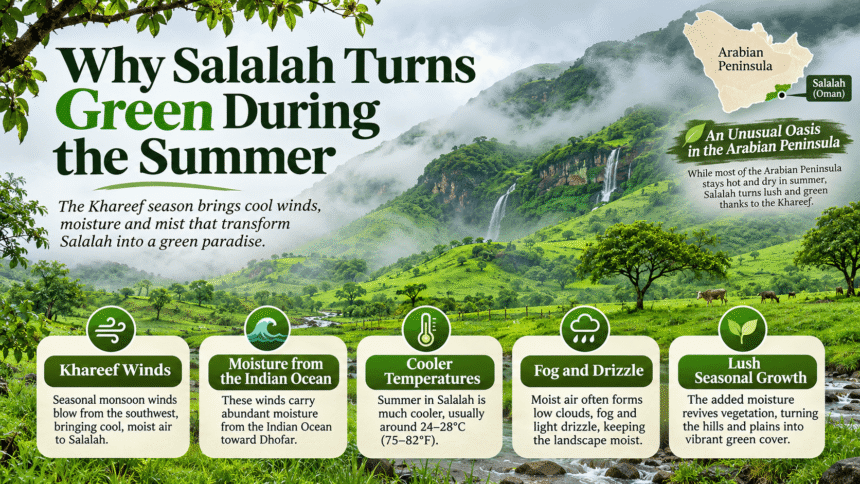
Why Salalah Turns Green During the Summer
Summer in the Arabian Peninsula is usually associated with burning sunlight, dry deserts and extremely high temperatures. While cities such as Dubai, Riyadh and Muscat experience intense heat, a remarkable transformation takes place in southern Oman. Mountains become covered with green grass, waterfalls begin to flow, valleys fill with water and thick mist settles over the landscape.
- 1. What Is the Khareef Season in Salalah?
- 2. How Southwest Monsoon Winds Transform Salalah
- 3. The Role of the Arabian Sea in Salalah’s Summer Weather
- 4. How the Dhofar Mountains Help Salalah Stay Green
- 5. How Fog, Rainfall and Natural Vegetation Work Together
- 6. Why Waterfalls, Springs and Valleys Come Alive During Khareef
- 7. How the Khareef Season Supports Tourism, Agriculture and Wildlife
- 8. Is Salalah Green Throughout the Year?
- Conclusion
- Frequently Asked Questions About Salalah and the Khareef Season
This beautiful transformation occurs in Salalah, the capital of Oman’s Dhofar Governorate. Every year, the city and its surrounding mountains experience a unique weather phenomenon known as the Khareef season.
Unlike most parts of the Arabian Peninsula, Salalah receives moisture from the southwest monsoon winds during summer. These winds bring cooler temperatures, persistent drizzle and thick clouds that encourage the growth of natural vegetation.
However, rainfall alone is not responsible for this transformation. The Arabian Sea, the geographical position of Salalah, the Dhofar Mountains and seasonal changes in atmospheric conditions all work together to create this unusual environment.
Understanding why Salalah turns green during the summer reveals one of the most fascinating natural wonders of the Middle East.
1. What Is the Khareef Season in Salalah?
The Khareef season is an annual weather phenomenon that affects southern Oman, particularly Salalah and the surrounding areas of Dhofar. It generally begins in late June and continues until around mid-September, although its exact timing varies from year to year.
The word Khareef means autumn in Arabic. However, in southern Oman, it refers to the seasonal monsoon that arrives during the summer months.
During this period, the normally dry landscape undergoes a remarkable transformation. Mountains become covered with vegetation, valleys become greener and clouds remain close to the ground.
Unlike tropical regions that experience frequent heavy rainfall during their monsoon seasons, Salalah often receives continuous light drizzle and dense fog. This steady supply of moisture helps support vegetation over an extended period.
Other parts of the Arabian Peninsula, which experience extreme summer heat, Salalah has cooler weather with cloudy skies, thick fog, light rain, and temperatures usually ranging from 20°C to 27°C.
Cloud cover also reduces direct exposure to sunlight, making the weather considerably cooler than in many neighbouring Gulf cities.
Quick facts about the Khareef season
| Feature | Details |
|---|---|
| Main location | Salalah and coastal Dhofar, Oman |
| Season | Late June to September |
| Main cause | Southwest monsoon winds |
| Typical summer temperature | Around the mid-to-high 20s Celsius |
| Weather conditions | Fog, clouds, drizzle and high humidity |
| Peak greenery | Usually July to September |
| Major natural attractions | Green mountains, waterfalls and valleys |
| Main environmental benefit | Seasonal vegetation growth and water replenishment |
The Khareef season is particularly special because it occurs when much of the Arabian Peninsula experiences its hottest weather.
For residents and tourists, it provides an opportunity to enjoy a cooler natural environment without travelling far from the Gulf region.
2. How Southwest Monsoon Winds Transform Salalah
The main reason Salalah turns green during the summer is the arrival of the southwest monsoon.
A monsoon is a seasonal change in wind direction that influences weather conditions across large geographical areas. The summer monsoon affects several countries surrounding the Indian Ocean, including India, Oman and Yemen.
During summer, land surfaces across Asia heat up more quickly than the surrounding ocean. These temperature differences contribute to changes in atmospheric pressure, encouraging seasonal winds to carry moist air from the ocean towards land.
Strong winds from the Somali Jet system blow northeast across the warm Indian Ocean and Arabian Sea, picking up large amounts of moisture from the water.
As these winds blow along the Arabian coast, they push warm water away from the shore. This allows colder water rich in nutrients to rise from deeper parts of the ocean. This natural process is known as upwelling.
Southern Oman lies within the influence of this seasonal weather system.
As moist air travels across the Arabian Sea towards Dhofar, interactions between ocean temperatures, atmospheric conditions and mountain slopes encourage the formation of low clouds, fog and drizzle.
How the Salalah monsoon works
- Summer heating creates differences in atmospheric pressure.
- Southwest monsoon winds develop across the Indian Ocean region.
- These winds carry moisture towards southern Oman.
- Cool coastal waters encourage the formation of low clouds.
- The Dhofar Mountains intercept moisture-rich air.
- Fog and light rainfall provide water for plants.
- Vegetation gradually spreads across suitable hills and valleys.
This process continues throughout much of the Khareef season, maintaining high humidity and favourable conditions for plant growth.
What makes Salalah different is that the moisture arrives consistently over several weeks. Even when rainfall appears light, the combined effect of drizzle and fog can provide significant amounts of water to the natural environment.
Instead of receiving all its seasonal moisture during a few major storms, the region experiences repeated periods of damp weather.
This allows grasses, shrubs and trees to make use of the available water and gradually transform the surrounding landscape.
3. The Role of the Arabian Sea in Salalah’s Summer Weather
The Arabian Sea plays an essential role in creating Salalah’s unusual summer climate.
Although seawater generally absorbs heat during summer, the coastal waters of southern Oman experience a natural process known as coastal upwelling.
During the monsoon, strong seasonal winds push some surface seawater away from the coastline. Colder water from deeper parts of the ocean then rises to replace it.
This process reduces sea surface temperatures along parts of the southern Omani coast.
When moist air passes over these cooler waters, it also cools. Under suitable atmospheric conditions, water vapour condenses into tiny droplets, producing low clouds and fog.
These clouds can then move inland towards Salalah and the surrounding mountains.
Why coastal upwelling is important
| Natural Process | Effect on Salalah |
|---|---|
| Strong monsoon winds | Encourage the movement of surface seawater |
| Cold water rising | Reduces coastal sea temperatures |
| Moist air cooling | Encourages cloud and fog formation |
| Persistent cloud cover | Reduces direct sunlight |
| Light rainfall and fog | Supply moisture to vegetation |
| Lower evaporation | Helps soil retain moisture for longer |
Coastal upwelling also brings nutrients from deeper ocean waters towards the surface. These nutrients can support the growth of microscopic marine organisms, which form the foundation of marine food chains.
However, the monsoon also creates rough sea conditions and strong waves along parts of the Dhofar coastline.
As monsoon winds blow along Oman’s southern coast, the Earth’s rotation helps push warm surface water away from the shore. This natural movement of water is called Ekman transport.
Although the cooler weather attracts visitors to Salalah’s beaches, swimming can be dangerous during the Khareef season. Visitors should respect local warnings and avoid entering restricted coastal waters.
The relationship between the Arabian Sea and Salalah demonstrates how ocean conditions can influence both inland vegetation and regional weather patterns.
4. How the Dhofar Mountains Help Salalah Stay Green
Salalah’s geographical position is another major reason for its seasonal transformation.
The city is located on a coastal plain between the Arabian Sea and the Dhofar Mountains. These mountains form a natural barrier that influences the movement of moist air arriving from the ocean.
When moisture-rich winds encounter the mountains, some air is forced upwards. As it rises and cools, cloud formation and condensation can increase.
This natural process is called orographic lifting.
Mountain slopes facing the sea receive greater exposure to seasonal fog and moisture. These areas often develop dense vegetation during the Khareef season.
Important mountain ranges in the region include:
- Jabal Al Qara.
- Jabal Al Qamar.
- Jabal Samhan.
However, the effects of the monsoon are not equally strong across all mountain ranges or elevations.
In Dhofar, a weather condition known as a temperature inversion also influences the movement of clouds. This happens when warmer air sits above cooler air, restricting the upward movement of the moist lower atmosphere.
As a result, fog and low clouds frequently remain concentrated around coastal areas and suitable mountain slopes.
This helps explain why green landscapes can exist relatively close to dry desert areas.
Why the Dhofar Mountains are important
- They intercept moisture from the Arabian Sea.
- They support the formation of fog and low clouds.
- They provide suitable conditions for seasonal forests.
- They help collect water that may enter underground reserves.
- They create natural habitats for plants and animals.
- They support the development of springs and seasonal waterfalls.
Without the geographical influence of these mountains, Salalah would experience a very different summer climate.
The combination of coastal waters, seasonal winds and mountainous terrain creates a local climate that stands out across the Arabian Peninsula.
5. How Fog, Rainfall and Natural Vegetation Work Together
One of the most interesting facts about Salalah is that rainfall alone cannot fully explain its summer greenery.
Fog plays an equally important role in supporting the region’s natural vegetation.
The Dhofar Mountains contain seasonal cloud forests that have adapted to the moisture brought by the monsoon.
When fog passes through these forests, tiny water droplets collect on leaves, branches and other plant surfaces. As the droplets become larger, they fall towards the ground.
Scientists call this process fog interception.
It allows trees to collect additional water that ordinary rainfall measurements may not fully capture.
Research on Dhofar’s cloud forests has shown that water collected beneath tree cover can substantially exceed the amount recorded through rainfall alone at certain locations.
The forests therefore help create and maintain the moist environmental conditions they need for survival.
Types of vegetation found around Salalah
| Vegetation Type | Environmental Importance |
|---|---|
| Seasonal grasses | Cover mountain slopes and provide livestock feed |
| Native trees | Collect fog moisture and provide shade |
| Wildflowers | Support insects and seasonal biodiversity |
| Shrubs | Provide shelter and help protect soil |
| Cloud forests | Contribute to moisture collection and water resources |
| Frankincense trees | Form part of Dhofar’s natural and cultural heritage |
One important native tree associated with the Dhofar cloud forest is Anogeissus dhofarica, which is particularly well adapted to seasonal moisture.
Many plants in the region have developed ways to survive the long dry periods between monsoon seasons.
Some trees lose their leaves to reduce water loss, while seasonal grasses survive through seeds or underground plant structures until favourable conditions return.
When moisture becomes available during summer, fresh leaves and grasses begin to appear.
The cooler temperatures and reduced sunlight also help limit water loss from the soil and plants.
As a result, Salalah’s summer greenery is created by a combination of moisture availability, reduced evaporation and natural plant adaptations.
6. Why Waterfalls, Springs and Valleys Come Alive During Khareef
The arrival of the Khareef season changes more than the appearance of Salalah’s mountains. It also influences the movement and availability of water across the region.
Rainwater and moisture collected by vegetation gradually enter the soil. Some water flows downhill through natural channels, while another portion enters underground rock formations.
This process contributes to the replenishment of springs, streams and groundwater resources.
Dhofar contains numerous wadis, which are natural valleys or watercourses. Some remain relatively dry for much of the year but receive additional water during the monsoon.
Natural attractions that reflect Salalah’s summer transformation
| Location | Seasonal Natural Features |
|---|---|
| Wadi Darbat | Green valleys, lakes and seasonal waterfalls |
| Ayn Athum | Natural spring and seasonal waterfall |
| Ayn Khor | Waterfalls when sufficient water is available |
| Ayn Razat | Natural springs and surrounding vegetation |
| Jabal Al Qara | Mist-covered mountains and grasslands |
| Jabal Al Qamar | Seasonal forests and green mountain slopes |
Wadi Darbat is one of the best-known examples of this natural transformation. During Khareef, additional water replenishes the valley, supporting its vegetation and seasonal waterfalls.
However, waterfall activity varies according to rainfall, groundwater conditions and the strength of the monsoon.
The seasonal increase in water availability also benefits local agriculture and livestock farming.
Underground water resources are particularly important because they support households, farms and economic activities throughout the year.
Protecting natural forests and mountain vegetation can help maintain these water systems. When vegetation disappears, the landscape may lose some of its ability to collect fog moisture and protect soil from erosion.
Salalah’s waterfalls and green valleys are therefore not simply beautiful tourist attractions. They are visible examples of the region’s wider natural water cycle.
7. How the Khareef Season Supports Tourism, Agriculture and Wildlife
The Khareef season has become an important part of southern Oman’s economy, cultural identity and natural environment.
Every summer, visitors travel to Salalah from other parts of Oman, the UAE, Saudi Arabia and neighbouring countries to experience its cooler climate.
The opportunity to enjoy green mountains, misty landscapes and flowing water makes Salalah a distinctive summer destination.
Benefits for the tourism industry
The seasonal arrival of tourists creates opportunities for several local businesses, including:
- Hotels and resorts.
- Restaurants and cafes.
- Car rental companies.
- Local tour operators.
- Traditional markets.
- Handicraft businesses.
- Transportation services.
- Cultural and entertainment activities.
Seasonal festivals also introduce visitors to Omani traditions, local cuisine, music and cultural heritage.
The Khareef Dhofar Tourism Festival has become closely associated with the region’s summer identity.
Benefits for agriculture
Salalah’s coastal plain supports agricultural activities, including the cultivation of bananas, coconuts and other crops suited to local conditions.
Although agriculture also depends on irrigation and groundwater, seasonal moisture can help replenish natural water resources.
Green mountain grasslands provide grazing opportunities for livestock, particularly cattle, goats and camels.
Benefits for wildlife and biodiversity
The monsoon supports native plants, insects, birds and other animals that depend on seasonal changes in vegetation and water availability.
Dhofar’s mountains are also home to rare wildlife, including the Arabian leopard and Nubian ibex.
Healthy natural habitats are important for maintaining these species and supporting the wider ecological balance.
However, the popularity of Salalah also creates environmental challenges. Uncontrolled camping, littering, off-road driving and excessive grazing can damage sensitive vegetation.
Responsible tourism is necessary to ensure that the natural beauty attracting visitors today remains available for future generations.
8. Is Salalah Green Throughout the Year?
Although Salalah is famous for its summer greenery, the entire region does not remain green throughout the year.
The most noticeable transformation occurs during the Khareef season, when moisture-rich winds provide favourable conditions for vegetation growth.
After the monsoon ends, skies gradually become clearer and humidity decreases. Seasonal grasses may remain green for some time before gradually drying as the available moisture declines.
The period following Khareef is locally known as the Sarb season. It is generally associated with clearer skies and landscapes that may still retain much of their greenery.
Salalah weather throughout the year
| Period | Typical Weather | Landscape |
|---|---|---|
| January to March | Generally mild and dry | Mostly dry natural landscapes |
| April to mid-June | Warmer and increasingly humid | Limited seasonal greenery |
| Late June to September | Cool, cloudy and misty | Green mountains and valleys |
| Late September to November | Gradually clearer conditions | Remaining greenery that slowly fades |
| December | Generally mild and sunny | Drier landscapes and permanent vegetation |
Some farms, gardens, coconut plantations and natural springs maintain vegetation outside the monsoon period.
However, the extensive green mountain landscapes seen during summer depend heavily on the seasonal weather system.
Environmental changes could also influence the future of Salalah’s natural greenery.
Climate change, forest loss, excessive livestock grazing and coastal development may affect the delicate relationship between fog, vegetation and water resources.
Protecting the Dhofar Mountains and their native forests is therefore essential for maintaining this extraordinary natural phenomenon.
Conclusion
Salalah’s remarkable summer transformation is one of the most fascinating examples of nature’s diversity across the Arabian Peninsula.
The combination of southwest monsoon winds, cooler waters of the Arabian Sea, the Dhofar Mountains and moisture collected by natural vegetation creates an environment unlike most other parts of the Gulf.
During the Khareef season, dry landscapes develop into green mountains, flowing valleys and mist-covered forests. This seasonal change supports tourism, agriculture, wildlife and important natural water resources.
However, the future of this extraordinary environment depends on responsible development, forest protection and sustainable tourism.
Understanding why Salalah turns green during the summer reminds us that even some of the world’s driest regions can contain remarkable natural ecosystems.
Salalah is not simply a refreshing summer destination. It is a living example of how geography, climate and nature work together to create something extraordinary.
Frequently Asked Questions About Salalah and the Khareef Season
Why does Salalah turn green during the summer?
Salalah turns green because southwest monsoon winds bring moisture, fog and light rainfall from the Arabian Sea. The Dhofar Mountains help intercept this moisture, supporting seasonal plant growth.
When does the Khareef season start in Salalah?
The season generally begins in late June and continues until around mid-September. Its exact beginning and ending depend on natural weather conditions.
What is the best time to visit Salalah for greenery?
July and August are generally among the best months to experience green mountains, misty weather and seasonal waterfalls. Early September can also offer beautiful landscapes.
Why is Salalah cooler than Dubai during summer?
Persistent cloud cover, cooler coastal waters and moist monsoon winds help reduce summer temperatures in Salalah compared with many other Gulf cities.
Does Salalah receive heavy rainfall during Khareef?
Salalah commonly experiences light drizzle and dense fog rather than continuous heavy rainfall. However, stronger rainfall events can also occur.
Is Salalah green all year round?
No. Although some agricultural areas and permanent vegetation remain green, the widespread mountain greenery is mainly associated with Khareef and the following weeks.
Does cloud seeding make Salalah green?
No. Salalah’s seasonal transformation is primarily caused by natural monsoon winds, coastal upwelling, fog and geographical conditions.
Do follow us on Instagram
Read More – Why Dubai Is Becoming a Global Hub for Millionaires