



How Artificial Intelligence (AI) Is Transforming the UAE: Complete Guide to the Future of Artificial Intelligence in the Emirates 2026
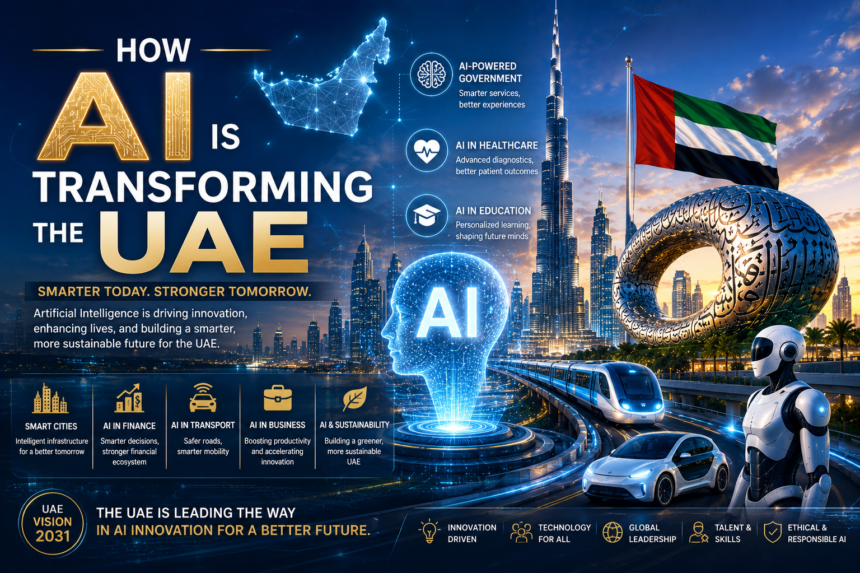
Artificial Intelligence (AI) is reshaping industries, governments, and societies worldwide, and the United Arab Emirates (UAE) has positioned itself as one of the global leaders in AI adoption. From smart government services and healthcare innovations to intelligent transportation, finance, education, and sustainable urban development, AI is becoming a cornerstone of the UAE’s long-term vision for economic growth and digital transformation.
- Why the UAE Is Investing in Artificial Intelligence (AI)
- Artificial Intelligence (AI) and Smart Government Services
- AI in Healthcare
- AI in Education
- AI in Finance and Banking
- AI in Retail and E-Commerce
- AI and Smart Cities
- AI in Transportation
- AI in Aviation
- AI in Real Estate
- AI in Tourism and Hospitality
- AI and Sustainability
- AI in Manufacturing
- AI for Small Businesses
- AI and Cybersecurity
- AI in Logistics and Supply Chains
- Artificial Intelligence (AI) and the Job Market
- AI and Entrepreneurship
- Responsible Artificial Intelligence (AI)
- Challenges of Artificial Intelligence (AI) Adoption
- Preparing for an Artificial Intelligence (AI) Driven Future
- Frequently Asked Questions
- Future of Artificial Intelligence (AI) in the UAE
The country has invested significantly in AI research, advanced technologies, digital infrastructure, and talent development to create an innovation-driven economy. As businesses and public institutions increasingly integrate AI-powered solutions, residents, visitors, and investors are experiencing faster services, improved decision-making, and enhanced quality of life.
This comprehensive guide explores how AI is transforming the UAE, the sectors leading the transformation, the opportunities AI creates, and what the future may hold.
Why the UAE Is Investing in Artificial Intelligence (AI)
The UAE recognizes AI as a strategic technology that can strengthen economic diversification and improve public services.
Key objectives include:
- Supporting innovation
- Increasing productivity
- Diversifying the economy
- Improving government efficiency
- Enhancing healthcare and education
- Building smart cities
- Attracting global investment
- Developing future-ready talent
- Encouraging entrepreneurship
AI is viewed as a long-term driver of competitiveness across many sectors.
Artificial Intelligence (AI) and Smart Government Services
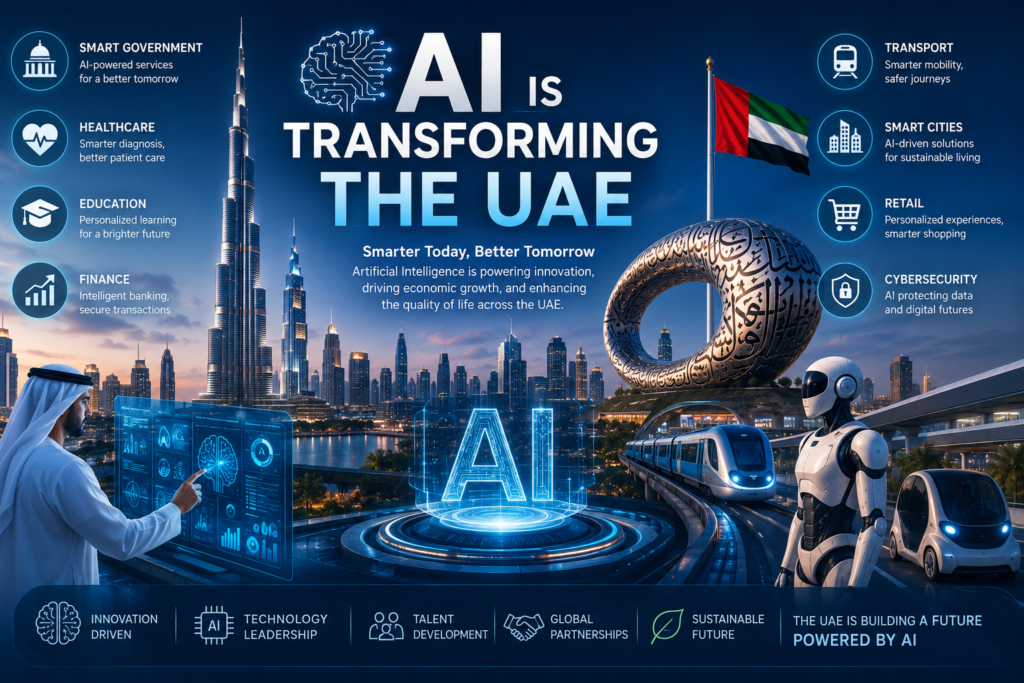
Government entities across the UAE continue to adopt AI to improve service delivery and streamline administrative processes.
Examples include:
- Digital government platforms
- Intelligent customer support
- Automated document processing
- Smart appointment systems
- Predictive service planning
- Data-driven decision-making
These technologies help reduce waiting times and improve user experiences.
AI in Healthcare
Healthcare is one of the sectors benefiting most from AI innovation.
Applications include:
- Medical imaging analysis
- Clinical decision support
- Early disease detection
- Hospital workflow optimization
- Remote patient monitoring
- Personalized treatment planning
AI assists healthcare professionals by providing data-driven insights while supporting, rather than replacing, clinical expertise.
AI in Education
Educational institutions are increasingly integrating AI into learning environments.
Potential applications include:
- Personalized learning pathways
- Intelligent tutoring systems
- Automated assessments
- Learning analytics
- Language translation tools
- Accessibility support
These technologies can help educators tailor instruction to individual student needs.
AI in Finance and Banking
Banks and financial institutions use AI to improve customer service, security, and operational efficiency.
Common applications include:
- Fraud detection
- Credit risk analysis
- Customer support chatbots
- Personalized financial recommendations
- Regulatory compliance monitoring
- Transaction analysis
AI can help financial institutions identify unusual patterns and respond more quickly to potential risks.
AI in Retail and E-Commerce
Retailers are using AI to create more personalized shopping experiences.
Examples include:
- Product recommendations
- Inventory forecasting
- Demand prediction
- Customer behavior analysis
- Dynamic pricing
- Automated customer service
Consumers benefit from faster service and more relevant product suggestions.
AI and Smart Cities
The UAE continues to develop smart city initiatives that integrate AI with connected technologies.
Potential applications include:
- Smart traffic management
- Energy optimization
- Waste management
- Water conservation
- Urban planning
- Public safety systems
These initiatives aim to improve sustainability and enhance residents’ quality of life.
AI in Transportation
Artificial intelligence is helping improve transportation systems through:
- Traffic flow optimization
- Intelligent navigation
- Predictive maintenance
- Fleet management
- Smart parking
- Public transport planning
These technologies can reduce congestion and improve travel efficiency.
AI in Aviation
The UAE’s aviation sector is exploring AI for:
- Predictive aircraft maintenance
- Passenger service enhancements
- Airport operations
- Baggage handling optimization
- Flight scheduling support
These applications can improve operational efficiency and passenger experiences.
AI in Real Estate
The property sector increasingly relies on AI-powered insights.
Applications include:
- Property valuation support
- Market trend analysis
- Customer relationship management
- Virtual property tours
- Investment analytics
AI can help buyers, sellers, and investors make more informed decisions.
AI in Tourism and Hospitality
Tourism remains a major contributor to the UAE economy, and AI is enhancing visitor experiences.
Examples include:
- Multilingual virtual assistants
- Smart hotel services
- Personalized travel recommendations
- Automated booking support
- Visitor analytics
Hotels and tourism businesses use AI to improve guest satisfaction and operational efficiency.
AI and Sustainability
Artificial intelligence supports environmental initiatives by helping organizations:
- Optimize energy use
- Monitor environmental conditions
- Improve water management
- Reduce waste
- Enhance renewable energy planning
These technologies contribute to broader sustainability goals.
AI in Manufacturing
Manufacturers use AI to improve production processes through:
- Predictive maintenance
- Quality inspection
- Robotics
- Supply chain optimization
- Production forecasting
Automation can improve efficiency while supporting human workers in complex tasks.
AI for Small Businesses
AI is becoming more accessible to startups and small businesses.
Affordable tools can assist with:
- Marketing automation
- Customer service
- Content creation
- Inventory management
- Data analysis
- Business forecasting
This allows smaller companies to compete more effectively.
AI and Cybersecurity
Cybersecurity is increasingly important as digital services expand.
AI helps organizations:
- Detect unusual activity
- Monitor networks
- Identify threats
- Prioritize security alerts
- Respond more quickly to incidents
Human oversight remains essential for managing cybersecurity risks.
AI in Logistics and Supply Chains
AI improves logistics through:
- Route optimization
- Warehouse automation
- Demand forecasting
- Shipment tracking
- Inventory management
These innovations support faster and more efficient supply chains.
Artificial Intelligence (AI) and the Job Market
Artificial intelligence is changing the nature of work.
Emerging career opportunities include:
- AI engineering
- Machine learning
- Data science
- Robotics
- Prompt engineering
- AI governance
- Digital transformation consulting
At the same time, many existing roles are evolving as AI tools become part of everyday workflows.
Developing digital and analytical skills can help professionals adapt to these changes.
AI and Entrepreneurship
The UAE has become an attractive destination for AI-focused startups.
Opportunities exist in areas such as:
- Health technology
- Financial technology
- Education technology
- Smart mobility
- Climate technology
- Enterprise software
A supportive innovation ecosystem can encourage business growth.
Responsible Artificial Intelligence (AI)
As AI adoption increases, responsible development becomes increasingly important.
Organizations should consider:
- Transparency
- Privacy
- Data security
- Fairness
- Human oversight
- Accountability
Responsible AI practices help build public trust and reduce potential risks.
Challenges of Artificial Intelligence (AI) Adoption
Although AI offers many benefits, organizations may face challenges such as:
- Skills shortages
- Integration with existing systems
- Data quality
- Implementation costs
- Cybersecurity concerns
- Regulatory compliance
Successful AI adoption often requires careful planning, workforce training, and ongoing evaluation.
Preparing for an Artificial Intelligence (AI) Driven Future
Individuals can prepare by developing skills in:
- Digital literacy
- Data analysis
- Critical thinking
- Programming
- AI fundamentals
- Problem-solving
- Communication
Continuous learning will remain important as technologies evolve.
Frequently Asked Questions
What is Artificial Intelligence (AI)?
Artificial Intelligence refers to computer systems designed to perform tasks that typically require human intelligence, such as learning, pattern recognition, language understanding, and decision support.
Why is Artificial Intelligence (AI) important to the UAE?
AI supports economic diversification, innovation, productivity, and improved public services, making it a strategic priority for the country’s long-term development.
Will Artificial Intelligence (AI) replace jobs?
AI is expected to automate some tasks while creating new roles and changing others. Many jobs will increasingly involve collaboration between people and AI-powered tools.
Which industries use Artificial Intelligence (AI) the most?
Healthcare, finance, transportation, retail, education, manufacturing, logistics, and government services are among the sectors making significant use of AI technologies.
Can small businesses benefit from AI?
Yes. Many affordable Artificial Intelligence (AI) tools can help small businesses improve marketing, customer support, operations, and decision-making.
Future of Artificial Intelligence (AI) in the UAE
The UAE continues to invest in advanced technologies, research, and digital infrastructure. Future developments may include:
- Smarter public services
- Expanded AI research
- Greater automation
- More personalized digital experiences
- Advanced robotics
- Sustainable smart city solutions
- Increased collaboration between government, academia, and industry
As AI capabilities evolve, the UAE is likely to remain an important hub for innovation and technology in the region.
Conclusion
Artificial Intelligence is transforming the UAE across government, healthcare, education, finance, transportation, tourism, manufacturing, and many other industries. By embracing innovation, investing in digital infrastructure, and developing skilled talent, the country is creating an environment where AI can support economic growth and improve daily life.
For businesses, AI offers opportunities to enhance efficiency, improve customer experiences, and drive innovation. For individuals, it opens doors to new careers, skills, and ways of working. While challenges such as responsible governance, privacy, and workforce adaptation remain important, thoughtful implementation can help ensure that AI benefits society as a whole.
As the UAE continues its digital transformation journey, Artificial Intelligence will remain one of the key technologies shaping the nation’s future and strengthening its position as a global center for innovation.
Do follow Gulf Prime on Instagram
Read More – How Artificial Intelligence is Reshaping Gulf Career Opportunities