




How to Open a Bank Account in the UAE Complete 2026 Guide for Residents, Expats, Freelancers, and Businesses
The United Arab Emirates (UAE) is one of the world’s leading financial hubs, attracting millions of expatriates, entrepreneurs, investors, students, and professionals. Whether you have recently moved to Dubai, Abu Dhabi, Sharjah, or another emirate, opening a UAE bank account is one of the first steps toward managing your finances efficiently.
- Why Open a Bank Account in the UAE?
- Understanding the UAE Banking System
- Who Can Open a Bank Account in the UAE?
- Types of Bank Accounts
- Islamic Bank Accounts
- Documents Required to Open a Bank Account in the UAE
- How to Open a Bank Account in the UAE
- Online Banking
- Mobile Banking
- Debit Cards
- Credit Cards
- International Money Transfers
- Salary Accounts
- Business Banking
- Banking Fees
- Security Tips
- Common Reasons Applications May Be Delayed
- Choosing the Right Bank to Open a Bank Account in the UAE
- Banking Tips for Expats
- Frequently Asked Questions
- Avoid Common Banking Mistakes to Open a Bank Account in the UAE
- Future of Banking in the UAE
A local bank account allows you to receive your salary, pay bills, transfer money internationally, apply for credit cards, access loans, save securely, and conduct day-to-day transactions with ease. The UAE banking sector is known for its modern digital services, strong regulatory framework, and a wide selection of local and international banks.
This comprehensive guide explains how to open a bank account in the UAE, including eligibility requirements, account types, required documents, the application process, costs, online banking, common challenges, and tips for choosing the right bank.
Why Open a Bank Account in the UAE?
Having a UAE bank account provides many financial and practical benefits.
Some of the main advantages for open a bank account in the UAE include:
- Secure money management
- Salary payments
- Online and mobile banking
- International money transfers
- Debit and credit cards
- Savings and investment products
- Bill payments
- Loan eligibility
- Cheque facilities (where offered)
- Easy access to ATMs
Whether you are a resident or a business owner, a local account simplifies everyday financial activities.
Understanding the UAE Banking System
The UAE has a well-developed banking sector comprising:
- Local commercial banks
- Islamic banks
- International banks
- Digital banks
- Investment banks
These institutions offer services for individuals, businesses, and corporate clients while operating under UAE financial regulations.
Who Can Open a Bank Account in the UAE?
Bank eligibility varies depending on the institution and the type of account.
Common applicant categories include:
- UAE residents
- Expatriates
- Employees
- Self-employed professionals
- Freelancers
- Business owners
- Companies
- Students (subject to bank policies)
Some banks also provide limited account options for eligible non-residents, subject to their internal requirements.
Types of Bank Accounts
1. Current Account: A current account is suitable for daily banking needs.
Typical features include:
- Salary deposits
- Debit card
- Cheque book (where available)
- Online banking
- Mobile banking
- Utility bill payments
This is the most common account for employed residents.
2. Savings Account: Savings accounts are designed for customers who wish to set aside funds while maintaining access to their money.
Common features include:
- Interest or profit-sharing (depending on the product)
- Online access
- Debit card
- Savings tools
Terms vary between banks.
3. Business Account: Business accounts are intended for companies and entrepreneurs.
Services often include:
- Business payments
- Payroll management
- International transfers
- Merchant services
- Multi-user access
Documentation requirements differ from personal accounts.
Islamic Bank Accounts
Islamic banking products operate according to Sharia principles.
Banks may offer:
- Current accounts
- Savings accounts
- Investment products
- Home finance
- Business banking
Customers seeking Islamic financial products should review the specific features and terms offered by each institution.
Documents Required to Open a Bank Account in the UAE
While requirements vary by bank and customer profile, applicants are commonly asked to provide:
- Valid passport
- UAE residence visa (if applicable)
- Emirates ID (or proof of application where accepted)
- Proof of address
- Salary certificate or employment confirmation (where required)
- Trade licence and company documents (for business accounts)
- Recent bank statements (in some cases)
Banks may request additional documentation depending on their compliance procedures.
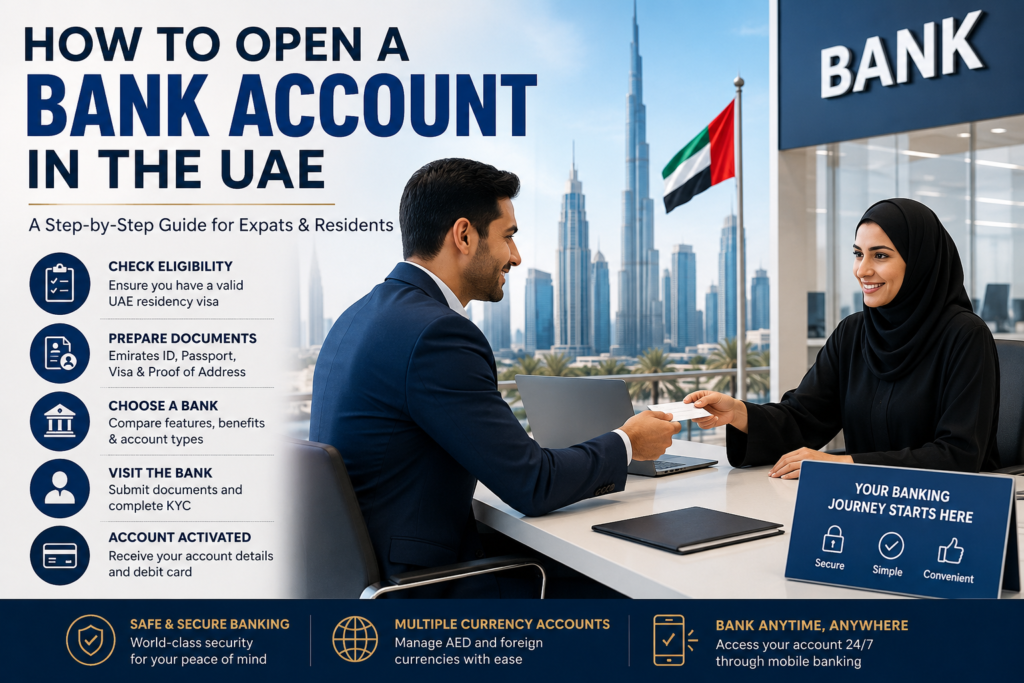
How to Open a Bank Account in the UAE
The process typically involves the following steps:
Step 1: Choose the Right Bank
Compare banks based on:
- Account features
- Fees
- Digital banking services
- ATM network
- Customer support
- International transfer options
Select the account that best matches your financial needs.
Step 2: Prepare Your Documents
Gather all required documents before applying.
Having complete documentation can help reduce processing delays.
Step 3: Submit Your Application
Applications may be submitted:
- At a bank branch
- Through a mobile application
- Via the bank’s website (where available)
Some products require an in-person identity verification step.
Step 4: Verification
The bank reviews your application and verifies your identity and supporting documents as part of its regulatory obligations.
Step 5: Account Activation
Once approved, you may receive:
- Account details
- Debit card
- Online banking credentials
- Mobile banking access
Activation procedures vary by institution.
Online Banking
Most UAE banks provide digital banking platforms that allow customers to:
- Check balances
- Transfer funds
- Pay bills
- View statements
- Manage cards
- Update personal information
- Apply for selected banking products
Using strong passwords and multi-factor authentication helps improve account security.
Mobile Banking
Mobile apps often provide convenient access to banking services such as:
- Instant transfers
- Card management
- Transaction notifications
- QR payments
- Utility bill payments
- International remittances
Features differ between banks.
Debit Cards
A debit card allows customers to:
- Withdraw cash from ATMs
- Make purchases in stores
- Shop online (where enabled)
- Pay utility bills
- Access contactless payments
Card usage should always follow the bank’s security recommendations.
Credit Cards
Many banks offer credit cards to eligible customers.
Potential benefits may include:
- Reward programmes
- Cashback
- Travel benefits
- Airport lounge access
- Instalment options
Approval depends on the bank’s eligibility and credit assessment criteria.
International Money Transfers
The UAE is home to a large expatriate population, making international transfers a common banking service.
When comparing transfer options, consider:
- Fees
- Exchange rates
- Transfer speed
- Destination countries
- Transfer limits
Compare providers carefully before making large transfers.
Salary Accounts
Many employers pay salaries directly into employee bank accounts.
Salary accounts may include:
- Lower banking fees
- Preferential lending products
- Debit card
- Digital banking
- Payroll services
Benefits vary between banks and employers.
Business Banking
Companies operating in the UAE may require specialised banking services, including:
- Business current accounts
- Payroll processing
- Trade finance
- International payments
- Merchant solutions
- Foreign currency services
Businesses should ensure they meet all documentation and regulatory requirements.
Banking Fees
Banks may charge fees for certain products and services, such as:
- Account maintenance (where applicable)
- International transfers
- Replacement cards
- Cheque books
- Foreign currency transactions
- Additional banking services
Always review the latest fee schedule before opening an account.
Security Tips
Protect your banking information by:
- Never sharing PINs or passwords
- Enabling transaction alerts
- Using secure internet connections
- Monitoring account activity regularly
- Reporting suspicious transactions immediately
- Keeping contact details up to date
Cybersecurity awareness is an important part of safe banking.
Common Reasons Applications May Be Delayed
Processing may take longer if:
- Documents are incomplete
- Identity verification is pending
- Additional compliance checks are required
- Business documentation needs further review
Providing accurate information can help minimise delays.
Choosing the Right Bank to Open a Bank Account in the UAE
Consider factors such as:
- Branch and ATM availability
- Mobile banking quality
- Customer service
- International banking options
- Fees and charges
- Savings products
- Business banking services
- Digital features
The best bank depends on your personal or business banking needs.
Banking Tips for Expats
If you are new to the UAE:
- Keep copies of important documents.
- Compare account features before applying.
- Understand applicable fees.
- Register for online banking.
- Activate transaction alerts.
- Learn about international transfer options.
- Review account terms carefully.
Planning ahead can make the banking experience smoother.
Frequently Asked Questions
Q1. Can expatriates open a bank account in the UAE?
Ans: Yes. Many UAE banks offer accounts for expatriate residents, subject to their eligibility criteria and documentation requirements.
Q2. Can I open an account online?
Ans: Some banks allow customers to begin or complete the application process digitally. Requirements vary depending on the bank and account type.
Q3. How long does the process take?
Ans: Processing times differ between institutions and depend on document verification and compliance procedures.
Q4. Can I open a business account?
Ans: Yes. Eligible businesses can apply for business banking services after providing the required company documentation.
Q5. Which account is best?
Ans: The most suitable account depends on your financial needs, employment status, business activities, and preferred banking services.
Avoid Common Banking Mistakes to Open a Bank Account in the UAE
Avoid:
- Applying without the required documents
- Ignoring account fees
- Failing to compare banking products
- Sharing online banking credentials
- Neglecting to monitor transactions
- Overlooking account terms and conditions
Careful preparation can help you choose the right banking solution.
Future of Banking in the UAE
The banking industry continues to evolve through:
- Digital banking
- Artificial intelligence
- Contactless payments
- Open banking initiatives
- Mobile-first services
- Enhanced cybersecurity
- Personalised financial tools
- Sustainable finance
Innovation is expected to continue improving customer convenience and security.
Conclusion
Opening a bank account in the UAE is an important step for residents, expatriates, entrepreneurs, and businesses looking to manage their finances efficiently. With a wide range of local, international, Islamic, and digital banks, customers can choose products that match their personal or professional requirements.
Before applying, compare account features, understand any fees, gather the necessary documents, and review the bank’s eligibility criteria. Taking the time to select the right institution can improve your day-to-day banking experience and support your long-term financial goals.
As the UAE continues to strengthen its position as a global financial centre, modern banking services, digital innovation, and customer-focused solutions will remain at the heart of the country’s financial ecosystem, making banking more accessible and convenient for people from around the world.
Do follow us on Instagram
Read More – Banks in the UAE