The Business and Social Benefits of Disability-Friendly Tourism
The Middle East has become an important destination for luxury travel, cultural exploration, business events and international tourism. From modern hotels in Dubai to heritage destinations in Saudi Arabia and waterfront attractions in Qatar, the region continues to invest in hospitality experiences. However, one important part of tourism development deserves greater attention: accessible tourism in the Middle East.
- The Business and Social Benefits of Disability-Friendly Tourism
- 1. Understanding Accessible Tourism and Its Importance in Modern Hospitality
- 2. Why Accessible Tourism Represents an Important Economic Opportunity
- 3. How Middle Eastern Destinations Are Responding to Accessibility Needs
- 4. The Accessibility Challenges That Middle Eastern Hospitality Must Address
- 5. Why Inclusive Hotel Design Should Become a Hospitality Priority
- 6. The Role of Technology and Staff Training in Accessible Tourism
- 7. How Accessible Tourism Supports Sustainable and Responsible Hospitality
- 8. Building a More Accessible Future for Middle Eastern Hospitality
- Conclusion: Accessibility Should Be Part of the Future of Middle Eastern Tourism
Accessible tourism focuses on making travel comfortable, safe and enjoyable for people with different physical, sensory, cognitive and mobility requirements. It includes travellers with disabilities, older visitors, families with young children and individuals who need additional assistance while travelling.
For hospitality businesses, accessibility is not simply about installing ramps or providing specially designed hotel rooms. It involves creating a complete travel experience where visitors can book accommodation, move between destinations, enjoy attractions and receive appropriate assistance without unnecessary barriers.
According to UN Tourism, approximately 1.3 billion people worldwide experience significant disability, representing around 16% of the global population. This demonstrates why accessible travel should be considered an essential part of tourism planning rather than a specialised service for a small group of visitors. untourism.int+1
As Middle Eastern countries continue strengthening their international tourism industries, accessible hospitality offers an opportunity to improve visitor satisfaction, encourage inclusive economic development and build stronger destination reputations.
1. Understanding Accessible Tourism and Its Importance in Modern Hospitality
Accessible tourism refers to the development of tourism environments, products and services that people with different abilities can use with dignity and independence.
The concept recognises that every traveller has different requirements. Some visitors use wheelchairs or mobility aids, while others experience visual or hearing impairments. Certain travellers may require quieter environments, clearer instructions or assistance navigating unfamiliar locations.
Hospitality providers must therefore consider accessibility across the entire visitor journey rather than focusing exclusively on individual facilities.
For example, a hotel might provide an accessible guest room but still present difficulties if its restaurant, swimming pool or shuttle service cannot be accessed easily.
Similarly, an attraction may offer wheelchair-friendly entrances while failing to provide suitable information for visitors with visual or hearing impairments.
A genuinely accessible tourism experience considers all these elements together.
Key components of accessible tourism include:
- Physical accessibility: Step-free entrances, suitable elevators, accessible bathrooms and clearly designed pathways.
- Digital accessibility: Websites and booking platforms compatible with assistive technologies.
- Communication accessibility: Clear signage, captioned videos, accessible documents and alternative communication methods.
- Transport accessibility: Suitable vehicles, accessible public transportation and convenient connections.
- Service accessibility: Staff who understand different customer requirements and provide respectful assistance.
- Sensory accessibility: Environments and services accommodating visitors with sensory sensitivities.
- Information accessibility: Accurate details about facilities, limitations and available support before booking.
These elements contribute to a more inclusive tourism environment.
Importantly, accessibility should not be confused with offering identical services to every guest. Instead, it means providing practical options that allow people with different needs to participate in travel experiences on equitable terms.
This principle is especially relevant in the Middle East, where tourism destinations serve international visitors from different cultures, age groups and backgrounds.
2. Why Accessible Tourism Represents an Important Economic Opportunity
The economic value of accessible tourism extends beyond travellers with disabilities alone.
People requiring accessible facilities frequently travel with relatives, friends, caregivers or organised groups. Consequently, destinations providing reliable accessibility may attract additional spending across accommodation, restaurants, transportation, shopping and recreational activities.
Accessible tourism also creates opportunities for businesses specialising in mobility services, travel planning, assistive technology and inclusive entertainment.
Research presented through UN Tourism and AccessibleEU highlights the wider economic influence of accessible travel, including the role of accompanying travellers in destination spending. Compendium of Good Practices+1
For Middle Eastern hospitality operators, this creates a business opportunity that deserves greater consideration.
A potentially underserved tourism market
Travellers with accessibility requirements may face difficulties identifying suitable destinations because reliable information is limited.
When a hotel clearly communicates its facilities and consistently delivers accessible services, it may become a preferred option for guests who previously struggled to find appropriate accommodation.
This can help hospitality businesses build customer relationships and differentiate themselves from competitors.
Encouraging longer and repeat visits
Accessibility can also influence whether visitors return to a destination.
For example, a family travelling with an older relative may prefer a hotel offering convenient transportation, comfortable walking routes, suitable bathrooms and accessible restaurants.
If the overall experience is positive, the family may be more willing to return or recommend the property to others.
Creating employment opportunities
Expanding accessible tourism may encourage demand for trained hospitality professionals, inclusive tour guides, accessible transportation providers and specialists in hospitality technology.
These opportunities can support workforce development while improving service quality.
| Hospitality sector | Potential accessibility improvement | Business benefit |
|---|---|---|
| Hotels and resorts | Accessible rooms, pathways and facilities | Broader customer reach |
| Restaurants | Accessible seating and menus | More inclusive dining experiences |
| Transport providers | Suitable vehicles and passenger assistance | Improved service coverage |
| Tourist attractions | Accessible entrances and guided experiences | Greater visitor participation |
| Travel agencies | Detailed accessibility information | Increased customer confidence |
| Event organisers | Inclusive venues and event services | Wider audience participation |
The commercial potential should not overshadow the central purpose of accessibility, which is equal participation in tourism.
However, recognising its economic benefits can encourage hospitality businesses to make accessibility a long-term investment.
3. How Middle Eastern Destinations Are Responding to Accessibility Needs
Several Middle Eastern destinations have introduced initiatives, guidelines and services intended to make tourism more inclusive.
Although approaches differ between countries, these developments demonstrate growing recognition of accessibility as part of hospitality quality.
Dubai: Expanding inclusive visitor experiences
Dubai promotes accessible travel through its tourism services and destination information. Its official visitor platform provides guidance for travellers with disabilities, including information about hotels, attractions and transportation.
The city also offers the Sanad Tourist Card for eligible visitors with disabilities. Visit Dubai
Saudi Arabia: Integrating accessibility into tourism development
Saudi Arabia has incorporated accessibility requirements into hospitality regulation and tourism planning.
Updated hospitality requirements address facilities for people with disabilities alongside safety, operational standards and building design.
Qatar: Improving access to attractions
Qatar provides official information for accessible travel and supports initiatives that help visitors understand the accessibility of attractions.
West Bay Beach has introduced an accessibility ramp as part of efforts to improve access for visitors with mobility challenges. Visit Qatar+1
The importance of regional cooperation
Accessibility improvements should not remain limited to individual destinations.
Middle Eastern tourism markets are connected through airlines, hotels, cruise services, business events and regional travel packages.
Visitors may travel between several countries during one journey, making consistency in information and services important.
Tourism authorities and hospitality operators could benefit from sharing practical experience in accessible infrastructure, staff training, transport solutions and digital services.
Regional cooperation could also help smaller hospitality businesses learn from established accessibility initiatives.
Nevertheless, progress should be assessed through measurable visitor experiences rather than promotional commitments alone.
The availability of accessible infrastructure does not automatically guarantee that every traveller can use it effectively.
4. The Accessibility Challenges That Middle Eastern Hospitality Must Address
Despite increasing awareness, several barriers can still make travel difficult for people with disabilities and other accessibility requirements.
These challenges may appear during booking, airport transfers, hotel stays, sightseeing or recreational activities.
One common difficulty is the difference between advertised accessibility and actual visitor experiences.
A property may describe itself as wheelchair accessible without explaining whether all essential facilities can be reached independently.
Travellers may therefore need to contact hotels repeatedly before confirming reservations.
Limited and inconsistent information
Hospitality websites sometimes provide general descriptions of accessibility without specifying useful details.
For example, a traveller may need to know whether a bathroom has sufficient turning space, whether a shower is step-free or whether an accessible transfer vehicle is available.
Without this information, booking decisions become more difficult.
Challenges in older properties and heritage attractions
Historic buildings and traditional destinations can present accessibility challenges because of stairs, uneven surfaces, narrow passages and conservation requirements.
In such settings, operators may need carefully designed alternatives that balance heritage protection with visitor access.
These alternatives could include accessible routes, digital experiences, adapted tours or additional visitor assistance.
Inconsistent staff training
Physical infrastructure is only one part of the visitor experience.
Employees may be unfamiliar with appropriate communication, mobility assistance or the needs of travellers with non-visible disabilities.
Training gaps can result in misunderstandings, even when staff genuinely intend to help.
Transport and connectivity barriers
An accessible hotel room provides limited benefit if guests cannot reach nearby attractions or transportation services.
Accessible vehicles, convenient pedestrian connections and reliable information about public transport can improve the overall journey.
Financial and operational concerns
Smaller hotels and tourism businesses may consider accessibility improvements expensive or technically difficult.
However, not every improvement requires major construction.
Better signage, clearer website information, staff training and improved customer communication can often be introduced through operational changes.
| Common barrier | Possible hospitality response |
|---|---|
| Unclear accessibility information | Publish detailed facility descriptions and photographs |
| Difficult hotel entrances | Provide compliant accessible entry routes |
| Limited transport options | Partner with suitable transport providers |
| Inaccessible online booking | Improve website accessibility and usability |
| Poor staff awareness | Conduct regular disability inclusion training |
| Challenging heritage environments | Develop accessible alternatives and visitor guidance |
| Sensory difficulties | Provide advance information and suitable quiet spaces |
Addressing these barriers requires cooperation between property owners, destination managers, policymakers and hospitality employees.
5. Why Inclusive Hotel Design Should Become a Hospitality Priority
Hotel design plays an important role in determining whether guests feel comfortable, independent and welcome.
Traditionally, accessibility improvements were sometimes treated as additional features incorporated after the main building design had already been completed.
A more effective approach is to consider inclusive design from the beginning of a hospitality project.
This principle is closely related to universal design, which aims to create environments usable by a wide range of people without unnecessary adaptation.
For Middle Eastern hotel developers, universal design can support long-term property functionality.
Designing accessible guest rooms
Accessible hotel rooms should consider the complete experience rather than individual equipment.
Important considerations include:
- Convenient routes between the entrance, bedroom and bathroom.
- Appropriate doorway clearances and circulation space.
- Accessible bathroom fixtures and suitable support features.
- Controls and switches positioned for different users.
- Clear communication about available room facilities.
- Emergency procedures accommodating different accessibility needs.
The precise design requirements should follow applicable local regulations and recognised accessibility standards.
Improving shared hotel facilities
Guest accessibility extends beyond accommodation.
Restaurants, meeting rooms, swimming pools, fitness centres and outdoor areas should also be evaluated.
A hotel may have excellent accessible rooms while offering limited access to its leisure facilities.
This inconsistency can restrict the visitor’s overall experience.
Developers should therefore consider how guests move through the entire property.
Combining accessibility with luxury
Accessible design does not need to compromise aesthetics.
Modern hospitality architecture can combine sophisticated materials, attractive interiors and premium services with inclusive functionality.
For example, spacious circulation routes, intuitive layouts, comfortable seating and well-designed bathrooms can benefit many guests, not only those with disabilities.
Luxury hospitality increasingly depends on personalisation and attention to individual requirements.
Accessibility naturally supports these principles by helping hotels understand and respond to different guest needs.
Planning for future demand
Hotels are long-term assets, while customer expectations and demographic needs can change.
Properties designed with flexibility may be better positioned to serve older travellers, multigenerational families and guests requiring additional assistance.
In this sense, inclusive design can contribute to the long-term resilience of hospitality investments.
6. The Role of Technology and Staff Training in Accessible Tourism
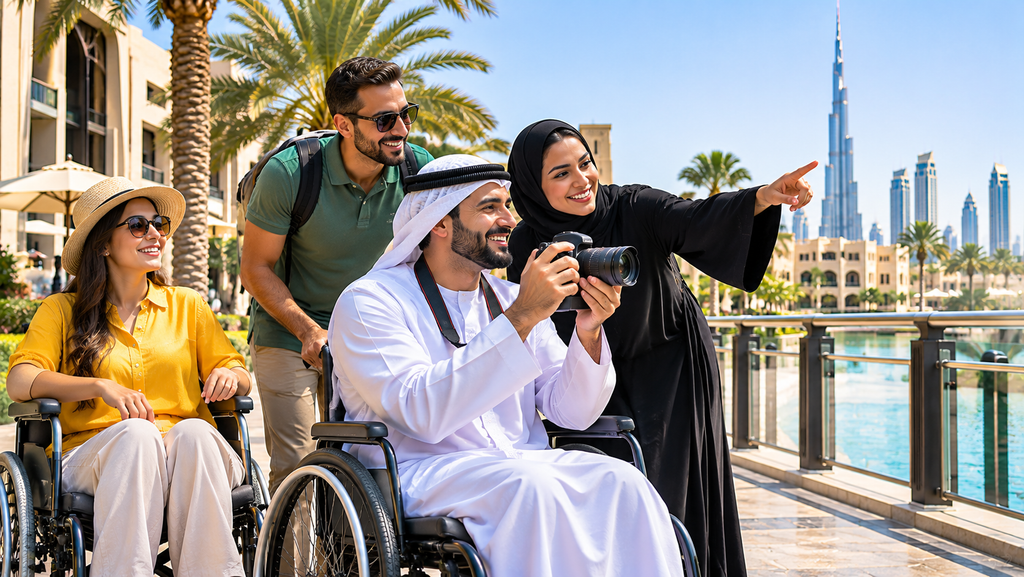
Technology can help remove some of the barriers that travellers encounter when researching, booking and experiencing destinations.
However, digital solutions must themselves be accessible.
A sophisticated hotel application offers limited value if visitors using screen readers or alternative navigation methods cannot operate it.
Hospitality companies should therefore evaluate technology from the perspective of different users.
Accessible hotel websites and booking systems
Online booking platforms should provide clear navigation, readable content, meaningful image descriptions and compatibility with assistive technologies.
Hotels should also make accessibility information easy to locate.
A visitor should not need to search through several pages simply to determine whether an appropriate room is available.
Dubai’s Department of Economy and Tourism reported in October 2026 that digital accessibility compliance scores among assessed hotels increased from 83% in 2024 to 90% in 2026. The findings illustrate the importance of evaluating and improving digital hospitality services. Dubai Department of Economy and Tourism
Assistive technologies in hospitality
Technology may improve accessible experiences through tools such as:
- Digital navigation systems with accessible route information.
- Audio descriptions for cultural attractions.
- Captioning and text-based communication services.
- Accessible digital menus and hotel information.
- Remote communication with trained guest-support teams.
- Sensory information provided before visits.
- Multilingual information presented in accessible formats.
Artificial intelligence may also assist with communication and trip planning, although businesses must consider accuracy, privacy and accessibility when implementing these tools.
Training hospitality employees
Technology cannot replace thoughtful human interaction.
Hospitality staff remain central to inclusive guest experiences.
Employees should understand how to communicate respectfully, offer assistance without making assumptions and respond to different requirements.
Training should include practical situations involving mobility, hearing, visual, cognitive and sensory accessibility.
For instance, staff should ask guests whether assistance is needed rather than automatically assuming that every person with a disability requires help.
Training can also cover emergency evacuation, customer complaints and effective coordination between departments.
Creating an accessibility-focused service culture
Hotels should treat accessibility as a responsibility shared across departments.
Front-desk teams, housekeeping staff, restaurant employees, transport coordinators and management all influence the guest experience.
Regular feedback from visitors with disabilities can help businesses identify improvements that may otherwise be overlooked.
UN Tourism has published practical accessibility guidance for tourism businesses, supporting the development of more inclusive services and operations. UN Tourism+1
7. How Accessible Tourism Supports Sustainable and Responsible Hospitality
Sustainability in hospitality is often associated with environmental protection, energy efficiency, waste reduction and responsible resource management.
However, sustainable tourism also has a social dimension.
A destination cannot fully achieve inclusive development if significant groups of travellers encounter avoidable barriers.
Accessible tourism supports the broader objective of making tourism participation more equitable.
Promoting social inclusion
Travel allows people to experience different cultures, develop relationships, participate in recreation and engage with communities.
When tourism facilities are inaccessible, some individuals may be excluded from these opportunities.
Improving accessibility helps remove barriers to participation.
Supporting local communities
Accessible tourism can benefit local residents as well as international visitors.
Infrastructure improvements such as safer pedestrian routes, accessible public spaces and clearer transport information may improve daily life for people with disabilities and older residents.
This overlap makes accessibility particularly relevant to destination planning.
Encouraging responsible business practices
Hospitality companies increasingly consider how their operations affect customers, employees and surrounding communities.
Accessibility can form part of responsible business management by promoting fair treatment and improving service availability.
It can also strengthen relationships with community organisations and disability advocacy groups.
Connecting accessibility with tourism quality
Reliable accessibility information, convenient transport, trained staff and effective service delivery can improve the wider hospitality experience.
Many design improvements that support accessibility also make destinations easier for families, older visitors and travellers unfamiliar with local environments.
UN Tourism identifies accessibility as an important component of responsible and sustainable tourism development. untourism.int
For Middle Eastern destinations seeking long-term competitiveness, inclusive hospitality can therefore complement wider sustainability and destination-quality objectives.
8. Building a More Accessible Future for Middle Eastern Hospitality
Creating accessible tourism destinations requires more than individual infrastructure projects.
It involves consistent planning, investment, service improvement and cooperation between public and private organisations.
Middle Eastern hospitality businesses have an opportunity to make accessibility a standard consideration in tourism development.
The following priorities can help guide that transition.
1. Conduct practical accessibility assessments
Hotels and attractions should evaluate their existing facilities, websites and customer services.
Assessments should involve people with different disabilities whenever possible.
Their experiences can reveal barriers that are not always apparent during conventional property inspections.
2. Publish accurate accessibility information
Tourism businesses should describe available facilities clearly and avoid unsupported claims.
Detailed photographs, measurements where useful, transport information and honest descriptions of limitations can help visitors make informed decisions.
3. Establish measurable improvement plans
Accessibility projects should have realistic priorities, responsibilities and performance indicators.
Businesses can track improvements in facility access, customer satisfaction, employee training and the accuracy of online information.
4. Include accessibility in future developments
New hospitality projects should incorporate accessibility during initial planning.
Doing so may reduce the need for expensive modifications after construction.
Developers should consult applicable building codes, accessibility professionals and intended users.
5. Strengthen cooperation across the travel sector
Hotels, airlines, transport operators and attractions should coordinate services wherever possible.
A consistent visitor journey is more valuable than isolated accessible facilities.
6. Invest in professional training
Hospitality education providers and employers should incorporate disability inclusion into customer-service development.
Regular refresher programmes can reinforce good practices and help new employees understand their responsibilities.
7. Include travellers with disabilities in decision-making
One of the most important improvements is direct participation.
People with lived experience of disability should have opportunities to advise on hotel services, tourism planning and destination accessibility.
Their feedback can make accessibility initiatives more relevant and effective.
8. Improve the visibility of accessible experiences
Tourism promotion should include reliable information about accessible attractions, accommodation and activities.
Inclusive marketing can help travellers identify suitable destinations while demonstrating that accessibility is part of mainstream hospitality.
A practical accessibility roadmap for hospitality operators
| Priority | Initial action | Long-term objective |
|---|---|---|
| Infrastructure | Assess barriers in existing facilities | Create more inclusive properties |
| Digital services | Review booking website accessibility | Deliver accessible online experiences |
| Employee development | Introduce awareness and service training | Build an inclusive service culture |
| Guest communication | Publish verified accessibility information | Increase traveller confidence |
| Transport | Identify accessible travel partners | Improve destination connectivity |
| Customer feedback | Collect feedback from guests with disabilities | Support continuous improvement |
| Management | Assign accountability and review progress | Integrate accessibility into business strategy |
These steps may require different levels of investment depending on property size, location and existing facilities.
The objective should be continuous improvement supported by clear standards and meaningful visitor participation.
Conclusion: Accessibility Should Be Part of the Future of Middle Eastern Tourism
The Middle East’s hospitality industry has established a strong reputation for ambitious tourism development, distinctive destinations and high-quality guest experiences.
However, the future of successful hospitality will increasingly depend on how effectively destinations serve visitors with different abilities and requirements.
Accessible tourism offers more than an opportunity to attract additional travellers. It supports fairness, customer satisfaction, social inclusion and responsible business development.
For hotels, airlines, attractions and tourism authorities, accessibility should become part of everyday planning rather than an optional enhancement.
Destinations that provide reliable information, inclusive infrastructure, appropriate transport and well-trained staff can create more welcoming experiences for a wider range of visitors.
As Middle Eastern countries continue investing in tourism, accessible hospitality deserves greater attention because a truly world-class destination should offer people of different abilities meaningful opportunities to experience it.
Do follow us on Instagram
Read More – The Role of Community Sports Leagues in Building Connections Among Gulf Residents