



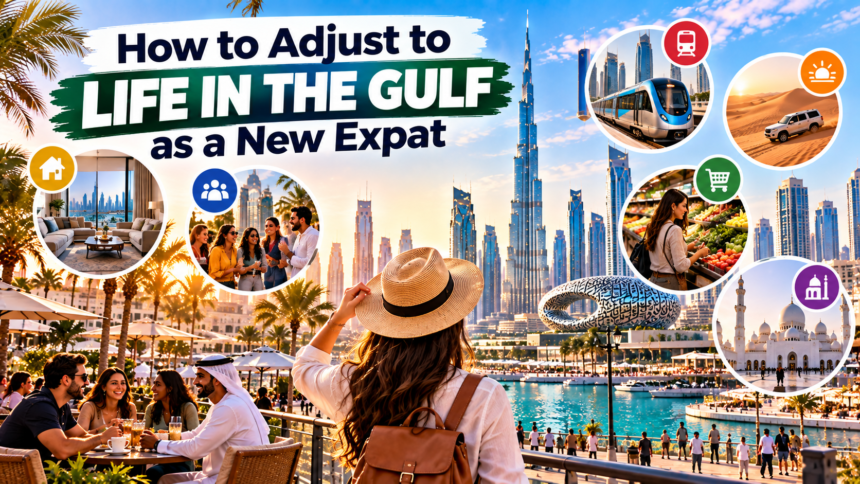
Understand That “The Gulf” Is Not One Single Lifestyle
How to adjust to life in the Gulf as a new expat is one of the biggest questions people face when moving to the UAE, Saudi Arabia, Qatar, Bahrain, Kuwait or Oman. The Gulf can offer excellent career opportunities, modern infrastructure, strong international communities and a very different lifestyle, but the first few months often require more adjustment than newcomers expect.
- How to Adjust to Life in the Gulf as a New Expat: Quick Guide
- Understand That “The Gulf” Is Not One Single Lifestyle
- Learn the Local Work Culture Before Making Assumptions
- Build a Realistic Gulf Budget During Your First Three Months
- Choose Housing Around Your Daily Routine
- Accept That the Climate Will Change Your Daily Routine
- Learn Cultural Norms Without Becoming Nervous About Every Interaction
- Ramadan Can Change the Rhythm of Daily Life
- Build a Social Circle Before Loneliness Becomes a Problem
- Do Not Compare Your New Life Constantly With Home
- Understand Your Employment and Residency Documents
- Give Yourself Time Before Buying a Car
- Families Should Plan Schools Before Choosing Their Home
- Use Official Sources for Laws and Employment Questions
- Expect Homesickness Even If You Like Your New Country
- Explore the Region Instead of Living Only Between Home and Work
- Avoid the Most Common New-Expat Mistakes
- A 90-Day Plan for Adjusting to Life in the Gulf
- How Long Does It Take to Feel Settled in the Gulf?
- Is Life in the Gulf Good for Expats?
The six Gulf Cooperation Council countries share several cultural and economic characteristics, but they are not interchangeable. The GCC officially includes the United Arab Emirates, Bahrain, Saudi Arabia, Oman, Qatar and Kuwait, and each country has its own residency processes, labour rules, housing market, public services and social environment.
For a new expat, the challenge is usually not one major problem. It is learning dozens of small things at once. You may need to understand a new workplace culture, organise residency documents, choose housing, open a bank account, adjust to the weather, learn local customs and build a completely new social circle.
The adjustment becomes much easier when you stop expecting yourself to understand everything immediately. Your first weeks should be about learning how your new city works, creating a stable daily routine and gradually building confidence.
This guide covers the practical, social and cultural side of settling into the Gulf, including work, housing, money, climate, friendships, family life and a simple 90-day adjustment plan.
How to Adjust to Life in the Gulf as a New Expat: Quick Guide
The first lesson is that settling in takes time.
Many expats arrive expecting to feel comfortable within a few weeks because Gulf cities can be highly modern and internationally connected. Digital banking, delivery apps, modern malls and English-language services may make daily life look familiar, particularly in cities such as Dubai, Abu Dhabi, Doha and Riyadh.
But convenience does not automatically mean emotional adjustment.
You are still learning a new culture, building a routine and often living far from family.
| Adjustment Area | What to Focus On First |
|---|---|
| Residency | Complete identification and residence requirements |
| Work | Understand schedules, hierarchy and communication |
| Housing | Prioritise commute and daily convenience |
| Money | Build a realistic local budget |
| Culture | Learn local customs without overthinking everything |
| Weather | Adapt daily routines to the climate |
| Social life | Join recurring communities |
| Transport | Test public transport before buying a car |
| Family | Research schools, healthcare and neighbourhoods |
| Mental adjustment | Give yourself time to settle |
A useful mindset is to separate your relocation into three stages.
First 30 days: solve practical problems.
Days 30 to 60: build routines.
Days 60 to 90: start creating a real social and personal life.
Trying to achieve all three during your first week is one of the easiest ways to make relocation feel overwhelming.
Understand That “The Gulf” Is Not One Single Lifestyle
One of the biggest mistakes newcomers make is assuming that living in one Gulf country will be exactly like living in another.
The six GCC countries share strong historical, cultural and economic ties, but daily life can differ considerably.
Dubai may feel heavily international and tourism-oriented.
Riyadh has a rapidly expanding business and entertainment scene but a different urban rhythm and work culture.
Doha offers a smaller-scale capital-city environment.
Muscat may feel quieter and more relaxed.
Bahrain has its own social atmosphere, while Kuwait combines a large expatriate population with a very different urban structure.
Compare the city, not only the country
Before deciding where to live, understand:
- Your workplace location
- Typical commuting time
- Public transport availability
- Housing costs
- School locations
- Social areas
- Airport access
- Healthcare
- Weekend activities
A job offer may sound excellent until you realise that your preferred neighbourhood is far from the office or that your children’s school creates a difficult daily commute.
Your actual experience will be shaped much more by your neighbourhood and routine than by general online descriptions of the country.
Learn the Local Work Culture Before Making Assumptions
Workplace culture can be one of the biggest adjustments for new expats.
Gulf workplaces are often extremely international. A single office may include employees from the Middle East, South Asia, Europe, Africa, Southeast Asia and North America.
That diversity is one of the region’s strengths, but it also means communication styles can vary.
Saudi Arabia’s official relocation guidance, for example, describes its work environment as increasingly international while emphasising professionalism, mutual respect and relationship-building. It also notes that the standard Saudi working week commonly runs from Sunday to Thursday, although actual schedules vary by employer and industry.
During your first month at work, observe before judging
Pay attention to:
- How formal communication is
- How managers prefer to receive updates
- Meeting etiquette
- Decision-making speed
- Office dress
- Working hours
- Weekend schedule
- Ramadan arrangements
- Email and messaging habits
- How direct feedback tends to be
Do not assume that the work culture you experienced in your previous country will apply automatically.
Ask questions early
If expectations are unclear, ask.
It is much better to confirm how deadlines, leave, overtime or remote work are handled than to build assumptions based on what colleagues seem to be doing.
Official labour portals are especially important if you have questions about contracts or rights. Saudi Arabia, for example, maintains a dedicated Labour Culture platform and expat-services guide explaining workplace regulations and government services.
Use official sources rather than old social-media posts for anything legal.
Build a Realistic Gulf Budget During Your First Three Months
A new salary can feel very different once local expenses begin.
Many Gulf countries have no personal income tax on employment income, but that does not mean everyday life is automatically inexpensive.
Housing, private schooling, cars, food delivery, entertainment and international travel can all become substantial expenses.
The first month is usually especially costly.
New expats commonly need money for:
- Temporary accommodation
- Rental deposit
- First rent payment
- Agency fees
- Utility deposits
- Internet setup
- Mobile service
- Furniture
- Transport
- School registration
- Health insurance where applicable
Do not calculate affordability using salary alone.
Calculate how much money remains after your normal monthly lifestyle.
Simple Monthly Budget Structure
| Category | Suggested Approach |
|---|---|
| Housing | Keep comfortably below your maximum limit |
| Transport | Compare car ownership with taxi/public transport |
| Food | Separate groceries from restaurants |
| Utilities | Track seasonal changes |
| Entertainment | Set a monthly amount |
| Remittances | Plan transfers rather than sending randomly |
| Savings | Transfer automatically after salary |
| Emergency fund | Keep separate from normal savings |
Watch lifestyle inflation
Gulf cities make spending very easy.
Restaurants, malls, hotels, delivery services and premium experiences are available constantly.
A new expat can quickly move from enjoying occasional convenience to treating expensive convenience as normal life.
Try to understand your real monthly costs before upgrading your apartment, car or social spending.
Choose Housing Around Your Daily Routine
Housing decisions can determine whether you enjoy your new city.
The cheapest apartment is not necessarily the best value.
A home that creates a 90-minute commute every morning can cost you more in time, fuel and stress than a slightly more expensive apartment closer to work.
Before signing a lease, check:
- Morning commute
- Evening commute
- Parking
- Grocery access
- Public transport
- Schools
- Healthcare
- Gym
- Noise
- Building maintenance
- Internet availability
- Air-conditioning arrangements
If possible, visit the area at several different times of day.
A neighbourhood that feels peaceful on Friday afternoon may be extremely congested on a weekday morning.
Start temporary if you are unsure
New expats sometimes benefit from spending their first month in temporary accommodation.
That gives you time to understand the city before committing to a longer tenancy.
Housing Priorities by Expat Type
| Expat Situation | Housing Priority |
|---|---|
| Single professional | Commute and social access |
| Family | Schools and space |
| Remote worker | Home quality and nearby amenities |
| Frequent traveller | Airport/highway access |
| Budget-focused | Lower rent without extreme commute |
| Car-free resident | Public transport |
Housing should support your life rather than simply photograph well.
Accept That the Climate Will Change Your Daily Routine
For many newcomers, Gulf weather is one of the biggest lifestyle adjustments.
The cooler months can be extremely pleasant, encouraging outdoor dining, beaches, walking, camping and desert activities.
Summer is different.
High heat and humidity can change how you commute, exercise and spend weekends.
Your summer routine may involve:
- Driving rather than walking
- Indoor exercise
- Malls and indoor entertainment
- Earlier or later outdoor activities
- Higher electricity use
- More careful hydration
- Greater reliance on air conditioning
New expats should avoid choosing a home based only on how walkable the area feels during winter.
A 15-minute outdoor walk that feels easy in January may be far less practical during hotter months.
Plan clothing realistically
Lightweight clothing is practical outdoors, while indoor spaces can be heavily air-conditioned.
Keeping a light jacket or extra layer at work is surprisingly useful.
Respect local expectations around modest clothing as well, particularly in government buildings, religious sites and more traditional areas.
Learn Cultural Norms Without Becoming Nervous About Every Interaction
Most Gulf residents are accustomed to living alongside people from many different cultures.
Newcomers therefore do not need to be terrified of making a small social mistake.
What matters is basic respect and willingness to learn.
Arabic is the official language across GCC states, while English is widely used in many business and service environments. In the UAE, for example, the government notes that road signs and commercial signage commonly appear in both Arabic and English, alongside a highly multilingual population.
Useful cultural habits include:
- Dress appropriately for the setting
- Be respectful when discussing religion
- Avoid aggressive public arguments
- Ask before photographing people
- Understand local rules around alcohol
- Respect Ramadan practices
- Use professional greetings at work
- Avoid assuming Western norms apply everywhere
You do not need to speak Arabic fluently to settle successfully, but learning a few common words can be appreciated.
Words such as shukran for thank you and basic greetings can help create warmer interactions.
Respect matters more than perfection
People generally understand that expats are learning.
Being polite, observant and open-minded will take you much further than trying to memorise every cultural detail before leaving home.
Ramadan Can Change the Rhythm of Daily Life
Ramadan is an important part of life across the Gulf.
During the holy month, working hours, restaurant schedules, traffic patterns and social routines may change.
The exact legal requirements vary by country and sector.
In Saudi Arabia, for example, official labour information states that working hours for Muslim employees are reduced during Ramadan under applicable labour rules.
Other GCC countries have their own rules and workplace arrangements.
For new expats, expect changes in:
- Office hours
- Government-service hours
- Restaurant schedules
- Traffic before sunset
- Evening activity
- Shopping hours
- Social events
Ramadan evenings can become extremely lively.
Restaurants, malls and neighbourhoods may remain active late into the night as families and friends gather after iftar.
The month can also provide an excellent opportunity for expats to understand local culture more deeply.
If colleagues invite you to an iftar, consider attending.
Build a Social Circle Before Loneliness Becomes a Problem
The practical side of relocation receives most of the attention, but social adjustment is just as important.
A new job and comfortable apartment can still feel lonely if you spend every evening alone.
The challenge is that friendships usually require repeated contact.
Good ways to meet people include:
- Sports clubs
- Fitness classes
- Professional groups
- Hobby communities
- Cultural events
- Parent groups
- Community events
- Volunteering
- Colleagues
- Neighbourhood gatherings
Avoid relying completely on work for your social life.
Colleagues can become close friends, but having relationships outside your employer gives your life more stability.
Choose recurring activities
A weekly running club usually creates stronger relationships than attending a different event every weekend.
Repetition is what turns a familiar face into a friend.
Social Adjustment Plan
| Action | Frequency |
|---|---|
| Recurring hobby or sport | Weekly |
| Coffee with colleague | Occasionally |
| Community event | Monthly |
| Call family back home | Regularly |
| Explore a new area | Twice monthly |
| Host or organise a plan | Monthly |
The aim is not to fill your entire calendar.
You simply need enough regular human contact that your new city starts to feel familiar.
Do Not Compare Your New Life Constantly With Home
Almost every expat goes through a period where small differences become irritating.
You may miss your favourite food, friends, family, weather or familiar systems.
That is normal.
The problem begins when every difference is automatically judged as worse.
Instead of saying:
“This is not how we do it back home.”
Try:
“This works differently here. How does the system work?”
That small mental shift makes adjustment much easier.
Keep parts of your old routine
You do not need to reinvent yourself completely.
Continue familiar habits such as:
- Calling family
- Cooking favourite meals
- Watching familiar sports
- Celebrating important traditions
- Exercising
- Reading
- Weekend routines
Adjustment works best when you combine familiar habits with new experiences.
Understand Your Employment and Residency Documents
Your ability to live and work in the Gulf is closely connected to your legal residence status.
The exact system differs between countries.
Saudi Arabia, for example, provides official guidance specifically for expatriates covering employment rights, healthcare, education, housing and government services.
The UAE Government similarly maintains dedicated information covering jobs, visas, housing, health and life in the country.
New expats should understand:
- Who sponsors their residence
- How long the permit remains valid
- What happens if employment ends
- How dependants are sponsored
- Health insurance requirements
- Renewal dates
- Passport requirements
Create a document folder
Keep digital copies of:
- Passport
- Residence card
- Employment contract
- Health insurance
- Driving licence
- Rental agreement
- Education certificates
- Marriage certificate
- Birth certificates
Set reminders for expiry dates.
Administrative problems become much easier when documents are organised.
Give Yourself Time Before Buying a Car
Car ownership is common in many Gulf cities, but buying one immediately may not be necessary.
Dubai and Doha have extensive public-transport options in many areas, while Riyadh’s expanding transport network is changing commuting possibilities. Other locations remain far more car-dependent.
Spend the first few weeks understanding your route.
Calculate the complete car cost
Do not only consider the purchase price.
Include:
- Insurance
- Registration
- Fuel
- Parking
- Road tolls
- Maintenance
- Tyres
- Finance
- Depreciation
When a Car Makes Sense
| Situation | Likely Choice |
|---|---|
| Work near Metro | Public transport may work |
| Family school runs | Car often useful |
| Frequent intercity travel | Car practical |
| Central neighbourhood | Taxi + public transport may work |
| Remote residential area | Car likely necessary |
| Unsure where you will live | Wait |
Delaying the purchase also gives you time to understand local driving culture.
Families Should Plan Schools Before Choosing Their Home
Families face additional adjustment challenges.
International schools can represent one of the largest household expenses, while school location can dramatically affect the daily routine.
If possible, research schools before signing a long-term lease.
Consider:
- Curriculum
- Tuition
- Waiting lists
- Bus transport
- Distance
- School calendar
- Activities
- Nursery options
- Special educational support
A home that looks perfect may become impractical if children spend two hours commuting every day.
Healthcare matters too
Identify nearby:
- Family clinic
- Paediatrician
- Pharmacy
- Emergency hospital
- Dentist
Knowing where to go before somebody becomes ill reduces a lot of stress.
Use Official Sources for Laws and Employment Questions
Gulf rules can change, and social-media information becomes outdated quickly.
This is especially important for:
- Labour law
- Visa rules
- Residency
- Driving licences
- Health insurance
- Family sponsorship
- Public holidays
- Business rules
Saudi Arabia’s HRSD, for example, actively publishes labour-awareness resources and guidance intended to help workers understand their contractual rights and obligations.
The UAE Government similarly maintains official information about working, housing, health and residency.
Use official government platforms first.
Then use reputable media or community forums for practical experiences rather than legal interpretation.
Expect Homesickness Even If You Like Your New Country
Homesickness does not mean you made the wrong decision.
You can enjoy your job, like your new city and still miss your previous life.
The feeling often appears after the initial excitement disappears.
The first month may feel like an adventure.
The second or third can feel more ordinary.
That is when some expats begin questioning the move.
Ways to make the transition easier
- Maintain regular contact with family
- Create a normal weekly routine
- Exercise
- Explore beyond malls
- Make your home comfortable
- Build friendships
- Visit cultural attractions
- Cook familiar food
Avoid spending every evening on video calls with people back home.
Staying connected is important, but you also need enough emotional space to build a life where you now live.
Explore the Region Instead of Living Only Between Home and Work

One of the biggest advantages of living in the Gulf is access to a region many newcomers previously knew only through airports or business travel.
Take time to explore.
Depending on where you live, weekends can include:
- Mountains
- Beaches
- Deserts
- Heritage districts
- Museums
- Traditional markets
- Islands
- Hiking
- Camping
- Historic towns
Exploration helps adjustment because it transforms the country from “the place where my job is” into somewhere you understand personally.
Start locally
You do not need to book a luxury resort every weekend.
Visit neighbourhoods.
Try local restaurants.
Explore old markets.
Attend cultural festivals.
The more familiar your surroundings become, the more quickly they begin to feel like home.
Avoid the Most Common New-Expat Mistakes
Most adjustment problems come from expectations rather than dramatic events.
Spending too quickly
Do not build a luxury lifestyle during your first salary cycle.
Choosing housing before understanding traffic
Test the commute first.
Depending only on colleagues
Build outside friendships.
Comparing everything with home
Learn how local systems work.
Ignoring official documentation
Understand your residence and employment rules.
Buying a car immediately
Test your transport needs.
Staying indoors constantly
Explore your new city.
Expecting instant friendships
Give relationships time.
New Expat Mistake Checklist
| Mistake | Better Approach |
|---|---|
| Overspend immediately | Track 90 days of expenses |
| Rush into long lease | Learn neighbourhoods first |
| Stay only with colleagues | Join outside communities |
| Ignore cultural differences | Observe and ask |
| Use unofficial legal advice | Check government sources |
| Expect immediate comfort | Allow time |
| Avoid new experiences | Explore gradually |
Most of these mistakes are easy to correct if you notice them early.
A 90-Day Plan for Adjusting to Life in the Gulf
Three months is a useful period for thinking about relocation.
You may not feel completely settled after 90 days, but you should have enough experience to understand what your normal life looks like.
Days 1 to 30: Build the foundation
Focus on practical stability.
- Complete residency requirements
- Open bank account
- Get local mobile service
- Arrange healthcare
- Understand your workplace
- Explore housing
- Learn transport
- Build a basic budget
Do not put too much pressure on yourself socially during this phase.
You already have a lot to organise.
Days 31 to 60: Create routine
Start making your life predictable.
- Set regular grocery habits
- Establish exercise routine
- Join one social activity
- Learn your commute
- Identify favourite local places
- Track spending
- Explore your neighbourhood
This is when your city should start feeling less unfamiliar.
Days 61 to 90: Build your actual life
Now move beyond basic survival.
- Invite people out
- Explore another city or region
- Start a hobby
- Create savings goals
- Review your housing choice
- Plan future travel
- Build weekend routines
90-Day Adjustment Tracker
| Goal | Complete |
|---|---|
| Residency organised | □ |
| Bank account | □ |
| Housing settled | □ |
| Healthcare understood | □ |
| Monthly budget created | □ |
| Transport routine | □ |
| One social group | □ |
| One regular hobby | □ |
| Local friends | □ |
| Emergency fund started | □ |
| Explored outside neighbourhood | □ |
| Comfortable weekly routine | □ |
Do not treat unchecked boxes as failures.
The purpose is simply to see where you may need more attention.
How Long Does It Take to Feel Settled in the Gulf?
There is no universal answer.
Some people feel comfortable within weeks.
Others may need six months or longer.
Adjustment depends on several factors:
- Previous international experience
- Family situation
- Workplace
- Housing
- Language
- Social support
- Personality
- Financial stability
A single professional arriving with friends already in the country may settle quickly.
A family relocating with children, schools and a completely new routine may need much longer.
Typical Adjustment Stages
| Period | Common Experience |
|---|---|
| First month | Excitement and administration |
| Months 2–3 | Routine begins |
| Months 3–6 | Social life becomes more stable |
| Months 6–12 | City starts feeling familiar |
| After one year | Better understanding of local life |
The process is rarely linear.
You may feel completely settled one week and homesick the next.
That is normal.
Is Life in the Gulf Good for Expats?
For many people, yes.
The Gulf attracts international workers because of employment opportunities, infrastructure, geographic location and increasingly diverse economies.
The region also contains very international cities where newcomers can build relationships with people from dozens of countries.
At the same time, life here requires flexibility.
The climate may be different.
Your workplace may operate differently.
Housing can be expensive.
Friendships can change because expatriate populations are mobile.
And government processes will not always resemble what you were used to.
The people who adjust most successfully usually do not try to recreate their previous life exactly.
They keep the parts of home that matter while learning how their new country works.
That balance is the real answer to how to adjust to life in the Gulf as a new expat.
Respect the culture without being afraid of it.
Build a budget before adopting an expensive lifestyle.
Choose housing around your actual daily routine.
Make an effort to meet people outside work.
Explore the region.
And most importantly, give yourself time.
A new country rarely feels like home after three weeks.
But after several months of repeated routines, familiar streets, favourite cafés, trusted colleagues and new friendships, the place that once felt unfamiliar can start to become part of your normal life.
Do follow us on Instagram
Read More – How to Make Friends After Moving to Dubai: 12 Easy Ways to Build a Social Circle