



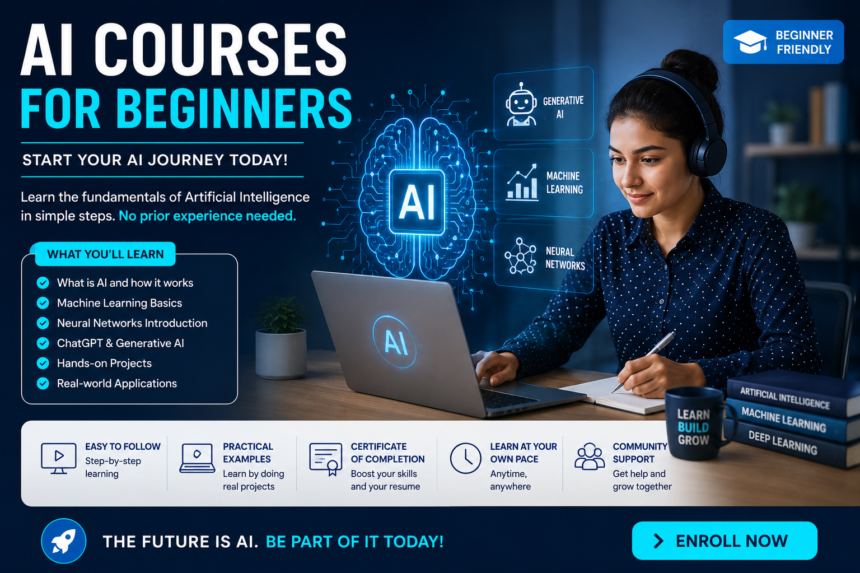
Learn Artificial Intelligence from Scratch: AI Courses for Beginners
Artificial Intelligence (AI) has quickly become one of the most important technologies shaping the modern world. From chatbots and recommendation systems to self-driving technology, healthcare applications, financial services, cybersecurity, education, and business automation, AI is changing how people work and interact with technology. As demand for AI skills continues to grow, more students, professionals, entrepreneurs, and career changers are looking for AI courses for beginners that can help them understand the technology without requiring an advanced technical background.
- What Are AI Courses for Beginners?
- Why Learn Artificial Intelligence as a Beginner?
- Who Should Take AI Courses for Beginners?
- What Do You Learn in an AI Courses?
- What Is Prompt Engineering?
- Do You Need Coding Skills to Learn AI?
- Best Programming Language for AI Beginners
- AI Courses for Beginners Without Coding
- AI Courses Learning Path for Beginners
- Practical AI Projects for Beginners
- Benefits of Online AI Courses for Beginners
- How to Choose the Best AI Courses for Beginners
- AI Certification for Beginners
- AI Courses for Beginners and Career Opportunities
- AI Skills for Business Professionals
- AI Courses for Students
- AI Courses for Career Changers
- Common Mistakes Beginners Make When Learning AI
- How Long Does It Take to Learn AI?
- Are AI Courses Worth It for Beginners?
- Frequently Asked Questions About AI Courses for Beginners
- Beginner AI Course Checklist
Learning AI does not necessarily mean becoming a highly skilled programmer or data scientist immediately. Beginners can start with fundamental concepts, understand how AI works, experiment with popular AI tools, and gradually progress toward machine learning, deep learning, generative AI, and practical applications.
The best approach is to choose a learning path that matches your current knowledge and career goals. Some learners may want to understand AI for business, while others may want to become AI engineers, data scientists, machine learning specialists, prompt engineers, or AI-powered entrepreneurs.
This guide explains what beginners should learn, the different types of AI courses for beginners, essential skills, popular course topics, career opportunities, learning methods, and practical tips for starting an AI journey from scratch.
What Are AI Courses for Beginners?
AI courses for beginners are educational programs designed to introduce learners to artificial intelligence in a simple and structured way. These courses generally start with fundamental concepts before introducing more advanced technologies.
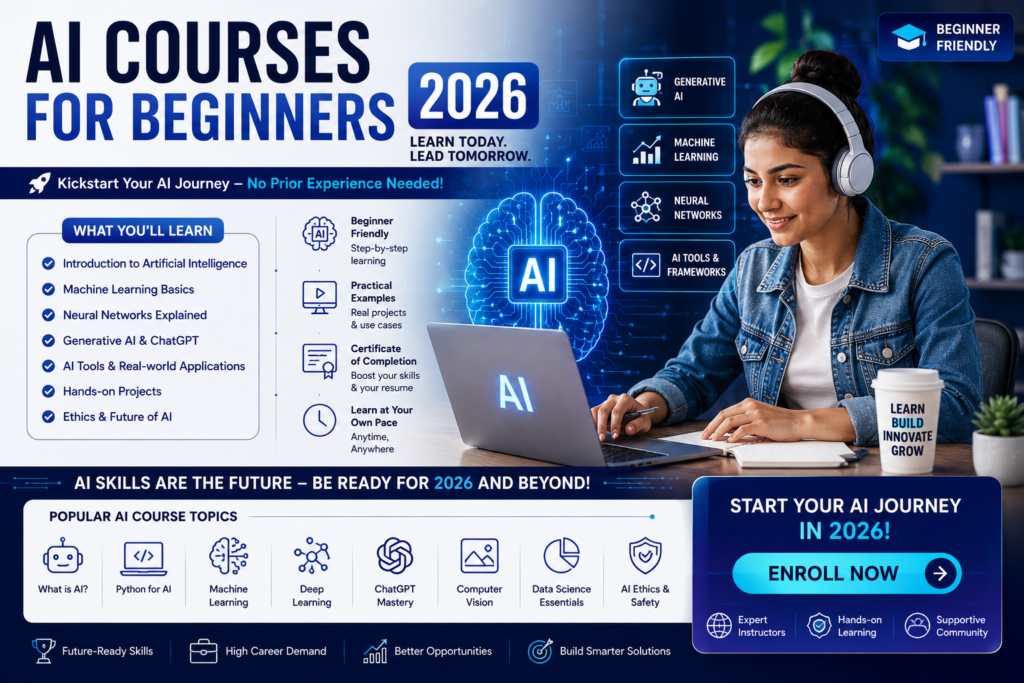
A beginner-friendly AI courses may cover:
- Introduction to Artificial Intelligence
- How AI works
- Machine learning basics
- Deep learning fundamentals
- Neural networks
- Generative AI
- ChatGPT and AI assistants
- Prompt engineering
- AI tools and applications
- Data fundamentals
- Python basics
- Computer vision
- Natural language processing
- AI ethics and responsible AI
- Hands-on AI projects
The exact curriculum depends on the course provider and level.
A good beginner course should avoid assuming that students already understand advanced mathematics, programming, or computer science. Instead, it should explain concepts progressively and provide practical examples.
Why Learn Artificial Intelligence as a Beginner?
AI skills are becoming increasingly valuable across many industries. Businesses are using AI to automate repetitive tasks, analyse information, improve customer experiences, create content, detect fraud, optimise operations, and support decision-making.
Learning AI can therefore benefit people from many professional backgrounds.
Major reasons to learn AI include:
Career opportunities: AI knowledge can support careers in technology, data, marketing, finance, healthcare, education, consulting, and other industries.
Workplace productivity: AI tools can help professionals automate repetitive work, summarise information, generate ideas, analyse data, and improve workflows.
Entrepreneurship: Entrepreneurs can use AI to create products, automate operations, develop services, and identify new business opportunities.
Future-ready skills: Understanding AI can help professionals adapt as AI becomes increasingly integrated into workplaces.
Personal development: Learning AI can improve digital literacy and help people understand one of the most influential technologies of the modern era.
Who Should Take AI Courses for Beginners?
Beginner AI courses are suitable for a wide range of learners.
Students: Students can learn AI fundamentals before pursuing university-level computer science, data science, or engineering programs.
Working Professionals: Professionals can learn how AI applies to their existing industry and discover ways to improve productivity.
Entrepreneurs: Business owners can learn how AI can support marketing, customer service, operations, research, and automation.
Career Changers: People moving into technology can use introductory AI courses to understand the field before choosing a specialised career path.
Freelancers: Freelancers can develop AI-related skills and incorporate AI tools into services such as writing, design, marketing, development, research, and consulting.
Non-Technical Learners: Many introductory AI courses are designed for learners without extensive programming experience. Non-technical students can begin with concepts and practical AI tools before moving into coding.
What Do You Learn in an AI Courses?
The curriculum varies, but most AI courses for beginners introduce several core areas.
1. Introduction to Artificial Intelligence
The first stage is understanding what artificial intelligence actually means.
Students learn about:
- AI definitions
- History of AI
- Types of AI
- Examples of AI in everyday life
- AI applications
- Benefits and limitations
- Difference between AI and traditional software
This foundation helps beginners understand where AI is being used and why it is important.
2. Machine Learning Basics
Machine learning is one of the most important areas of artificial intelligence.
Instead of programming every rule manually, machine learning systems can identify patterns from data and use those patterns to make predictions or decisions.
Beginners may learn concepts such as:
- Supervised learning
- Unsupervised learning
- Classification
- Regression
- Clustering
- Training data
- Testing data
- Features and labels
- Model evaluation
A beginner course should explain these ideas using simple examples before introducing complex algorithms.
3. Neural Networks
Neural networks are computational models inspired loosely by the way biological neural systems process information.
Beginners may learn about:
- Neurons
- Layers
- Inputs and outputs
- Weights
- Activation functions
- Training
- Neural network applications
Understanding basic neural networks provides a foundation for exploring deep learning.
4. Generative AI
Generative AI has become one of the most accessible areas of AI for beginners.
Generative AI systems can produce content such as:
- Text
- Images
- Audio
- Video
- Computer code
- Summaries
- Ideas and outlines
Beginner courses may introduce large language models, AI assistants, image-generation systems, and other generative AI technologies.
5. ChatGPT and AI Assistants
AI courses increasingly include practical lessons on using conversational AI tools.
Students can learn how to:
- Write effective prompts
- Ask AI for structured responses
- Summarise information
- Generate ideas
- Improve writing
- Analyse information
- Create workflows
- Use AI for productivity
The goal should not simply be learning how to ask questions but understanding how to communicate instructions clearly and evaluate AI-generated results.
What Is Prompt Engineering?
Prompt engineering involves designing effective instructions for AI systems to produce useful results.
A beginner can learn basic prompting techniques such as:
- Clearly defining the objective
- Providing relevant context
- Specifying the desired format
- Giving examples
- Setting constraints
- Asking for step-by-step reasoning or structured outputs where appropriate
- Reviewing and refining prompts
For example, instead of asking an AI tool to “write about marketing,” a user could specify the audience, topic, format, word count, tone, and desired outcome.
Prompt engineering is useful for professionals who want to integrate generative AI into everyday work.
Do You Need Coding Skills to Learn AI?
No, you do not necessarily need programming experience to start learning AI.
There are different levels of AI education.
Non-technical AI learning
Beginners can learn:
- AI concepts
- Generative AI
- AI tools
- Prompt engineering
- AI productivity
- Business applications
- AI ethics
This path is suitable for business professionals, marketers, entrepreneurs, educators, writers, and other non-technical users.
Technical AI learning
Learners interested in becoming AI developers or machine learning engineers will eventually benefit from programming knowledge.
Common technical skills include:
- Python
- Mathematics
- Statistics
- Data analysis
- Machine learning frameworks
- Databases
- Algorithms
- Model evaluation
Therefore, beginners do not have to start with programming. They can gradually develop technical skills as their goals become clearer.
Best Programming Language for AI Beginners
Python is widely used in AI, machine learning, data science, and automation.
Beginners interested in technical AI should consider learning basic Python concepts, including:
- Variables
- Data types
- Conditions
- Loops
- Functions
- Lists and dictionaries
- File handling
- Libraries
- Basic object-oriented programming
After learning the fundamentals, students can explore Python libraries and frameworks used for data analysis and machine learning.
However, programming should not discourage non-technical learners. Many AI applications can be explored without writing code.
AI Courses for Beginners Without Coding
No-code and low-code AI education is increasingly popular.
These courses focus on using existing AI tools rather than building machine learning models from scratch.
Topics may include:
- AI productivity tools
- AI writing tools
- Generative AI
- AI image generation
- AI presentation tools
- AI automation
- Prompt engineering
- AI-powered research
- Business automation
This can be an excellent starting point for professionals who want to use AI at work without becoming programmers.
AI Courses Learning Path for Beginners
A structured learning path can make AI less overwhelming.
Step 1: Learn AI Fundamentals
Start by understanding:
- What AI is
- How AI differs from traditional software
- Where AI is used
- Advantages and limitations of AI
Step 2: Explore Generative AI
Learn how modern AI assistants and generative AI systems work at a high level.
Experiment with text, image, coding, and productivity tools.
Step 3: Learn Prompting
Practice creating clear and effective prompts.
Learn how context, examples, instructions, and formatting influence results.
Step 4: Study Machine Learning
Once the fundamentals are comfortable, learn basic machine learning concepts.
Step 5: Learn Python
If you want a technical AI career, begin learning Python.
Step 6: Build Practical Projects
Apply your knowledge to simple projects rather than only watching lectures.
Step 7: Choose a Specialisation
You can eventually explore:
- Machine learning
- Deep learning
- Generative AI
- Natural language processing
- Computer vision
- Data science
- AI engineering
- Robotics
- AI automation
Practical AI Projects for Beginners
Projects are one of the best ways to reinforce AI concepts.
Beginners can start with simple projects such as:
AI Chatbot: Create a basic chatbot that answers questions about a specific topic.
Sentiment Analysis: Build a simple system that identifies whether text expresses positive, negative, or neutral sentiment.
Image Classification: Create a beginner-level image classification project using an appropriate machine learning framework.
AI Content Assistant: Build a workflow that helps generate, summarise, or organise content.
Recommendation System: Experiment with a simple recommendation model using a small dataset.
Document Summariser: Create a tool that processes documents and produces concise summaries.
The purpose of beginner projects is to develop practical understanding rather than create production-ready commercial systems.
Benefits of Online AI Courses for Beginners
Online learning provides flexibility for people who have work, school, or other commitments.
Flexible schedule: Students can study at a convenient time.
Learn from anywhere: An internet connection can provide access to lessons, exercises, and learning communities.
Self-paced education: Many platforms allow learners to progress at their own speed.
Practical learning: Online courses can include coding exercises, quizzes, demonstrations, projects, and assignments.
Variety of subjects: Learners can select introductory courses or specialised programs based on their goals.
How to Choose the Best AI Courses for Beginners
There are many AI courses available, so choosing the right one requires careful evaluation.
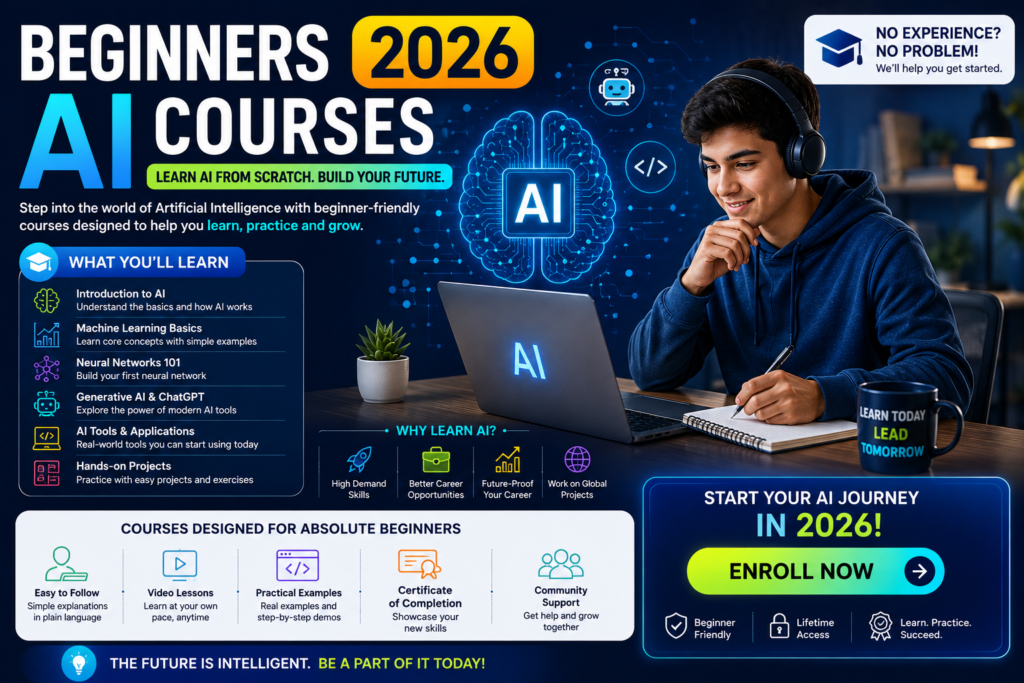
Check the Course Level: Make sure the course is genuinely designed for beginners if you have no previous AI experience.
Review the Curriculum: Look for a clear progression from fundamentals to practical applications.
Look for Hands-On Practice: A course that combines theory with exercises and projects can provide more practical value.
Check Instructor Expertise: Review the instructor’s professional and educational background where available.
Consider Course Duration: A short introductory course can be useful for exploration, while a longer program may provide more comprehensive training.
Check Certification: If you need a certificate for professional development, confirm whether the course provides one and whether it is recognised by relevant employers or institutions.
Read Student Reviews: Reviews can provide insights into course quality, difficulty, teaching style, and practical value.
Check for Updated Content: AI technology evolves quickly. Look for courses that are regularly updated to reflect current tools and practices.
AI Certification for Beginners
An AI certificate can demonstrate that you have completed a structured learning program.
However, a certificate alone does not guarantee employment.
Employers may also look at:
- Practical skills
- Projects
- Technical knowledge
- Problem-solving ability
- Communication
- Portfolio work
- Industry experience
For beginners, a combination of AI certification and practical projects can be more valuable than simply collecting multiple certificates.
AI Courses for Beginners and Career Opportunities
Learning AI can open pathways into several technology and non-technology careers.
Possible roles include:
- AI specialist
- Machine learning engineer
- Data analyst
- Data scientist
- AI product specialist
- AI consultant
- Automation specialist
- Prompt specialist
- AI trainer
- Business intelligence professional
- AI-focused software developer
- Generative AI specialist
Not every role requires the same skill level.
For example, a machine learning engineer typically requires substantial programming, mathematics, and machine learning knowledge, while an AI-focused business professional may primarily need AI literacy and practical tool expertise.
AI Skills for Business Professionals
AI is not limited to technology companies.
Marketing professionals can use AI for:
- Content ideas
- Market research
- Customer segmentation
- Campaign analysis
- Copywriting support
Human resources professionals can explore AI for:
- Job-description drafting
- Candidate communication
- Workforce analytics
- Employee-support workflows
Finance professionals can use AI for:
- Data analysis
- Reporting support
- Document processing
- Financial research
Business owners can explore AI for:
- Customer support
- Automation
- Marketing
- Research
- Internal knowledge management
- Productivity
Human review remains important, especially when AI is used for financial, legal, medical, employment, or other high-impact decisions.
AI Courses for Students
Students can gain a significant advantage by developing AI literacy early.
A beginner course can help students understand how AI systems work before they decide whether to pursue a technical career.
Students can gradually progress from:
AI fundamentals → Python → Data Science → Machine Learning → Deep Learning → AI Projects
Students interested in research or advanced technical careers may eventually need stronger mathematics and computer science foundations.
AI Courses for Career Changers
AI courses can also be useful for professionals transitioning into technology.
A career changer should avoid trying to learn every AI technology at once.
Instead, start with fundamentals and identify one target career.
For example:
AI business career: AI fundamentals + productivity tools + business applications.
Data career: Python + statistics + data analysis + machine learning.
AI engineering career: Python + algorithms + machine learning + deep learning + software engineering.
Generative AI career: LLM fundamentals + prompting + APIs + automation + application development.
A focused learning path is generally easier to manage than studying unrelated technologies simultaneously.
Common Mistakes Beginners Make When Learning AI
Learning AI can feel overwhelming, especially because new tools and concepts appear constantly.
Trying to learn everything: AI is a huge field. Start with fundamentals and specialise gradually.
Focusing only on certificates: Certificates can support a learning journey, but practical skills matter too.
Avoiding practical projects: Projects help transform theoretical knowledge into usable skills.
Starting with advanced mathematics: Mathematics is important for advanced AI, but beginners can first understand the concepts before studying advanced mathematical theory.
Following outdated tutorials: AI tools and frameworks change quickly. Check when educational content was published or last updated.
Trusting AI outputs without verification: AI systems can produce inaccurate or misleading information. Always review important outputs.
How Long Does It Take to Learn AI?
There is no fixed amount of time required to learn AI.
A beginner may understand basic concepts within a few weeks of consistent study. Developing job-ready technical skills can take considerably longer.
Your learning speed depends on:
- Previous experience
- Study time
- Learning method
- Technical background
- Course difficulty
- Practice frequency
- Career goal
Someone learning AI for productivity may need only a basic introduction, while someone targeting machine learning engineering will need months or longer to develop the required technical foundation.
Are AI Courses Worth It for Beginners?
For many learners, AI courses can be worthwhile if they provide structured education and practical skills.
A good course can save time by organising complex concepts into a logical sequence.
However, learners should choose courses based on their goals rather than popularity alone.
A beginner should ideally look for a program that offers:
- Clear explanations
- Practical exercises
- Real-world examples
- Updated content
- Projects
- Instructor guidance
- Appropriate difficulty
- A logical learning path
Frequently Asked Questions About AI Courses for Beginners
Q1. What is the best AI course for a complete beginner?
Ans: The best course depends on your goal. Complete beginners should generally start with an introductory course covering AI fundamentals, generative AI, machine learning concepts, practical applications, and basic AI tools.
Q2. Can I learn AI without programming?
Ans: Yes. You can learn AI concepts, generative AI, prompt engineering, AI productivity, and business applications without becoming a programmer. Programming becomes increasingly important if you want to build AI systems professionally.
Q3. Is Python necessary for AI?
Ans: Python is highly useful for technical AI and machine learning careers, but it is not required for everyone who wants to understand or use AI.
Q4. Can students take beginner AI courses?
Ans: Yes. Beginner courses can be suitable for students who want to develop foundational AI knowledge before pursuing advanced studies.
Q5. Are online AI courses useful?
Ans: Online AI courses can be useful because they offer flexibility, structured lessons, practical exercises, and access to a wide range of subjects.
Q6. Do AI courses provide certificates?
Ans: Many courses offer certificates after completing lessons, assessments, or projects. The value of a certificate depends on the provider and how employers or institutions recognise it.
Q7. Can AI courses help with a career change?
Ans: They can provide foundational knowledge and help career changers determine which area of AI they want to pursue. A technical career may require additional programming, mathematics, computer science, and project experience.
Q8. What should I learn after an introductory AI course?
Ans: Depending on your goals, you can move into Python, data science, machine learning, deep learning, generative AI, natural language processing, computer vision, AI automation, or another specialisation.
Beginner AI Course Checklist
Before enrolling in an AI course, consider the following:
- Is the course designed for beginners?
- Does it explain AI fundamentals?
- Does it include practical examples?
- Does it provide hands-on projects?
- Is programming required?
- Is Python included?
- Does it cover generative AI?
- Does it explain machine learning?
- Is the content regularly updated?
- Does it offer a certificate?
- Are instructor credentials available?
- Are student reviews positive?
- Does the course match your career goal?
- Is the course duration suitable for your schedule?
Conclusion
AI courses for beginners provide an accessible starting point for anyone who wants to understand artificial intelligence and develop practical AI skills. Whether you are a student, professional, entrepreneur, freelancer, or career changer, you can begin with fundamental concepts and gradually progress toward more advanced areas.
The best learning approach is to start with the basics rather than attempting to master every AI technology immediately. Learn what artificial intelligence is, explore generative AI and modern AI tools, understand the fundamentals of machine learning, and practise what you learn through simple projects.
If your goal is a technical AI career, consider adding Python, statistics, data analysis, machine learning, and eventually deep learning to your learning path. If your goal is to use AI in business or your existing profession, focus on AI literacy, prompting, automation, productivity tools, and responsible AI use.
Most importantly, treat AI education as a continuous learning process. The field is developing rapidly, and new models, tools, frameworks, and applications continue to emerge. A strong foundation will make it easier to evaluate new technologies and adapt your skills over time.
For beginners, the journey can be simple:
Learn the fundamentals → Practise with AI tools → Build projects → Develop specialised skills → Create a portfolio → Continue learning.
With consistent practice and a clear learning plan, AI courses for beginners can provide the foundation needed to understand one of the most transformative technologies of today’s digital economy.
Do follow us on Instagram
Read More – AI Startups in the UAE