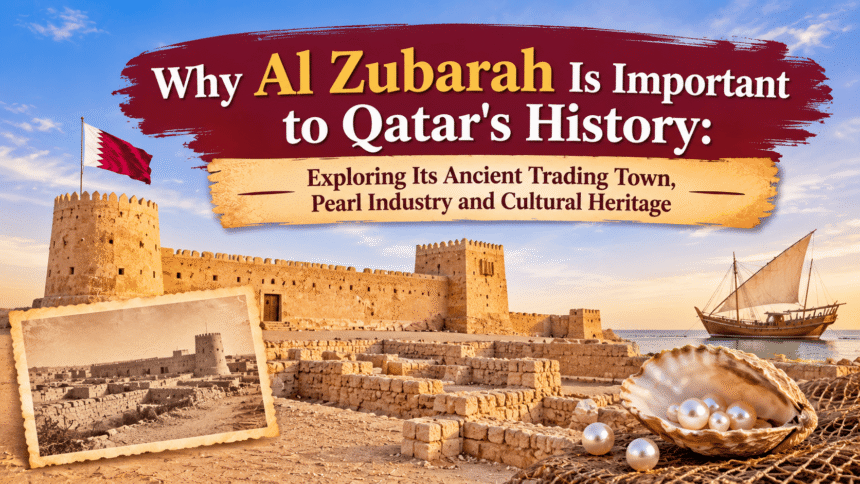
Why Al Zubarah Is Important Historical Site in Qatar
Al Zubarah is one of the most important historical destinations in Qatar. Located on the country’s northwestern coast, approximately 100 kilometres from Doha, this archaeological site preserves the remains of an old coastal town that once played an important role in the Arabian Gulf’s trading and pearl-diving industries.
- 1. Where Is Al Zubarah Located in Qatar?
- 2. How Al Zubarah Developed into a Trading Town
- 3. The Importance of Pearl Diving in Al Zubarah’s History
- 4. Al Zubarah’s Connection with International Trade
- 5. Traditional Houses and the Architecture of Old Al Zubarah
- 6. Old Mosques and Religious Life in the Town
- 7. The Old Market and Date-Syrup Production
- 8. The Defensive Walls and Fortified Structures of Al Zubarah
- 9. Why Al Zubarah Was Destroyed in 1811
- 10. Al Zubarah Fort: A Separate Landmark from the Ancient Town
- 11. How Al Zubarah Was Discovered and Studied by Archaeologists
- 12. Why UNESCO Recognised Al Zubarah as a World Heritage Site
- 13. Visiting Al Zubarah Today: What Can Travellers Explore?
- 14. Why Al Zubarah Is Important for Qatar’s Cultural Identity
- Conclusion
- Frequently Asked Questions (FAQs)
The town developed during the middle of the 18th century and became a successful centre for merchants, sailors, pearl divers and local communities. Traders connected Al Zubarah with different parts of Arabia, the Indian Ocean and Western Asia. Its location near the sea made it suitable for fishing, maritime trade and the movement of valuable goods.
Today, visitors can explore the remains of old buildings, mosques, streets, defensive walls and other structures. These discoveries provide an interesting picture of life in Qatar before the development of its modern cities.
Al Zubarah was added to UNESCO’s World Heritage List in 2013. It is an important reminder of Qatar’s trading history, traditional architecture and cultural development.
Let’s discover why Al Zubarah is important historical site in Qatar and explore the stories behind its fascinating past.
1. Where Is Al Zubarah Located in Qatar?
Al Zubarah is situated in Madinat Ash Shamal Municipality in the northwestern part of Qatar. It lies near the country’s coastline, overlooking the Arabian Gulf.
Its coastal location was one of the main reasons the settlement developed into an important trading town. During the 18th and 19th centuries, sea routes connected different parts of the Arabian Peninsula with the Indian Ocean and other trading regions.
The surrounding landscape is mostly dry, with open sandy areas and a relatively flat coastal environment. Although the town is now a quiet archaeological destination, its original location provided access to fishing grounds, maritime routes and inland settlements.
The historic archaeological area covers around 60 hectares and extends approximately 2.5 kilometres between Al Zubarah Fort and the coast. The wider site includes the remains of the old town and nearby historical structures.
Its location also helps visitors understand how traditional settlements developed along the Gulf. People needed access to the sea for trade and fishing, while inland connections provided other supplies and resources.
2. How Al Zubarah Developed into a Trading Town
Al Zubarah began developing as a settlement during the middle of the 18th century. According to UNESCO, it was founded by merchants from the Utub tribal group who came from Kuwait.
The town grew during a period when maritime trade and pearl diving were important parts of the Arabian Gulf economy.
Merchants recognised the advantages of its coastal location and began developing businesses connected with trading and fishing. As more people arrived, the settlement expanded with houses, markets, mosques and other important buildings.
The town became particularly successful during the late 18th century. Its commercial activities attracted traders from nearby settlements and distant markets.
Al Zubarah was not simply a fishing village. It developed into a planned and fortified coastal settlement with residential areas, commercial spaces and defensive structures.
Its growth also attracted the attention of regional powers because of its economic importance and strategic position. This made Al Zubarah an important part of the political and commercial history of the Gulf.
3. The Importance of Pearl Diving in Al Zubarah’s History
One of the biggest reasons behind Al Zubarah’s success was the traditional pearl industry.
Pearl diving played a major role in Al Zubarah’s growth during the late 18th century. It helped turn the small coastal settlement into one of the busiest and wealthiest trading ports in the Arabian Gulf.
In the mid-1700s, Utub merchants moved from Kuwait to the northwest coast of Qatar to find rich oyster beds and avoid regional taxes.
Before the development of the oil and gas industry, pearl diving supported many coastal communities across the Arabian Gulf. Natural pearls were valuable products that were traded in regional and international markets.
Pearl divers travelled into the sea during the diving season and searched for oysters on the seabed. They often worked with small wooden boats called dhows, using traditional tools and techniques.
The work was difficult and required physical strength, experience and courage. Divers had to hold their breath underwater while collecting oysters, often repeating the process many times in a single day.
Al Zubarah benefited from this industry because it became an important place for merchants involved in the pearl trade.
Pearls collected from nearby waters could be brought to the town, sorted, purchased and transported to other markets. This created business opportunities for traders, boat owners, sailors and other workers.
Archaeological discoveries, including pearl-diving weights and imported objects, help researchers understand the economic importance of this industry.
The remains of Al Zubarah therefore provide valuable evidence of the traditional pearl economy that once supported coastal communities throughout the Gulf.
4. Al Zubarah’s Connection with International Trade
Although pearl diving was a major part of its economy, Al Zubarah was also connected with wider trading networks.
Merchants used the town’s coastal location to exchange goods with different regions. According to UNESCO, Al Zubarah had trading links with Arabia, Western Asia and the Indian Ocean.
These connections brought different products, materials and cultural influences into the town.
Imported ceramics discovered during archaeological excavations provide evidence of these commercial relationships. Other findings suggest that people used the settlement to store, produce and exchange goods.
Trade was important because it helped the town grow beyond its local economy. Merchants could sell valuable products, purchase supplies and build relationships with traders from other areas.
Al Zubarah’s trading connections included:
- Pearls: One of the most valuable products exported from the town.
- Food supplies: Products needed by local families, workers and travelling merchants.
- Ceramics: Imported pottery and household objects discovered during excavations.
- Dates and date products: Traditional agricultural goods used for food and trade.
- Other commercial goods: Materials and products exchanged through regional maritime routes.
These activities show that Al Zubarah was part of a much wider economic network during its most successful years.
5. Traditional Houses and the Architecture of Old Al Zubarah
One of the most interesting parts of the archaeological site is its traditional architecture.
The remains of houses reveal how families lived during the 18th and 19th centuries. Many buildings were arranged around central courtyards, creating private outdoor spaces within the home.
Courtyard houses were useful in the hot climate of the Arabian Gulf. They provided shade, improved privacy and allowed families to organise different household activities around a central area.
The remains also show that homes were not all identical. Some were larger and more complex, while others were simpler structures.
The archaeological area contains evidence of residential buildings, large fortified houses and palatial structures.
Some important architectural features include:
- Central courtyards: Open spaces inside homes that supported household activities.
- Thick walls: Helped protect interiors from heat and provided strong building structures.
- Small openings: Used for ventilation and limiting direct sunlight.
- Traditional building materials: Stone, rubble and mortar were among the materials used.
- Narrow streets: Connected houses, shops and public buildings across the settlement.
These buildings help historians understand how people adapted their homes to the local environment.
6. Old Mosques and Religious Life in the Town
Religion played an important role in the daily lives of Al Zubarah’s residents.
Archaeological research has identified several mosque remains within the town. These structures show how public religious spaces were included in the settlement’s layout.
Instead of building one large mosque, people built several small and medium-sized mosques across the town. They were placed near homes, the harbour, and the main market so merchants, sailors, and local people could easily attend their five daily prayers.
Mosques were important places for prayer and community gatherings. They also helped create shared spaces where residents could meet regularly.
The remains of these buildings provide information about the religious traditions and architectural styles used in the town.
Their presence also shows that Al Zubarah was a developed settlement with different facilities for residential, commercial and religious activities.
Today, the mosque remains are valuable archaeological evidence of everyday community life in historic Qatar.
7. The Old Market and Date-Syrup Production
Al Zubarah was not only a pearl-trading town. It also had important activities connected with food production and local commerce.
One of the most interesting discoveries is the concentration of traditional date presses, locally known as madabis. These structures were used to produce date syrup, commonly called dibs.
Dates were an important food product in the Arabian Gulf. They could be eaten fresh or dried, stored for later use and processed into other products.
In traditional date presses, dates were placed in prepared spaces where their natural syrup could be collected.
Archaeological excavations in Al Zubarah have revealed more than 60 date presses. They were arranged in rows along a main street in the area identified as the old suq.
This discovery suggests that date-syrup production was carried out on a considerable scale rather than being limited to individual households.
The presses provide useful information about the town’s food production, commercial activities and urban planning. They also show that agriculture and trade were connected in the daily life of the settlement.
Today, these remains are among the most interesting archaeological features of Al Zubarah. They help explain how people used local resources to support their economy.
8. The Defensive Walls and Fortified Structures of Al Zubarah
Al Zubarah was a successful trading town, but its wealth and location also made it vulnerable to attacks.
For protection, the settlement had defensive structures, including walls, fortified buildings and other security features.
The archaeological remains show that the town had double defensive walls in some areas. These structures helped protect the settlement and controlled access to important sections.
Fortified houses and large buildings also formed part of the town’s defensive character.
Another important site nearby is Qal’at Murair. This fortified settlement was connected with the management and protection of water supplies in the surrounding area.
Water was essential for survival in the dry landscape. Controlling and protecting local water resources was therefore important for residents and traders.
The remains of these defensive structures show that Al Zubarah was planned with both commercial success and security in mind.
9. Why Al Zubarah Was Destroyed in 1811
Al Zubarah enjoyed a period of prosperity, but its success did not last forever.
In 1811, the town was attacked and largely destroyed by forces loyal to the Sultan of Muscat. The destruction brought a major change to the settlement and affected its commercial importance.
Some activity continued in the wider area after the attack, but Al Zubarah never returned to the same level of economic success it had experienced during its most prosperous period.
By the early 20th century, the town had been abandoned.
Over time, many of its buildings collapsed and were gradually covered by sand carried by the wind.
Ironically, this natural process helped preserve important parts of the old settlement. The sand covered the remains of houses, streets and other structures, protecting some archaeological evidence from later development.
This is one of the reasons why Al Zubarah is so valuable to researchers today. Unlike many historic towns that were replaced by modern buildings, much of its original layout remains visible in the archaeological landscape.
10. Al Zubarah Fort: A Separate Landmark from the Ancient Town
One important detail about Al Zubarah is that the famous fort standing at the site is not as old as the original trading town.
Al Zubarah Fort was built in 1938, more than a century after the town was largely destroyed.
It is a traditional Qatari fort with thick walls, corner towers and small openings. Its design reflects the defensive architecture commonly found in the region.
The fort was built during the early modern period and later became an important heritage landmark associated with Al Zubarah.
Visitors often begin their exploration of the archaeological area at the fort before discovering the remains of the older town.
The fort helps complete the story of the site by showing a later stage in Qatar’s history, while the town ruins represent the earlier pearl-trading period.
It is important to understand that the 18th-century settlement, Qal’at Murair and the 1938 fort are different historical elements within the wider archaeological landscape.
11. How Al Zubarah Was Discovered and Studied by Archaeologists
The archaeological importance of Al Zubarah became clearer through research and excavation.
The site was investigated by archaeologists during different periods, including early excavations in the 1980s and further research from the early 2000s onwards.
Qatar Museums and international research teams have studied different parts of the settlement to understand how people lived, traded and organised their communities.
Excavations have uncovered:
- Residential houses and courtyards.
- Mosques and other religious structures.
- Market areas and production spaces.
- Date presses used to produce date syrup.
- Defensive walls and fortified buildings.
- Imported ceramics and other trade objects.
- Wells and structures connected with water management.
- Harbour-related remains and coastal features.
These findings help researchers build a clearer picture of the town’s economic and social life.
Another important feature is that only a relatively small part of the settlement has been excavated. Much of the archaeological landscape remains protected beneath the sand.
This means that Al Zubarah still offers opportunities for future research and new discoveries.
12. Why UNESCO Recognised Al Zubarah as a World Heritage Site
Al Zubarah received international recognition when UNESCO added it to the World Heritage List in 2013.
It was recognised for its importance in showing the development of the Gulf’s pearl-diving and trading towns during the 18th and 19th centuries.
UNESCO highlighted three important areas of value:
Cultural tradition: The town provides outstanding evidence of the traditional pearl-diving and merchant economy that supported coastal communities across the Gulf.
Historical architecture: Its remains show how fortified coastal settlements developed during a period of important political and economic change.
Human relationship with the environment: Archaeological discoveries show how residents depended on the sea, desert, local water resources and agricultural activities.
Al Zubarah is especially valuable because its old town layout has remained relatively well preserved. The abandoned settlement allows researchers to study a traditional Gulf town that was not completely replaced by modern construction.
Its World Heritage recognition also highlights the importance of preserving the archaeological remains for future generations.
13. Visiting Al Zubarah Today: What Can Travellers Explore?
Today, Al Zubarah is one of Qatar’s most important heritage destinations. It offers visitors an opportunity to explore the country’s older history away from the modern buildings of Doha.
The site is located around 100 kilometres northwest of the capital and can be reached by car or taxi.
Visitors can explore several interesting features:
- Al Zubarah Fort: A traditional fort built in 1938 and one of the most visible landmarks in the area.
- Old town remains: Archaeological foundations of houses, streets and other buildings.
- Traditional mosques: Remains that provide information about religious life.
- Date presses: Structures used for producing date syrup.
- Defensive walls: Evidence of the settlement’s efforts to protect itself.
- Coastal surroundings: The landscape that supported fishing, pearl diving and trading activities.
Qatar Museums provides visitor information, ticket details and access arrangements for the archaeological site. It is advisable to check the official website before travelling because visitor facilities and opening arrangements can change.
Visitors should also avoid touching archaeological remains, climbing on old walls or removing objects from the site.
14. Why Al Zubarah Is Important for Qatar’s Cultural Identity
Al Zubarah is important because it connects modern Qatar with the lives of people who lived and worked along the coast more than 200 years ago.
The site tells stories about merchants, pearl divers, fishermen, craftspeople and families who helped develop the town.
It also reminds visitors that Qatar’s history did not begin with the discovery of oil and gas. Long before that transformation, coastal trade, pearl diving and local industries supported communities and helped shape the region’s development.
The town also highlights Qatar’s connections with neighbouring Gulf communities and international trade routes.
For younger generations, Al Zubarah is an opportunity to learn about traditional architecture, food production, trade and the importance of preserving cultural heritage.
Its archaeological remains provide a direct connection with the country’s past that cannot be fully understood through books or photographs alone.
Conclusion
Al Zubarah is an important historical site in Qatar because it preserves the story of a once-thriving pearl-diving and trading town. Its houses, mosques, markets, defensive walls, date presses and coastal remains provide valuable information about life in the Arabian Gulf during the 18th and 19th centuries.
The town’s destruction in 1811 and its later abandonment helped preserve much of its original layout beneath desert sands. Archaeological research has since uncovered important evidence of its commercial activities, architecture and relationship with the sea.
Its recognition as a UNESCO World Heritage Site in 2013 highlights its importance not only for Qatar but also for the wider history of the Arabian Gulf.
Today, Al Zubarah remains a powerful reminder of Qatar’s cultural roots. Protecting its archaeological remains helps future generations understand the people, traditions and trading activities that shaped the country before the modern era.
Frequently Asked Questions (FAQs)
1. Why is Al Zubarah is important historical site in Qatar?
Al Zubarah is important because it preserves the remains of an 18th- and 19th-century pearl-trading town. Its archaeological remains reveal the region’s traditional economy, architecture and coastal lifestyle.
2. Where is Al Zubarah located in Qatar?
Al Zubarah is located in Madinat Ash Shamal Municipality on the northwestern coast of Qatar, approximately 100 kilometres from Doha.
3. When was Al Zubarah founded?
The town developed during the middle of the 18th century and became an important trading and pearling centre during the late 18th and early 19th centuries.
4. Why was Al Zubarah famous in the past?
Al Zubarah was famous for pearl diving, maritime trade, date-syrup production and its role as a commercial centre connecting different parts of the Arabian Gulf with wider trading regions.
5. What happened to Al Zubarah in 1811?
In 1811, the town was attacked and largely destroyed by forces loyal to the Sultan of Muscat. It was gradually abandoned and eventually fell into ruin.
6. When did Al Zubarah become a UNESCO World Heritage Site?
Al Zubarah Archaeological Site was officially added to UNESCO’s World Heritage List in 2013.
7. When was Al Zubarah Fort built?
Al Zubarah Fort was built in 1938. It is a later landmark and should not be confused with the remains of the original 18th-century town.
8. What can visitors see at Al Zubarah today?
Visitors can explore Al Zubarah Fort, archaeological remains of houses, mosques, streets, date presses, defensive walls and other historic structures.
Do follow us on Instagram
Read More – The Story Behind Qatar Famous Souq Waqif