


Turns Identity Into Powerful Contemporary Art
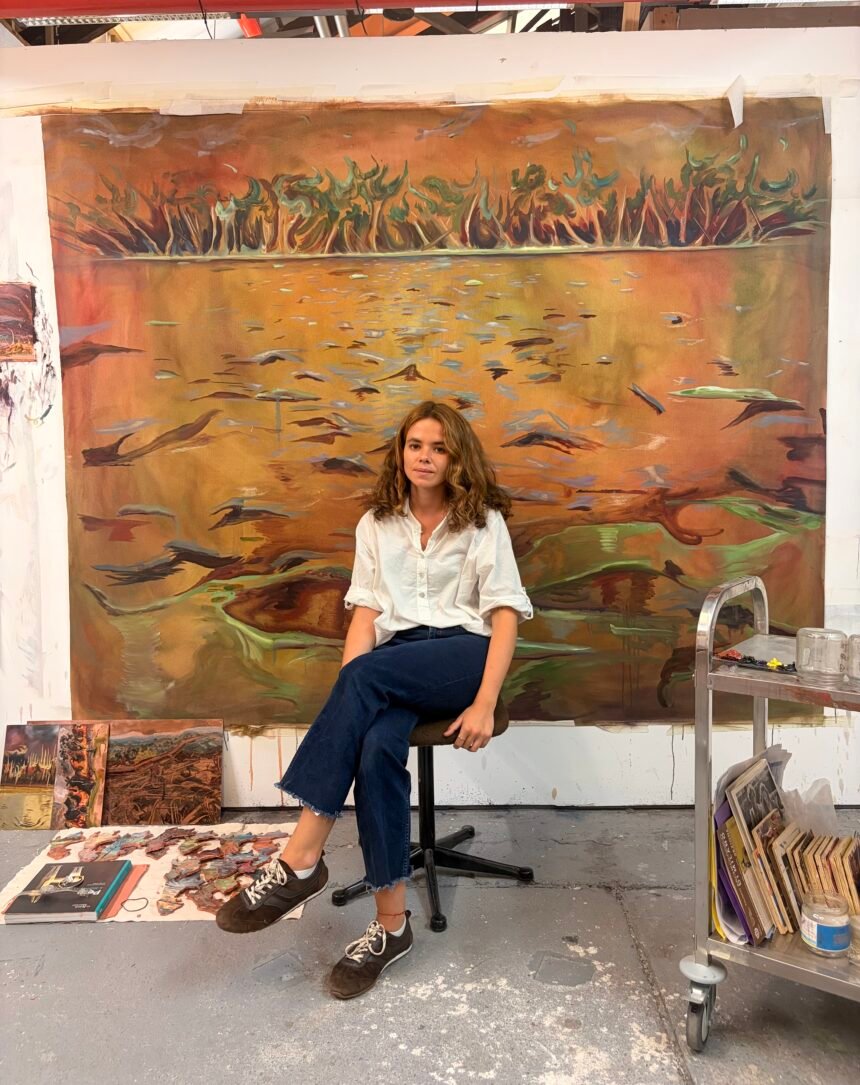
For Alessandra Risi, painting is more than an image placed on a surface. It is a way of communicating, remembering and questioning the experiences that shape a person. Born and raised in Lima, Peru, Alessandra has developed an artistic practice that brings together identity, family archives, cultural memory, scientific research and material experimentation.
Her journey has taken her from Lima to Milan and London, allowing different cultural environments to become part of the way she sees and creates. Rather than treating identity as something fixed, Alessandra explores it as something constantly changing. Her Peruvian and Italian connections appear throughout her work, not as simple references, but as experiences that have been absorbed and transformed through her artistic language.
Today, her paintings and installations are finding an increasingly international audience, with exhibitions and presentations across different cities and art spaces. Her recent activity in London and Mexico in 2026 reflects the continuing development of a practice that refuses to remain within one definition of painting.
A Journey Shaped By Three Creative Cities
Alessandra’s artistic education began in Lima, where she studied at Corriente Alterna between 2016 and 2018. She later moved to Italy and continued her education at Nuova Accademia di Belle Arti Milano, completing her diploma between 2019 and 2021.
London became another important chapter in her development. She completed her studies in Painting at the Royal College of Art between 2024 and 2025, placing her practice within an international environment where painting can be examined through material, conceptual and cultural perspectives.
The experience of moving between countries has become an important part of her creative identity. Each place has contributed something different to the way she understands history, belonging and visual language.
Instead of separating these influences, Alessandra allows them to exist together. Her work becomes a space where different memories, territories and references can meet.
When Archives Become Artistic Material
One of the most distinctive aspects of Alessandra’s practice is the way she approaches archives. Her research has included personal and family collections, stamps, Italian botanical books from the twentieth century and material gathered through scientific research trips.
These objects are not simply sources of inspiration. They become starting points for transformation.
A stamp, botanical image or scientific reference can carry information about a particular time, place or system. Alessandra takes these familiar forms and moves them into another context, allowing their meaning to change.
This process gives her paintings a layered quality. What may initially appear abstract can contain traces of something historical, personal or recognisable. Her work encourages viewers to look beyond the immediate surface and consider what may be hidden underneath.
For Alessandra, the archive is not necessarily a complete record of the past. It can also be fragmented, selective and open to reinterpretation.
That idea sits at the centre of her creative journey.
Painting Beyond The Traditional Canvas
Although painting remains central to Alessandra’s practice, she does not limit herself to conventional materials. Copper, ceramics, matchboxes, light boxes and canvas all become part of her visual vocabulary.
This experimentation allows her work to move between painting and installation.
Many of her pieces are presented without traditional frames, creating a direct relationship between the artwork and the surrounding space. The absence of a frame gives the paintings a sense of movement and openness, allowing their textures and forms to interact with the environment.
The result is a practice that feels both intimate and physical.
Her expressive brushstrokes move between figurative and abstract forms, creating a visual language where body, landscape and memory can overlap. The materials themselves contribute to this experience, giving the work different textures and layers of depth.
A useful way to understand her approach is through the idea that art does not simply preserve memory; it can transform the way memory is experienced.
That transformation is visible throughout Alessandra’s work.
A Dialogue Between Peru And Italy
Alessandra’s Peruvian and Italian identities are not presented as separate chapters. They are intertwined throughout her artistic process.
Growing up in Lima and later developing her education and practice in Italy and the United Kingdom gave her a perspective shaped by movement between cultures.
This experience can be seen in the way she approaches nature, history, archives and personal memory. Italian botanical books, for example, can become part of a much broader conversation about territory, knowledge and cultural exchange.
Her work does not simply illustrate these subjects. Instead, it allows them to become part of an emotional and material process.
The tension between different places and experiences creates an important energy within her paintings. There is a sense of intimacy, but also a feeling of distance. There is familiarity, but also uncertainty.
This balance gives her work its distinctive character.
An International Exhibition Journey
Alessandra’s artistic development has been accompanied by an expanding exhibition history. Her work has appeared in international contexts including Art Basel Miami, South Korea and Revolver Galeria in Lima.
In 2025, her work was presented through exhibitions and group shows in London, Madrid, Lima and Brescia, including appearances connected with Mucciaccia Gallery, Somerset House and MO.CA Brescia.
Her momentum continued in 2026.
At General Assembly London, Alessandra participated in Reassemblage, a group exhibition presented by General Assembly and Teaspoon Projects. The exhibition brought together artists exploring how landscapes and materials can hold memory, history and cultural experience. Alessandra’s practice fitted naturally into this conversation through her use of archives, botanical references, stamps and materials such as copper and ceramics.
She also participated in Salon Acme in Mexico City in February 2026, adding another international chapter to a career that continues to develop across borders. Her current exhibition history demonstrates how her practice is increasingly entering conversations around contemporary painting, materiality and cultural identity.
Alessandra Risi Building A Language That Belongs To Her
What makes Alessandra’s journey particularly compelling is that her work does not appear to follow a single formula.
Instead, she continues to investigate.
She researches, collects, observes and transforms. A family archive can become a visual reference. A botanical book can lead to questions about territory. A piece of copper can become part of a painting. An unframed canvas can change the relationship between artwork and space.
Every element can carry another layer of meaning.
This approach reflects an artist who understands that contemporary painting can exist far beyond traditional boundaries. It can communicate through objects, textures, gestures, spaces and memories.
For Alessandra, the creative process appears to be as important as the final image. The journey from research to material, from material to painting and from painting to installation creates a continuous process of transformation.
The Future Of Alessandra’s Artistic Journey
At a relatively early stage of her career, Alessandra has already built an international trajectory connecting Latin America, Europe and the wider contemporary art world.
Her education in Lima, Milan and London has provided different foundations, but her artistic identity has developed through the connections between them.
As her work continues to evolve, her exploration of identity, archives, cultural memory and material transformation offers a strong foundation for future projects and exhibitions.
Alessandra’s journey is ultimately about more than creating paintings. It is about discovering how personal history can move through materials and become something new.
Her work reminds viewers that identity does not have to be explained in a single image or contained within a fixed definition. It can remain fluid, layered and unfinished.
Through painting and installation, Alessandra continues to turn that uncertainty into a visual language of her own.
And perhaps that is what makes her artistic journey so engaging: she is not simply looking at where she comes from. She is continually transforming it into where her art can go next.
Follow Alessandra Risi on Instagram
Read More – Nicole Rodrigues Builds A Powerful Dubai Business Legacy