


Transforms Arabic Calligraphy Into Striking Modern Sculpture
For Saudi artist Ali AlHamoud, professionally known as Alif, creativity did not begin inside a traditional sculpture studio. It began with Arabic letters, public walls and a fascination with the emotional power of calligraphy. Over time, those written forms moved away from flat surfaces and became objects that could be held, carved and eventually experienced at an architectural scale.
- Tarout Island Remains at the Heart of Alif’s Story
- A Wooden Spoon Changed His Creative Direction
- When Arabic Words Became Physical Forms
- Leaving a Seventeen Year Career for Art
- Ali AlHamoud Builds Recognition Through Wood, Stone and Calligraphy
- Out of Black Marks a New Chapter
- Spirituality Gives His Sculptures a Deeper Meaning
- Alif Is Bringing Calligraphy Into Everyday Life
- Following the Path That Feels True
Born in 1986 and based on Tarout Island in Saudi Arabia, Alif has developed an artistic identity rooted in Arabic calligraphy while constantly questioning what a letter can become. Working mainly with wood and stone, his sculptures explore humanity, spirituality, emotion and the connection between people and the Divine.
His journey is also a story of reinvention. Before becoming a full time artist, Alif spent around seventeen years building a career in the energy sector. Art remained part of his life, but eventually a simple wooden spoon would change his direction completely.
Tarout Island Remains at the Heart of Alif’s Story
Tarout Island is more than the place where Alif was born and continues to live and work. It is part of the visual and emotional foundation behind his practice. Surrounded by a region with a deep cultural history, he developed an early relationship with Arabic language, form and identity.
Alif studied English Linguistics and Translation at King Khalid University before entering the energy sector. His professional life initially appeared far removed from galleries and sculpture studios, yet the discipline developed during those years later became valuable to his artistic practice.
His first major public steps as an artist came through graffiti and calligraphy. In 2014, his work began appearing publicly, giving him an opportunity to explore Arabic lettering on a much larger scale.
What began on walls would eventually move into wood, granite and three dimensional forms.
A Wooden Spoon Changed His Creative Direction
The turning point in Alif’s career did not begin with a major commission or exhibition. It began in an unexpectedly ordinary way.
Alif has always enjoyed cooking for people close to him. During a stressful period at work, he felt an urge to carve a wooden spoon. He was not trying to create a career changing artwork. He simply wanted to make something with his hands.
That first spoon became far more important than he could have expected.
He continued carving. Each new piece became smoother and more considered. Curves became more deliberate, proportions became more refined and the process began to feel increasingly artistic.
Then Alif introduced Arabic calligraphy into the objects.
Suddenly, two creative worlds connected. The written word was no longer simply placed on a surface. It became part of the object itself.
For Alif, that wooden spoon remains one of his most meaningful creations. It may be small compared with the large sculptures that followed, but it represents the moment when his artistic language began changing.
When Arabic Words Became Physical Forms
After experimenting with smaller carved pieces, Alif began creating works inspired by words connected with love and its different meanings. These early objects allowed him to explore how emotion could be communicated not only through the meaning of a word but through its physical shape.
His ideas quickly became more ambitious.
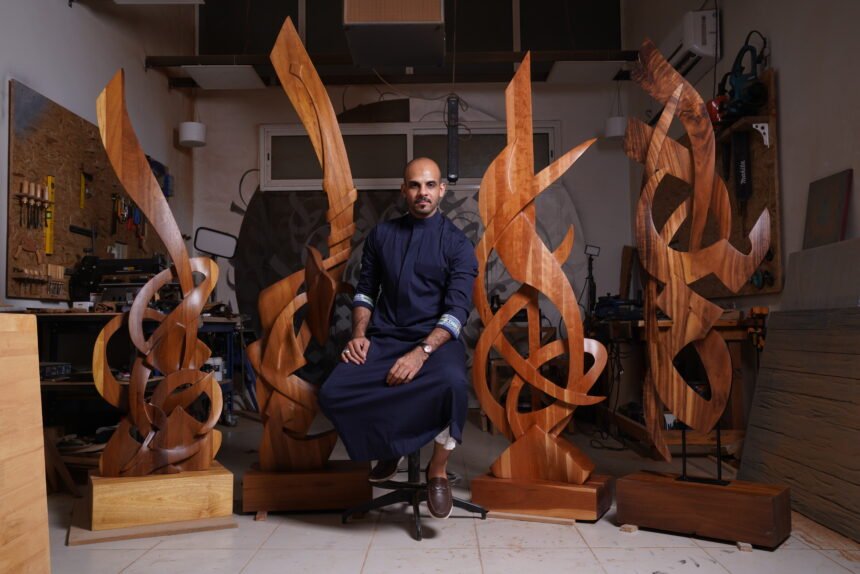
After producing several smaller works, Alif made the leap into a wooden sculpture measuring around two metres. The change in scale opened an entirely different creative direction. What had started with a spoon was developing into a serious sculptural practice.
A studio followed, along with new materials, larger projects and increasing attention to the relationship between calligraphy and three dimensional design.
The Arabic letter became something people could move around rather than simply read.
This idea continues to define much of Alif’s work today.
Leaving a Seventeen Year Career for Art
Changing careers after nearly two decades is rarely simple. By the time Alif committed himself fully to art, he had already spent around seventeen years working in the energy sector.
Instead of viewing those years as separate from his artistic story, he sees them as part of it.
One of the most valuable lessons he has taken from his journey is that changing direction does not erase the road that came before. Previous experiences can leave behind discipline, perspective, confidence and courage that later become useful in unexpected ways.
That philosophy reflects his own transition. The structured professional world of the energy industry and the freedom of artistic creation may appear completely different, yet both contributed to the person and artist he became.
His journey offers a reminder that reinvention does not always require starting from nothing. Sometimes it means carrying everything you have learned into a new direction.
Ali AlHamoud Builds Recognition Through Wood, Stone and Calligraphy
As his practice evolved, Alif began appearing across important Saudi and regional cultural platforms.
His work has been presented through exhibitions and programmes connected with institutions including Ithra, Riyadh Art and other contemporary art platforms. His sculptural development also led him toward granite and larger public artworks, expanding his practice beyond the intimacy of hand carved wooden pieces.
Participation in the Tuwaiq Sculpture Symposium in Riyadh further demonstrated that evolution. Working with monumental material challenged Alif to translate the fluidity of Arabic letters into stone while preserving their emotion and movement.
His artistic journey has also reached audiences beyond Saudi Arabia through exhibitions and creative programmes in cities including Dubai, Doha and Paris.
Yet even as his geographical reach grows, his artistic language remains closely connected to Arabic calligraphy.
Out of Black Marks a New Chapter
In 2026, Alif presented his solo exhibition Out of Black at Katara Art Center in Doha. The exhibition became an important moment in a period when his life was increasingly centred around art.
For an artist whose career began publicly through graffiti and who later discovered sculpture almost by accident, reaching a solo exhibition on a major regional cultural platform reflected years of experimentation and persistence.
His growth has not followed a perfectly planned path. Instead, one discovery has repeatedly opened the door to another.
Graffiti led toward a deeper exploration of calligraphy. Calligraphy entered carved wooden objects. Those objects expanded into sculpture. Sculpture grew into large scale works and international artistic opportunities.
The process has been gradual, but the direction has become increasingly clear.
Spirituality Gives His Sculptures a Deeper Meaning
Alif’s work is not simply concerned with making Arabic letters visually attractive. At the centre of his practice is an interest in humanity’s relationship with the Divine and the emotions that connect people.
This gives his sculptures a reflective quality. Wood grain, carved curves, stone surfaces and Arabic forms become ways of exploring ideas that can be difficult to communicate through ordinary language.
A thought that closely reflects his artistic philosophy is simple.
“What comes from the heart finds its way to the heart.”
For Alif, meaningful art does not need to become complicated simply to appear important. Its strength can come from sincerity, intention and the emotional connection created between an object and the person experiencing it.
Alif Is Bringing Calligraphy Into Everyday Life
Alif’s current direction pushes his practice beyond traditional sculpture once again.
He is developing a series of sculptural design objects scheduled to be introduced gradually from the end of 2026 into early 2027. The collection explores how the spirit of Arabic calligraphy can move beyond writing and become part of functional objects used in everyday environments.
It is a natural continuation of the idea that began with his first wooden spoon.
The difference is that Alif now approaches the relationship between function, sculpture and calligraphy with years of artistic experience behind him. These new pieces are intended to bring art, meaning and a feeling of connection into daily life rather than separating art from ordinary human experience.
Following the Path That Feels True
Alif’s journey carries a message that extends beyond the art world.
A career can change. An unexpected experiment can become a calling. A small object created during a stressful moment can completely redirect a life.
His story also challenges the idea that success must follow one predictable route. Alif moved from language studies to the energy industry, from graffiti to carving, from wooden spoons to monumental sculpture, and from Tarout Island to exhibitions and artistic platforms across the region and beyond.
Through every transition, Arabic calligraphy has remained the thread connecting his work.
His advice reflects that same simplicity.
“Follow your heart. It knows the path.”
For Alif, following that path transformed a spontaneous moment of carving into an entirely new life in art. Today, each letter he shapes in wood or stone carries part of that journey forward.
Follow Alif on Instagram
Read More – Dr Ahmed Hweidi Builds A Powerful Career In Plastic Surgery