

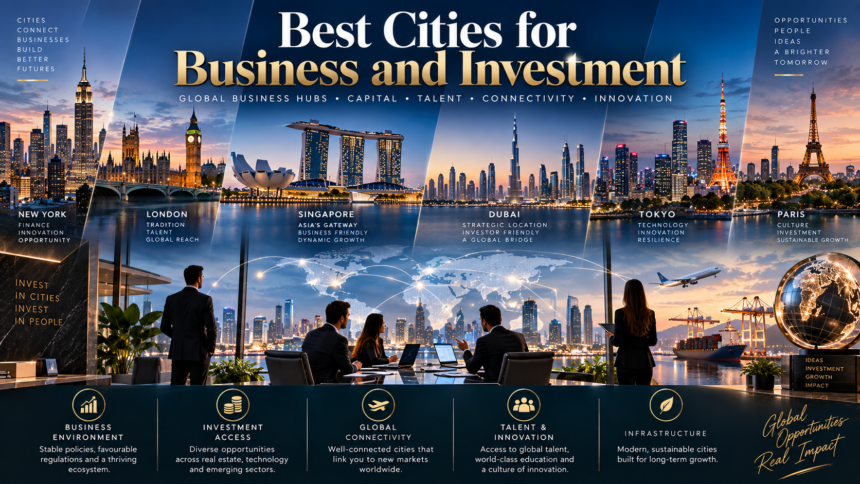
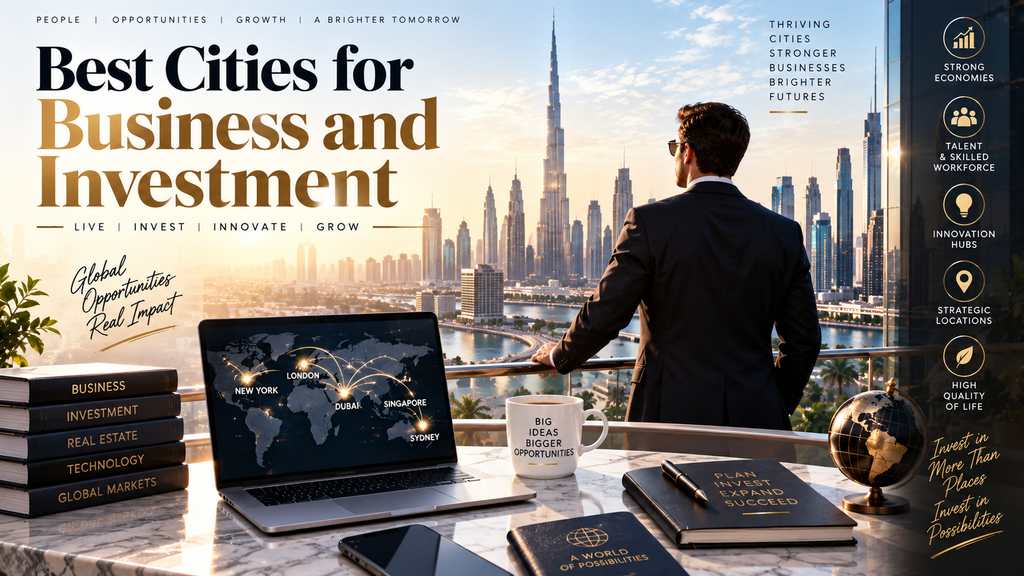
Best Cities for Business and Investment in 2026 including Dubai, London, New York and Singapore
Choosing where to start a company, establish an international headquarters or deploy investment capital has become more complicated. The largest economy is not automatically the easiest place to operate, the fastest-growing city may carry higher risks, and an excellent startup ecosystem may not be the right location for manufacturing, logistics or asset management.
- Best Cities for Business and Investment at a Glance
- What Makes the Best Cities for Business and Investment Stand Out?
- 1. New York: Scale Makes It Difficult to Ignore
- 2. London: One of the Most International Business Platforms
- 3. Singapore: A Gateway to Southeast Asia
- 4. Dubai: One of the Best Cities for Business and Investment in the Gulf
- 5. San Francisco: The Global Startup Capital
- 6. Paris: A Large European Market With Strong Human Capital
- 7. Tokyo: Scale, Manufacturing and Deep Technology
- 8. Dublin: A Strategic European Base for Global Companies
- 9. Abu Dhabi: A Fast-Growing Capital for Capital
- 10. Riyadh: One of the Fastest-Rising Business Centres
- Comparing the Best Cities for Business and Investment
- Best Cities for Business and Investment for Startups
- Best Cities for Business and Investment in the Middle East
- Established Cities vs Fast-Growing Business Hubs
- Major Risks to Consider Before Choosing a City
- How to Choose Between the Best Cities for Business and Investment
- Frequently Asked Questions About the Best Cities for Business and Investment
- Final Thoughts on the Best Cities for Business and Investment
The Best Cities for Business and Investment in 2026 therefore succeed for different reasons. New York offers unmatched economic scale and access to capital. London combines finance, international talent and connectivity. Singapore provides a strategic gateway into Southeast Asia, while Dubai continues to attract exceptionally high levels of greenfield foreign direct investment. San Francisco remains a global startup powerhouse, while Abu Dhabi and Riyadh are rapidly expanding their roles in international finance and regional headquarters.
The latest Oxford Economics Global Cities Index 2026 provides a useful starting point. It assesses 1,000 cities using economics, human capital, quality of life, environment and governance. New York ranks first overall, followed by London and Paris, while cities including San Francisco, Dublin and Tokyo also appear in the global top 10. Dubai and Riyadh entered Oxford Economics’ top 50 for the first time in 2026.
However, no single ranking can identify the perfect city for every investor. StartupBlink places San Francisco first in the world for startups, while Singapore is one of Asia’s leading headquarters destinations and Dubai has ranked first globally for new greenfield FDI projects for five consecutive years. The right choice therefore depends on the business model, target customers, capital requirements and region you want to access.
Best Cities for Business and Investment at a Glance
The following cities stand out across a combination of economic scale, investment activity, startup strength, finance, international connectivity and access to regional markets. They should not be read as a one-size-fits-all ranking because each performs differently depending on what an investor needs.
| City | Major Strength | Particularly Relevant For |
|---|---|---|
| New York | Economic scale and capital | Finance, media, technology, professional services |
| London | International finance and talent | Global HQs, fintech, investment management |
| Singapore | Asian headquarters platform | ASEAN expansion, manufacturing, technology |
| Dubai | FDI and global connectivity | Regional HQs, trade, logistics, technology |
| San Francisco | Startup and venture ecosystem | AI, software, deep technology |
| Paris | Large European economy and talent | Technology, luxury, finance, corporate expansion |
| Tokyo | Huge market and corporate ecosystem | Finance, deep tech, manufacturing |
| Dublin | European multinational base | Technology, fintech, life sciences |
| Abu Dhabi | Asset management and institutional capital | Finance, funds, AI, private capital |
| Riyadh | Rapid expansion and regional HQ growth | Saudi market access, infrastructure, finance |
The strongest city for one business may be a poor choice for another. A venture-backed artificial-intelligence startup may value San Francisco’s access to capital and specialist talent, while a company building operations across Southeast Asia may find Singapore much more practical.
The same principle applies in the Gulf. Dubai offers an internationally connected commercial ecosystem, Abu Dhabi is building a powerful asset-management and investment platform, while Riyadh provides direct access to Saudi Arabia’s large domestic transformation and infrastructure pipeline.
What Makes the Best Cities for Business and Investment Stand Out?
A major business centre needs more than skyscrapers and office towers. Investors usually look for a combination of market size, capital, talent, infrastructure, predictable institutions, customers and the ability to expand into surrounding markets.
Oxford Economics’ 2026 methodology illustrates this broader approach. Its economic category includes GDP size, GDP growth, economic stability, GDP per capita, employment growth and economic diversity rather than simply measuring which city has the largest economy.
Startup investors may weigh completely different factors. Access to venture capital, founders, universities and technology talent matter more, which helps explain why StartupBlink continues to place San Francisco far ahead of other startup ecosystems in 2026.
A practical investor should therefore evaluate several dimensions together:
- Size and growth of the addressable market
- Availability of skilled workers and specialist talent
- Access to investment capital and banking
- Business setup and regulatory environment
- International airport and logistics connectivity
- Local and regional customer access
- Strength of the startup and innovation ecosystem
- Cost of offices, salaries and housing
- Tax structure and applicable incentives
- Political, economic and regulatory stability
The final decision should also consider sector-specific regulations. A city ideal for software may not be equally suitable for biotechnology, manufacturing, financial services or real-estate investment.
1. New York: Scale Makes It Difficult to Ignore
New York remains one of the clearest choices for companies that need access to capital, customers, professional services and international talent.
Oxford Economics ranks New York first overall and first for economic strength in 2026. Its metropolitan economy is described as the largest in the world and nearly twice the size of the next-largest city economies measured by Oxford Economics.
Finance remains fundamental to that position, but New York is considerably more diversified than its Wall Street reputation suggests. Technology, advertising, media, real estate, professional services, healthcare, fashion and corporate headquarters all contribute to the broader business environment.
The startup ecosystem is equally important. StartupBlink places New York second globally in 2026 behind only San Francisco Bay, with its ecosystem score growing by 11.6% over the previous year.
| New York Advantage | Why Businesses Care |
|---|---|
| World’s largest metro economy in Oxford index | Huge customer and corporate market |
| Major capital markets | Fundraising and investment access |
| No.2 global startup ecosystem | Founders, VCs and innovation |
| International talent | Broad specialist workforce |
| Global brand recognition | Valuable for international expansion |
The trade-off is cost. Premium offices, salaries and housing can create a substantial operating burden, particularly for younger companies.
New York therefore makes the most sense when the benefits of access to customers, capital and talent are valuable enough to justify those costs.
2. London: One of the Most International Business Platforms
London consistently performs near the top of broad global-city assessments. Oxford Economics ranks it second overall in 2026, while the IESE Cities in Motion Index places London first.
Its importance comes partly from finance. London remains one of the world’s most significant centres for banking, asset management, insurance, foreign exchange, fintech and professional services. A January 2026 City of London study again placed London first among the financial centres it assessed, although alternative financial-centre indices use different methodologies and can rank New York ahead.
The city also ranks third globally in StartupBlink’s 2026 startup ecosystem index, behind San Francisco and New York.
London’s biggest advantage may be its international character. Companies can access global investors, legal firms, accountants, technology workers, creative talent and financial specialists within the same metropolitan economy.
London works particularly well for: financial services, fintech, investment management, professional services, media, technology, corporate headquarters and businesses requiring connections across multiple continents.
The main drawbacks are high operating costs and housing expenses. These factors matter especially for startups attempting to hire large teams while conserving capital.
3. Singapore: A Gateway to Southeast Asia
Singapore combines a sophisticated financial system with excellent infrastructure and direct access to the rapidly growing economies of Southeast Asia.
Singapore’s Economic Development Board describes it as the most popular regional-headquarters destination in Asia and says the country ranks first in the IMD World Competitiveness Ranking 2026. Companies can also complete basic business incorporation extremely quickly when documentation is in order.
Investor confidence has strengthened. Singapore climbed from 15th to eighth in Kearney’s 2026 FDI Confidence Index, its strongest position since 2012. Investment commitments secured in 2025 included S$14.2 billion in fixed-asset investment and S$8.9 billion in annual total business expenditure.
Singapore City also entered StartupBlink’s global startup top 10 in 2026 after growing its ecosystem score by 26.7%.
| Singapore Strength | Business Benefit |
|---|---|
| Major Asian HQ destination | Easy regional management |
| Strong logistics | Access to global supply chains |
| Stable regulatory environment | Long-term planning |
| Growing startup ecosystem | Technology and innovation opportunities |
| Advanced manufacturing | Electronics, semiconductors and biomedical sectors |
| ASEAN location | Gateway to fast-growing regional economies |
The city is particularly strong for technology, financial services, logistics, semiconductors, pharmaceuticals, advanced manufacturing and regional headquarters.
Its limitation is cost. Office rents, housing and skilled labour can be expensive, making Singapore less attractive for businesses whose main competitive advantage depends on very low operating expenses.
4. Dubai: One of the Best Cities for Business and Investment in the Gulf
Few major cities currently demonstrate Dubai’s ability to attract new international business projects.
Dubai ranked No.1 globally for greenfield FDI projects for the fifth consecutive year in 2025, according to fDi Markets data released in June 2026. The city attracted 1,253 new greenfield projects, representing a record 7% share of global projects.
The same data showed around US$8.83 billion in greenfield investment capital and nearly 38,918 jobs associated with those projects. Dubai also ranked first globally for headquarters greenfield FDI projects and performed strongly across technology, financial services, manufacturing, professional services, transportation and environmental technology.
Oxford Economics says Dubai entered its global top 50 cities for the first time in 2026, reflecting several decades of economic transformation.
Dubai’s advantage is partly geographical. Businesses can operate between Asia, Africa, the Middle East and Europe from one highly connected location. International aviation, ports, free zones and a large expatriate workforce strengthen that position.
Current business infrastructure is also expanding. Dubai Silicon Oasis projects announced in 2026 include an AED11 billion District IO development intended to support AI, robotics, quantum technology, Web3 and other future-focused industries.
For investors interested in the Gulf, Dubai remains particularly relevant to trade, logistics, finance, tourism, technology, professional services, real estate and regional headquarters.
5. San Francisco: The Global Startup Capital
If the main goal is building a venture-backed technology startup, San Francisco remains exceptionally difficult to match.
StartupBlink ranks the San Francisco Bay Area first globally in 2026, with a score around 2.7 times larger than New York’s second-place ecosystem. Its score increased 9.7%, supported heavily by continuing investment in artificial intelligence.
Oxford Economics places San Francisco fifth overall in its Global Cities Index and gives it one of the strongest economic scores globally.
Its real advantage is concentration. Venture funds, founders, engineers, accelerators, technology companies and specialist service providers operate within a dense ecosystem.
| San Francisco Is Strong For | Why |
|---|---|
| Artificial intelligence | Concentration of companies and investors |
| SaaS | Mature software ecosystem |
| Venture-backed startups | Deep capital network |
| Deep tech | Universities, research and specialist talent |
| Scaling technology firms | Access to experienced executives |
That concentration is valuable because early-stage companies depend heavily on networks. Meeting investors, recruiting senior employees or finding experienced advisers can be easier when those people are already nearby.
The drawback is again cost. Salaries and housing can be difficult for companies with limited funding. San Francisco therefore works best when access to the ecosystem provides more value than the additional burn rate it creates.
6. Paris: A Large European Market With Strong Human Capital
Paris ranks third overall in Oxford Economics’ 2026 Global Cities Index and also holds third place in IESE’s broad Cities in Motion ranking.
That gives the French capital a combination many cities struggle to replicate: a large metropolitan economy, global connectivity, universities, cultural influence and access to the European Union market.
StartupBlink places Paris ninth among global startup ecosystems in 2026, giving entrepreneurs access to an established technology and investor community even though its ecosystem remains considerably smaller than San Francisco, New York or London.
Paris is especially relevant for luxury goods, consumer brands, technology, finance, tourism, aerospace-related business, life sciences and creative industries.
Its broader European location also makes it useful for companies that want a major continental base rather than operating solely through London.
However, companies should assess labour rules, taxes and administrative requirements carefully. Large mature economies often provide excellent infrastructure and consumer access while also requiring more regulatory planning than newer business hubs.
7. Tokyo: Scale, Manufacturing and Deep Technology
Tokyo ranks ninth overall in Oxford Economics’ 2026 Global Cities Index. The Tokyo Metropolitan Government also highlights the enormous scale of the wider metropolitan market, with a population of roughly 37 million.
The city remains particularly attractive for businesses needing access to Japan’s large domestic market, major industrial corporations and sophisticated consumers.
Tokyo’s official investment agency says the city ranks second globally for the number of Fortune Global 500 headquarters and first in Asia for R&D city performance in the referenced 2025 Global Power City Index.
The Tokyo Metropolitan Government is also actively trying to attract foreign companies. Current programs provide establishment assistance, one-stop business support and incentives in designated strategic zones. Its 2026 Deep Tech Tokyo Launchpad offers selected overseas deep-tech companies subsidies of up to ¥100 million over three years.
Industries that fit Tokyo particularly well include: advanced manufacturing, robotics, automotive technology, financial services, electronics, healthcare, semiconductors, entertainment and deep technology.
International companies should nevertheless prepare for language, business-culture and regulatory differences. Using specialist local advisers can significantly simplify market entry.
8. Dublin: A Strategic European Base for Global Companies
Dublin’s scale is much smaller than New York, London or Tokyo, yet its position within international business is unusually significant.
Oxford Economics ranks Dublin sixth overall among the world’s cities in 2026.
Ireland’s inward investment agency reported 190 investment projects during the first half of 2026, expected to support more than 10,400 jobs. Technology, life sciences, industrial engineering and financial services were among the strongest areas of activity.
Dublin has also continued attracting European headquarters and financial operations. During 2026, companies including Qashio and Trading 212 announced new European hubs in the city, while Block opened a new office supporting its financial-technology operations.
| Dublin Strength | Relevant Sector |
|---|---|
| EU market access | Regional headquarters |
| Strong multinational base | Technology |
| Financial ecosystem | Fintech and payments |
| Life-sciences sector | Pharmaceuticals and medtech |
| English-speaking workforce | International business services |
The city works particularly well as a European operational or technology base. The challenge is that housing and infrastructure pressures have become important considerations when companies plan large workforce expansions.
9. Abu Dhabi: A Fast-Growing Capital for Capital
Abu Dhabi is becoming increasingly relevant to investors, asset managers and financial institutions looking for a Middle Eastern base.
The strongest evidence comes from Abu Dhabi Global Market. ADGM reported that assets under management grew 54% year-on-year during the first half of 2026, while the number of asset and fund managers reached 190 and funds managed from the financial centre increased to 276.
Active licences across ADGM reached 13,974, while the workforce operating within the jurisdiction approached 50,000. Financial-services entities increased to 392.
The financial centre also reported that institutions established in its jurisdiction were deploying around US$100 billion of AI-focused capital.
These figures make Abu Dhabi particularly important for:
| Investment Area | Why Abu Dhabi Matters |
|---|---|
| Asset management | Rapid AUM and fund-manager growth |
| Private capital | Strong institutional-investor ecosystem |
| AI | Significant capital deployment |
| Financial services | Expanding ADGM ecosystem |
| Sustainable finance | Regulatory focus and capital availability |
| Family offices | Growing wealth-management infrastructure |
Abu Dhabi’s business proposition differs from Dubai’s. Dubai has a broader trade, commercial, startup and multinational-headquarters ecosystem, while Abu Dhabi has particularly strong institutional capital and asset-management momentum.
For investors, the two cities can therefore complement rather than simply compete with each other.
10. Riyadh: One of the Fastest-Rising Business Centres
Riyadh deserves attention because of the speed at which its international corporate presence is expanding.
Oxford Economics says Riyadh entered its global top 50 cities for the first time in 2026, alongside Dubai. It attributes the broader rise of Middle Eastern cities to infrastructure development, economic transformation and the ability to attract companies and skilled workers.
Saudi Arabia’s Regional Headquarters Program is also changing the city’s corporate landscape. By August 2026, the Ministry of Investment reported that more than 750 international companies had joined the program, already exceeding its original target of 500 companies by 2030.
Recent entrants include international financial institutions, technology groups and professional-services firms using Riyadh as a base for operations across Saudi Arabia and the wider region.
The appeal is connected directly with the Kingdom’s broader transformation. Major infrastructure, tourism, technology, real estate, entertainment and industrial investment programs are creating opportunities for companies that want direct access to Saudi demand.
Riyadh can therefore be particularly relevant for construction, consulting, technology, financial services, hospitality, infrastructure, healthcare and professional services.
The city is still evolving quickly, however. Businesses entering the market should understand sector-specific licensing, Saudisation requirements and other applicable regulations rather than assuming that operating models used elsewhere in the Gulf will transfer unchanged.
Comparing the Best Cities for Business and Investment
Different cities become more attractive when the business objective changes.
| Business Goal | Cities Worth Comparing |
|---|---|
| Access to global capital | New York, London, Abu Dhabi |
| Launch a technology startup | San Francisco, New York, London |
| Southeast Asia headquarters | Singapore |
| Middle East headquarters | Dubai, Riyadh, Abu Dhabi |
| European headquarters | London, Dublin, Paris |
| AI and deep tech | San Francisco, Dubai, Tokyo |
| Asset management | New York, London, Abu Dhabi |
| Logistics and international trade | Dubai, Singapore |
| Large consumer market | New York, Tokyo, Paris |
| Saudi expansion | Riyadh |
| EU technology operations | Dublin, Paris |
| Venture fundraising | San Francisco, New York, London |
This is a more useful way to approach city selection than blindly following a single global ranking.
A logistics operator and a hedge fund may both describe themselves as investors, but the infrastructure, regulation and talent they need are completely different.
Best Cities for Business and Investment for Startups
Startup founders should place disproportionate weight on capital, specialist talent, mentors, potential customers and how quickly they can hire and test products.
On that basis, San Francisco remains the standout technology ecosystem. StartupBlink’s 2026 ranking places it first by a very large margin, followed by New York and London. Singapore entered the top 10 this year and offers the additional advantage of direct access to Southeast Asian growth markets.
Dubai takes a different route. Its strength comes from international entrepreneurs, access to Gulf markets, free-zone infrastructure and strong incoming FDI rather than a startup ecosystem as deep as Silicon Valley’s. The city also ranks first globally for AI-related greenfield FDI projects in the data released for 2025.
The best startup city therefore depends heavily on customers. A B2B SaaS company selling to US corporations may want San Francisco or New York, while a fintech serving ASEAN could be more logically positioned in Singapore.
Best Cities for Business and Investment in the Middle East
The Middle East now offers several increasingly distinct business hubs.
Dubai provides the broadest internationally oriented commercial ecosystem among the cities discussed here, supported by greenfield FDI, regional headquarters, aviation, logistics and multiple economic zones.
Abu Dhabi has become especially relevant to investment management, institutional capital and funds. ADGM’s 54% year-on-year AUM growth during H1 2026 illustrates how quickly that ecosystem is expanding.
Riyadh offers something different again: direct access to the largest economy in the Gulf and a rapidly expanding corporate headquarters environment.
| Gulf City | Particularly Strong For |
|---|---|
| Dubai | Trade, headquarters, technology, logistics, FDI |
| Abu Dhabi | Asset management, funds, institutional capital, AI |
| Riyadh | Saudi market access, headquarters, infrastructure |
Oxford Economics’ 2026 report specifically highlights the growing global role of Dubai and Riyadh, both of which entered its top 50 this year.
For companies building a long-term Gulf strategy, maintaining operations across more than one of these centres may ultimately be more effective than viewing them as substitutes.
Established Cities vs Fast-Growing Business Hubs
Investors often face a choice between established markets and cities experiencing faster transformation.
New York and London provide enormous financial ecosystems, mature institutions and deep labour markets. Their advantages are proven, but entering these markets can be expensive.
Dubai, Abu Dhabi and Riyadh offer faster-moving investment environments where new sectors, infrastructure and regulatory frameworks are still expanding. That can create opportunities but may require businesses to adapt more frequently.
| Established Global Hub | Faster-Rising Hub |
|---|---|
| Deeper mature markets | Faster structural change |
| Large established customer bases | New demand created by investment |
| Greater competition | Potential first-mover opportunities |
| High operating costs | Costs vary widely by sector |
| Mature regulation | Frameworks may evolve more quickly |
| Extensive talent base | Rapid international talent inflows |
Neither category is inherently better.
A conservative asset manager may value decades of market depth in London or New York, while an infrastructure supplier may see far greater expansion opportunities in Riyadh or Dubai.
Major Risks to Consider Before Choosing a City
High rankings do not eliminate investment risk.
Operating costs can reduce profitability in New York, London, San Francisco and Singapore. Housing shortages can make recruitment more difficult in several technology and financial hubs, while regulatory requirements can become complex in large established markets.
Fast-growing cities present different questions. Investors should examine whether demand is sustainable, how regulations may evolve and whether their business depends too heavily on one sector.
Currency exposure, tax rules, labour legislation, visa requirements and restrictions affecting particular industries also need to be assessed at both city and national level.
Investors should therefore treat global city rankings as a research starting point rather than a substitute for legal, tax or financial due diligence.
How to Choose Between the Best Cities for Business and Investment
Start with the business model rather than the skyline.
A company should first identify its primary customers and the region it wants to serve. Next, calculate realistic costs for salaries, offices, licences, visas and taxes instead of looking only at headline incentives.
Access to talent should then be considered alongside cost. A lower-cost location can become expensive if specialist employees are difficult to recruit.
Funding requirements also matter. Startups dependent on repeated venture rounds gain more from being close to investors than profitable businesses financing expansion from internal cash flow.
Finally, consider whether the city provides a genuine strategic advantage. A regional headquarters should make it easier to reach customers, regulators and employees across the region rather than simply provide a prestigious address.
Frequently Asked Questions About the Best Cities for Business and Investment
What is the best city for business in 2026?
There is no universal answer, but New York ranks first overall in the Oxford Economics Global Cities Index 2026 and first for economic strength. London ranks second overall and also performs strongly in finance, human capital and international business.
Which city is best for startups?
StartupBlink ranks the San Francisco Bay Area first globally in 2026, followed by New York and London. San Francisco’s ecosystem score remains substantially higher than every other city measured.
Which city is best for business in Asia?
Singapore is one of the strongest choices for regional headquarters, technology, finance and Southeast Asian expansion. Singapore EDB says it is Asia’s most popular regional-headquarters destination and ranked first in IMD’s 2026 World Competitiveness Ranking.
Why is Dubai attractive for investors?
Dubai has ranked first globally for greenfield FDI projects for five consecutive years. In 2025, it attracted 1,253 greenfield projects and around US$8.83 billion of associated greenfield capital.
Is Abu Dhabi good for investment businesses?
Abu Dhabi is becoming increasingly important for asset managers, funds and institutional capital. ADGM reported 54% annual growth in assets under management during H1 2026 and nearly 14,000 active licences.
Is Riyadh becoming a global business hub?
Riyadh entered Oxford Economics’ global top 50 cities in 2026. Saudi Arabia also reported that more than 750 companies had joined its Regional Headquarters Program by August 2026.
Which city is best for a European headquarters?
London, Paris and Dublin offer different advantages. London has a deep financial and professional-services ecosystem, Paris combines a large EU market with strong talent, while Dublin continues to attract technology, fintech and multinational investment.
Which city is best for venture capital access?
San Francisco, New York and London remain among the strongest choices. StartupBlink ranks them first, second and third respectively in its 2026 global startup ecosystem ranking.
Final Thoughts on the Best Cities for Business and Investment
The Best Cities for Business and Investment in 2026 do not all succeed through the same formula.
New York offers extraordinary economic scale and deep capital markets. London combines international finance, talent and global connectivity, while Singapore remains one of the strongest bases for companies expanding across Asia.
San Francisco continues to dominate the startup ecosystem, particularly for technology and AI. Paris and Tokyo provide access to very large mature markets, while Dublin demonstrates how a smaller city can become strategically important by attracting international technology, financial-services and life-sciences investment.
The Gulf’s rise is equally significant. Dubai remained the world’s leading destination for new greenfield FDI projects in 2025, Abu Dhabi’s asset-management sector continues to expand rapidly, and Riyadh’s regional-headquarters program has already attracted more than 750 companies.
Investors should therefore avoid searching for one city that is supposedly best at everything. Instead, match the location to the objective.
Choose San Francisco when venture networks matter most. Consider Singapore for Southeast Asia, Dubai for internationally connected Middle Eastern operations, Abu Dhabi for asset management and institutional capital, and Riyadh when direct participation in Saudi Arabia’s growth is central to the strategy.
That is ultimately what separates an attractive city from the right investment city. The strongest location is not simply the place with the highest ranking. It is the place where market access, capital, talent, regulation and long-term opportunity align most closely with what the business is actually trying to build.
Do follow us on Instagram
Read More – How to Download YouTube Videos: 7 Safe and Easy Methods