

Best Gulf Countries for Entrepreneurs: Where to Start and Grow a Business
For decades, the GCC economies were primarily associated with oil, large corporations and government-led development. That picture has changed considerably. Startups, technology companies, e-commerce businesses, consultants, creators, manufacturers, logistics companies and international investors are now building businesses across the region.
- Best Gulf Countries for Entrepreneurs at a Glance
- 1. UAE: Best Overall Gulf Country for Entrepreneurs
- Why Dubai Is So Popular With Entrepreneurs
- UAE Mainland vs Free Zone for Entrepreneurs
- UAE Taxes for Entrepreneurs
- UAE Residence Options for Founders
- 2. Saudi Arabia: Best for Entrepreneurs Seeking Scale
- Riyadh Is Becoming a Major Startup Centre
- Saudi Premium Residency for Entrepreneurs
- UAE vs Saudi Arabia for Entrepreneurs
- 3. Bahrain: A Strong Choice for Fintech Entrepreneurs
- Why Startups Consider Bahrain
- 4. Qatar: Strong for Specialised Entrepreneurs
- Qatar Free Zones and Startup Opportunities
- 5. Oman: A Growing Opportunity for Entrepreneurs
- Why Oman Can Work for Long-Term Businesses
- 6. Kuwait: Opportunities in a Wealthy Consumer Market
- Best Gulf Countries for Entrepreneurs by Business Type
- Best Gulf Country for Startups
- Best Gulf Country for Small Businesses
- Best Gulf Country for Online Entrepreneurs
- Best Gulf Country for Tech Entrepreneurs
- Best Gulf Country for Women Entrepreneurs
- Best Gulf Country for Foreign Entrepreneurs
- Taxes Across Gulf Countries for Entrepreneurs
- Business Setup Costs Across the Gulf
- Funding for Entrepreneurs in the Gulf
- Should You Start in Dubai or Riyadh?
- What Entrepreneurs Should Check Before Choosing a Gulf Country
- Best Gulf Countries for Entrepreneurs: Final Ranking
- UAE vs Saudi Arabia for Entrepreneurs
- Is the Gulf a Good Place to Start a Business?
- Final Thoughts on the Best Gulf Countries for Entrepreneurs
The UAE has established itself as a global business hub with free zones, international connectivity and a large expatriate entrepreneur community. Saudi Arabia offers something different: access to the Gulf’s largest domestic market and an economy undergoing enormous transformation. Qatar combines significant purchasing power with opportunities in technology, energy and professional services, while Bahrain has built a reputation around finance and fintech.
Oman is becoming increasingly interesting for logistics, tourism, manufacturing and businesses that want access to ports and international trade routes. Kuwait remains a wealthy consumer market with opportunities for entrepreneurs who understand its regulatory and commercial environment.
But which are the Best Gulf Countries for Entrepreneurs in 2026?
There is no single answer.
A technology founder looking for investors may prioritise the UAE or Saudi Arabia. A fintech startup may consider Bahrain. A logistics or manufacturing company may find Oman strategically attractive, while a business targeting high-spending consumers could see opportunities in Qatar or Kuwait.
The right country depends on ownership rules, taxation, residence options, startup funding, market size, business costs and the customers you want to reach.
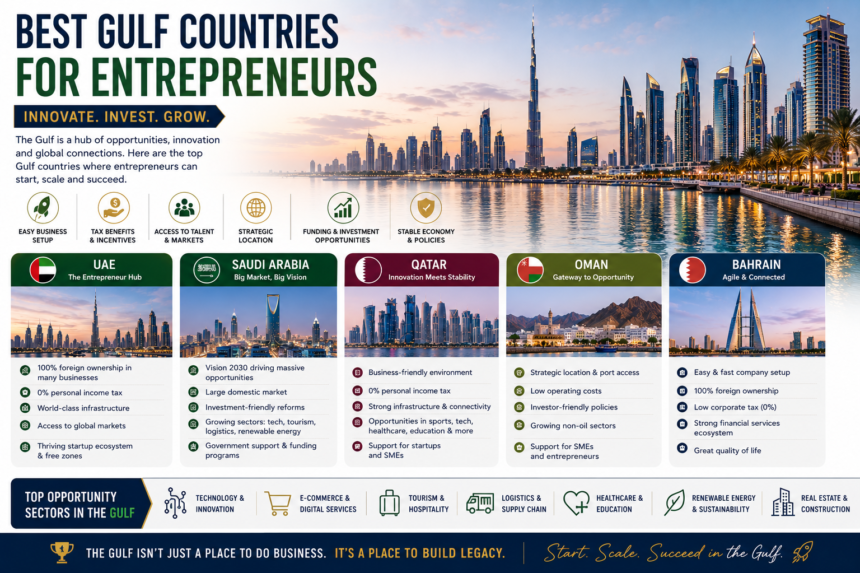
Here is how the six GCC countries compare.
Best Gulf Countries for Entrepreneurs at a Glance
Before choosing where to establish a company, entrepreneurs should understand that the Gulf is not one single business environment.
Each country has its own advantages.
| Rank | Country | Best For | Foreign Ownership | Market Opportunity |
|---|---|---|---|---|
| 1 | UAE | International startups and global businesses | Up to 100% widely available | Excellent |
| 2 | Saudi Arabia | Large-market growth and scaling | Available subject to structure/activity | Excellent |
| 3 | Bahrain | Fintech and smaller startups | 100% in many activities | Very good |
| 4 | Qatar | Technology and specialised services | Up to 100% in permitted structures/sectors | Very good |
| 5 | Oman | Logistics, tourism and manufacturing | 100% available under investment framework | Growing |
| 6 | Kuwait | Consumer businesses and established sectors | Depends on structure/activity | Good |
This ranking is not meant to suggest that every entrepreneur should automatically establish a company in the UAE.
The best jurisdiction depends on where your customers, investors, employees and operations will actually be located.
1. UAE: Best Overall Gulf Country for Entrepreneurs
The UAE remains the strongest all-round choice for many international entrepreneurs.
Its biggest advantage is the ecosystem.
An entrepreneur can establish a company, obtain residency through eligible routes, access international banking and professional services, attend global business events and reach customers across the Middle East, Africa, Asia and Europe from one location.
Foreign investors can establish and fully own companies across a broad range of activities.
The UAE also has more than 40 free zones, many designed around particular industries or types of business.
Dubai has become particularly attractive for startups and international entrepreneurs.
Technology, e-commerce, consulting, real estate, tourism, logistics, media, financial services, artificial intelligence and professional services all have substantial business ecosystems.
Abu Dhabi provides another powerful environment, particularly for technology, finance, energy, manufacturing and businesses seeking institutional investment.
Other emirates can provide lower-cost alternatives depending on the business.
For entrepreneurs who want a regional headquarters rather than access to only one national market, the UAE remains extremely difficult to beat.
Why Dubai Is So Popular With Entrepreneurs
Dubai’s attraction extends beyond tax.
The city has built an entire infrastructure around international business.
Entrepreneurs have access to lawyers, accountants, marketing agencies, investors, accelerators, coworking spaces, banks, consultants and specialised free zones.
This reduces one of the biggest difficulties of entering a foreign market: finding professional support.
Dubai also hosts a continuous calendar of conferences, exhibitions and industry events.
For founders, those events can generate customers, partnerships and investment opportunities.
International connectivity is another major advantage.
Dubai International Airport provides extensive direct connections across the world, allowing founders to operate internationally while remaining based in the Gulf.
The city’s lifestyle also helps companies recruit international talent.
For businesses requiring multilingual employees and globally experienced professionals, Dubai provides access to an unusually diverse workforce.
UAE Mainland vs Free Zone for Entrepreneurs
One of the first decisions a UAE entrepreneur needs to make is whether to establish a mainland or free-zone business.
There is no universal best option.
A mainland company can be attractive for businesses whose main customers are inside the UAE and which want broad access to the domestic market.
Free zones can be particularly attractive for startups, international service companies, trading businesses and companies working within specialised industries.
Dubai alone has specialised environments serving industries ranging from technology and media to commodities, finance, healthcare and design.
However, entrepreneurs should not assume that a free-zone licence automatically allows unrestricted activity everywhere in the UAE mainland.
The exact licensing and market-access rules depend on the company, emirate and business activity.
The correct structure should therefore be selected according to how the business will actually make money.
UAE Taxes for Entrepreneurs
The introduction of corporate tax changed the UAE’s business landscape, but the country remains internationally competitive.
The standard UAE corporate tax framework provides a 0% rate on taxable income up to AED 375,000 and 9% on taxable income above that threshold, subject to the applicable rules.
Qualifying Free Zone Persons can potentially benefit from a 0% corporate tax rate on qualifying income when all required conditions are met.
Entrepreneurs should therefore avoid the outdated assumption that every UAE business automatically pays zero tax.
Tax depends on company structure, income, activity and compliance.
The UAE also has VAT.
Proper accounting and tax planning have therefore become increasingly important parts of running a company.
The advantage is that the overall framework remains comparatively straightforward and competitive for many entrepreneurs.
UAE Residence Options for Founders
Residency flexibility is another reason entrepreneurs choose the UAE.
Traditional business-owner residence routes remain available through company structures, while eligible founders and investors may qualify for longer-term residence categories.
The UAE’s Golden Visa ecosystem can be particularly valuable for qualifying entrepreneurs and investors because it provides greater long-term stability than relying exclusively on short-duration company-linked residence.
This matters psychologically as well as practically.
Entrepreneurs building companies over several years need to know that their ability to remain in the country is not unnecessarily fragile.
That makes residency policy an important part of business planning.
2. Saudi Arabia: Best for Entrepreneurs Seeking Scale
If the UAE’s biggest advantage is international connectivity, Saudi Arabia’s biggest advantage is scale.
The Kingdom has the largest population and domestic economy among the GCC countries.
For entrepreneurs building consumer businesses, technology platforms, professional services, tourism companies, logistics operations or business-to-business services, that creates enormous potential.
Saudi Arabia’s Vision 2030 transformation is also creating new industries and accelerating existing ones.
Investment is flowing into tourism, entertainment, technology, infrastructure, construction, sports, hospitality, logistics and digital services.
For entrepreneurs, economic transformation creates gaps.
New industries require suppliers.
New hotels require technology and services.
New entertainment destinations require operators.
New companies require marketing, recruitment, software, consulting and professional support.
This is where entrepreneurial opportunities emerge.
Riyadh Is Becoming a Major Startup Centre
Riyadh sits at the centre of Saudi Arabia’s business transformation.
International companies are expanding their presence in the capital, while Saudi startups are attracting investment across sectors including fintech, e-commerce, software and technology.
For founders targeting Saudi customers, having a direct presence in Riyadh can provide advantages that operating remotely from another Gulf country may not fully replicate.
Relationships matter in business.
Being physically present can make it easier to understand customers, build networks and respond to regulatory or market changes.
Riyadh also hosts major investment and technology events, creating networking opportunities for founders.
The trade-off is that Saudi market entry can involve more regulatory preparation than establishing a simple free-zone company in the UAE.
Entrepreneurs should therefore plan properly rather than treating Saudi Arabia as an extension of their UAE operation.
Saudi Premium Residency for Entrepreneurs
Saudi Arabia has made a significant move toward attracting founders and investors through its Premium Residency programme.
The programme now contains seven residency products, including dedicated Entrepreneur Residency and Business Investor Residency categories.
Entrepreneur Residency is specifically designed for startup founders who meet investment and ownership requirements.
Eligibility differs according to category.
The programme can provide qualifying entrepreneurs with a more independent and long-term connection to Saudi Arabia.
This is important because entrepreneurs need more than a business licence.
They need confidence that they can build teams, establish homes and plan their lives around the market they are entering.
Saudi Arabia’s evolving residency framework therefore strengthens its position as a serious alternative to the UAE.
UAE vs Saudi Arabia for Entrepreneurs
For many founders, this will be the most important comparison.
| Factor | UAE | Saudi Arabia |
|---|---|---|
| International business hub | Excellent | Rapidly growing |
| Domestic market size | Medium | Very large |
| Startup ecosystem | Mature | Rapidly expanding |
| Free-zone choice | Extensive | Different investment model |
| International networking | Excellent | Increasing rapidly |
| Founder residency | Strong | Strong and expanding |
| Global connectivity | Excellent | Excellent and expanding |
| Best for | Regional/global headquarters | Saudi market growth |
The UAE is usually easier for entrepreneurs who want to serve multiple countries from one base.
Saudi Arabia may be stronger for businesses whose primary customer base will be inside the Kingdom.
Some businesses may ultimately need both.
A company can use the UAE as its international headquarters while building a Saudi presence to serve the Kingdom directly, provided its structure complies with both countries’ laws.
3. Bahrain: A Strong Choice for Fintech Entrepreneurs
Bahrain is much smaller than the UAE or Saudi Arabia, but that can work in an entrepreneur’s favour.
The country has spent years developing its financial-services and fintech ecosystem.
For startups working in payments, banking technology, financial software and related areas, Bahrain can provide an interesting entry point into the Gulf.
Manama has an established financial-services sector, which means founders can access banks, financial professionals and potential corporate customers within a relatively concentrated environment.
A smaller ecosystem can also make networking easier.
Instead of trying to navigate an enormous business community, founders may repeatedly meet the same investors, regulators and industry professionals.
Bahrain can therefore work particularly well for entrepreneurs who value access and relationships over sheer market size.
Its geographic proximity to Saudi Arabia is another important advantage.
The King Fahd Causeway directly connects Bahrain with Saudi Arabia’s Eastern Province.
That gives businesses based in Bahrain strategic access to a much larger neighbouring economy.
Why Startups Consider Bahrain
Cost can influence the decision.
Operating expenses can potentially be more manageable than premium business locations in Dubai, depending on the activity and setup.
Bahrain also permits 100% foreign ownership across many business activities, although restrictions and sector-specific conditions can apply.
For a founder building a lean startup, lower overhead can extend the company’s runway.
That matters during the early stages when every month of operating capital counts.
However, Bahrain’s domestic market is small.
Entrepreneurs should therefore consider whether the business can expand into Saudi Arabia or other GCC markets.
A Bahrain-based company targeting only Bahrain may encounter a natural growth ceiling much sooner than one operating in Saudi Arabia.
4. Qatar: Strong for Specialised Entrepreneurs

Qatar provides another interesting entrepreneurial environment.
Its domestic population is relatively small, but purchasing power, infrastructure and government investment create opportunities in specialised sectors.
Technology, sports, tourism, professional services, logistics, education, healthcare and energy-related services can all provide entrepreneurial opportunities.
Foreign investors can obtain up to 100% ownership in eligible activities and structures under Qatar’s investment framework, subject to the relevant approvals and regulations.
This makes Qatar more accessible to international founders than outdated assumptions about mandatory majority local ownership might suggest.
Doha is the country’s commercial centre.
Because Qatar is geographically compact, most major business networks, customers and institutions are concentrated around the capital.
This can make business development easier.
A founder can potentially reach a large proportion of the relevant national market without managing operations across several distant cities.
Qatar Free Zones and Startup Opportunities
Qatar has also developed specialised business environments designed to attract international companies.
Free-zone and technology ecosystems can be particularly relevant to companies working in logistics, emerging technology, aviation and related sectors.
The country’s international connectivity through Doha strengthens its appeal for businesses serving multiple markets.
However, Qatar does not have the same enormous private-sector ecosystem as Dubai or the domestic scale of Saudi Arabia.
Entrepreneurs therefore need a clear reason for choosing Qatar.
If the target customer base is connected with sectors where Qatar has significant spending and expertise, the market can be highly attractive.
If the business is a generic consumer startup requiring tens of millions of potential domestic customers, another GCC market may offer greater scale.
5. Oman: A Growing Opportunity for Entrepreneurs
Oman is one of the most interesting GCC markets for entrepreneurs who think beyond conventional city-based startups.
Its geography is a major advantage.
Oman sits outside the Strait of Hormuz with direct access to major international shipping routes.
Ports including Sohar, Salalah and Duqm support the country’s ambitions in logistics, manufacturing, trade and industrial development.
For entrepreneurs working in logistics, warehousing, manufacturing, food processing, tourism, fisheries, renewable energy and industrial services, this creates opportunities that are different from those available in Dubai or Riyadh.
Oman’s investment framework also allows 100% foreign ownership in applicable structures.
Special economic and free zones provide additional incentives for qualifying investors.
The country is therefore worth considering for businesses that require physical operations rather than simply an office and laptop.
Why Oman Can Work for Long-Term Businesses
Oman’s appeal is not based on becoming another Dubai.
Its strengths are different.
Operating costs can be competitive, while the country’s ports provide strategic access to international markets.
Tourism also creates opportunities.
Oman’s mountains, coastline, wadis, deserts and cultural heritage support businesses in hospitality, adventure tourism, travel services and related industries.
Renewable energy and industrial development provide another longer-term opportunity.
The country’s investment licensing process is increasingly digital, with investors able to apply through the Oman Business Platform.
For entrepreneurs prepared to build patiently, Oman can offer less crowded sectors and opportunities that may receive far more competition in larger GCC markets.
6. Kuwait: Opportunities in a Wealthy Consumer Market
Kuwait is the final GCC country in this comparison.
Its entrepreneurial environment is different from the startup-focused branding associated with Dubai or Bahrain.
However, Kuwait has substantial consumer purchasing power and established sectors including retail, food, finance, healthcare and professional services.
This creates opportunities for businesses that understand local consumer preferences.
Food and beverage concepts, e-commerce, digital services, professional services and specialised retail can all find customers.
Kuwait also has a strong entrepreneurial culture among its citizens.
For international entrepreneurs, however, company ownership and licensing structures can require more careful planning depending on the activity.
The regulatory environment may therefore feel less immediately accessible than a UAE free-zone setup.
That does not mean Kuwait should be ignored.
It means the entrepreneur needs a strong market reason for entering.
Best Gulf Countries for Entrepreneurs by Business Type
The right country becomes clearer when the business model is considered.
| Business Type | Strong Gulf Choices |
|---|---|
| Technology startup | UAE, Saudi Arabia, Bahrain |
| Fintech | UAE, Bahrain, Saudi Arabia |
| E-commerce | UAE, Saudi Arabia |
| Consulting | UAE, Saudi Arabia, Qatar |
| Tourism | UAE, Saudi Arabia, Oman |
| Hospitality | UAE, Saudi Arabia, Oman, Qatar |
| Logistics | UAE, Saudi Arabia, Oman |
| Manufacturing | Saudi Arabia, UAE, Oman |
| Financial services | UAE, Bahrain, Saudi Arabia |
| AI startup | UAE, Saudi Arabia |
| Creator or digital business | UAE |
| Consumer brand | Saudi Arabia, UAE, Kuwait |
| Energy services | Saudi Arabia, UAE, Qatar, Oman |
| International trading | UAE, Oman |
| Regional headquarters | UAE, Saudi Arabia |
This is why choosing a country based solely on the cheapest licence can be a mistake.
A business licence is only the beginning.
The real question is whether the market helps the company find customers and grow.
Best Gulf Country for Startups
For a typical international startup, the UAE remains the strongest all-round choice.
The ecosystem is already mature.
Founders can access incubators, accelerators, investors, service providers, international talent and business events without leaving the country.
Dubai is particularly strong for startups that expect to sell across multiple GCC countries.
Abu Dhabi can be attractive for technology companies and startups seeking institutional investment.
Saudi Arabia is the most serious challenger.
Its enormous domestic market and rapidly expanding startup ecosystem make it especially attractive for businesses that need scale.
The difference is simple.
The UAE is an excellent place to build a regional company.
Saudi Arabia can be an excellent place to build a very large domestic business that later expands regionally.
Best Gulf Country for Small Businesses
Small businesses have different priorities from venture-backed startups.
They usually care more about setup cost, licensing, rent, visas and predictable cash flow than raising millions from investors.
The UAE remains attractive because entrepreneurs can choose among numerous jurisdictions and company structures.
However, founders need to compare the full annual cost rather than promotional setup prices.
Licence renewal, visas, office requirements, insurance, accounting and tax compliance can add significantly to the headline figure.
Bahrain and Oman can also be attractive for selected small businesses because operating expenses may be more manageable.
The right answer depends on where the customers are located.
A cheap company that cannot reach its target customers is not actually cheap.
Best Gulf Country for Online Entrepreneurs
The UAE is particularly attractive for digital entrepreneurs.
Consultants, marketing agencies, software developers, content creators, e-commerce entrepreneurs and other location-flexible businesses can find company structures suited to relatively lean operations.
Dubai’s international lifestyle also makes it easier to build global professional networks.
The time zone is another advantage.
A UAE-based entrepreneur can communicate with Asian markets in the morning and European markets later in the day.
International aviation connectivity makes client travel straightforward.
For an online entrepreneur who does not need a large domestic consumer market, these advantages can be more important than population size.
Best Gulf Country for Tech Entrepreneurs
The technology race across the Gulf is accelerating.
The UAE and Saudi Arabia stand out most clearly.
Dubai has built technology clusters and free zones serving software, artificial intelligence, e-commerce and digital businesses.
Abu Dhabi adds major investment institutions and technology initiatives.
Saudi Arabia provides a much larger customer market and substantial investment in digital transformation.
Technology founders building products for government, enterprises or consumers may therefore find significant opportunities in Riyadh.
Bahrain deserves attention in fintech, while Qatar can be attractive for technology connected with its priority sectors.
The best technology market depends on the product.
A fintech company and a logistics software company may reasonably choose completely different countries.
Best Gulf Country for Women Entrepreneurs
Women are increasingly visible across Gulf startup and business ecosystems.
The UAE provides one of the most internationally established environments, with women building companies across technology, beauty, fashion, consulting, media, food, healthcare and professional services.
Saudi Arabia has also experienced major growth in women’s entrepreneurship as economic and labour-market participation expands.
Female founders are increasingly building companies across technology, retail, services, tourism and other sectors.
Bahrain, Qatar and Oman also have women-led businesses and entrepreneurship programmes.
Rather than assuming one market is automatically easier, founders should investigate their particular industry, customer base and available funding networks.
Best Gulf Country for Foreign Entrepreneurs
For a foreign founder arriving in the GCC for the first time, the UAE is generally the easiest starting point.
Its international population reduces many of the cultural and operational barriers associated with entering a new region.
English is widely used in business.
Professional services are easy to find.
Foreign ownership is widely available.
Numerous company formation options exist.
Residence routes are well established.
Dubai also provides easy access to the rest of the GCC.
Once the company understands the region, expansion into Saudi Arabia, Qatar, Bahrain or Oman can become easier.
However, founders whose business depends heavily on Saudi customers may save time by establishing directly in Saudi Arabia rather than treating the market remotely.
Taxes Across Gulf Countries for Entrepreneurs
Tax should be considered, but it should never be the only factor.
| Country | General Business Tax Position |
|---|---|
| UAE | 0% up to applicable taxable-income threshold; 9% above it under standard CT framework; qualifying free-zone income may receive 0% |
| Saudi Arabia | Tax treatment depends on ownership and business structure |
| Bahrain | Generally considered a relatively low-tax environment, with sector-specific exceptions |
| Qatar | Corporate income-tax rules apply depending on ownership and income |
| Oman | Standard corporate income tax generally 15%, with special-zone incentives possible |
| Kuwait | Tax obligations depend on company and ownership structure |
Tax rules can change and contain important exceptions.
Entrepreneurs should obtain qualified professional advice before establishing a company based primarily on a tax comparison.
Business Setup Costs Across the Gulf
There is no reliable single figure for setting up a business in any GCC country.
Costs depend on:
- Business activity
- Legal structure
- Number of shareholders
- Number of visas
- Office requirements
- Free-zone or mainland location
- Regulatory approvals
- Immigration requirements
- Professional fees
- Licence duration
A consultant operating alone from a flexi-desk will have a completely different setup cost from a restaurant, logistics warehouse or manufacturing company.
Entrepreneurs should therefore request a complete first-year and renewal-cost breakdown.
The renewal cost is particularly important.
A heavily discounted first-year licence can become much more expensive in year two.
Funding for Entrepreneurs in the Gulf
Access to capital is becoming one of the region’s biggest entrepreneurial advantages.
Dubai and Abu Dhabi have established venture-capital and investor ecosystems.
Saudi Arabia’s startup funding market has expanded rapidly alongside the Kingdom’s technology and entrepreneurship agenda.
Bahrain has built specialised support around fintech and startups.
Qatar also has investment programmes connected with entrepreneurship and innovation.
Founders should remember that investors rarely fund companies simply because they are registered in a fashionable jurisdiction.
Investors care about the team, product, customers, market size and potential growth.
Choose the country that strengthens those fundamentals.
Should You Start in Dubai or Riyadh?
For many founders, this is the defining Gulf entrepreneurship question.
Choose Dubai if your business:
- Serves several international markets
- Requires frequent international travel
- Depends on global talent
- Needs a mature startup ecosystem
- Is digital or service-based
- Benefits from free-zone infrastructure
- Needs extensive international networking
Choose Riyadh if your business:
- Targets Saudi consumers
- Serves major Saudi companies
- Works with large projects
- Needs access to the Kingdom’s domestic scale
- Operates in sectors benefiting from Vision 2030
- Plans substantial local expansion
Some successful regional businesses may eventually operate in both.
What Entrepreneurs Should Check Before Choosing a Gulf Country
Do not begin with the question, “Where is the cheapest business licence?”
Begin with customers.
Where are they?
Then examine regulation.
Can your business activity legally operate under the structure you are considering?
After that, evaluate banking, taxation, visas, hiring and office costs.
A useful decision framework is:
Market → Licence → Ownership → Tax → Banking → Residency → Hiring → Operating Cost → Growth
Following that order prevents entrepreneurs from establishing companies that look inexpensive but do not fit their actual business model.
Best Gulf Countries for Entrepreneurs: Final Ranking
Based on the overall combination of business setup options, foreign ownership, market opportunity, startup ecosystem, international connectivity and growth potential, a practical 2026 ranking is:
| Rank | Country | Biggest Entrepreneurial Advantage |
|---|---|---|
| 1 | UAE | Best overall international business ecosystem |
| 2 | Saudi Arabia | Largest GCC market and exceptional growth potential |
| 3 | Bahrain | Fintech and lean startup environment |
| 4 | Qatar | Wealthy specialised market and infrastructure |
| 5 | Oman | Logistics, manufacturing, tourism and trade |
| 6 | Kuwait | Purchasing power and consumer opportunities |
This does not mean Kuwait is a poor place to do business or that every startup should choose the UAE.
The ranking reflects general entrepreneurial flexibility.
A logistics company could reasonably rank Oman much higher.
A company selling primarily to Saudi consumers should probably put Saudi Arabia first.
A fintech founder may find Bahrain extremely attractive.
Business model matters more than rankings.
UAE vs Saudi Arabia for Entrepreneurs
The UAE currently has the more mature international entrepreneurial ecosystem.
Its free zones, professional services, international population and global connectivity make company formation and regional operations relatively accessible.
Saudi Arabia provides the larger market.
That difference explains why many entrepreneurs view the two countries as complementary rather than direct competitors.
Dubai can serve as an international headquarters.
Riyadh can provide direct access to Saudi customers.
As both markets continue developing, operating across the UAE-Saudi corridor may become increasingly important for regional companies.
Is the Gulf a Good Place to Start a Business?
For the right entrepreneur, yes.
The GCC combines several characteristics that make it unusual.
Its cities have high-quality infrastructure.
Governments are investing heavily in economic diversification.
International talent is arriving.
Technology adoption is high.
Large development projects create demand for suppliers and services.
And the region sits geographically between Asia, Europe and Africa.
But entrepreneurs should not confuse economic growth with guaranteed success.
Competition can be intense.
Business regulations differ by country.
Customer preferences are local.
Hiring can be expensive.
Banking and compliance require preparation.
A founder who understands these realities has a much stronger chance of succeeding than someone attracted only by social-media claims about tax-free business.
Final Thoughts on the Best Gulf Countries for Entrepreneurs
The Best Gulf Countries for Entrepreneurs in 2026 offer very different paths to success.
The UAE remains the strongest all-round choice for many international founders. Its combination of foreign ownership, free zones, global connectivity, international talent, business services and mature startup ecosystems gives entrepreneurs an unusually flexible platform from which to build regional or global companies.
Saudi Arabia is the region’s major growth story.
Its large domestic market and economic transformation create opportunities that are difficult to replicate elsewhere in the GCC. For entrepreneurs targeting Saudi consumers, major projects or rapidly developing sectors, establishing directly in the Kingdom may be the smarter strategy.
Bahrain provides a smaller but attractive environment, particularly for fintech and financial services.
Qatar offers opportunities in specialised sectors supported by high-quality infrastructure and significant purchasing power.
Oman deserves attention from entrepreneurs in logistics, manufacturing, tourism and international trade.
Kuwait remains a valuable consumer market for businesses with the right local strategy.
There is therefore no single Gulf country that is best for every entrepreneur.
A founder should choose according to customers rather than headlines.
If your customers are international, the UAE may provide the strongest base.
If your customers are primarily Saudi, Saudi Arabia may be the logical choice.
If your company is fintech-focused, investigate Bahrain.
If logistics and international shipping matter, Oman deserves a closer look.
If specialised services are your strength, Qatar may offer opportunities.
The Gulf’s entrepreneurial story is no longer about one city or one country.
It is becoming an interconnected business region.
The entrepreneurs most likely to succeed will be those who understand what each market does best and build their strategy accordingly.
follow us on Instagram
Read More – Best Gulf Cities for Young Professionals: 10 Powerful Choices in 2026