



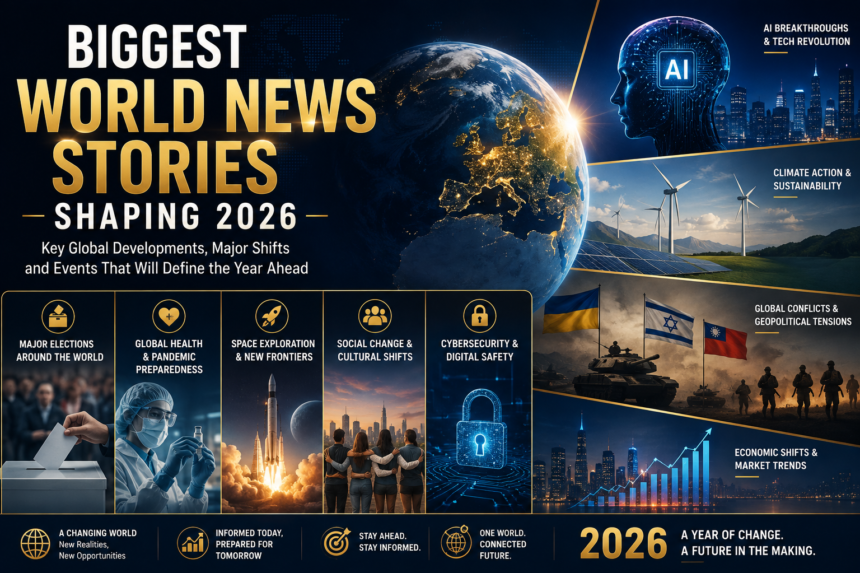
Powerful Events Changing the World
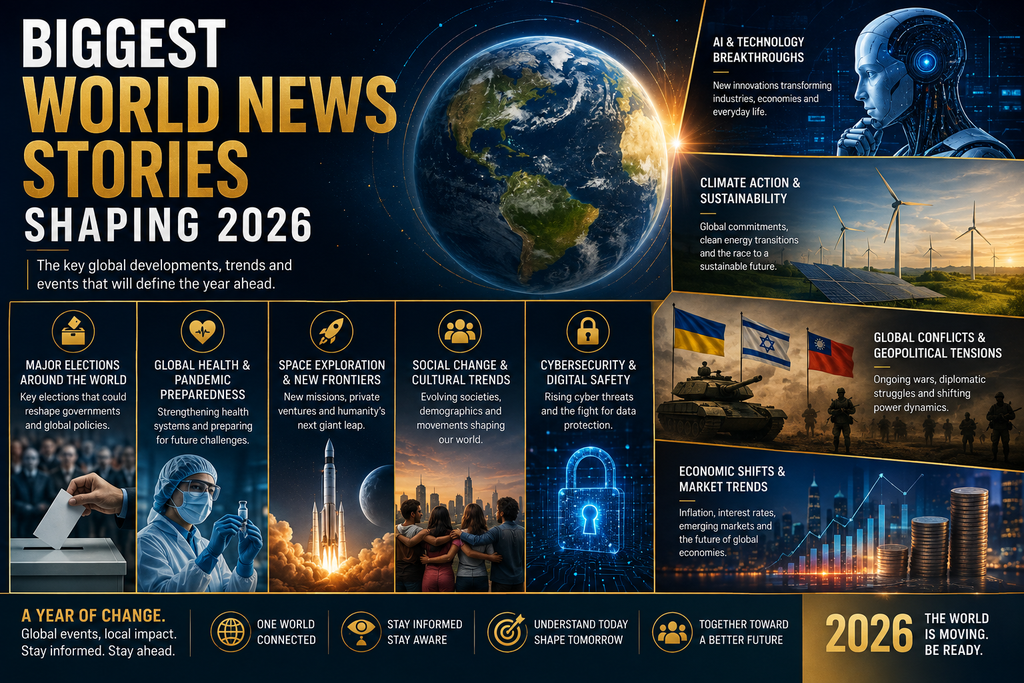
The Biggest World News Stories Shaping 2026 reveal a world experiencing geopolitical conflict, technological transformation, economic uncertainty and increasingly visible climate pressures at the same time.
- Biggest World News Stories Shaping 2026: The Events Changing Our World
- 1. The Iran Conflict Reshapes the Middle East
- 2. The Strait of Hormuz Becomes a Global Flashpoint
- 3. Russia-Ukraine War Continues With Drones at the Centre
- 4. Artificial Intelligence Moves From Trend to Economic Force
- 5. AI Changes the Future of Work
- 6. Global Trade Enters a More Political Era
- 7. US-China Competition Continues to Shape Global Strategy
- 8. The Global Economy Shows Surprising Resilience
- 9. Energy Security Returns to the Global Agenda
- 10. Extreme Heat Becomes Harder to Ignore
- 11. Floods and Disasters Expose Infrastructure Vulnerability
- 12. Climate Adaptation Becomes as Important as Climate Targets
- 13. Technology Competition Goes Beyond AI
- 14. The World Becomes More Multipolar
- 15. Gulf Countries Gain Greater Diplomatic Importance
- 16. News Consumption Itself Is Changing
- 17. The Cost of Living Remains a Global Concern
- 18. 2026 Shows How Connected Global Risks Have Become
- What Could Shape the Rest of 2026?
- Why These World News Stories Matter
- Conclusion
By August 2026, international attention has been dominated by the prolonged conflict involving Iran, the United States and Israel, continued war between Russia and Ukraine, disruption around the Strait of Hormuz, changing global trade relationships, artificial intelligence investment and extreme weather.
These stories are connected.
Conflict in the Middle East affects energy markets. Energy prices influence inflation. Inflation affects interest rates and household budgets. Trade restrictions influence supply chains. Artificial intelligence is changing investment and employment. Climate disasters are forcing governments to rethink infrastructure and emergency planning.
The Reuters Institute’s 2026 Digital News Report describes audiences as confronting simultaneous political, economic and technological turbulence while established international alliances and the global trading system face growing pressure.
Here are some of the biggest developments defining 2026 so far.
Biggest World News Stories Shaping 2026: The Events Changing Our World
From wars to artificial intelligence, the events of 2026 are showing how quickly developments in one part of the world can affect people thousands of kilometres away.
The year has reinforced an important reality: international politics, economics, technology, climate and energy security can no longer be viewed separately.
1. The Iran Conflict Reshapes the Middle East
One of the biggest geopolitical stories of 2026 has been the conflict involving Iran, the United States and Israel.
February 28 marked the beginning of US and Israeli strikes against Iran, with the stated focus on Iranian military infrastructure and its nuclear and ballistic missile programmes. Iran responded with attacks on neighbouring Arab states and announced the closure of the Strait of Hormuz.
Six months later, the conflict remains a major source of international uncertainty.
Its consequences stretch well beyond Iran.
Gulf countries face security and economic pressures, international energy markets remain sensitive to developments around Hormuz, and diplomatic efforts have focused on preventing further escalation.
The conflict is therefore not simply another Middle Eastern war.
It has become a global economic story.
2. The Strait of Hormuz Becomes a Global Flashpoint
A narrow stretch of water has become one of 2026’s most important geopolitical locations.
The Strait of Hormuz is critical because of the enormous amount of global energy trade connected to the Gulf.
Iran’s actions around the strait and the wider conflict have disrupted normal shipping conditions. A UK House of Commons Library briefing published in late August reported that blockades remained in place and only a limited number of ships were traversing the strait.
The consequences have been felt through energy, shipping, logistics and production costs.
UN Trade and Development reported that disruption through Hormuz contributed to higher energy, transport and logistics costs during the first half of 2026.
Diplomatic efforts have continued.
Iran and Oman have worked on arrangements intended to facilitate shipping through the waterway, illustrating Oman’s growing diplomatic importance during the crisis.
For businesses and governments, Hormuz has become a reminder that one strategically important shipping route can affect the global economy.
3. Russia-Ukraine War Continues With Drones at the Centre
The Russia-Ukraine war remains another defining international story.
Years after Russia’s full-scale invasion began in February 2022, the conflict continues to produce casualties, destruction and geopolitical tension.
One major development in 2026 has been the increasing importance of drones.
Both sides are using unmanned systems on a significant scale, demonstrating how modern warfare is changing.
Late August brought another devastating reminder of the human cost.
A Russian drone strike on an ammunition warehouse in Myla, west of Kyiv, triggered massive secondary explosions and killed at least 37 people, according to Ukrainian authorities. The incident prompted investigations into why ammunition had been stored close to civilians.
Ukraine, meanwhile, has sought to increase its own long-range drone attacks against targets connected to Russia’s military and industrial capacity.
The battlefield increasingly demonstrates how relatively inexpensive unmanned technology can influence a major conventional war.
4. Artificial Intelligence Moves From Trend to Economic Force
Not every major story of 2026 is about conflict.
Artificial intelligence continues to transform the global economy.
The AI boom has moved beyond consumer chatbots.
Investment is flowing into data centres, chips, infrastructure, energy systems and software. Businesses are trying to integrate AI into operations, while governments are debating regulation, security and competitiveness.
The IMF has identified AI investment as an important source of economic support, particularly in the United States, with investment in data centres and AI hardware spreading internationally.
Trade data provides another indication of the scale of the transformation.
During the first quarter of 2026, UNCTAD reported that trade in semiconductors increased 25 percent, critical minerals 38 percent and ICT products 14 percent, with demand for AI infrastructure and digital technologies among the major drivers.
This means AI is no longer only a technology story.
It is becoming a trade story, an energy story, an investment story and a labour-market story.
5. AI Changes the Future of Work
Alongside investment comes another question:
What will artificial intelligence mean for jobs?
AI tools are becoming increasingly capable of handling tasks involving writing, research, coding, customer support, analysis, design and administration.
Businesses see opportunities to improve productivity.
Workers see both possibilities and uncertainty.
Some jobs may be transformed rather than eliminated. Employees who understand how to work effectively with AI may become more productive.
Other tasks could become heavily automated.
At the same time, entirely new professions are developing around AI engineering, safety, data, infrastructure, governance and implementation.
The long-term impact remains uncertain.
But 2026 is strengthening the argument that AI literacy may become a basic professional skill rather than something limited to technology workers.
6. Global Trade Enters a More Political Era
International trade has traditionally been discussed in terms of prices, supply and demand.
Increasingly, it is also about national security.
Tariffs, industrial policy, sanctions, critical minerals and strategic technologies are becoming central parts of international competition.
Trade tensions involving the United States and other major economies have contributed to uncertainty during 2026.
The IMF says the global economy continues to face headwinds from trade tensions, stubborn inflation and high debt levels.
Yet international trade has remained surprisingly resilient.
UNCTAD estimates global goods trade reached approximately $13.7 trillion during the first half of 2026, around 12.5 percent higher than the same period in 2025. Services trade increased approximately 10.5 percent.
However, higher prices accounted for an important part of that increase.
So stronger trade values do not necessarily mean the underlying global economy is booming.
7. US-China Competition Continues to Shape Global Strategy
Behind many global economic developments is the continuing strategic competition between the United States and China.
The relationship affects technology, semiconductors, artificial intelligence, critical minerals, manufacturing, defence and international diplomacy.
China remains central to global manufacturing and trade.
The United States remains a dominant financial, technological and military power.
Both countries are trying to protect strategic industries while maintaining economic advantages.
This competition matters to countries far beyond Washington and Beijing.
Governments across Asia, Europe, Africa and the Middle East increasingly have to navigate relationships with both powers.
The result is a more complicated international system where countries may cooperate with one power on security, another on trade and several others on technology and investment.
8. The Global Economy Shows Surprising Resilience
Despite wars, energy disruption and trade tensions, the global economy has not collapsed.
That itself is one of 2026’s important stories.
In July, the IMF projected global growth of around 3 percent for 2026. In late August, IMF Managing Director Kristalina Georgieva said the global economy had handled the energy shock from the Iran conflict better than initially feared.
Several factors helped.
Countries released strategic energy reserves.
Non-Gulf energy supplies increased.
Renewable capacity provided additional alternatives.
Energy demand adjusted.
AI investment supported parts of the economy.
However, risks remain.
Debt is high in many economies.
Inflation has not disappeared.
Borrowing costs remain a concern.
Trade tensions can escalate.
Energy disruption could worsen again.
Economic resilience should therefore not be confused with economic stability.
9. Energy Security Returns to the Global Agenda
The Iran conflict has demonstrated that energy security remains one of the world’s most important strategic issues.
Even as countries invest heavily in renewable energy, oil and natural gas continue to influence transportation, manufacturing, electricity systems and international trade.
The Strait of Hormuz disruption produced a major energy shock in 2026.
The IMF says strategic reserves, additional non-Gulf production and growing renewable capacity helped soften the impact.
But the lesson for governments is clear.
Depending too heavily on one region, one fuel or one shipping route creates vulnerability.
That could accelerate investment in:
Renewable energy
Nuclear power
Energy storage
Alternative shipping routes
Domestic production
Strategic reserves
Electric vehicles
Grid infrastructure
The transition to cleaner energy is therefore increasingly linked not only to climate policy but also to national security.
10. Extreme Heat Becomes Harder to Ignore
Climate change has remained one of the biggest global stories of 2026.
The World Meteorological Organization reported in August that record land and sea-surface temperatures, drought, wildfires and floods were defining the global climate picture through July and early August.
Extreme heat affects much more than comfort.
It influences agriculture.
It increases electricity demand.
It threatens outdoor workers.
It raises wildfire risks.
It places additional pressure on healthcare systems.
It can damage transport infrastructure.
And it increases water demand.
The conversation around climate adaptation is consequently changing.
Governments are no longer planning only for what might happen decades in the future.
Many are responding to impacts occurring now.
11. Floods and Disasters Expose Infrastructure Vulnerability
Flooding has also become a major international concern.
In August, severe flooding caused destruction across parts of China and Nepal, while other regions experienced their own extreme weather events.
Assam in northeastern India experienced repeated spells of heavy to extremely heavy rainfall between late June and early August, producing flash floods and widespread inundation.
Europe has faced another combination of climate pressures.
The European Commission’s Joint Research Centre reported in August that drought and record heat were contributing to extraordinary wildfires and very low river flows across parts of Europe.
These events reinforce an increasingly important policy question.
Are cities and infrastructure designed for the climate conditions of the future, or those of the past?
12. Climate Adaptation Becomes as Important as Climate Targets
For years, international climate discussions focused heavily on reducing future emissions.
That remains essential.
But 2026 is also demonstrating the importance of adaptation.
Countries need stronger flood defences.
Cities need heat-resistant infrastructure.
Buildings need better cooling efficiency.
Agricultural systems need to adapt to changing rainfall.
Emergency services need improved disaster-response capabilities.
Water systems need to withstand drought.
Coastal communities need protection from rising risks.
The challenge is particularly difficult for lower-income countries, where financial resources for large-scale adaptation can be limited.
Climate change is therefore becoming increasingly connected with development, inequality, migration and national budgets.
13. Technology Competition Goes Beyond AI
AI may dominate headlines, but the wider technological competition is equally important.
Semiconductors have become strategic assets.
Critical minerals are essential for electronics, batteries and advanced technologies.
Electric vehicles are transforming automotive markets.
Cybersecurity is becoming a national-security priority.
Quantum computing, robotics and biotechnology could create the next wave of technological competition.
UNCTAD’s 2026 trade data shows particularly strong growth in critical minerals, semiconductors, batteries, ICT products and electric vehicles.
Countries increasingly want control over the technologies and materials that will power future industries.
This is encouraging governments to support domestic manufacturing and secure alternative supply chains.
14. The World Becomes More Multipolar
Another major story of 2026 is less visible than a war or natural disaster.
The structure of international power itself is changing.
The United States remains enormously influential.
China continues to expand its economic and strategic importance.
Russia remains a major military and geopolitical actor.
India’s economic and diplomatic weight continues to grow.
Gulf states are developing increasingly independent foreign policies.
Middle powers are gaining greater importance.
UN Secretary-General António Guterres described this changing environment as evidence of the limits of superpower influence and warned that a more multipolar order could produce greater confrontation if international institutions fail to adapt.
This may prove to be one of the most consequential trends of the decade.
15. Gulf Countries Gain Greater Diplomatic Importance
The Middle East is not simply a region affected by international competition.
Gulf states are increasingly becoming diplomatic actors themselves.
Oman’s role in discussions connected to Iran and the Strait of Hormuz is one example.
Qatar has also remained involved in regional diplomacy.
Saudi Arabia and the UAE continue to expand economic and political relationships across Asia, Europe, Africa and the Americas.
The result is a Gulf region that is increasingly important not only because of energy.
Investment, logistics, technology, diplomacy, aviation and financial influence are strengthening its global position.
The 2026 Iran crisis has made the strategic importance of these states even clearer.
16. News Consumption Itself Is Changing
The way people discover these global events is another story worth watching.
Traditional television and newspapers now compete with YouTube, Instagram, TikTok, podcasts, creators and AI-powered platforms.
Breaking events can reach millions of people before a traditional news bulletin begins.
But speed creates problems.
False information can spread quickly.
Old videos can be presented as current events.
AI-generated images and videos can appear realistic.
Unverified claims can move across platforms faster than journalists can fact-check them.
The Reuters Institute’s 2026 Digital News Report describes audiences navigating rapid political, technological and economic change while spending significant amounts of their daily lives on smartphones.
For journalism, verification is becoming more important precisely because publishing has become easier.
17. The Cost of Living Remains a Global Concern
Major geopolitical stories eventually reach ordinary households.
Energy disruption affects fuel prices.
Fuel affects transportation.
Transportation influences food and product costs.
Interest rates affect mortgages and borrowing.
Trade restrictions can make imported goods more expensive.
Climate disasters can reduce agricultural supply.
This explains why cost-of-living concerns remain important even when headline inflation improves in some economies.
The IMF has warned that another rise in oil prices could revive inflationary pressure and force central banks to keep monetary policy restrictive for longer.
For households, global economics ultimately becomes personal economics.
18. 2026 Shows How Connected Global Risks Have Become
Perhaps the biggest story of the year is not any single event.
It is the connection between them.
Consider one example.
Conflict affects the Strait of Hormuz.
Hormuz disruption raises energy costs.
Higher energy costs increase transportation and manufacturing expenses.
Those costs can increase inflation.
Inflation influences interest rates.
Higher rates affect businesses, governments and households.
Meanwhile, AI companies need enormous amounts of electricity for data centres, adding another dimension to energy demand.
Climate change simultaneously creates pressure to move away from fossil fuels.
One geopolitical event can therefore affect energy, technology, climate policy, inflation and household finances.
That interconnectedness is becoming one of the defining characteristics of the modern world.
What Could Shape the Rest of 2026?
With several months still remaining in 2026, the global picture could change significantly.
The future of the Iran conflict will remain critical.
Any sustained improvement in shipping through the Strait of Hormuz could reduce some energy pressure. Renewed escalation could do the opposite.
Russia and Ukraine remain locked in war, with drones playing an increasingly prominent role.
Trade tensions could intensify or ease depending on political decisions.
AI investment could continue supporting economic growth while simultaneously increasing questions about employment, financial valuations and energy demand.
Climate risks will remain significant.
And unexpected political or natural events could quickly create new international headlines.
The lesson of 2026 so far is that forecasts can change quickly.
Why These World News Stories Matter
The Biggest World News Stories Shaping 2026 are important because their effects extend far beyond governments and financial markets.
Wars affect energy prices.
Trade disputes affect businesses.
AI changes careers.
Climate disasters affect homes and infrastructure.
Interest rates affect families.
Shipping disruptions affect the price of products.
Technology competition influences which countries dominate future industries.
Understanding world news therefore means understanding how international developments eventually influence everyday life.
For businesses, these stories affect investment decisions.
For workers, they affect career opportunities.
For governments, they influence policy.
For investors, they change risk.
For journalists, they create the responsibility to explain increasingly complicated connections clearly.
Conclusion
The Biggest World News Stories Shaping 2026 show a world undergoing several transformations simultaneously.
The Iran conflict has changed the security landscape of the Middle East and placed the Strait of Hormuz at the centre of global attention.
The Russia-Ukraine war continues, with drone warfare becoming increasingly important.
Artificial intelligence has evolved from a technology trend into a major economic force driving investment, infrastructure and global trade.
Trade itself is becoming increasingly connected with national security and geopolitical competition.
The global economy has shown resilience, but high debt, inflation risks, energy uncertainty and trade tensions remain significant concerns.
At the same time, record heat, drought, wildfires and floods are demonstrating that climate risks are no longer distant possibilities. They are increasingly part of current economic and political decision-making.
And behind these individual developments is a broader shift.
The international system is becoming more complicated and more multipolar. Established powers remain influential, but emerging and middle powers are playing increasingly important roles.
Technology, geopolitics, economics, energy and climate are becoming deeply connected.
That may ultimately be the defining story of 2026.
The world is not changing in one direction at a time.
It is changing in many directions at once.
Follow us on Instagram
Read More – Emirati Women’s Day 2026 Women Celebration Across the UAE