Business Setup in Oman for Foreign Investors and Entrepreneurs
Business Setup in Oman has become increasingly attractive to entrepreneurs, foreign investors and companies looking for a base in the Gulf. Oman’s strategic location between Asia, Africa and the Middle East, combined with economic diversification under Oman Vision 2040, creates opportunities across logistics, tourism, manufacturing, technology, renewable energy, healthcare and other industries.
- Business Setup in Oman for Foreign Investors in 2026
- Why Start a Business in Oman
- Understanding Oman Vision 2040
- 100% Foreign Ownership in Oman
- Choosing a Business Structure in Oman
- Limited Liability Company in Oman
- One-Person Company in Oman
- Foreign Company Branches
- Representative Offices in Oman
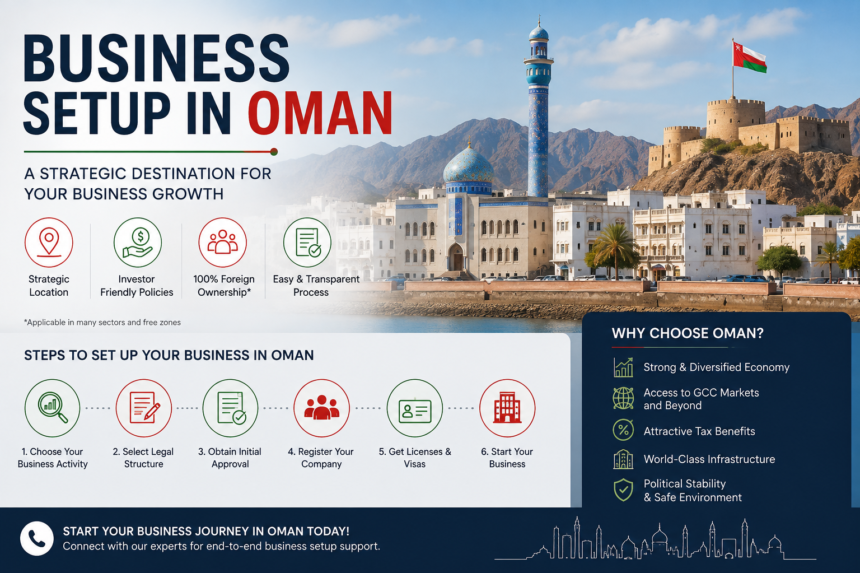
- Step 1: Decide Your Business Activity
- Step 2: Select the Legal Structure
- Step 3: Choose and Register the Business Name
- Step 4: Obtain Commercial Registration
- Step 5: Obtain the Investment License When Required
- Step 6: Find Business Premises
- Step 7: Obtain Sector-Specific Licences
- Step 8: Register for Tax
- Corporate Tax in Oman
- VAT in Oman
- Free Zones in Oman
- Special Economic Zone at Duqm
- Sohar for Industrial and Logistics Businesses
- Salalah for Logistics and Tourism
- Muscat for Professional and Service Businesses
- Business Setup Costs in Oman
- Opening a Corporate Bank Account
- Hiring Employees in Oman
- Omanisation and Business Setup
- Business Opportunities in Technology
- Business Opportunities in Renewable Energy
- Business Opportunities in Tourism
- Business Opportunities in Logistics
- Business Opportunities in Manufacturing
- Investor Residency in Oman
- Personal Income Tax Changes to Know
- Creating a Business Plan for Oman
- Common Business Setup Mistakes
- How Long Does Business Setup Take
- Should You Use a Business Setup Consultant
- Frequently Asked Questions About Business Setup in Oman
- Conclusion
One of the biggest attractions for international investors is foreign ownership. Invest Oman states that Oman offers 100% foreign ownership as an investor incentive, although the exact eligibility, licensing conditions and permitted activities should always be checked for the proposed business.
Oman has also digitalised much of the company-establishment process. The Oman Business Platform provides services related to commercial registration, permits and business information, while its Business Simulator and License Simulator help investors understand requirements before starting.
However, opening a company involves more than receiving a commercial registration. Depending on the activity and ownership structure, entrepreneurs may need investment licensing, municipal permissions, sector approvals, tax registration, premises and employment-related approvals.
This guide explains the major considerations for Business Setup in Oman in 2026.
Business Setup in Oman for Foreign Investors in 2026
Oman has been working to attract international investment while expanding its non-oil economy.
The country’s location is particularly valuable. Businesses established in Oman can operate from a Gulf market positioned near major shipping routes connecting Asia, Africa and the Middle East.
International investors can explore opportunities across areas including:
Technology
Manufacturing
Renewable energy
Tourism
Logistics
Mining
Healthcare
Pharmaceuticals
Food industries
Circular economy
ICT
Invest Oman provides an investment-opportunities explorer where projects can be filtered by sector and governorate.
The appropriate business structure and licensing requirements depend on the actual activity, so investors should determine exactly what the company will do before starting registration.
Why Start a Business in Oman
Oman provides several potential advantages for entrepreneurs.
These include:
Strategic geographic location
Access to Gulf markets
Modern ports and logistics infrastructure
Foreign ownership opportunities
Free zones and special economic zones
Growing non-oil sectors
Digital government services
Investor residency opportunities
Competitive corporate taxation
Government-backed investment support
Invest Oman says its investor platform brings together more than 22 government and private entities to support investors from setup through expansion.
For businesses planning regional operations, Oman can therefore function as both a domestic market and a base for international trade.
Understanding Oman Vision 2040
Oman’s business environment cannot be understood without considering Oman Vision 2040.
The strategy aims to diversify economic activity, strengthen the private sector, attract international investment and reduce excessive dependence on hydrocarbons.
This creates opportunities for businesses that support:
Digital transformation
Clean energy
Advanced manufacturing
Tourism
Logistics
Healthcare
Education
Food security
Technology
Industrial development
Investors should therefore look beyond traditional industries when evaluating opportunities in Oman.
100% Foreign Ownership in Oman
One of the most important changes for international entrepreneurs has been the expansion of foreign ownership possibilities.
Invest Oman lists 100% foreign ownership among the country’s investor incentives.
This can allow qualifying foreign investors to establish businesses without automatically requiring an Omani shareholder.
However, this should not be interpreted as meaning that every business activity has identical rules.
Some sectors or activities may involve additional approvals, restrictions or licensing requirements.
Investors should check their exact activity before forming the company.
Choosing a Business Structure in Oman
Selecting the legal structure is one of the first major decisions.
Invest Oman identifies several available structures, including:
Joint Partnership
Limited Partnership
Limited Liability Company
Sole Proprietorship
Closed Joint Stock Company
Public Joint Stock Company
Foreign Branch
The appropriate structure depends on ownership, number of investors, business activity, capital requirements, liability and expansion plans.
Entrepreneurs should avoid selecting a structure simply because it appears cheapest or easiest.
Limited Liability Company in Oman
A Limited Liability Company can be suitable for many commercial activities.
The structure provides separation between the company and shareholders, with liability generally connected to the shareholder’s contribution subject to applicable law.
An LLC may be considered by:
Consultancies
Trading companies
Technology businesses
Professional services firms
Manufacturers
Hospitality businesses
Other commercial enterprises
However, investors should verify whether the proposed activity can operate under an LLC and whether sector-specific approvals apply.
One-Person Company in Oman
Oman also provides a commercial registration service for one-person companies.
The government’s current service allows applicants to request commercial registration for a one-person company through the business platform or authorised service offices.
This can be relevant for entrepreneurs who want a corporate structure without multiple shareholders.
The legal and financial implications should still be understood before registration.
Foreign Company Branches
International companies planning to enter Oman may consider establishing a foreign branch rather than forming an entirely separate local company.
Whether this is appropriate depends on the company’s activity, contracts and long-term strategy.
Foreign businesses should compare:
Branch structure
Local subsidiary
LLC
Representative office
Free-zone company
Each can have different regulatory, operational and tax implications.
Professional advice may be valuable for larger international investments.
Representative Offices in Oman
Foreign companies involved in trade, industry or services may also be able to establish a commercial representation office.
The government provides a registration route for foreign commercial representation offices through the business-registration system.
A representative office should not automatically be treated as equivalent to a normal operating company.
Its permitted activities and commercial limitations should be checked before choosing this structure.
Step 1: Decide Your Business Activity
The first practical step in Business Setup in Oman is defining the activity.
Do not start with the company name.
Start with what the company will actually do.
For example:
Management consultancy
Software development
Restaurant operations
E-commerce
Import and export
Engineering services
Tourism
Healthcare
Construction
Manufacturing
Logistics
Different activities can require different permits.
The Oman Business Platform’s License Simulator is designed to help investors identify requirements, responsible entities and fees.
Step 2: Select the Legal Structure
Once the activity is clear, choose the company type.
Consider:
Number of owners
Nationality of shareholders
Liability
Capital
Future investors
Business scale
Tax implications
Location
Licensing requirements
Expansion plans
A small consulting business may require a different structure from an industrial manufacturing project.
Step 3: Choose and Register the Business Name
The company needs an approved commercial name.
The name should comply with Omani naming rules and should not conflict with protected or existing registrations.
Entrepreneurs should prepare several alternatives in case the preferred name is unavailable.
A clear brand name can also help with future marketing, domain registration and regional expansion.
Step 4: Obtain Commercial Registration
Commercial registration is central to legally establishing a business.
Oman’s government provides online services for different legal forms, including partnerships and one-person companies.
The registration process establishes important information such as:
Company identity
Legal form
Owners or partners
Commercial activities
Authorised signatories
Capital information
Business details
Once established, commercial-registration data can later be amended through the Oman Business Platform for changes such as trade name, legal form, capital, activities and authorised signatories.
Step 5: Obtain the Investment License When Required
Foreign investors subject to the Foreign Capital Investment Law need to understand the investment-license requirement.
Oman’s government states that companies subject to the Foreign Capital Investment Law must register for an investment licence after obtaining commercial registration.
The current application can require:
Passport copy
Feasibility study
Evidence of experience
Bank statement covering at least three months
Lease contract
Project information
The investment licence is valid for two years under the current service conditions.
Requirements should be checked immediately before applying because regulations can change.
Step 6: Find Business Premises
Depending on the activity, businesses may need physical premises.
Location can affect:
Rent
Customer access
Licensing
Employee commute
Warehousing
Logistics
Municipal approvals
Business visibility
Industrial businesses should investigate industrial cities and economic zones rather than automatically choosing Muscat.
Office-based companies may have much greater flexibility.
Always confirm that the property can legally support the intended commercial activity before signing a long lease.
Step 7: Obtain Sector-Specific Licences
Commercial registration alone may not be sufficient to begin operations.
Additional approvals can apply to activities involving:
Healthcare
Education
Tourism
Food
Construction
Financial services
Transportation
Industrial production
Professional services
Telecommunications
Import and export
The License Simulator on the Oman Business Platform can help identify applicable requirements.
Investors should determine licensing costs and timelines before committing major capital.
Step 8: Register for Tax
Businesses must understand their tax obligations.
The standard corporate income tax rate is generally 15% of taxable annual profit. The Oman Tax Authority also identifies a 3% rate for certain qualifying small establishments that satisfy specified conditions relating to capital, revenue, workforce and activity.
Tax planning should begin during company formation rather than after the business starts generating revenue.
Proper accounting systems are essential.
Corporate Tax in Oman
The headline 15% corporate income tax rate is an important consideration when creating financial forecasts.
However, businesses should not simply multiply revenue by 15%.
Corporate tax applies according to taxable profit and the detailed rules of Oman’s tax system.
Businesses should maintain accurate records covering:
Revenue
Expenses
Payroll
Assets
Invoices
Contracts
VAT
Tax deductions
A qualified tax adviser can be valuable for companies with international transactions or complicated structures.
VAT in Oman
Oman operates a Value Added Tax system.
Businesses reaching applicable registration requirements need to understand VAT registration, invoicing, filing and payment obligations.
VAT should be built into:
Pricing
Accounting
Cash-flow planning
Supplier agreements
Customer invoices
Contracts
Ignoring VAT until the company becomes operational can create unnecessary compliance problems.
Free Zones in Oman
Free zones can be particularly attractive to international companies involved in logistics, manufacturing, exports and regional trade.
Oman promotes incentives in designated zones that can include tax and customs benefits depending on the zone and qualifying project.
Invest Oman currently promotes potential corporate-tax exemptions extending beyond ten years in free zones.
However, investors should verify the specific incentive package directly with the relevant zone because benefits and eligibility conditions can differ.
Special Economic Zone at Duqm

Duqm has become one of Oman’s most important long-term economic developments.
Its strategic location and industrial infrastructure make it relevant to sectors such as:
Manufacturing
Logistics
Energy
Petrochemicals
Heavy industry
Renewable energy
Warehousing
Maritime services
Large-scale projects should compare Duqm with other economic and industrial locations before selecting a base.
Sohar for Industrial and Logistics Businesses
Sohar is another important business location.
Its port and industrial ecosystem can support companies involved in:
Manufacturing
Shipping
Logistics
Warehousing
Metals
Petrochemicals
Industrial services
Import and export
A company whose business depends on cargo movement may gain more from locating near a major port than operating from central Muscat.
Salalah for Logistics and Tourism
Salalah provides opportunities across tourism and logistics.
The city has an important port and a strong tourism identity, particularly during the Khareef season.
Businesses may explore opportunities involving:
Hotels
Restaurants
Tour operations
Logistics
Shipping
Warehousing
Food
Retail
Hospitality services
Location should always match the target customer and industry rather than personal preference.
Muscat for Professional and Service Businesses
Muscat remains Oman’s primary corporate and commercial centre.
It can be particularly suitable for:
Consultancies
Technology companies
Marketing agencies
Healthcare businesses
Retail
Restaurants
Professional services
Financial businesses
Education services
Corporate headquarters
However, Muscat office costs and competition should be considered when creating a business plan.
Business Setup Costs in Oman
There is no universal figure for the cost of starting a company.
Costs depend on:
Legal structure
Commercial activities
Licences
Office
Share capital
Employees
Visas
Municipal permissions
Professional services
Technology
Insurance
Banking
Industry
Government charges
A consultancy can require far less initial investment than a restaurant, factory or logistics company.
Entrepreneurs should request an activity-specific cost breakdown before committing capital.
Opening a Corporate Bank Account
After company formation, businesses generally need an appropriate corporate banking relationship.
Banks can request documents relating to:
Commercial registration
Ownership
Authorised signatories
Business activity
Source of funds
Expected transactions
Company address
Contracts
Tax information
Ultimate beneficial owners
International investors should expect compliance and due-diligence checks.
Do not assume the bank account will automatically open immediately after commercial registration.
Hiring Employees in Oman
Businesses planning to recruit workers must understand Omani labour rules and Omanisation requirements.
Workforce planning should begin before launch.
Consider:
Required positions
Omani employees
Foreign workers
Salary costs
Work permits
Insurance
Training
Accommodation where relevant
Recruitment costs
Omanisation can influence how many foreign employees a company can recruit depending on its activity and circumstances.
A business model that depends entirely on importing workers without checking labour rules can face major problems.
Omanisation and Business Setup
Omanisation is designed to increase employment opportunities for Omani nationals.
For entrepreneurs, it means workforce planning should be integrated into the business plan.
Instead of viewing Omanisation only as a compliance requirement, companies can invest in recruiting and developing local talent.
Businesses that build strong local teams may also integrate more effectively into the market.
Business Opportunities in Technology
Technology is one of the strongest areas for future entrepreneurship.
Potential opportunities include:
Software development
Cybersecurity
Artificial intelligence
Cloud services
Fintech
E-commerce
Digital marketing
Data analytics
Enterprise software
Automation
Smart-city solutions
Technology companies can also support traditional industries as Oman continues its digital transformation.
Business Opportunities in Renewable Energy
Oman’s energy transition creates potential for entrepreneurs and investors.
Areas can include:
Solar services
Green hydrogen supply chains
Energy efficiency
Environmental consulting
Engineering
Energy storage
Sustainability services
Industrial technology
Renewable-energy maintenance
Large projects may require substantial investment, but smaller businesses can participate as contractors, consultants and technology providers.
Business Opportunities in Tourism
Oman’s mountains, deserts, coastline and cultural heritage create significant tourism potential.
Entrepreneurs can explore:
Hotels
Eco-lodges
Adventure tourism
Tour operators
Restaurants
Travel technology
Destination management
Transport
Cultural experiences
Wellness tourism
Luxury travel
Businesses should avoid simply copying tourism models from neighbouring countries.
Oman’s strongest tourism advantage is its distinctive natural and cultural identity.
Business Opportunities in Logistics
Oman’s geographic position supports logistics opportunities.
Businesses can explore:
Freight forwarding
Warehousing
Shipping services
Supply chain technology
Cold storage
Last-mile delivery
Customs support
Industrial logistics
E-commerce fulfilment
Fleet services
Companies involved in regional trade should compare Sohar, Salalah and Duqm when selecting a location.
Business Opportunities in Manufacturing
Manufacturing is another important diversification sector.
Potential areas include:
Food processing
Pharmaceuticals
Construction materials
Industrial equipment
Packaging
Chemicals
Consumer goods
Advanced manufacturing
Export-oriented production
Businesses should investigate industrial-city incentives and infrastructure before selecting premises.
Investor Residency in Oman
Business ownership can also connect with long-term residency options for qualifying investors.
Oman’s Golden Residency programme provides a 10-year residency route through several investment pathways, including company formation, qualifying property investment, securities, deposits and certain employment-creation routes.
The current programme states a minimum investment threshold of OMR 200,000 for eligible routes.
Business registration itself should not be confused with automatic Golden Residency eligibility.
Investors must separately satisfy the residency programme’s requirements.
Personal Income Tax Changes to Know
Business owners should also be aware of Oman’s future personal income tax.
Royal Decree 56/2025 introduced a Personal Income Tax Law scheduled to take effect from the beginning of 2028.
The law provides for a 5% rate on taxable income under the law for individuals whose total annual income exceeds OMR 42,000, subject to applicable rules and exemptions.
Entrepreneurs planning beyond 2027 should include this change in long-term financial planning.
Creating a Business Plan for Oman
A strong business plan should answer several questions.
Who is the customer?
What problem are you solving?
Who are your competitors?
What licences are required?
How much capital is needed?
How many employees will you hire?
What is the Omanisation requirement?
What will rent cost?
How will customers find you?
When will the business become profitable?
What happens if revenue grows more slowly than expected?
Foreign investors should also consider cultural adaptation and localisation.
A successful business model elsewhere may need adjustment for Oman.
Common Business Setup Mistakes
Several mistakes can make company formation more expensive.
Choosing the wrong business activity
Ignoring additional licences
Renting premises before checking approvals
Underestimating working capital
Ignoring Omanisation
Assuming every activity permits identical foreign ownership
Poor tax planning
Using unverified business setup agents
Opening with too many employees
Failing to research competitors
Expecting immediate profitability
Entrepreneurs should separate company registration from business success.
Obtaining a commercial registration is only the beginning.
How Long Does Business Setup Take
The timeline depends on the company.
A relatively straightforward service business can have fewer approvals than a healthcare facility, restaurant or industrial plant.
Digital government services can simplify registration, but investors should still allow time for:
Approvals
Licensing
Banking
Office setup
Visas
Recruitment
Tax registration
Sector permissions
Do not sign customer contracts based on an unrealistic launch date before confirming all required approvals.
Should You Use a Business Setup Consultant
Simple structures may be manageable through official digital platforms.
Complex businesses may benefit from legal, accounting or business-setup advice.
Professional support can be useful when dealing with:
Foreign ownership
Multiple shareholders
Regulated activities
Industrial projects
Free zones
Tax structuring
International transactions
Employment planning
Large investments
The important point is to use licensed and reputable advisers rather than relying on unverified intermediaries.
Frequently Asked Questions About Business Setup in Oman
Can foreigners start a business in Oman?
Yes. Oman promotes foreign investment and lists 100% foreign ownership among its investor incentives, although eligibility and licensing should be checked for the specific activity.
What company structures are available?
Options include Limited Liability Companies, partnerships, sole proprietorships, joint stock companies and foreign branches, among other structures.
How do I register a company?
Company registration services are available through the Oman Business Platform, which also provides business and licence simulators for understanding requirements.
Do foreign investors need an investment licence?
Companies subject to the Foreign Capital Investment Law must obtain the relevant investment licence after commercial registration.
What is corporate tax in Oman?
The standard income tax rate is generally 15% of taxable annual profit. Certain qualifying small establishments may be subject to a 3% rate if they meet specified conditions.
Can business investment provide residency?
Qualifying investments can provide access to Oman’s 10-year Golden Residency programme. Current eligible routes include company formation, qualifying real estate, securities, fixed deposits and certain job-creation investments, subject to programme requirements.
Conclusion
Business Setup in Oman can provide entrepreneurs and international investors with access to a market undergoing significant economic transformation.
Foreign ownership opportunities have made market entry more accessible. Digital government services have simplified parts of company registration. Free zones and industrial areas provide additional possibilities for export-oriented and industrial businesses.
At the same time, investors need to approach company formation strategically.
Choose the correct activity.
Select an appropriate legal structure.
Complete commercial registration.
Obtain the investment licence where applicable.
Confirm sector approvals.
Choose premises carefully.
Understand corporate tax.
Prepare for VAT compliance.
Plan recruitment around labour regulations and Omanisation.
Open the appropriate banking relationships.
And maintain enough working capital to survive the early stages of the business.
Oman’s strongest opportunities are also increasingly connected with economic diversification. Technology, logistics, manufacturing, tourism, renewable energy, healthcare and other growth industries can provide room for new companies and international investment.
The government-backed Invest Oman platform provides support covering company establishment, licensing, location selection and investor guidance, while the Oman Business Platform provides digital tools for commercial registration and licence requirements.
For entrepreneurs, the biggest mistake is assuming that registering a company automatically creates a successful business.
Registration gives you the legal structure.
Success still requires market demand, appropriate capital, strong operations, compliant hiring, effective marketing and a product or service that customers actually need.
With proper research and planning, Business Setup in Oman can provide a foundation for accessing not only the Omani market but also wider opportunities across the Gulf, Indian Ocean and international trade routes.
Follow us on Instagram
Read More – Jobs in Oman: 12 Powerful Career Opportunities for 2026