



Public and Private Healthcare Across the GCC
Moving to the Gulf often means adjusting to a new job, new neighbourhood, different driving conditions and unfamiliar administrative systems. Healthcare is another area that newcomers need to understand quickly, yet many expatriates do not think carefully about where they will receive medical treatment until they become sick.
- Choosing the Right Hospital or Clinic in the Gulf
- Public and Private Healthcare Across the GCC
- Hospital Care Compared With Clinic Care
- Insurance Networks and Healthcare Provider Access
- Choosing the Right Doctor and Specialist
- Healthcare Facility Licensing and Accreditation
- Hospital Reputation and Quality of Care
- Emergency Departments and Urgent Care
- Family Healthcare and Paediatric Services
- Maternity and Women’s Healthcare
- Chronic Disease and Long-Term Medical Care
- Dental, Optical and Mental Healthcare
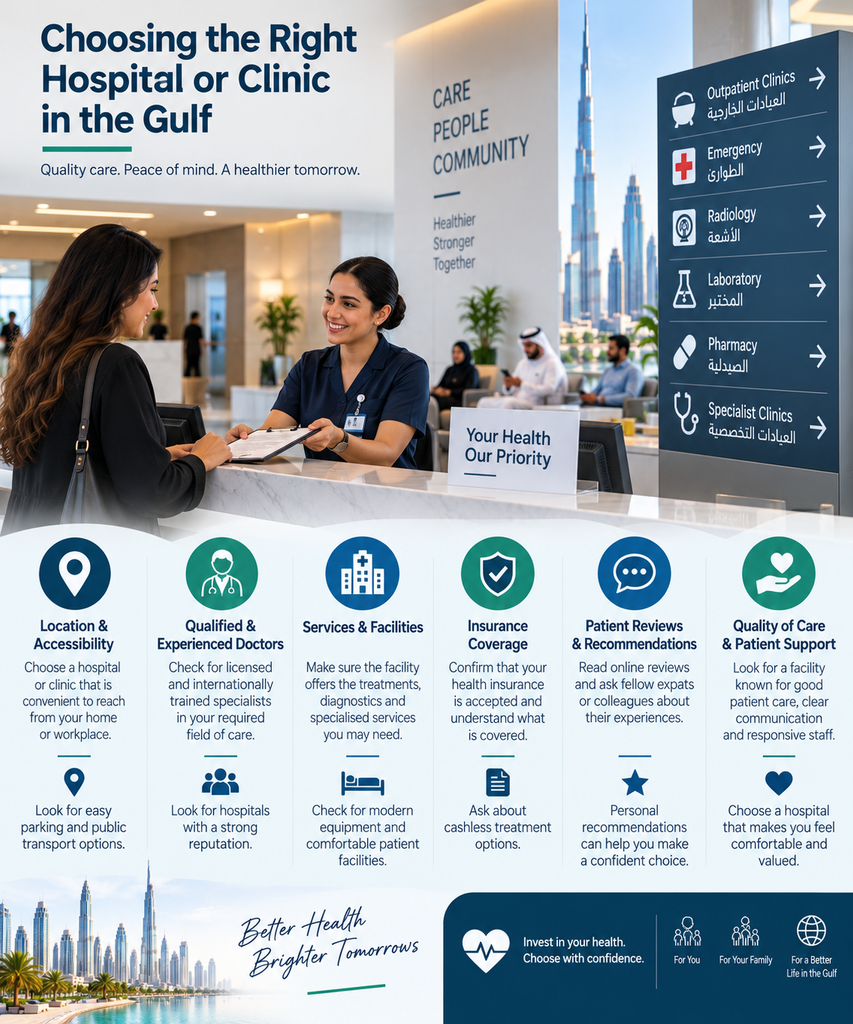
- Location and Accessibility
- Language and Communication in Gulf Healthcare
- Medical Costs and Insurance Co-Payments
- Diagnostic and Laboratory Services
- Digital Healthcare and Telemedicine
- Healthcare Choices Across GCC Countries
- Preparing for a Hospital or Clinic Visit
- Medical Second Opinions
- Common Mistakes When Choosing Healthcare
- Practical Hospital and Clinic Checklist
- Healthcare Planning for Gulf Expats
- Final Thoughts on Choosing Healthcare in the Gulf
The UAE, Saudi Arabia, Qatar, Kuwait, Bahrain and Oman all have established healthcare systems combining government hospitals, private hospitals, specialist centres, medical clinics, pharmacies and diagnostic facilities. In major cities, patients can sometimes choose between dozens of providers within a relatively small area.
Having more options is useful, but it can also make the decision confusing.
The nearest clinic may be perfect for a minor infection but unsuitable for a complicated medical condition. A famous hospital may provide excellent specialist care but fall outside your insurance network. A highly rated doctor may work at a facility located an hour from your home, making regular follow-up difficult.
Choosing the right hospital or clinic in the Gulf therefore requires more than searching online for the highest rating.
Patients should consider the type of care they need, doctor qualifications, licensing, insurance coverage, location, emergency services, hospital facilities, costs and continuity of care.
For expatriates in particular, making these decisions before an emergency occurs can make healthcare significantly easier.
Choosing the Right Hospital or Clinic in the Gulf
Gulf healthcare ranges from small neighbourhood clinics to major tertiary hospitals treating complex medical conditions.
For routine healthcare, a nearby medical centre may provide everything a patient needs. These facilities commonly offer general practitioners, family medicine, basic paediatrics, laboratory testing and selected specialist consultations.
Larger hospitals provide broader services such as surgery, intensive care, advanced imaging, emergency departments and specialist medical teams.
There are also highly specialised centres focusing on areas such as:
- Cardiology
- Orthopaedics
- Oncology
- Fertility treatment
- Dermatology
- Ophthalmology
- Dental care
- Rehabilitation
- Maternity
- Paediatrics
- Mental health
- Sports medicine
The right choice therefore depends on the medical problem.
A useful first step for any expat is creating a simple healthcare map after moving to a new Gulf city. Identify a nearby general clinic, an in-network hospital with emergency services, a pharmacy and any specialist provider you regularly need.
That preparation can save considerable stress later.
Public and Private Healthcare Across the GCC
Healthcare systems across the Gulf generally combine public and private providers, although the balance differs between countries.
Government hospitals often provide major emergency, specialist and tertiary services. Private hospitals and clinics have expanded rapidly across large Gulf cities and are commonly used by expatriates, particularly when private medical insurance forms part of an employment package.
Private facilities often appeal to patients because of appointment availability, multilingual staff, shorter waiting times for some services and convenient locations.
Public healthcare should not automatically be considered inferior, however. Major government hospitals across the GCC provide advanced specialist treatment and manage complicated cases.
The best choice depends on:
- Eligibility for public healthcare
- Insurance coverage
- Type of medical condition
- Required specialist
- Urgency
- Location
- Cost
- Referral requirements
Expats should understand the healthcare access rules in the GCC country where they live rather than assuming that public hospitals work exactly as they do in their home country.
Hospital Care Compared With Clinic Care
One of the simplest ways to make better healthcare decisions is understanding when a clinic is enough.
A medical clinic is often the best starting point for routine or non-emergency care.
A clinic may be suitable for:
- Colds and flu
- Minor infections
- Routine blood tests
- Vaccinations
- Prescription renewals
- Skin problems
- Mild allergies
- General health checks
- Follow-up consultations
- Stable chronic conditions
Hospitals become more appropriate when patients need complex diagnostics, surgery, emergency treatment, inpatient admission or access to several specialists within the same facility.
Hospital care may be more appropriate for:
- Severe injuries
- Chest pain
- Breathing difficulty
- Major bleeding
- Serious pregnancy complications
- Suspected stroke
- Severe allergic reactions
- Complex surgery
- Intensive care
- Serious childhood emergencies
Using a hospital emergency department for every minor illness can result in unnecessary cost and waiting. At the same time, choosing a small clinic for a genuine emergency can delay important treatment.
Knowing the difference is part of responsible healthcare planning.
Insurance Networks and Healthcare Provider Access
For many Gulf expatriates, insurance should be one of the first factors considered when choosing a hospital.
Having medical insurance does not necessarily mean every private facility is covered.
Most local insurance policies operate through provider networks. These networks include hospitals, medical centres, pharmacies, laboratories and doctors that have agreements with the insurer.
A hospital may accept one plan from an insurance company but not another plan issued by the same insurer.
This is why patients should check their specific insurance network, not simply look for the insurer’s logo on a hospital website.
Before booking non-emergency treatment, confirm:
- The hospital is in network
- The doctor is covered
- The service is covered
- A referral is not required
- Prior authorisation is not required
- The expected co-payment
- Any annual or treatment-specific limit
For planned surgery, expensive scans or specialist procedures, obtaining written confirmation of coverage can reduce the risk of unexpected bills.
Choosing the Right Doctor and Specialist
Choosing the hospital is only part of the decision. In many situations, choosing the right doctor matters even more.
Start with the doctor’s medical speciality.
A specialist title should match the medical problem. Someone with recurring knee pain may need orthopaedics or sports medicine, while persistent digestive problems may require a gastroenterologist.
Then consider the doctor’s experience.
Useful factors include:
- Medical qualifications
- Specialist certification
- Years of experience
- Particular clinical interests
- Experience with your condition
- Languages spoken
- Hospital affiliation
- Availability for follow-up care
Online reviews can provide useful information about communication and appointment experiences, but they should not be treated as a scientific measure of clinical skill.
A doctor with fewer online reviews may still be an experienced specialist.
For complex conditions, professional credentials and relevant clinical expertise should carry more weight than social media popularity.
Healthcare Facility Licensing and Accreditation
Patients should use properly licensed healthcare facilities and professionals.
Health regulators across the GCC oversee medical facilities and healthcare professionals within their jurisdictions. Bahrain’s National Health Regulatory Authority, for example, regulates hospitals, medical centres, private clinics and healthcare professionals and publishes information relating to licensed facilities.
Similar regulatory structures exist across other Gulf countries, although the responsible authority differs depending on location.
In the UAE, healthcare regulation can involve different authorities depending on the emirate. Saudi Arabia, Qatar, Oman and Kuwait also maintain government healthcare regulation and licensing systems.
Facility accreditation can provide another useful quality indicator.
Some Gulf hospitals hold international or national healthcare accreditation, which generally means the facility has been assessed against defined standards covering areas such as patient safety, clinical processes, infection control and administration.
Accreditation should not be used as the only measure of quality, but it can form part of the decision-making process.
Hospital Reputation and Quality of Care
Large brand names are not always necessary for every medical problem.
A neighbourhood medical centre may have an excellent family doctor, while a major tertiary hospital may be the better choice for complex heart surgery.
Rather than asking which hospital is most famous, consider whether it is strong in the specific area of medicine you need.
Look at:
- Specialist departments
- Medical team experience
- Diagnostic capability
- Surgical facilities
- Intensive care availability
- Infection-control standards
- Patient safety processes
- Pharmacy support
- Follow-up care
Recommendations from trusted doctors can also be valuable.
If a family physician recommends a particular specialist or hospital for a complex problem, ask why. The referring doctor may know which medical teams regularly manage that condition.
Emergency Departments and Urgent Care
Every family living in the Gulf should know where the nearest suitable emergency department is before an emergency happens.
Do not wait until someone is seriously ill to search for hospitals.
Save the location of an in-network hospital with 24-hour emergency services and learn the emergency telephone number for the country where you live.
Emergency departments should be used for potentially serious conditions such as severe injuries, major breathing difficulties, suspected strokes, significant chest pain or other situations requiring immediate assessment.
Less serious problems may be handled by urgent-care centres or clinics.
The difference can matter financially as well. Emergency department charges may be considerably higher than ordinary outpatient consultations.
During a genuine medical emergency, however, treatment should not be delayed while trying to compare prices online.
Family Healthcare and Paediatric Services
Families should evaluate healthcare differently from single adults.
Children may require more frequent healthcare visits for vaccinations, infections, allergies, injuries and developmental monitoring.
Families should therefore identify a reliable paediatrician or family medicine clinic close to home.
Useful features include:
- Paediatric specialists
- Child-friendly emergency services
- Vaccination services
- Laboratory facilities
- Pharmacy access
- Weekend appointments
- Extended operating hours
Parents should also check insurance carefully because paediatric services, vaccines and developmental assessments can have different coverage rules.
For families with children who have asthma, allergies or other long-term medical needs, continuity of care becomes especially important.
Seeing the same doctor over time can make medical history easier to manage.
Maternity and Women’s Healthcare
Women planning a pregnancy should choose maternity care well before the expected delivery date.
Hospitals vary in maternity packages, obstetric teams, neonatal facilities and insurance arrangements.
Consider:
- Obstetrician availability
- Maternity ward quality
- Neonatal intensive care
- Emergency obstetric services
- Delivery options
- Insurance coverage
- Maternity benefit limits
- Paediatric support after birth
A hospital that is convenient for routine antenatal appointments may not necessarily provide the level of neonatal support required for a high-risk pregnancy.
Patients with high-risk pregnancies should discuss hospital selection directly with their obstetrician.
Insurance also deserves early attention because maternity coverage can involve sub-limits, co-payments or other policy conditions.
Chronic Disease and Long-Term Medical Care
Patients managing diabetes, hypertension, asthma, thyroid disorders or other chronic conditions need more than occasional treatment.
Continuity matters.
A healthcare provider that maintains comprehensive records and offers coordinated access to laboratory testing, pharmacy services and relevant specialists may be more practical than switching between unrelated clinics.
Patients should consider:
- Specialist availability
- Prescription access
- Laboratory services
- Medication coverage
- Insurance approval procedures
- Appointment frequency
- Medical record access
Location becomes particularly important when appointments occur every few weeks or months.
Travelling across a large Gulf city for every routine follow-up can become exhausting even if the doctor is excellent.
Dental, Optical and Mental Healthcare
Not every medical need requires a general hospital.
Specialist dental centres, eye hospitals and mental healthcare providers can sometimes offer more focused services.
For dental care, check whether the dentist is licensed, whether diagnostic imaging is available and whether the clinic specialises in the treatment required.
For eye care, distinguish between routine optical services and medical ophthalmology. Vision testing for glasses is very different from treating retinal disease, glaucoma or eye injuries.
Mental healthcare may involve psychiatrists, psychologists, counsellors or specialised centres depending on the patient’s needs.
Insurance coverage should be checked carefully because dental, optical and mental health benefits can differ from general medical benefits.
Location and Accessibility
The best healthcare facility on paper may not be practical if reaching it is difficult.
This matters particularly in cities with busy traffic.
A clinic located 45 minutes away may be manageable for one annual appointment but inconvenient for weekly treatment.
Consider:
- Distance from home
- Distance from work
- Parking
- Metro or public transport access
- Taxi availability
- Operating hours
- Weekend appointments
- Accessibility for people with disabilities
Families should also consider proximity to schools.
For regular treatment, convenience can improve attendance and reduce the likelihood of missed appointments.
For emergencies, knowing the nearest appropriate hospital may be more important than knowing the highest-rated hospital on the other side of the city.
Language and Communication in Gulf Healthcare
One advantage of healthcare in major Gulf cities is the international workforce.
Hospitals may employ doctors and nurses from the Middle East, Europe, South Asia, Southeast Asia, North America and elsewhere.
Many facilities therefore provide care in several languages.
Communication matters because patients need to understand:
- Their diagnosis
- Treatment options
- Medication instructions
- Possible risks
- Follow-up requirements
- Warning signs
Saudi Arabia’s Ministry of Health explicitly identifies access to clear information about diagnosis and treatment options, informed healthcare decision-making, privacy and complaint mechanisms as important patient rights.
If you do not understand something during a consultation, ask for clarification.
A good healthcare interaction should leave the patient understanding what happens next.
Medical Costs and Insurance Co-Payments
Private healthcare costs can vary considerably between hospitals.
A consultation at a premium specialist hospital may cost considerably more than the same category of appointment at a neighbourhood medical centre.
Insurance reduces this difference for many residents, but co-payments and deductibles can still apply.
Before non-urgent treatment, check:
| Cost factor | Details to confirm |
|---|---|
| Consultation | Patient co-payment |
| Tests | Insurance approval and coverage |
| Imaging | Prior authorisation requirements |
| Medication | Pharmacy benefit and co-pay |
| Surgery | Hospital and surgeon coverage |
| Physiotherapy | Session limits |
| Maternity | Overall maternity limit |
| Dental | Separate annual limit |
Patients paying without insurance should ask for an estimated cost before planned procedures.
For surgery or major treatment, request a written estimate covering surgeon fees, hospital charges, anaesthesia, investigations and expected follow-up.
Diagnostic and Laboratory Services
Convenient access to diagnostics can make healthcare significantly easier.
Larger hospitals often provide laboratory testing, radiology and specialist imaging within the same facility.
This can be particularly useful when a doctor wants results quickly.
Common diagnostic services include:
- Blood testing
- X-rays
- Ultrasound
- CT scanning
- MRI
- Mammography
- Cardiac testing
- Endoscopy
Not every clinic needs advanced diagnostic equipment. Many smaller clinics work with external laboratories and imaging centres.
The important factor is whether results can be shared efficiently with the treating doctor.
Patients should also ask how they can access copies of reports and imaging.
Keeping your own medical records is especially useful for expatriates who may eventually move between Gulf countries.
Digital Healthcare and Telemedicine
Telemedicine has become increasingly useful for routine healthcare.
Video consultations may work well for follow-up discussions, medication reviews, minor illnesses and reviewing test results.
They are not appropriate for every condition.
Physical examinations, severe symptoms and medical emergencies require in-person assessment.
Digital healthcare systems can also improve everyday convenience through:
- Online appointments
- Electronic prescriptions
- Insurance approvals
- Laboratory results
- Medical reports
- Digital health records
- Pharmacy delivery
Before choosing a provider for long-term care, check whether its digital services are easy to use.
This can make a considerable difference for busy professionals and families.
Healthcare Choices Across GCC Countries
Healthcare systems differ across the six Gulf countries, but the same basic selection principles remain useful.
UAE
Expats have extensive private healthcare options, particularly in Dubai and Abu Dhabi. Insurance networks are extremely important because hospital access can depend heavily on the policy tier.
Saudi Arabia
Major cities such as Riyadh, Jeddah and Dammam offer extensive public and private healthcare services. Patients should check insurance networks and specialist availability. Saudi Arabia also maintains formal patient-rights guidance covering information, privacy, informed decision-making and complaint mechanisms.
Qatar
Doha contains public healthcare services alongside a growing private medical sector. Expats should verify insurance arrangements and referral requirements before specialist treatment.
Bahrain
Bahrain has government and private healthcare facilities within a relatively compact geographic area. The NHRA regulates both facilities and professionals and provides information relating to licensed healthcare facilities.
Oman
Muscat provides a wide range of private and public medical services, while people living outside the capital should consider how far they are from major specialist hospitals.
Kuwait
Kuwait combines government healthcare facilities with private hospitals and clinics. Expats should understand both their government healthcare eligibility and any private insurance supplied by employers.
Across all six countries, patients should confirm current healthcare and insurance rules with the appropriate national or local authority because regulations can change.
Preparing for a Hospital or Clinic Visit
Good preparation makes appointments more productive.
Bring or have digital access to:
- Resident identification
- Insurance card
- Previous medical reports
- Medication list
- Allergy information
- Recent laboratory results
- Imaging reports
- Relevant vaccination records
Write down important symptoms before the visit.
Include when they started, how frequently they occur and anything that makes them better or worse.
For chronic conditions, keep an updated list of all medications and doses.
Patients should also tell doctors about supplements and medicines obtained outside the Gulf because these can still interact with prescribed treatment.
Medical Second Opinions
A second opinion can be valuable for major medical decisions.
This is particularly reasonable before:
- Major surgery
- Cancer treatment
- Complex spinal procedures
- Long-term treatment with significant side effects
- Major fertility treatment
- Procedures where several treatment options exist
Seeking another opinion does not automatically mean distrusting the original doctor.
Complex medicine can involve more than one reasonable approach.
Ask for copies of test results, scans and medical reports so another specialist can review the same information.
Insurance coverage for second opinions varies, so check the policy before making appointments.
Common Mistakes When Choosing Healthcare
Choosing only by online rating
Reviews can be useful, but specialist expertise and clinical suitability matter more.
Ignoring the insurance network
A good hospital outside the network can become extremely expensive.
Using emergency departments for every problem
Routine conditions can often be handled more efficiently in clinics.
Selecting a doctor only by nationality or language
Communication matters, but professional expertise should remain the priority.
Ignoring travel time
Regular appointments become difficult when the facility is far away.
Not keeping medical records
Expats frequently change employers, insurers and sometimes countries.
Waiting for an emergency before researching hospitals
Every household should already know its preferred emergency facility.
Assuming the most expensive hospital is automatically the best
Healthcare quality depends on the medical team and specific service, not simply the building or room.
Practical Hospital and Clinic Checklist
Before making a provider your regular healthcare facility, consider this simple checklist.
| Factor | Check |
|---|---|
| Licensed facility | Confirmed |
| Appropriate specialist | Available |
| Insurance | In network |
| Emergency department | Available if required |
| Pharmacy | On-site or nearby |
| Laboratory | Available |
| Imaging | Available if relevant |
| Location | Practical |
| Parking/transport | Convenient |
| Language | Comfortable communication |
| Appointment availability | Suitable |
| Digital records | Available |
| After-hours support | Confirmed |
| Patient reviews | Reasonable overall pattern |
Not every facility needs to meet every requirement.
A small family clinic does not need intensive care facilities. The purpose of the checklist is to match the provider with the type of healthcare you expect to need.
Healthcare Planning for Gulf Expats
New Gulf residents can make healthcare much easier by completing a few tasks during their first weeks after relocation.
First, understand the insurance policy.
Download the insurer’s app and identify the hospital network.
Then find three healthcare locations:
Regular clinic: for routine consultations and minor illness.
Preferred hospital: for specialists and planned hospital treatment.
Emergency hospital: for urgent situations.
Families should additionally identify a paediatrician, while anyone managing a chronic medical condition should establish care with the relevant specialist.
Keep digital copies of important medical records and ensure emergency contact information is available to family members.
Review healthcare arrangements whenever you change jobs because the new employer may provide a completely different insurance network.
Final Thoughts on Choosing Healthcare in the Gulf
Choosing the right hospital or clinic in the Gulf is not about finding one facility that is universally better than every other option.
Healthcare needs vary.
For a routine fever, the right choice may be a well-run medical clinic ten minutes from home.
For a complicated heart condition, the right choice may be a major specialist hospital with an experienced cardiology team.
For a family, proximity to paediatrics and emergency services may matter most. For someone with a chronic condition, continuity with the same specialist may be more valuable than luxurious facilities.
Insurance should also play a major role. Before booking planned treatment, confirm that both the facility and the doctor are within your network and understand any co-payment or approval requirements.
Across the UAE, Saudi Arabia, Qatar, Kuwait, Bahrain and Oman, healthcare options continue to range from neighbourhood clinics to major specialist hospitals. The smartest approach for Gulf expats is to choose care according to medical need, professional expertise, insurance access, safety, convenience and continuity rather than reputation alone.
Most importantly, make these choices before they become urgent.
Know your local clinic. Save your preferred hospital. Understand your insurance. Keep your medical records organised.
A little preparation can make navigating healthcare in the Gulf significantly simpler when you or your family actually need it.
Do follow us on Instagram
Read More – How Does Health Insurance Work for Gulf Expats in 2026?