



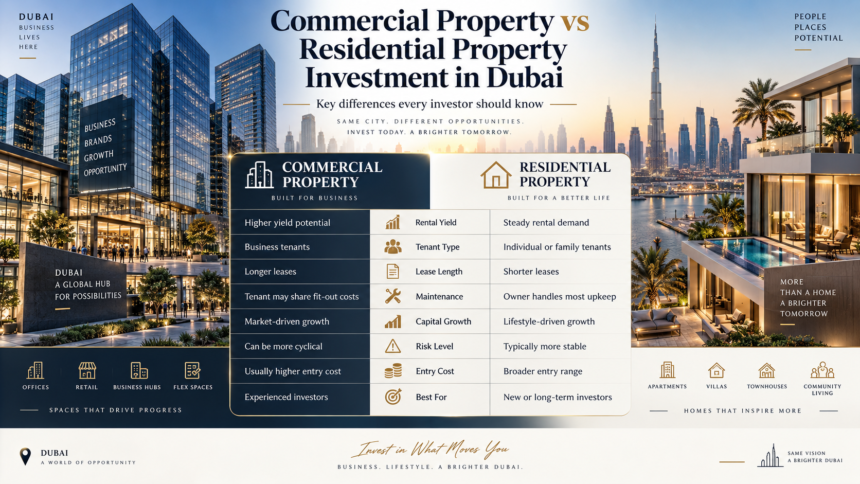
Commercial Property vs Residential Property Investment in Dubai: 2026 Overview
Commercial vs Residential Property Investment in Dubai is an increasingly important decision for investors looking to benefit from the emirate’s property market in 2026. Residential apartments, villas and townhouses offer access to Dubai’s large population and rental market, while offices, retail units and industrial properties provide exposure to the city’s expanding business economy.
- Commercial Property vs Residential Property Investment in Dubai: 2026 Overview
- Understanding Commercial and Residential Property Investment
- 1. Purchase Price and Initial Investment
- 2. Rental Yield and Income Potential
- 3. Tenant Demand and Occupancy
- 4. Lease Length and Rental Stability
- 5. Vacancy Risk
- 6. Financing and Mortgage Availability
- 7. VAT and Tax Treatment
- 8. Service Charges and Operating Costs
- 9. Property Management Requirements
- 10. Capital Appreciation Potential
- 11. Liquidity and Resale Demand
- 12. Market Risk and Economic Sensitivity
- Dubai Residential Property Market in 2026
- Dubai Commercial Property Market in 2026
- Office Property Investment in Dubai
- Retail Property Investment in Dubai
- Warehouse and Industrial Property Investment
- Apartments as Residential Investments
- Villas and Townhouses as Residential Investments
- Freehold Ownership for Foreign Investors
- Dubai Property Registration Costs
- Golden Visa and Dubai Property Investment
- Commercial vs Residential Property for First-Time Investors
- Commercial vs Residential Property for Rental Income
- Commercial vs Residential Property for Long-Term Growth
- Choosing the Right Dubai Investment Property
- Common Property Investment Mistakes in Dubai
- Practical Property Investment Comparison Checklist
- Final Thoughts on Commercial vs Residential Property Investment in Dubai
There is no universal winner.
Commercial property can offer attractive income opportunities, longer leases and exposure to corporate tenants, but it can also require more capital, specialist knowledge and patience during periods of vacancy. Residential property is generally easier for individual investors to understand, finance, rent and resell, although competition between landlords can be stronger and tenant turnover may be more frequent.
Dubai’s current market also makes the comparison particularly interesting.
CBRE reported that Dubai office rents were 13% higher year-on-year in Q2 2026, with prime office rents up 16% and occupancy at approximately 94%. At the same time, the residential market was showing some moderation as additional supply began easing pricing pressure.
That does not mean commercial automatically beats residential. It means each sector is currently at a different stage of its market cycle.
The right investment depends on your budget, risk tolerance, preferred level of involvement, financing needs and whether you prioritise rental income, capital appreciation or liquidity.
Commercial Property vs Residential Property Investment in Dubai: 2026 Overview
The easiest way to understand the difference is to compare how each asset class generates returns and where its risks come from.
| Factor | Residential Property | Commercial Property |
|---|---|---|
| Typical assets | Apartments, villas, townhouses | Offices, retail, warehouses |
| Tenant type | Individuals and families | Businesses |
| Entry cost | Often lower | Can be higher |
| Financing | Generally more accessible | More specialised |
| Lease duration | Often shorter | Often longer |
| Tenant pool | Broad | More specialised |
| Vacancy impact | Usually easier to spread across market | Can be more severe |
| Management | Relatively straightforward | More technical |
| VAT on rent | Generally exempt for residential | Generally 5% |
| Liquidity | Usually stronger | Depends heavily on asset |
| Income potential | Often stable | Can be higher but more variable |
| Economic sensitivity | Population and housing demand | Business activity and corporate demand |
This is a general comparison rather than a guarantee.
A small office in Business Bay and a warehouse in Dubai South are both commercial properties, but they behave very differently.
Likewise, a studio in International City and a luxury villa on Palm Jumeirah should not be evaluated using the same investment assumptions.
Understanding Commercial and Residential Property Investment
Residential real estate is primarily designed for people to live in.
Common Dubai residential investments include:
- Studios
- Apartments
- Penthouses
- Townhouses
- Villas
Commercial real estate is primarily used for business or economic activity.
Common categories include:
- Offices
- Retail units
- Warehouses
- Industrial facilities
- Business units
Commercial property requires an additional layer of analysis because the success of the investment depends not only on where people want to live but also on where businesses want to operate.
An office investor should examine corporate demand, building quality, metro access and business licensing requirements.
A warehouse investor should consider logistics infrastructure, road connectivity, ceiling heights, loading access and industrial zoning.
Residential investment is usually more directly connected to population growth, household formation, affordability and lifestyle.
1. Purchase Price and Initial Investment
Residential property generally offers more entry points for smaller investors.
Dubai contains apartments across a wide range of prices, allowing investors to enter through studios or one-bedroom units before progressing to larger properties.
Commercial property can sometimes require a higher initial commitment.
Prime offices, entire floors, retail units and industrial properties can involve substantial purchase prices.
However, commercial investment is not always more expensive.
Small office units in strata buildings can sometimes cost less than luxury apartments.
The real comparison should include all acquisition costs, not just the listing price.
These can include:
- Dubai Land Department registration
- Brokerage
- Mortgage charges
- Valuation
- VAT where applicable
- Service charges
- Fit-out
- Property management
A commercial unit that appears competitively priced may require significant additional spending before a tenant can occupy it.
A residential apartment can often be rented with much less modification.
2. Rental Yield and Income Potential
Rental yield is often the strongest argument made in favour of commercial property.
Commercial assets can produce attractive income when acquired at the right price and leased to a strong tenant.
Knight Frank’s Dubai research has previously shown asset-class differences in market yields. Its Dubai investment analysis reported cap rates around 6% in prime DIFC offices and around 7.5% for broader Grade A office stock, while prime logistics assets were around 7.75% to 8%. Mainstream apartment yields were typically around 5% to 7%, with villas and townhouses around 4.5% to 6% in that study.
These should not be treated as guaranteed 2026 returns because actual yields change with purchase price, rent, vacancy and market conditions.
Residential investors can also achieve strong returns.
Bayut’s H1 2026 market analysis showed projected apartment returns above 7% in several mid-market communities and above 8% in some affordable areas, with Discovery Gardens reported at approximately 9.06% in its dataset.
The important distinction is that property selection matters more than the commercial or residential label alone.
A badly priced commercial unit can generate a weaker return than a well-bought residential apartment.
3. Tenant Demand and Occupancy
Residential tenant demand in Dubai is supported by population growth, employment, family relocation and the city’s continuing attraction to international professionals.
Almost everyone needs somewhere to live.
That gives residential property a broad tenant base.
Commercial tenants are narrower.
An office needs a business that wants the specific location, building category, layout and rent.
The advantage is that Dubai’s office market is currently experiencing strong occupancy.
CBRE reported Dubai office occupancy of approximately 94% in Q2 2026, while office rents increased 13% year-on-year.
Knight Frank has also highlighted particularly strong corporate demand from banking, finance and technology companies, with those sectors accounting for more than half of new office requirements in H2 2025.
This creates opportunities, especially for high-quality offices.
However, commercial demand can vary dramatically between Grade A buildings and older secondary stock.
Simply buying “an office in Dubai” is not enough.
4. Lease Length and Rental Stability
Commercial tenants often sign longer leases than residential tenants.
A business that spends money fitting out an office, retail unit or warehouse usually has less incentive to move every year.
Longer leases can provide investors with more predictable income.
Residential tenants tend to have more flexibility.
A tenant may leave because of:
- Job relocation
- Family changes
- Rent increases
- Buying a home
- Moving to a different community
That can create more frequent leasing work.
However, residential vacancy may be easier to solve because the potential tenant pool is larger.
A well-priced one-bedroom apartment can appeal to thousands of potential tenants.
A highly specialised commercial unit may appeal only to a much smaller group of businesses.
5. Vacancy Risk
Vacancy is where commercial property can become more challenging.
A residential landlord may lose one or two months of rent while finding a replacement tenant.
A commercial investor can sometimes face a much longer vacancy if the asset is specialised, badly located or poorly configured.
Commercial vacancy is also more expensive because operating costs continue while income stops.
An empty office may still generate:
- Service charges
- Maintenance
- Financing payments
- Utilities
- Fit-out or refurbishment expenses
Location becomes extremely important.
Knight Frank’s 2026 office review noted that companies were willing to pay premiums for high-quality efficient space with good infrastructure, metro connectivity and nearby food and beverage amenities.
This means poor-quality commercial stock may increasingly struggle even when the overall office market is strong.
6. Financing and Mortgage Availability
Residential finance is generally easier for individual investors to access.
Banks have established mortgage products for apartments, villas and townhouses, with relatively standard valuation and underwriting processes.
Commercial financing tends to be more specialised.
Lenders may consider:
- Property type
- Existing tenant
- Lease length
- Business location
- Borrower’s income
- Commercial valuation
- Asset condition
- Expected rental income
Banks may also require a larger equity contribution for some commercial investments.
The exact financing terms depend on the lender and investor profile.
This can make residential property more practical for first-time buyers who rely heavily on mortgage finance.
Cash investors have greater flexibility and may find commercial property more accessible.
7. VAT and Tax Treatment
Tax treatment is one of the most important differences between residential and commercial property in Dubai.
The UAE Federal Tax Authority states that sales and leases of commercial properties are generally subject to VAT at 5%.
Residential property is treated differently.
Residential rent and subsequent residential property supplies are generally exempt from VAT, while the first supply of a newly completed residential property within three years of completion is generally zero-rated.
This distinction can materially affect commercial transactions.
A commercial investor therefore needs to understand:
- Whether VAT applies to the purchase
- Whether VAT must be charged on rent
- VAT registration requirements
- Recoverability of VAT on expenses
The FTA states that owners of commercial buildings can generally recover VAT relating to taxable commercial supplies, while owners making exempt residential supplies generally cannot recover VAT associated with those exempt supplies.
Corporate Tax also needs careful handling.
For natural persons investing in property in their personal capacity, the FTA states that qualifying real estate investment income is generally excluded from UAE Corporate Tax where the investment activity is not conducted or required to be conducted through a licence.
Company ownership and licensed business structures can create different tax consequences, so professional tax advice is sensible for larger commercial portfolios.
8. Service Charges and Operating Costs
Both commercial and residential owners need to consider recurring property costs.
In jointly owned Dubai developments, the property owner is generally responsible for approved service and usage charges unless the lease provides otherwise, and the owner cannot necessarily avoid liability simply because a tenant has agreed to pay.
Residential service charges commonly cover:
- Building maintenance
- Security
- Cleaning
- Common areas
- Swimming pools
- Gyms
- Landscaping
Commercial costs may include additional building services, specialised maintenance or facilities requirements.
The best investment calculation is therefore based on net yield, not headline gross yield.
Net yield should consider:
Annual rent minus vacancy, service charges, management, maintenance and other ownership costs.
A commercial asset advertising a 9% gross return can become significantly less attractive after these deductions.
9. Property Management Requirements
Residential property is generally easier to manage.
The landlord mainly needs to handle:
- Leasing
- Maintenance
- Rent collection
- Renewals
- Inspections
Commercial management can become more complex.
Businesses may negotiate:
- Fit-out periods
- Rent-free periods
- Signage
- Maintenance responsibilities
- Alterations
- Parking
- Renewal options
- Break clauses
Retail properties can involve additional requirements related to shopfronts, trading licences and footfall.
Industrial property introduces operational issues such as loading, access, safety and permitted activities.
Investors who want a highly passive investment may therefore find residential property easier unless they appoint specialist commercial management.
10. Capital Appreciation Potential
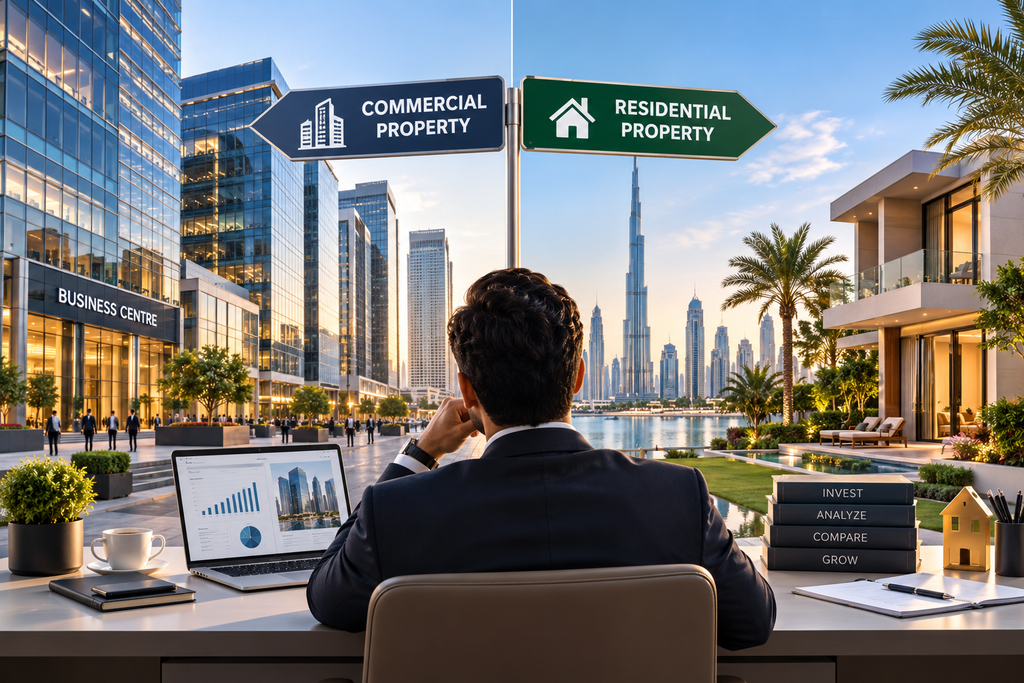
Both property types can appreciate, but the drivers differ.
Residential prices tend to respond strongly to:
- Population growth
- Lifestyle demand
- New infrastructure
- Supply levels
- Investor sentiment
- Mortgage conditions
Commercial property values are influenced more directly by:
- Rental income
- Occupancy
- Lease quality
- Corporate demand
- Building quality
- Business growth
Dubai’s commercial market has recently experienced strong appreciation.
Knight Frank reported that average office sales prices in Downtown Dubai rose 29% year-on-year to AED 5,130 per square foot during 2025, while the number of office transactions above AED 10 million reached 167, more than double the previous year’s level.
Residential property has also shown major growth.
Knight Frank reported approximately 205,400 residential deals worth AED 544.2 billion in 2025, both record levels in its analysis.
By Q2 2026, however, CBRE was reporting some moderation in the broader residential market, demonstrating that property cycles can evolve quickly.
11. Liquidity and Resale Demand
Residential property generally has a larger resale audience.
Potential buyers include:
- Investors
- First-time buyers
- Families
- International purchasers
- End users
Commercial resale demand is narrower.
The buyer needs to understand the asset’s commercial use and potential return.
This can make commercial property slower to sell, particularly if it is vacant or located in a secondary building.
Prime income-producing commercial assets can behave differently.
A leased Grade A office with a strong corporate tenant may be highly attractive to investors specifically seeking predictable income.
Liquidity therefore depends heavily on asset quality.
Residential usually wins for broad resale demand.
Commercial can perform well when the income profile is strong.
12. Market Risk and Economic Sensitivity
Residential and commercial assets react differently to economic cycles.
Residential demand is closely linked to population and household formation.
As long as people continue moving to Dubai, homes are required.
Commercial demand depends more directly on businesses expanding, relocating and hiring.
This can make offices and retail more sensitive to corporate confidence.
Dubai’s 2026 office market remains tight, but supply risk is becoming important.
Knight Frank estimates that around 24.2 million square feet of new office stock is scheduled for delivery between 2026 and 2030, including major pipelines in Business Bay, Meydan City, DIFC and JLT.
That new stock can create opportunities but may also increase competition for older offices.
Commercial investors therefore need to think several years ahead.
Today’s shortage does not guarantee tomorrow’s shortage.
Dubai Residential Property Market in 2026
Dubai’s residential market entered 2026 after a record 2025.
Knight Frank recorded 205,400 residential transactions in 2025, an increase of 18% year-on-year, with total value rising 25% to AED 544.2 billion.
The market remained resilient into 2026, particularly at the luxury end.
Knight Frank reported 296 homes selling for more than US$10 million during the first half of 2026, including 165 transactions in Q1 and 131 in Q2.
However, mainstream conditions are becoming more balanced.
CBRE said Dubai’s residential sector moderated in Q2 as transaction activity softened and additional supply reduced pricing pressure.
This means residential investors need to become more selective.
Future performance may increasingly depend on community quality, developer reputation, transport links and real tenant demand rather than broad market momentum alone.
Dubai Commercial Property Market in 2026
Commercial property has one of the strongest current market stories in Dubai.
Office rents were 13% higher year-on-year in Q2 2026, prime rents rose 16%, and occupancy stood at about 94% according to CBRE.
Office investors have also benefited from capital-value growth.
Knight Frank recorded particularly strong investment demand in prime districts and noted that high-quality, efficient offices remained preferred by businesses.
Industrial and logistics property has also been performing strongly.
Knight Frank reported 12.3 million square feet of new industrial and logistics requirements in Dubai during H1 2026, with manufacturing and industry representing the largest share of new demand.
Commercial is therefore not one single market.
Offices, retail and industrial assets should be analysed separately.
Office Property Investment in Dubai
Office property can be one of the most accessible commercial categories for private investors.
Common investment areas include Business Bay, Downtown Dubai, DIFC and Jumeirah Lake Towers.
Investors should prioritise:
- Building quality
- Metro access
- Parking
- Efficient layouts
- Business district reputation
- Existing tenant
- Lease terms
Knight Frank’s data shows that banking, finance and technology firms have been major sources of office demand, with a clear preference for Grade A space.
Older offices may therefore need refurbishment or discounted pricing to compete.
Retail Property Investment in Dubai
Retail can produce attractive income when the location has strong footfall and the tenant operates a sustainable business.
However, retail is highly location-sensitive.
A shop in a successful community centre is fundamentally different from a unit in a quiet retail podium with limited customer traffic.
Investors should examine:
- Visibility
- Parking
- Residential catchment
- Tourism
- Tenant business model
- Competition
- Lease conditions
CBRE reported major Dubai malls operating at roughly 98% occupancy in Q2 2026 despite softer tourism conditions, demonstrating the strength of prime retail but not necessarily every retail location.
Warehouse and Industrial Property Investment
Dubai’s industrial and logistics market has become increasingly important.
Manufacturing, logistics, e-commerce and supply-chain investment support warehouse demand.
Knight Frank reported Dubai South as recording the strongest industrial rental growth in Dubai in H1 2026, with rents rising 22% year-on-year in its analysis.
Industrial property can provide strong returns, but investors need more specialist knowledge.
Issues include:
- Power capacity
- Loading access
- Zoning
- Ceiling height
- Fire regulations
- Vehicle access
- Tenant activity
This is usually not the simplest starting point for a first-time property investor.
Apartments as Residential Investments
Apartments remain one of Dubai’s most accessible investment assets.
They generally offer:
- Lower entry costs
- Large tenant pools
- Easier management
- Strong resale liquidity
Smaller apartments can produce particularly strong gross yields in selected communities.
Bayut’s H1 2026 data showed some affordable and mid-market apartment communities generating projected rental returns above 7% and 8%.
However, investors should carefully check service charges.
A high gross rental yield can be reduced significantly by expensive building costs.
Villas and Townhouses as Residential Investments
Villas and townhouses generally require more capital but attract families and long-term residents.
They can benefit from demand for:
- More space
- Private gardens
- Schools
- Community amenities
- Family lifestyle
Rental yields may sometimes be lower than apartments because acquisition prices are higher, but investors may benefit from stronger capital appreciation in land-constrained villa communities.
Knight Frank’s recent residential commentary has also highlighted relative stability in established villa-dominated areas during periods of market uncertainty.
Freehold Ownership for Foreign Investors
Foreign investors can own property in areas designated for foreign freehold ownership.
Dubai Land Department states that foreign nationals can own property in designated freehold areas, while Emirati and GCC citizens have broader ownership rights across Dubai.
This applies to the relevant registered real estate interests, but investors should still verify that a specific commercial or residential unit is eligible before committing funds.
DLD also stresses that property transactions must be registered in its real estate register to protect ownership rights.
Dubai Property Registration Costs
Purchase calculations should include Dubai Land Department registration charges.
DLD’s published fee schedule sets the registration fee for a standard real property sale contract at 4% of the sale value.
Additional costs can include:
- Trustee fees
- Brokerage
- Mortgage registration
- Valuation
- VAT on relevant commercial transactions
- Developer charges
These costs should be included before calculating return on investment.
Golden Visa and Dubai Property Investment
Real estate can also support long-term residency for qualifying investors.
Dubai Land Department currently states that an investor owning qualifying real estate worth at least AED 2 million can apply for a renewable 10-year Golden Visa, subject to the service’s conditions. Mortgaged property can be considered where the required bank documentation proves the qualifying paid amount.
Residency should not be the only reason to buy property.
The investment should still make financial sense independently.
Commercial vs Residential Property for First-Time Investors
For many first-time investors, residential property is the easier starting point.
The market is simpler to understand.
Tenant demand is broad.
Financing is usually easier.
Resale can also be quicker.
Commercial property may suit investors who already understand business districts, leases and income valuation.
A first commercial investment can work well when the unit is already leased to a strong tenant and the investor can clearly understand the net return.
Commercial vs Residential Property for Rental Income
Investors focused primarily on income may find commercial property attractive.
Longer leases and potentially stronger yields can make the cash flow appealing.
However, a residential portfolio can offer greater diversification.
Instead of putting AED 4 million into one commercial office, an investor might purchase several smaller apartments.
If one residential unit becomes vacant, the others can continue producing rent.
A single vacant commercial asset can temporarily reduce the portfolio’s income to zero.
Commercial vs Residential Property for Long-Term Growth
Residential growth is closely linked to Dubai’s increasing population and attractiveness as a place to live.
Commercial growth is linked to Dubai’s ability to attract businesses and corporate headquarters.
Both trends remain important.
Commercial investors should pay particular attention to future supply.
Residential investors should focus on neighbourhood-level supply and upcoming handovers.
The best long-term asset is rarely simply “commercial” or “residential.”
It is usually a high-quality property in a location where demand remains stronger than competing supply.
Choosing the Right Dubai Investment Property
Start with your objective.
If you want simplicity, financing accessibility and liquidity, residential property may be more suitable.
If you want income and are comfortable with greater complexity, commercial property may deserve closer attention.
Ask yourself:
Income or appreciation?
Cash purchase or mortgage?
Active management or passive ownership?
One large asset or several smaller units?
Shorter residential tenancies or longer commercial leases?
These answers will usually narrow the choice quickly.
Common Property Investment Mistakes in Dubai
Buying only for advertised ROI
Gross yield is not net profit.
Ignoring service charges
Recurring costs can materially reduce returns.
Assuming every commercial property has high yield
Vacancy can erase income.
Buying poor-quality office space because it is cheap
Corporate tenants increasingly prefer efficient Grade A offices.
Ignoring VAT on commercial property
Commercial transactions and rents are generally subject to 5% VAT under UAE rules.
Overpaying during strong market conditions
Future return begins with purchase price.
Ignoring future supply
New buildings can change rental competition.
Buying without an exit strategy
Think about who will buy the property from you later.
Practical Property Investment Comparison Checklist
| Question | Residential | Commercial |
|---|---|---|
| Is the entry price affordable? | Usually easier | Varies widely |
| Is financing easy? | Generally stronger | More specialised |
| Is tenant demand broad? | Yes | Depends on asset |
| Are leases long? | Usually shorter | Often longer |
| Is vacancy easy to fill? | Usually easier | Can take longer |
| Is management simple? | Generally yes | More complex |
| Does VAT apply to rent? | Generally exempt | Generally 5% |
| Is resale liquidity strong? | Usually stronger | Asset-dependent |
| Can yields be attractive? | Yes | Yes |
| Does building quality matter? | Very much | Extremely |
| Is location critical? | Yes | Yes |
| Best suited to beginners? | Often | Usually experienced investors |
Final Thoughts on Commercial vs Residential Property Investment in Dubai
The debate around Commercial Property vs Residential Property Investment in Dubai does not have one correct answer.
Residential property offers a larger tenant pool, relatively straightforward management, accessible financing and strong resale demand. Apartments can also produce competitive yields, particularly in affordable and mid-market communities.
Commercial property provides a different opportunity.
Dubai’s office market remains exceptionally strong in 2026, with CBRE reporting approximately 94% occupancy and 13% annual rental growth during Q2.
Prime commercial assets can benefit from longer leases, business expansion and higher income potential.
At the same time, commercial investors face additional risks.
Vacancy can last longer. Fit-out can be expensive. Financing may be more specialised. Commercial rent and sales are generally subject to 5% VAT, and future office supply could increase competition over the coming years.
Residential investors face their own challenges.
Dubai’s broader residential market was showing signs of moderation by Q2 2026 as new supply began to influence pricing, even though luxury demand and selected communities remained strong.
For a new investor with a moderate budget, residential property is usually the simpler starting point.
For an experienced or higher-capital investor who understands tenant quality, commercial leases and business locations, commercial property can provide compelling income opportunities.
Some investors may ultimately benefit from holding both.
Residential property can provide liquidity and diversified tenant demand, while commercial assets can add longer leases and exposure to Dubai’s expanding business economy.
The strongest investment strategy therefore begins not with choosing commercial or residential, but with understanding the location, tenant demand, purchase price, net yield, future supply and exit strategy of the individual asset.
Do follow us on Instagram
Read More – Complete Guide to Personal Loans in the GCC: 12 Essential Things to Know in 2026