


6 Crucial GCC Visa Rules Before Moving to the Gulf
Moving to the Gulf can open the door to a new job, higher international exposure, business opportunities or a completely different lifestyle. But before booking a flight or signing a rental contract, one issue needs to be understood clearly: immigration.
- Complete GCC Visa Guide at a Glance
- 1. UAE Visa and Residence Options
- UAE Green Visa
- UAE Golden Visa
- UAE Virtual Work Residence
- UAE Family Sponsorship
- 2. Saudi Arabia Work Visa and Residence
- Saudi Work Permits and Residence
- Saudi Temporary Work Visa
- Saudi Ajeer Temporary Work Permits
- Saudi Family Residence
- 3. Qatar Work Residence Permit
- Qatar Family Residence
- 4. Kuwait Work Visa and Article 18 Residence
- Why Article 18 Matters
- 5. Bahrain Work Permits
- Bahrain and Employer Sponsorship
- 6. Oman Employment Visa
- Oman Work Visa Documents
- GCC Visit Visas Are Not Work Visas
- GCC Residents Can Sometimes Get Easier Visit Access
- Common Documents Needed Across GCC Visa Applications
- Passport Validity Matters
- Educational Certificate Attestation
- Professional Licensing Is Separate From Immigration
- Medical Fitness Tests
- Biometric Requirements
- Can You Sponsor Your Family in the GCC?
- Can You Change Employers in Gulf Countries?
- Always Check the Profession on Your Visa
- How Long Does GCC Visa Processing Take?
- How to Avoid GCC Visa Scams
- Do Not Pay for a Guaranteed Gulf Job
- Before Moving to the Gulf, Check These 10 Things
- Which GCC Country Has the Most Flexible Visa System?
- Complete GCC Visa Guide for Job Seekers
- Frequently Asked Questions
- Conclusion
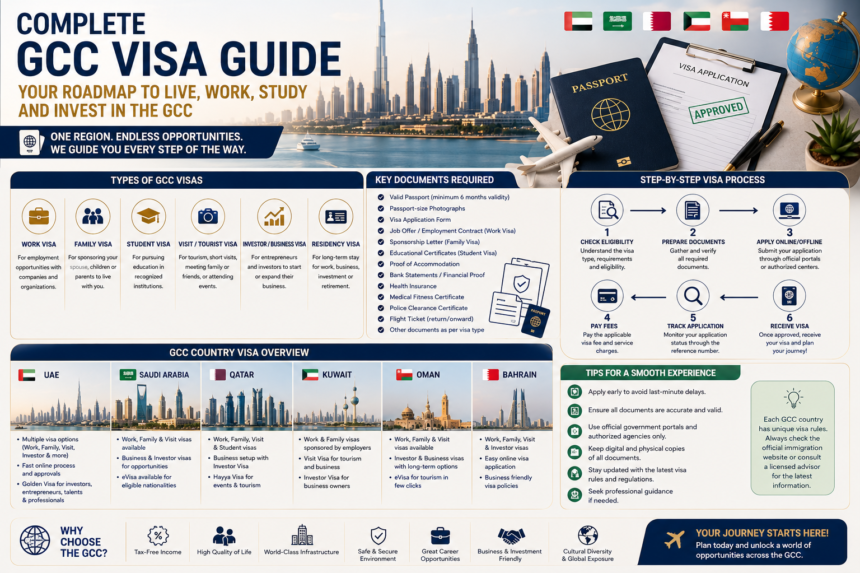
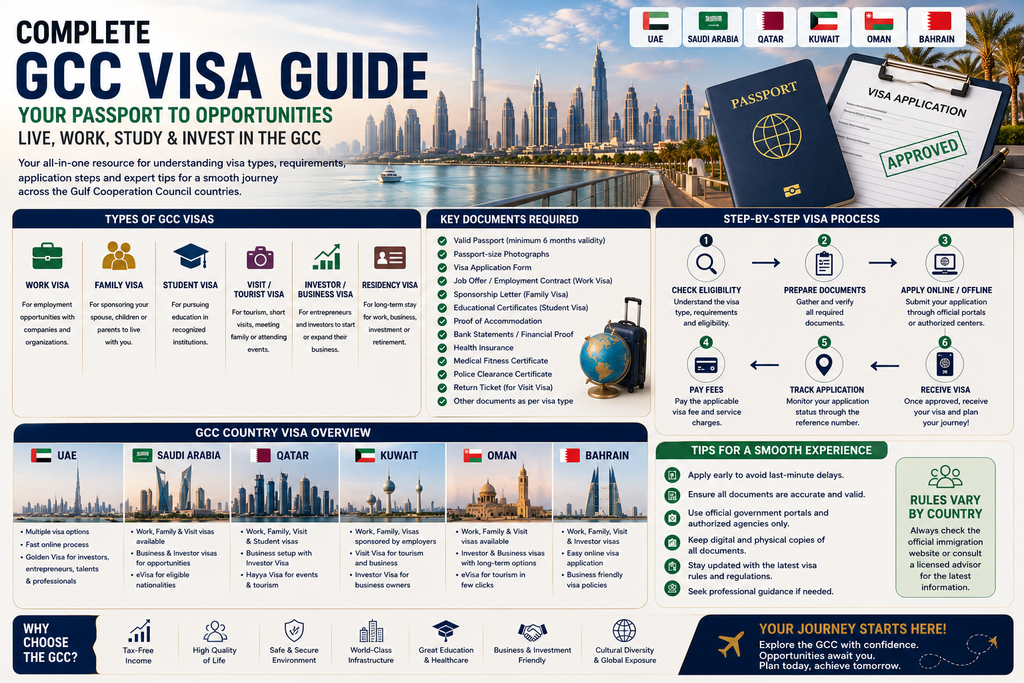
This Complete GCC Visa Guide explains how work, residence, family and selected long term visa routes operate across the six Gulf Cooperation Council countries: the UAE, Saudi Arabia, Qatar, Kuwait, Bahrain and Oman.
Although the countries form one regional bloc, expatriates do not receive one universal GCC work or residence visa. Each country operates its own immigration and labour system.
A residence permit from Dubai does not automatically allow you to work in Riyadh. A Qatar residence permit does not become an Oman employment visa. Each move generally requires separate immigration approval.
That makes understanding the correct visa route essential before relocating.
Complete GCC Visa Guide at a Glance
| Country | Common Employee Route | Typical Sponsor |
|---|---|---|
| UAE | Standard work and residence visa | Employer |
| Saudi Arabia | Work visa, work permit and residence | Employer |
| Qatar | Work Residence Permit | Employer |
| Kuwait | Work entry visa and Article 18 residence | Employer |
| Bahrain | LMRA work permit and residence | Employer |
| Oman | Employment visa and labour permit | Employer |
The employer sponsored model remains the most common route for foreign employees throughout the GCC.
The UAE, however, offers a broader range of self sponsored residence options, including Green, Golden and virtual work residence categories for qualifying applicants.
1. UAE Visa and Residence Options
The UAE has one of the Gulf’s most diverse immigration systems.
Its official government platform currently lists several categories, including:
- Work visa
- Residence visa
- Golden visa
- Green visa
- Investor visa
- Student visa
- Tourist visa
- Visit visa
- Virtual work residence
- Blue visa
For a typical foreign employee joining a private company or government organisation, the standard work visa remains the main route.
The employer generally handles the employment related process, after which the worker completes the required residence formalities.
Depending on the case, these can involve medical fitness testing, identity registration and residence processing.
UAE Green Visa
The Green Visa offers a different pathway.
Official UAE guidance describes it as a self sponsored route for qualifying skilled employees and other eligible applicants.
This is important because it reduces dependence on traditional employer sponsorship for people who satisfy the required criteria.
Candidates should still check the current eligibility standards before applying because professional, income and qualification conditions can apply.
UAE Golden Visa
The Golden Visa is designed for qualifying foreign talent and other eligible categories.
The UAE government identifies investors, entrepreneurs, scientists, outstanding students and graduates, humanitarian pioneers and frontline heroes among potential categories.
Golden Visa residence is different from a standard employment visa.
It is designed as a longer term residence pathway and can provide greater independence from ordinary employer sponsorship.
UAE Virtual Work Residence
Foreign professionals working for employers outside the UAE may also have access to the virtual work residence route.
Official UAE information describes this as a one year self sponsored residence option allowing qualifying foreign workers employed outside the country to live in the UAE.
This can be useful for remote professionals who want to live in the UAE without being employed by a local company.
UAE Family Sponsorship
Residents may also be able to sponsor qualifying family members.
Current official information states that employees with valid UAE residence visas can sponsor family members if they meet applicable requirements. The UAE currently lists a minimum salary of AED 4,000, or AED 3,000 plus accommodation, for this general family sponsorship route.
Marriage and birth documentation may need to be properly authenticated.
Always verify current requirements before relocating dependants.
2. Saudi Arabia Work Visa and Residence
Saudi Arabia has become one of the Gulf’s biggest employment destinations as Vision 2030 projects expand activity across infrastructure, hospitality, technology, finance and healthcare.
For foreign workers holding long term employment contracts, Saudi Arabia provides a permanent work visa route.
The official process includes submitting passport information, selecting the correct profession, completing professional qualification approval where applicable, undergoing medical examination and biometric fingerprinting, and obtaining Ministry of Foreign Affairs approval before completing embassy or consulate procedures.
This makes one point particularly important:
Your profession needs to be entered correctly.
A mismatch between the job, qualification and visa profession can create problems later.
Saudi Work Permits and Residence
Receiving the work visa is not the end of the process.
Saudi employers must also issue the necessary work permit.
The Ministry of Human Resources and Social Development states that the work permit is a condition for issuing or renewing regular expatriate residency.
The residence identity used by expatriate workers is commonly known as the Iqama.
Workers should make sure their:
- Work permit remains valid
- Residency remains valid
- Profession details are correct
- Employer information is accurate
Professionals working in regulated occupations may require additional registration beyond the immigration process.
Examples can include doctors, engineers and other licensed professionals.
Saudi Temporary Work Visa
Saudi Arabia also has a temporary work visa for short term employment contracts.
The official route includes visa application, passport and photo submission, medical examination, biometric requirements and embassy or consulate completion after approval.
This is important for consultants, project specialists and other workers entering for limited assignments.
Temporary employment should use the appropriate work route rather than a tourist visa.
Saudi Ajeer Temporary Work Permits
Saudi Arabia also operates the Ajeer system.
The government describes the permit as a legal document authorising a worker to work for a specific facility for a defined temporary period.
This can be relevant where employment arrangements involve temporary deployment between eligible establishments.
Saudi Family Residence
Saudi residents may be able to bring qualifying first degree relatives under residence visa pathways.
The current official service requires applicants to complete visa processing through Saudi missions abroad, with documents such as a valid passport, photograph and medical insurance.
Premium Residency holders also have dedicated family related visa services.
3. Qatar Work Residence Permit
Foreign professionals planning to work and live in Qatar normally require a Work Residence Permit.
Qatar’s government states that newcomers generally need a Qatari employer, which is normally responsible for handling the residence permit paperwork.
A temporary entry arrangement is generally converted into the Work Residence Permit after arrival.
Qatar’s official guidance says this conversion can typically take two to four weeks and sometimes longer.
During the conversion process, applicants may face restrictions on leaving the country.
Once the Work Residence Permit is issued, the employee can access practical services such as renting accommodation and applying for other permits or services.
Qatar Family Residence
A qualifying resident may also sponsor immediate family members.
The current official guidance lists documents such as:
- Authenticated marriage certificate
- Birth certificates
- Employer documentation
- Salary certificate
Family members need individual residence visas.
Eligibility can depend on salary, profession, accommodation and other conditions.
Families should verify the latest rules before signing school or housing contracts.
4. Kuwait Work Visa and Article 18 Residence
Kuwait uses specific residence categories for expatriates.
For private sector employees, one of the most important is commonly referred to as Article 18 residence.
The process typically involves employer sponsorship, labour authorisation and residence completion after entry.
Professionals considering Kuwait should prepare carefully because documentation can involve:
- Passport
- Work permit
- Employment documentation
- Medical tests
- Police clearance where required
- Residence application
The exact procedure should always be checked through Kuwait’s official government and labour portals.
Why Article 18 Matters
Article 18 is associated with private sector employment.
It is different from visitor status or family residence.
This means expatriates should ensure the visa and residence category matches the work they are actually performing.
A tourist or family visit arrangement is not a substitute for proper private sector work authorisation.
5. Bahrain Work Permits
Bahrain regulates expatriate employment primarily through the Labour Market Regulatory Authority.
The basic rule is simple:
A foreign worker should hold the correct legal work authorisation before beginning employment.
The employer typically applies for the employee’s work permit.
Applicants may need:
- Passport
- Employment details
- Medical fitness
- Supporting labour documentation
- Residence processing
Bahrain has also introduced more flexible permit options for certain workers already legally residing in the country.
However, these alternative routes should not be confused with permission to arrive on a tourist visa and start working.
Bahrain and Employer Sponsorship
For ordinary overseas recruitment, the employer remains central to the process.
Employees should verify that the employer has actually initiated the LMRA process before travelling for work.
If someone claims you can enter Bahrain as a visitor and legally begin full time employment immediately, verify that advice with official authorities first.
6. Oman Employment Visa
Oman’s work visa system also relies heavily on employer sponsorship.
The Royal Oman Police states that a work visa is issued at the request and responsibility of an employer for a foreign national coming to Oman for employment.
Unless the employer is a government organisation, an approved labour permit is normally required.
The standard employment visa currently allows residence for up to two years from the date it is stamped in the passport and permits multiple entry.
Applicants are generally required to be at least 21 years old.
Another important rule is that the occupation on the visa application should match the occupation approved on the labour permit.
This is especially important for skilled professionals whose degree or certification relates to a specific role.
Oman Work Visa Documents
Applicants can generally expect documentation involving:
- Passport
- Photographs
- Labour permit
- Visa application
- Medical documentation where applicable
Some regulated professions may need additional approval.
These can include healthcare, education and other specialised occupations.
Oman also provides temporary work visas for shorter approved periods.
GCC Visit Visas Are Not Work Visas
One of the most important lessons in this Complete GCC Visa Guide is the difference between visiting and working.
A visit visa may allow someone to:
- Travel
- Visit family
- Attend meetings
- Explore opportunities
It does not automatically authorise normal employment.
Saudi Arabia, for example, operates a dedicated visa finder where visitors choose their visit purpose and eligibility before applying for an eVisa, visa on arrival or visa through a mission abroad.
That system is separate from the permanent and temporary work visa routes.
Do not assume that entering legally means working legally.
GCC Residents Can Sometimes Get Easier Visit Access
Holding residence in one GCC country may sometimes make visiting another Gulf country easier.
For example, the UAE provides an eVisa route for qualifying GCC residents and their companions. Current UAE guidance says this entry visa is valid for 30 days and can be extended once for another 30 days.
Saudi Arabia’s visit visa eligibility system also specifically considers whether applicants hold valid legal residency in a GCC country.
But this creates an important distinction.
GCC residence can facilitate travel in some cases. It does not automatically transfer work rights.
Common Documents Needed Across GCC Visa Applications
Requirements vary, but foreign workers should prepare several common documents.
These can include:
- Valid passport
- Passport photographs
- Employment contract
- University certificates
- Experience letters
- Police clearance certificate
- Medical fitness documentation
- Professional registration
- Marriage certificate
- Children’s birth certificates
Not every country requires every document.
The exact checklist depends on visa category, nationality and profession.
Passport Validity Matters
A passport close to expiry can delay immigration.
Many Gulf visa processes require several months of remaining validity.
Because work visa and residence procedures may take time, renewing a passport early can be easier than trying to update immigration documents later.
The name on the passport should also match academic, professional and civil documents as closely as possible.
Inconsistent names can cause verification problems.
Educational Certificate Attestation
Engineers, doctors, teachers and other professionals may need verified academic credentials.
Depending on the destination, documents may require:
- University verification
- Government authentication
- Embassy or consular attestation
- Translation
Do not wait until the last moment to prepare these records.
Academic verification can take longer than the visa application itself.
Professional Licensing Is Separate From Immigration
A work visa does not automatically give someone permission to practise every profession.
Healthcare provides a clear example.
A doctor may have legal residence but still need approval from the country’s healthcare regulator before treating patients.
The same principle can apply to:
- Engineers
- Teachers
- Lawyers
- Accountants
- Other regulated professions
Think of immigration and professional licensing as separate processes.
You may need both.
Medical Fitness Tests
Medical checks are common in GCC employment processes.
Saudi Arabia’s permanent and temporary work visa procedures explicitly require medical examination and biometric steps.
Other Gulf countries also apply medical fitness requirements depending on the visa and profession.
Use only approved medical facilities.
Unofficial medical certificates may not be accepted.
Biometric Requirements
Fingerprinting, identity registration or other biometric steps are also increasingly common.
Saudi work visa applicants undergo biometric fingerprinting as part of the official process.
Other GCC systems may capture biometrics after arrival or during identity card processing.
Applicants should therefore expect immigration to involve more than submitting forms online.
Can You Sponsor Your Family in the GCC?
Often yes, but conditions differ.
Family residence may depend on:
- Salary
- Profession
- Valid residence
- Housing
- Relationship documents
The UAE currently permits qualifying employees to sponsor family members subject to financial criteria.
Qatar’s Work Residence Permit system also allows eligible workers to sponsor immediate family members.
Saudi Arabia provides residence visa services for qualifying relatives of residents.
Family sponsorship should be checked before relocating children because school, health insurance and accommodation costs can be substantial.
Can You Change Employers in Gulf Countries?
Yes in many situations, but the process is regulated.
Changing companies may require:
- New labour permit
- New employment contract
- Residence transfer or cancellation
- Immigration update
- Professional licence update
Do not assume that resigning automatically gives you the right to work for another employer.
The old and new employer may need to complete formal steps.
Starting a new job before completing required transfer procedures can create immigration or labour problems.
Always Check the Profession on Your Visa
The job listed in immigration records should match your actual employment wherever required.
Saudi Arabia asks applicants to select the correct profession during its permanent work visa process.
Profession mismatches can affect:
- Professional registration
- Family sponsorship
- Future job transfers
- Government records
Check all documents before the application is finalised.
How Long Does GCC Visa Processing Take?
There is no universal timeframe.
Saudi Arabia currently lists four working days as the service duration for its permanent work visa service, but applicants still need to complete other steps such as professional qualification approval, medical testing, biometrics and embassy procedures.
Qatar states that converting initial status into a Work Residence Permit typically takes two to four weeks and sometimes longer.
The full relocation process can therefore take longer than the official online service time.
Do not book expensive non refundable travel until your immigration position is clear.
How to Avoid GCC Visa Scams
Immigration scams often target people desperate to work abroad.
Warning signs include:
- Guaranteed work visas
- Jobs without interviews
- Huge salaries for basic roles
- Pressure to send money immediately
- Personal bank accounts used for visa fees
- Fake government documents
- Recruiters refusing to identify the employer
A legitimate looking PDF does not prove the job is genuine.
Contact the employer independently.
Check government portals directly.
Do not use contact details supplied only by the suspicious recruiter.
Do Not Pay for a Guaranteed Gulf Job
Professional recruitment agencies generally work for employers.
Someone asking for large payments in exchange for a guaranteed position should immediately raise concerns.
Some legitimate immigration or document services may charge fees, but those charges should be transparent and connected to a real service.
Always distinguish between:
A legitimate government or service fee
and
Payment for a promised job
They are not the same.
Before Moving to the Gulf, Check These 10 Things
- Verify your employer.
- Read the employment contract.
- Confirm your visa category.
- Check passport validity.
- Prepare attested qualifications.
- Complete approved medical tests.
- Confirm professional licensing.
- Understand family sponsorship.
- Keep copies of all documents.
- Check the residence process after arrival.
These simple checks can prevent expensive mistakes.
Which GCC Country Has the Most Flexible Visa System?
For traditional employees, all six countries continue relying significantly on employer related work authorisation.
The UAE stands out because it also offers several self sponsored and long term routes.
These include Green Visa, Golden Visa and virtual work residence categories.
Saudi Arabia has also expanded residence alternatives through Premium Residency structures.
But the best visa system depends on the person.
A salaried engineer may need a normal work permit.
An entrepreneur may benefit from an investor or long term residence pathway.
A remote professional may prefer a virtual work programme.
Complete GCC Visa Guide for Job Seekers
For most professionals, the safest sequence is straightforward.
Step 1
Find a genuine employer.
Step 2
Receive and review the employment contract.
Step 3
Confirm which work visa and labour permit apply.
Step 4
Prepare your qualifications and identity documents.
Step 5
Complete medical, biometric and verification procedures.
Step 6
Enter the country using the correct visa.
Step 7
Complete residence and identity registration.
Step 8
Begin work only once you are legally authorised.
Avoid shortcuts.
A fast but incorrect route can create far more problems later.
Frequently Asked Questions
What is the Complete GCC Visa Guide for workers?
It refers to understanding the separate work, residence and family visa systems used by the UAE, Saudi Arabia, Qatar, Kuwait, Bahrain and Oman. There is no universal employment visa covering all six countries.
Which GCC country offers the most visa options?
The UAE has a particularly broad range, including standard work visas, Green Visa, Golden Visa, investor residence and virtual work residence options.
Can a UAE resident work in Saudi Arabia without a Saudi work visa?
No. Holding UAE residence does not automatically create Saudi employment rights. The worker needs the appropriate Saudi work authorisation.
What is Qatar’s main employment residence route?
Foreign employees generally need a Work Residence Permit sponsored by a Qatari employer.
Can Gulf residents travel more easily between GCC countries?
Sometimes. Certain countries provide special visit or eVisa routes for legal GCC residents. The UAE has an eVisa for qualifying GCC residents, while Saudi visa eligibility considers GCC residence status.
Can you work using a GCC visit visa?
A visit visa should not be treated as ordinary employment permission. Employees should use the correct work visa and labour authorisation for the destination country.
Does Saudi Arabia have temporary work visas?
Yes. Saudi Arabia provides a temporary work visa for short term employment contracts as well as Ajeer temporary work permits in eligible situations.
Can UAE residents sponsor family members?
Yes, subject to current conditions. Official UAE guidance currently lists a general minimum income requirement of AED 4,000 or AED 3,000 plus accommodation for employee family sponsorship.
Conclusion
This Complete GCC Visa Guide highlights one essential point: the Gulf may operate as an interconnected economic region, but expatriate immigration remains country specific.
The UAE offers standard employer sponsored visas alongside Green, Golden and virtual work residence options.
Saudi Arabia uses dedicated permanent and temporary work visa systems, supported by work permits and residence procedures.
Qatar generally requires expatriate employees to obtain a Work Residence Permit through a local employer.
Kuwait, Bahrain and Oman also maintain their own employment and residence systems, each with separate labour and immigration requirements.
For job seekers, the safest approach is not complicated.
Get the job first.
Verify the employer.
Use the correct visa.
Prepare genuine documents.
Complete professional licensing when required.
Do not treat a tourist visa as a work permit.
And most importantly, always check the latest official immigration requirements before travelling because visa categories, fees and eligibility rules can change.
A Gulf career opportunity can become an important professional step.
The right visa ensures that step begins legally, securely and with far fewer surprises.
follow us on Instagram
Read More – Visas and Immigration for Gulf Regions: 6 Essential Guides