


Cost of Living in Bahrain for Expats in 2026
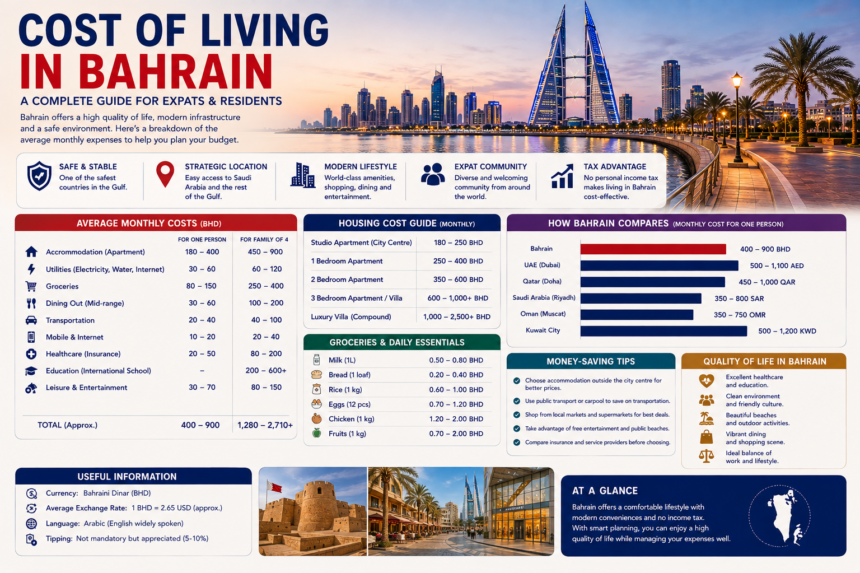
The Cost of Living in Bahrain is one of the most important things to understand before accepting a job, relocating with family or planning a long term stay in the Kingdom. Bahrain offers a modern Gulf lifestyle, international communities and access to major industries, but monthly expenses can vary considerably depending on where and how you live.
- Cost of Living in Bahrain for Expats in 2026
- 1. Housing and Rent in Bahrain
- 2. Electricity and Water Costs
- 3. Grocery Costs in Bahrain
- 4. Eating Out in Bahrain
- 5. Transportation Costs
- 6. Mobile Phone and Internet Costs
- 7. Healthcare Costs in Bahrain
- 8. Education Costs for Families
- 9. Entertainment and Lifestyle Costs
- 10. VAT and Everyday Expenses
- Cost of Living in Bahrain for a Single Professional
- Cost of Living in Bahrain for Couples
- Cost of Living in Bahrain for Families
- Is Rent Expensive in Bahrain?
- Can You Save Money While Living in Bahrain?
- How to Reduce the Cost of Living in Bahrain
- What to Check Before Accepting a Bahrain Job
- Bahrain Cost of Living Compared With Other Gulf Countries
- Common Cost of Living Mistakes
- Frequently Asked Questions
- Conclusion
A single professional sharing accommodation will naturally spend far less than a family renting a large apartment, sending children to private schools and maintaining multiple cars.
Housing is usually one of the largest expenses. Groceries, transportation, telecommunications, utilities, healthcare and education can also make a significant difference to a household budget.
Another factor is taxation. Bahrain currently applies a standard VAT rate of 10 percent to most taxable goods and services, although some supplies are zero rated or exempt. Residential and commercial property rent is among the real estate supplies treated as VAT exempt, while separately charged services such as internet and certain facility services can be subject to VAT.
Understanding these costs before relocating makes it easier to decide whether a salary package genuinely provides the lifestyle and savings potential you expect.
Cost of Living in Bahrain for Expats in 2026
There is no single monthly figure that represents every expatriate.
The Cost of Living in Bahrain depends on several factors, including accommodation, family size, school choice, transportation and personal lifestyle.
Someone living alone may choose a smaller apartment and use taxis or public transport. A family may need a larger property, two vehicles, private healthcare and international schooling.
For this reason, expatriates should calculate their personal budget rather than relying only on an average cost of living figure.
1. Housing and Rent in Bahrain
Accommodation is likely to be one of your largest monthly expenses.
Rental prices vary according to location, building quality, size, furnishings and facilities.
Premium apartments with pools, gyms, security and waterfront views naturally cost more than basic accommodation away from major commercial areas.
Popular choices for expatriates include areas in and around Manama as well as residential communities offering apartments and villas.
Before signing a rental agreement, check whether the advertised rent includes:
Electricity
Water
Internet
Municipality charges
Building maintenance
Parking
Air conditioning
Some properties are advertised as inclusive, while others require tenants to pay several additional bills.
One useful tax consideration is that Bahrain treats the sale and rental of real estate as VAT exempt, although separately charged services connected with the property can receive different VAT treatment.
2. Electricity and Water Costs
Utilities can become a meaningful household expense, particularly during Bahrain’s hot summer months.
Air conditioning is heavily used for much of the year.
The amount a household spends will depend on property size, consumption, tariff category and whether utilities are already included in the rental agreement.
Before renting an apartment, ask the landlord or agent for an indication of previous utility bills if available.
A cheaper apartment with inefficient air conditioning may ultimately cost more than a slightly higher priced property with better energy efficiency.
3. Grocery Costs in Bahrain
Bahrain offers everything from local supermarkets and traditional markets to premium international grocery stores.
Your monthly food budget will depend heavily on your shopping habits.
Basic products and locally or regionally sourced goods can help keep costs manageable. Imported specialty products, international brands and premium organic foods can increase the grocery bill considerably.
Bahrain’s VAT rules provide zero rating for approved basic food items, while other food products can receive the standard VAT treatment.
Families can reduce spending by preparing meals at home, buying larger quantities of commonly used products and comparing supermarkets instead of relying entirely on premium stores.
4. Eating Out in Bahrain
Bahrain has a diverse restaurant culture.
Residents can choose from affordable local restaurants, Indian and Asian eateries, cafes, international chains, hotel restaurants and luxury dining.
The amount spent on restaurants is therefore highly lifestyle dependent.
Someone eating at home during the working week may maintain a relatively modest food budget.
Someone frequently visiting premium restaurants and hotels can spend significantly more.
Restaurant and cafe meals are generally subject to Bahrain’s standard 10 percent VAT rate.
This should be considered when comparing menu prices and planning a monthly entertainment budget.
5. Transportation Costs
Transportation is another major consideration.
Many expatriates choose to own or lease a car because it provides greater flexibility for commuting, shopping and family activities.
Car related expenses can include:
Vehicle purchase or monthly finance
Insurance
Registration
Fuel
Maintenance
Tyres
Parking
Repairs
Bahrain’s VAT guidance confirms that vehicle purchases and car rentals without a driver generally fall under the standard 10 percent VAT treatment. Local passenger transportation by buses and taxis, however, is zero rated for VAT purposes.
People living close to their workplace may therefore be able to reduce transportation costs significantly.
6. Mobile Phone and Internet Costs
Internet and mobile connectivity are basic monthly expenses for most residents.
Bahrain has a developed telecommunications market with mobile, broadband and data services available from multiple providers.
Costs depend on:
Internet speed
Mobile data allowance
International minutes
Postpaid or prepaid plans
Device financing
Entertainment packages
Bahrain’s National Bureau for Revenue states that fixed telephone, home internet, wireless internet and mobile communication services used in Bahrain are generally subject to the standard 10 percent VAT rate.
Compare packages carefully rather than automatically selecting the largest data plan.
7. Healthcare Costs in Bahrain
Healthcare expenses vary depending on employment benefits and insurance.
Many expatriate professionals receive health insurance through their employer.
However, the quality and extent of coverage can differ significantly.
Before accepting a job, check whether the insurance covers:
Hospitalisation
Outpatient consultations
Prescription medicines
Specialists
Dental treatment
Maternity
Children
Emergency care
Existing conditions
Bahrain’s VAT treatment provides zero rating for qualifying healthcare services and approved medicines and medical equipment, while certain non-medical or cosmetic services can attract the standard rate.
Families should pay particular attention to insurance limits because private medical expenses can become a significant additional cost.
8. Education Costs for Families
Education can become one of the largest annual expenses for expatriate families.
Bahrain has private and international schools serving different curricula.
School expenses can include more than tuition.
Parents should budget for:
Registration fees
Application fees
School transport
Uniforms
Books
Devices
Activities
Trips
Meals
Extracurricular programmes
Bahrain applies zero rate VAT treatment to qualifying education provided by nurseries, kindergartens, primary, secondary and higher education institutions. Certain directly related educational books and services can also be zero rated. However, items such as uniforms, stationery and some recreational activities can attract 10 percent VAT.
When comparing employment packages, parents should check whether the employer provides a school allowance.
9. Entertainment and Lifestyle Costs
Lifestyle spending can vary more than almost any other category.
Bahrain offers shopping malls, cafes, restaurants, hotels, beaches, fitness centres and entertainment venues.
A resident who prefers home based activities may spend relatively little.
Someone who regularly visits premium restaurants, hotels and entertainment venues will naturally need a larger budget.
This is where lifestyle inflation can become important.
A salary that initially appears generous can disappear quickly when premium housing, frequent dining and luxury shopping become regular expenses.
Setting a fixed monthly leisure budget can help protect savings.
10. VAT and Everyday Expenses
Bahrain introduced VAT at 5 percent in January 2019 and increased the standard rate to 10 percent from 1 January 2022. The National Bureau for Revenue continues to list 10 percent as the standard rate in its updated 2026 guidance.
Not everything carries 10 percent VAT.
Different supplies can be:
Standard rated
Zero rated
Exempt
Outside the scope of VAT
For example, approved basic food items and qualifying education and healthcare services can be zero rated, while real estate rental is generally exempt. Restaurants, telecommunications, clothing and vehicle purchases are examples of areas where the standard rate can apply.
Understanding this helps newcomers create a more realistic budget.
Cost of Living in Bahrain for a Single Professional
A single expatriate generally has greater flexibility.
The biggest decision will often be housing.
Sharing an apartment can dramatically reduce monthly expenses, while renting a premium one bedroom apartment alone will require a larger budget.
A single professional should consider:
Rent
Utilities
Groceries
Transportation
Mobile and internet
Health insurance not covered by employer
Gym or entertainment
Flights home
Personal shopping
Savings
The employment package can significantly affect the final cost.
If accommodation, transportation, health insurance and annual flights are included, the employee may be able to save a much larger portion of salary.
Cost of Living in Bahrain for Couples
Couples may benefit from sharing housing and utility expenses.
However, costs can rise if both partners commute separately or prefer a larger apartment.
Before relocating, couples should determine whether both partners can legally work under their respective immigration arrangements and whether one salary will initially need to support the household.
A strong emergency fund can be useful during the first few months.
Cost of Living in Bahrain for Families
Families usually face the highest relocation costs.
Major expenses include:
Larger housing
School tuition
School transport
Groceries
Health insurance
Multiple residence permits
Transportation
Childcare
Flights home
Entertainment
Families should calculate annual costs and then convert them into a monthly budget.
This is especially important for school fees, insurance and annual travel because these expenses may not appear every month but can represent a large portion of annual income.
Is Rent Expensive in Bahrain?
Whether rent feels expensive depends on salary, neighbourhood and expectations.
Premium waterfront or luxury properties will command higher rents than standard apartments.
Instead of asking only how much an apartment costs, ask how much of your monthly income will go toward housing.
If rent consumes too much of your salary, saving money can become difficult even when other living expenses remain manageable.
Choosing accommodation slightly farther from premium districts can sometimes create significant savings.
Can You Save Money While Living in Bahrain?
Yes, but savings depend more on the relationship between salary and lifestyle than on salary alone.
A professional with employer provided housing, insurance and transport may save considerably more than someone earning a higher basic salary but paying every expense personally.
A useful approach is to divide income between:
Essential living expenses
Emergency savings
Long term savings
Travel
Entertainment
Family commitments
Avoid allowing lifestyle expenses to automatically increase whenever salary rises.
How to Reduce the Cost of Living in Bahrain
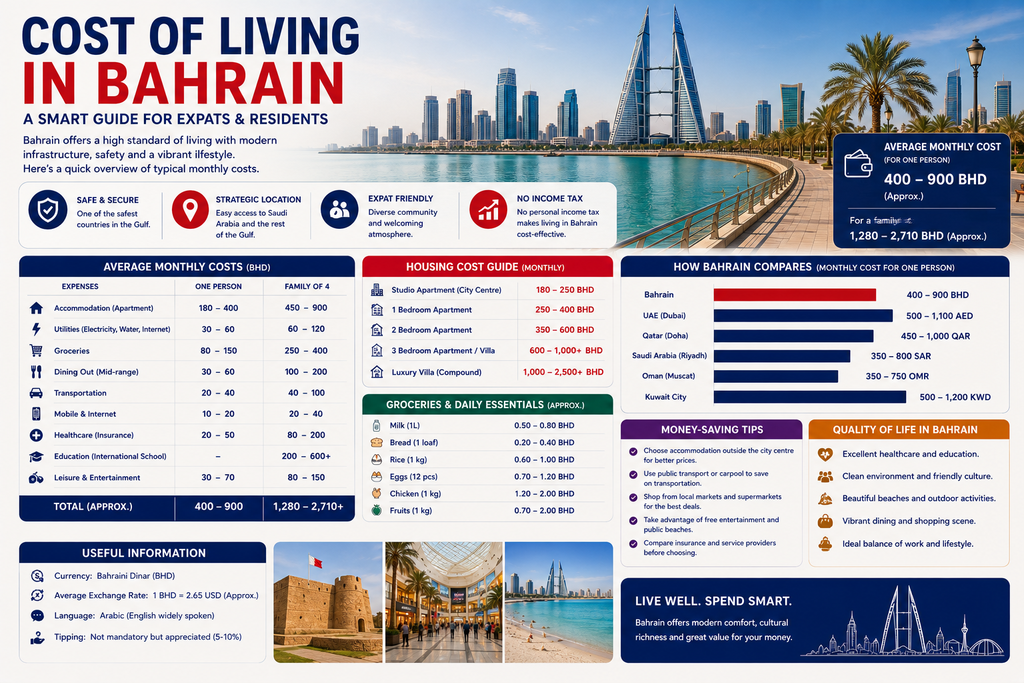
Several practical decisions can make Bahrain more affordable.
Choose housing based on total monthly cost rather than rent alone.
Live reasonably close to work.
Compare supermarkets.
Cook at home regularly.
Review mobile and internet plans.
Avoid unnecessary car finance.
Use buses or taxis when practical.
Check what your employer already covers.
Choose health insurance carefully.
Set a fixed entertainment budget.
Families should also negotiate employment packages around school fees and dependent insurance where possible.
What to Check Before Accepting a Bahrain Job
The basic salary tells only part of the story.
Before signing an employment contract, check whether the package includes:
Accommodation allowance
Transport allowance
Health insurance
Family insurance
Annual flights
School allowance
Relocation support
Residence permit costs
Performance bonus
End of service benefits
A lower basic salary with strong benefits can sometimes provide greater disposable income than a higher salary with no allowances.
Bahrain Cost of Living Compared With Other Gulf Countries
Bahrain’s smaller geographic scale can help reduce certain lifestyle costs, particularly when residents live close to their workplace.
However, comparing Bahrain directly with Dubai, Abu Dhabi, Doha, Riyadh or Muscat requires looking beyond rent.
Consider:
Salary levels
Housing
School fees
Healthcare
Transportation
Taxes
Family benefits
Entertainment
Savings potential
The best Gulf destination is not necessarily the one with the lowest monthly expenses. It is the location where your income, career opportunities and lifestyle requirements create the strongest overall balance.
Common Cost of Living Mistakes
New expatriates often underestimate their real expenses.
Common mistakes include:
Choosing expensive housing immediately
Ignoring school costs
Forgetting utility charges
Buying a car too quickly
Not checking health insurance coverage
Eating out too frequently
Ignoring VAT in everyday spending
Failing to budget for annual flights
Sending too much income into lifestyle upgrades
Not maintaining emergency savings
The first few months are a good time to track every major expense before making long term financial commitments.
Frequently Asked Questions
Is the Cost of Living in Bahrain high?
The Cost of Living in Bahrain varies significantly according to accommodation, family size, schooling, transportation and lifestyle. Housing and private education are likely to be among the biggest expenses for many expatriate households.
What is the VAT rate in Bahrain?
Bahrain currently has a standard VAT rate of 10 percent. Some goods and services are zero rated or exempt.
Is rent subject to VAT in Bahrain?
The sale and rental of real estate, including residential and commercial real estate and vacant land, is generally exempt from VAT. Certain separately charged property related services can still be subject to VAT.
Are school fees subject to VAT?
Qualifying educational services provided by recognised institutions can be zero rated. However, items such as uniforms, stationery and certain recreational activities can attract standard rate VAT.
Is public transport subject to VAT?
Bahrain’s VAT guidance treats local passenger transportation by buses and taxis as zero rated.
Can expats save money in Bahrain?
Yes. Savings potential depends on salary, housing choices, family expenses and the benefits included in the employment package.
Conclusion
The Cost of Living in Bahrain can range from relatively manageable to expensive depending largely on lifestyle and family circumstances.
Housing is likely to be the largest monthly expense for many residents, while international schooling can become a major financial commitment for families.
Groceries, transport, healthcare, telecommunications and entertainment should also be included when calculating the real cost of relocation.
Bahrain currently applies a 10 percent standard VAT rate, although important areas such as qualifying basic foods, education and healthcare can receive zero rated treatment, while real estate rental is generally exempt.
For expatriates, the most useful approach is to evaluate the complete employment package.
Do not look only at salary.
Calculate housing.
Check insurance.
Add school fees.
Estimate transport.
Budget for flights home.
Include everyday spending.
Then calculate how much income remains for savings.
When those numbers work comfortably, Bahrain can provide a balanced Gulf lifestyle with opportunities for career development, family life and long term financial planning.
follow us on Instagram
Read More – Bahrain Travel Guide: 10 Amazing Things to Know in 2026