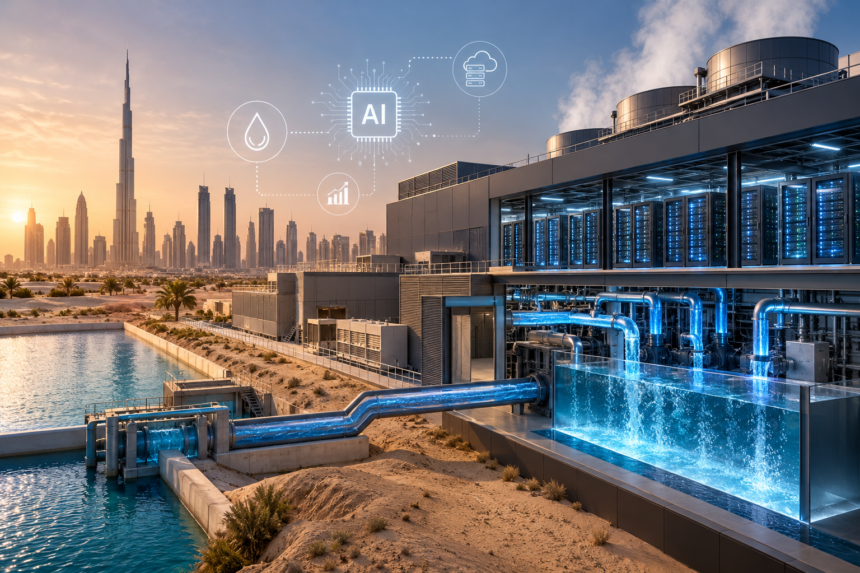
The Future of Sustainable AI Data Centres in the Gulf
Data Centre Water Usage is becoming an important environmental concern as the United Arab Emirates, Saudi Arabia and other Gulf countries invest heavily in artificial intelligence infrastructure. Behind the advanced processors, powerful servers and enormous computing facilities supporting AI lies a less visible requirement: water.
- Data Centre Water Usage: Why AI Infrastructure Needs Water
- How Much Water Do Data Centres Actually Consume?
- Why the AI Boom Creates a Bigger Water Challenge in the Gulf
- UAE and Saudi Arabia: How AI Data Centre Expansion Could Affect Water Security
- 7 Ways Data Centres Can Reduce Water Consumption
- The Hidden Environmental Costs Beyond Water Consumption
- The Future of Sustainable AI Data Centres in the Gulf
Artificial intelligence depends on data centres capable of processing huge amounts of information. These facilities operate continuously, consuming electricity and generating heat that must be removed to protect sensitive equipment.
Water can play a significant role in this cooling process. Some facilities use evaporative cooling towers, while others rely on chilled-water systems or advanced liquid cooling technologies. The amount of water consumed varies considerably according to location, design and operational conditions.
The challenge is particularly important in the Gulf, where extremely hot summers, limited natural freshwater resources and dependence on desalination create difficult environmental conditions.
According to the International Energy Agency’s 2025 Energy and AI report, global data centres consumed approximately 560 billion litres of water annually, a figure projected to rise to around 1.2 trillion litres by 2030 in its base-case scenario.
The same research estimated that a typical 100-megawatt hyperscale data centre in the United States consumes approximately two million litres of water daily when direct and indirect consumption are considered.
These figures are not specific to Gulf facilities, and they should not be used to calculate the water demand of an individual UAE or Saudi Arabian project without knowing its cooling technology and energy supply.
Nevertheless, they demonstrate the scale of the environmental considerations accompanying global AI expansion.
The Gulf is becoming an important location for this infrastructure. The UAE announced a five-gigawatt AI campus in Abu Dhabi in 2025, including the planned one-gigawatt Stargate UAE cluster.
Meanwhile, Saudi Arabia is pursuing major investment in computing infrastructure as part of its wider digital economy ambitions.
The question is no longer simply how much computing power these countries can build. It is how that growth can be supported without placing unnecessary pressure on water resources, electricity systems and the environment.
This article explains why data centres need water, how cooling systems operate, what makes the Gulf particularly vulnerable and which technologies could reduce the environmental cost of artificial intelligence.
Data Centre Water Usage: Why AI Infrastructure Needs Water
Data centres are specialised facilities containing servers, networking equipment, storage systems and supporting infrastructure.
These machines process information for websites, cloud applications, financial systems and increasingly sophisticated artificial intelligence models.
Although digital services may seem intangible, the equipment supporting them operates inside physical buildings.
Why Servers Generate Heat
Computer processors use electricity to perform calculations.
A substantial portion of that electrical energy ultimately becomes heat.
As servers operate, temperatures increase around sensitive electronic components.
Without effective cooling, high temperatures can reduce performance, shorten equipment life or trigger automatic shutdowns.
Cooling systems are therefore essential for reliable operation.
Why AI Increases Cooling Requirements
AI workloads can involve powerful graphics processing units and specialised accelerators.
These components often operate at high power densities, concentrating substantial heat inside individual server racks.
Advanced AI facilities consequently require carefully designed cooling infrastructure.
However, not every AI computation or data centre has the same energy demand. Efficiency depends on hardware, software, workloads and utilisation.
How Water Helps Remove Heat
Water can absorb and transport heat efficiently.
In many cooling systems, chilled water circulates through equipment that transfers heat away from server rooms.
The collected heat must then be released into the surrounding environment.
Cooling towers can accomplish this by evaporating some water, carrying heat into the atmosphere.
This process is effective but consumes water that must be replaced.
Where Data Centres Use Water
| Water Use | Main Purpose | Environmental Consideration |
|---|---|---|
| Cooling Towers | Release heat through evaporation | Direct water consumption |
| Chilled-Water Systems | Transfer heat | Depends on final heat rejection |
| Humidification | Maintain equipment-room conditions | Additional water demand |
| Electricity Generation | Supply power to facilities | Indirect water footprint |
| Chip Manufacturing | Produce computing components | Supply-chain water consumption |
| Facility Operations | Maintenance and sanitation | Smaller operational requirement |
An important distinction is that not all water circulating inside a facility is consumed.
Closed-loop systems can circulate the same fluid repeatedly, while evaporative systems require ongoing replacement water.
How Much Water Do Data Centres Actually Consume?
The amount of water consumed by a data centre depends on its computing capacity, cooling design, electricity source and surrounding climate.
There is no single reliable figure representing every facility.
Global Water Consumption Estimates
The International Energy Agency’s 2025 analysis provides a useful global baseline.
| Indicator | IEA Estimate |
|---|---|
| Global Annual Data Centre Water Consumption | Around 560 billion litres |
| Projected Global Consumption by 2030 | Around 1.2 trillion litres |
| Example 100 MW Hyperscale Facility | Around 2 million litres daily |
| Share of Example Facility’s Water Use That Is Indirect | More than 60% |
The 2030 number is a projection, not a measured future outcome.
The 100 MW example is based on a representative US facility and includes water associated with electricity and other indirect demands.
It is not a universal cooling-water requirement.
Understanding Water Withdrawal and Consumption
Water withdrawal describes the total amount taken from a source.
Water consumption refers to water that is not returned to the original source after use, often because it evaporates.
A facility may withdraw a large quantity of water but discharge some of it after treatment.
These two measurements should not be confused.
What Is Water Usage Effectiveness?
Water Usage Effectiveness, or WUE, is a standard measure of data-centre water efficiency.
It compares annual on-site water use with the energy consumed by computing equipment.
WUE is generally expressed in litres per kilowatt-hour.
Lower values indicate less on-site water use per unit of IT electricity consumption.
However, WUE does not normally include the water consumed through electricity generation.
A facility with low direct water use may still have a significant indirect footprint.
What Corporate Reporting Reveals
Google’s 2025 environmental report disclosed that its owned and operated data centres consumed approximately 7.79 billion US gallons of water in 2024.
This figure covered its reported global data-centre operations, not Gulf-specific facilities.
Such disclosures demonstrate why consistent reporting matters, but comparisons between companies require careful attention to what each figure includes.
Why the AI Boom Creates a Bigger Water Challenge in the Gulf
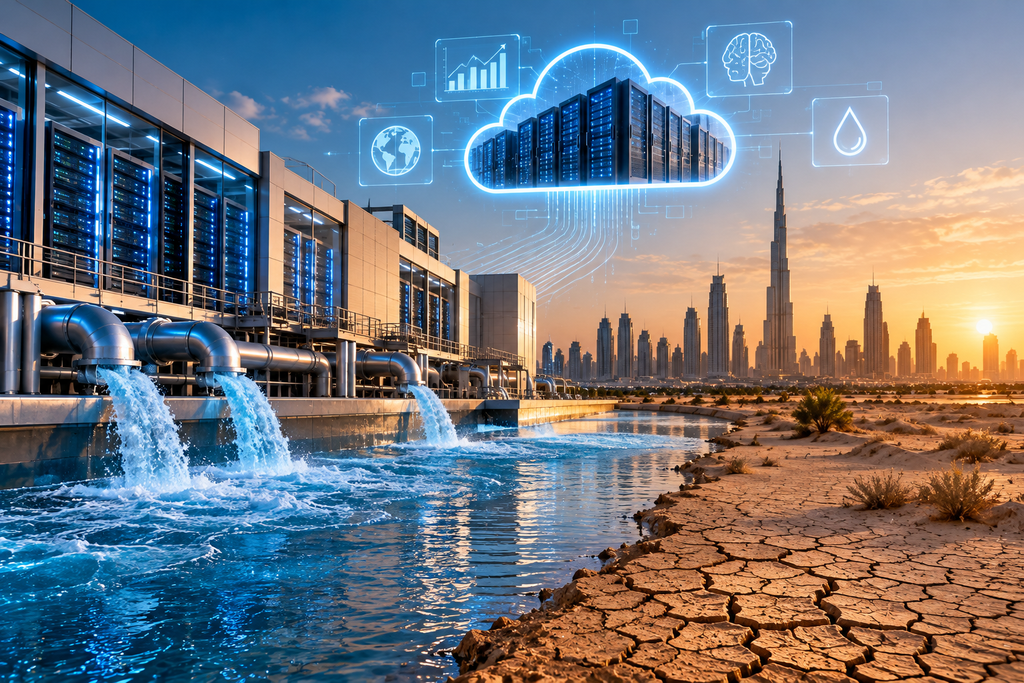
The Gulf Cooperation Council comprises the UAE, Saudi Arabia, Qatar, Kuwait, Bahrain and Oman.
All six countries face significant water-related challenges because of their generally arid climates.
Large AI facilities add another category of demand to an already complex relationship between electricity, cooling and freshwater supply.
Extreme Summer Temperatures
Outdoor temperatures in parts of the Gulf can exceed 40°C during summer.
High ambient temperatures can increase the difficulty of rejecting heat from data-centre systems.
Cooling equipment may need to operate more intensively when outdoor conditions provide limited opportunities for efficient heat removal.
The exact impact depends on the cooling system and local temperature and humidity.
Limited Renewable Freshwater Resources
Many Gulf countries have limited naturally replenished freshwater supplies.
Groundwater resources are already important for agricultural and other uses.
This creates a need to evaluate carefully any new industrial demand for freshwater.
Dependence on Desalination
Desalination provides a major portion of municipal water supplies across the region.
The International Energy Agency estimates that the Middle East and North Africa produced approximately 12 billion cubic metres of desalinated water in 2024.
Producing desalinated water requires energy, infrastructure and ongoing operating costs.
If data centres depend on desalinated water, their cooling requirements can create additional demand for water-production capacity.
The Electricity-Water Connection
Data centres require electricity to operate computing equipment and cooling systems.
Producing electricity can also consume water, depending on the power generation technology.
This creates two connected environmental considerations:
- Water consumed directly at the data centre.
- Water consumed indirectly through electricity generation and supply chains.
Reducing direct cooling-water demand does not automatically eliminate the wider water footprint.
Why the Gulf Is Different
| Factor | Effect on Data Centre Planning |
|---|---|
| High Summer Temperatures | Increased cooling challenges |
| Limited Freshwater | Greater importance of water efficiency |
| Desalination Dependence | Connection between water and electricity |
| Rapid AI Investment | Potential increase in infrastructure demand |
| Urban Development | Competition for infrastructure capacity |
| Renewable Energy Expansion | Opportunities to improve electricity supply |
The Gulf’s challenge is not simply a lack of water. It is ensuring that new digital infrastructure fits within long-term water, energy and environmental planning.
UAE and Saudi Arabia: How AI Data Centre Expansion Could Affect Water Security
The UAE and Saudi Arabia are among the Gulf countries investing heavily in AI infrastructure. Their projects illustrate both the economic opportunities and environmental questions associated with expanding computing capacity.
The UAE’s Stargate AI Project
In May 2025, the UAE and international technology partners announced Stargate UAE, a planned one-gigawatt computing cluster within a larger five-gigawatt AI campus in Abu Dhabi.
The project involves G42, OpenAI, Oracle, NVIDIA, Cisco and SoftBank. Its first 200-megawatt phase was originally scheduled to become operational during 2026.
The announced gigawatt figures describe planned infrastructure capacity, not measured water consumption or proof that the full campus is operating.
In September 2026, Reuters reported that the UAE was considering changes to the wider campus configuration following security concerns. G42 said construction remained on schedule, although the implications of potential design changes were not fully established.
Saudi Arabia’s AI Infrastructure Ambitions
Saudi Arabia is also developing substantial AI computing capacity through government-backed and private-sector initiatives.
The expansion reflects the country’s ambition to support cloud services, artificial intelligence development and digital industries.
However, new facilities will require reliable electricity and cooling infrastructure.
Project-level water requirements will depend on the specific equipment, technology and location.
Qatar and Other GCC Markets
Qatar, Bahrain, Kuwait and Oman are also developing their digital infrastructure.
Cloud computing, financial services and AI applications create demand for reliable local and regional data centres.
Water efficiency will be an important consideration wherever facilities operate in water-stressed environments.
Regional Water Risk Comparison
| Country | Relevant Planning Challenge |
|---|---|
| UAE | Expanding AI capacity alongside desalination-dependent supplies |
| Saudi Arabia | Large-scale computing investment across hot, dry locations |
| Qatar | Cooling demand and water infrastructure requirements |
| Kuwait | High temperatures and limited natural freshwater |
| Bahrain | Water security and efficient infrastructure development |
| Oman | Location-specific climate and water availability |
Why Gulf-Specific Evidence Matters
Research published in 2026 highlights the difficulty of estimating regional water demand because detailed operator-level figures remain limited.
Some studies use modelling to explore possible future requirements, but these should not be confused with measured consumption.
A recently published UAE preprint, dated October 24, 2026, also examines the environmental implications of data-centre growth. Its findings remain preliminary and have not undergone peer review.
More consistent reporting will be necessary to understand how much water new Gulf facilities actually consume.
7 Ways Data Centres Can Reduce Water Consumption
Reducing water consumption requires careful choices about cooling technology, facility design and energy supply.
There is no universal solution suitable for every location.
1. Use Closed-Loop Liquid Cooling
Direct-to-chip cooling circulates liquid through specialised equipment near processors.
The fluid transfers heat away from electronic components and can be reused within a closed loop.
However, the final system still needs a method of releasing heat.
If that method uses evaporative cooling towers, water consumption may remain significant.
2. Consider Dry Cooling Systems
Dry cooling releases heat into the surrounding air without relying on continuous evaporation.
It can substantially reduce direct water consumption.
The disadvantage is that dry cooling may require more electricity, particularly during extremely hot weather.
This makes the source of electricity an important environmental consideration.
3. Introduce Hybrid Cooling
Hybrid systems combine different cooling methods.
A facility may use dry cooling when conditions are favourable and water-assisted cooling when additional efficiency is needed.
This approach can balance electricity demand with water conservation.
4. Use Treated Wastewater
Some facilities can use suitably treated reclaimed water rather than potable water.
This may reduce competition with household drinking-water supplies.
However, reclaimed water must meet technical requirements, and its treatment and distribution also require resources.
5. Improve Server Efficiency
Efficient processors, optimised software and better workload management can reduce electricity consumption for a given amount of computing.
Lower electrical demand generally means less heat requiring removal.
Efficiency improvements should be evaluated alongside overall growth in computing demand.
6. Monitor Water Consumption Continuously
Operators can install measurement systems to track cooling performance and identify excessive use.
Monitoring can reveal leaks, inefficient operating conditions or maintenance problems.
Transparent reporting also makes it easier to compare facility performance over time.
7. Combine Water Efficiency With Cleaner Electricity
Reducing water use at a data centre is only one part of the challenge.
Electricity generation can have an additional water footprint.
Combining efficient cooling with low-water electricity sources can help reduce overall consumption.
Cooling Technology Comparison
| Cooling Technology | Direct Water Demand | Main Trade-Off |
|---|---|---|
| Evaporative Cooling | Can be high | Saves cooling electricity in suitable conditions |
| Dry Cooling | Generally low | May increase electricity demand |
| Closed-Loop Liquid Cooling | Depends on heat-rejection system | Requires specialised infrastructure |
| Hybrid Cooling | Variable | More complex operation |
| Reclaimed-Water Cooling | May reduce potable-water demand | Requires suitable water treatment |
The most appropriate solution depends on local conditions, electricity sources and the facility’s computing requirements.
The Hidden Environmental Costs Beyond Water Consumption
Water is only one part of the environmental impact of artificial intelligence infrastructure.
Data centres also require substantial electricity, equipment and construction materials.
Electricity Demand
AI computing systems operate continuously and may require substantial power.
The IEA’s Energy and AI report estimated global data-centre electricity consumption at approximately 415 terawatt-hours in 2024, with demand projected to reach around 945 terawatt-hours by 2030 in its base case.
These figures cover data centres serving different digital workloads, not AI alone.
Carbon Emissions
The environmental impact of electricity depends partly on how it is generated.
Facilities relying on fossil-fuel electricity can have a different emissions profile from those supplied by lower-carbon sources.
However, renewable electricity arrangements also require careful evaluation, including when and where electricity is generated and consumed.
Manufacturing Advanced Chips
Producing semiconductors involves sophisticated manufacturing processes requiring ultrapure water.
As demand for AI equipment increases, semiconductor manufacturing becomes another important part of the industry’s wider water footprint.
This impact may occur outside the country where a data centre operates.
Construction and Materials
New computing facilities require buildings, electrical systems, cooling equipment and other infrastructure.
Manufacturing and transporting these materials creates additional environmental impacts.
A complete assessment should therefore consider construction, operation, equipment replacement and eventual disposal.
The Water-Energy Trade-Off
One important challenge is that reducing direct water consumption may increase electricity demand.
For example, replacing evaporative cooling with dry cooling may save significant amounts of water at the facility.
However, electricity consumption may rise during hot periods.
Whether this provides an overall environmental improvement depends on the electricity system and local water scarcity.
Environmental Impact Checklist
- Measure on-site water consumption.
- Assess indirect water demand.
- Report electricity consumption.
- Evaluate cooling-system efficiency.
- Consider local water availability.
- Examine the source of cooling water.
- Assess emissions associated with electricity.
- Account for equipment manufacturing.
- Review environmental performance regularly.
- Publish meaningful operational indicators.
A responsible environmental assessment should consider these factors together rather than focusing on one headline figure.
The Future of Sustainable AI Data Centres in the Gulf
The Gulf’s growing AI infrastructure creates an opportunity to establish water-efficient design as a central part of digital development.
However, meaningful improvements require cooperation between technology companies, utilities, planners and regulators.
Planning Infrastructure Before Construction
Large computing facilities should be evaluated against local electricity and water capacity before development proceeds.
Such assessments can help identify whether additional supply infrastructure is needed.
They can also support comparisons between different cooling approaches.
Improving Transparency
Publicly available data on the water consumption of individual Gulf facilities remains limited.
Regular reporting of actual consumption, water sources and cooling performance would make environmental assessments more reliable.
Companies should distinguish measured outcomes from future commitments and engineering projections.
Encouraging Responsible Technology Investment
AI infrastructure can support research, innovation and economic diversification.
However, its benefits should be considered alongside resource requirements and operational costs.
Water-efficient design, reliable electricity and strong environmental management can contribute to more sustainable development.
Frequently Asked Questions
Why do AI data centres need so much water?
Some use water-based cooling systems to remove heat generated by servers and processors. Water is also consumed indirectly through electricity production and equipment manufacturing.
Do all data centres consume large amounts of water?
No. Direct consumption varies considerably according to cooling technology, location and operations. Some facilities use dry or closed-loop systems with very low on-site water consumption.
How much water does a large data centre use daily?
The IEA provides an illustrative estimate of approximately two million litres per day for a 100 MW hyperscale facility in the United States, including indirect water use. Individual facilities may differ substantially.
Why is data-centre water usage a concern in the UAE?
The UAE has limited natural freshwater resources and relies heavily on desalination. Additional industrial water demand must therefore be evaluated carefully.
Can seawater cool data centres?
Certain specially engineered systems can use seawater for heat rejection. However, corrosion, marine environmental effects, location and infrastructure requirements must be addressed.
Is liquid cooling completely water-free?
Not necessarily. Liquid can circulate repeatedly inside a closed loop, but the system used to reject heat may still consume water.
Can renewable energy reduce data-centre water consumption?
Some low-water electricity sources can reduce the indirect water footprint. The benefit depends on the generation technology and cooling arrangements.
Final Thoughts on Data Centre Water Usage and the Gulf AI Boom
The rapid expansion of artificial intelligence is creating new economic opportunities across the Gulf, but it also introduces substantial infrastructure requirements.
Behind powerful processors and sophisticated computing systems are physical facilities that require reliable electricity and continuous cooling.
Water can be an essential part of that process, particularly where evaporative cooling systems are used.
For countries such as the UAE and Saudi Arabia, the challenge is particularly important because high temperatures and limited natural freshwater resources already create pressure on water infrastructure.
The solution is not necessarily to abandon AI development or assume that every data centre has the same environmental impact.
Instead, governments and businesses need reliable consumption data, efficient cooling technologies and appropriate planning.
Dry cooling, closed-loop liquid systems, treated wastewater and cleaner electricity can all play roles, depending on local circumstances.
Ultimately, Data Centre Water Usage should become a central consideration in discussions about the Gulf’s AI ambitions.
The region’s long-term success in artificial intelligence will depend not only on computing capacity and technological innovation, but also on how responsibly it manages the resources required to support them.
Editorial Note: This article reflects published research and infrastructure announcements available through October 27, 2026. Global figures are not presented as Gulf-specific consumption measurements. Future estimates and preliminary research findings remain subject to uncertainty.
Do follow us on Instagram
Read More – Digital Twins Explained: How Virtual Cities Could Transform Urban Planning in the UAE