Redefining Rhinoplasty Through Precision and Experience
In the world of modern aesthetic medicine, rhinoplasty requires more than the ability to reshape a nose. It demands an understanding of facial anatomy, breathing function, individual identity, and the delicate relationship between appearance and natural movement.
- A Medical Journey Defined by Experience and Specialisation
- Understanding the Expectations of Gulf Patients
- The Role of Piezo Ultrasonic Technology in Rhinoplasty
- Dynamic Rhinoplasty: Considering How the Nose Moves
- Revision Rhinoplasty: Addressing the Complexity of Previous Surgery
- Cartilage Grafting and Rebuilding Nasal Support
- Sharing Surgical Knowledge Beyond Istanbul
- Why Experience Matters When Choosing Rhinoplasty Abroad
- A Philosophy of Preservation, Precision and Natural Harmony
- Looking Ahead: Advancing Rhinoplasty Through Experience and Innovation
For patients across the Gulf, particularly those travelling from Dubai, Riyadh, and Doha, Turkey has become an important destination to consider for specialised rhinoplasty procedures.
The country’s established surgical community, international medical conferences, and experienced specialists have contributed to its visibility in the field of facial aesthetic surgery.
According to the International Society of Aesthetic Plastic Surgery’s 2024 Global Survey, Turkey ranked third worldwide in estimated rhinoplasty procedure volume, with nearly 61,000 procedures.
Among Istanbul’s internationally active specialists is Dr. Emre İlhan, an ear, nose, and throat surgeon whose professional focus includes primary and revision rhinoplasty.
With more than 25 years of experience and over 10,000 surgical operations reported by his practice, Dr. İlhan has developed an approach centred on individual anatomy, careful planning, and the balance between aesthetic refinement and nasal function.
His philosophy begins with two important questions: What should be changed, and what should be preserved?
A Medical Journey Defined by Experience and Specialisation
Dr. Emre İlhan’s medical journey began in 1994, establishing the foundation for a career dedicated to understanding the complexities of nasal anatomy and surgical treatment.
Through his training in ear, nose, and throat surgery, he developed a strong understanding of the relationship between nasal structure, breathing, and facial appearance.
Over the following decades, rhinoplasty became a central focus of his professional work.
Today, his practice includes both primary rhinoplasty, performed on patients undergoing nasal surgery for the first time, and revision rhinoplasty, which addresses concerns following previous operations.
His experience across thousands of procedures has exposed him to a wide range of anatomical variations, patient expectations, and surgical challenges.
However, the significance of this experience extends beyond numbers.
Every patient presents a different combination of facial proportions, nasal structure, medical history, and personal preferences.
For Dr. İlhan, these differences make individualised surgical planning essential.
Rather than applying a standard aesthetic ideal, his approach considers which refinements may complement the patient’s natural features while maintaining the structural support required for healthy nasal function.
Understanding the Expectations of Gulf Patients
Patients travelling from the Gulf often approach rhinoplasty with specific aesthetic preferences and personal considerations.
Some may wish to refine a prominent nasal bridge while maintaining the distinctive character of their profile.
Others may seek greater definition around the nasal tip or improvements in breathing alongside aesthetic changes.
These goals require careful consultation because the same requested appearance may involve different surgical considerations depending on the individual’s anatomy.
For example, a patient may wish to smooth a bump along the nasal bridge without dramatically changing their overall facial identity.
Another patient may want more nasal tip definition while also experiencing breathing difficulties associated with structural concerns.
In both situations, Dr. İlhan’s consultation process examines the relationship between appearance, anatomy, and function.
He evaluates how the nose fits the face, discusses the patient’s expectations, and considers whether the proposed changes are surgically appropriate.
This personalised approach is particularly important for international patients, who must understand the proposed procedure, its limitations, recovery requirements, and follow-up arrangements before deciding to travel for surgery.
For Dr. İlhan, the objective is not to create identical noses but to develop a surgical plan that respects the individuality of each patient.
The Role of Piezo Ultrasonic Technology in Rhinoplasty
Advances in surgical technology have introduced new possibilities for precision during rhinoplasty.
One technique incorporated into Dr. İlhan’s practice is Piezo ultrasonic rhinoplasty.
This approach uses specialised ultrasonic instruments to reshape or cut nasal bones in a controlled manner.
Traditional bone reshaping techniques rely on mechanical instruments, whereas Piezo technology offers an alternative method for selected procedures requiring adjustments to the nasal framework.
For Dr. İlhan, the decision to use this technology depends on the patient’s anatomy and the specific structural changes being considered.
When the nasal bones require reshaping, ultrasonic instruments may allow the surgeon to perform controlled bone cuts while planning the desired contours.
However, technology alone does not determine surgical success.
Its effectiveness depends on appropriate patient selection, anatomical understanding, and the surgeon’s experience in applying the technique.
Dr. İlhan’s interest in ultrasonic bone surgery also extends into professional education, where he shares technical knowledge with other surgeons.
His work reflects an approach in which modern instruments support surgical judgment rather than replace it.
Dynamic Rhinoplasty: Considering How the Nose Moves
A nose is not a completely static facial structure.
Its appearance can change subtly when a person smiles, speaks, or makes different facial expressions.
These movements are an important consideration in Dr. İlhan’s approach to dynamic rhinoplasty.
Rather than evaluating the nose only through photographs or its appearance at rest, dynamic rhinoplasty considers the relationship between nasal anatomy, movement, and structural support.
For some patients, movement during smiling may influence the appearance of the nasal tip or the overall balance of the profile.
In these situations, surgical planning must consider how the nose behaves during everyday expressions.
Dr. İlhan incorporates these observations when deciding which structures may require adjustment and which should be preserved.
The aim is to refine the nasal appearance without unnecessarily compromising its natural movement or support.
This approach demonstrates why rhinoplasty requires both anatomical precision and an understanding of facial expression.
Piezo technology and dynamic rhinoplasty serve different purposes within his surgical practice.
While Piezo instruments may assist with controlled bone reshaping, dynamic rhinoplasty informs planning when nasal movement and structural stability are important considerations.
Together, they reflect a surgical philosophy that looks beyond appearance alone.
Revision Rhinoplasty: Addressing the Complexity of Previous Surgery
Revision rhinoplasty represents one of the more technically demanding areas of nasal surgery.
Unlike primary rhinoplasty, revision procedures involve a nose that has already undergone surgical alteration.
Previous operations may have changed the available cartilage, created scar tissue, affected structural support, or introduced functional concerns.
As a result, a revision procedure cannot simply repeat the techniques used during an initial operation.
Dr. İlhan’s published approach to revision rhinoplasty begins with a detailed assessment of what the previous surgery changed.
An important element of this process is structural mapping, which helps establish the condition of the existing nasal framework before further surgical decisions are made.
He reviews the patient’s surgical history and examines the septum, scar tissue, airway, remaining cartilage, and supporting structures.
This evaluation helps identify whether a patient may benefit from a focused adjustment or requires more extensive reconstruction.
For example, some cases may involve relatively limited concerns about nasal contour.
Others may require restoration of structural support around the bridge, tip, or nasal valves.
Understanding these differences is essential because two patients requesting similar aesthetic changes may need entirely different surgical procedures.
Dr. İlhan’s revision protocol places particular importance on identifying the underlying structural problem before deciding how to address it.
Cartilage Grafting and Rebuilding Nasal Support
In complex revision rhinoplasty, the surgeon may need additional cartilage to reinforce or reconstruct parts of the nose.
The choice of graft material depends on the condition of the existing nasal structure and the support required.
Dr. İlhan considers several potential sources of cartilage, including the nasal septum, ear, and rib.
Each option has different characteristics and may be appropriate for different reconstructive needs.
Septal cartilage may be considered when sufficient suitable tissue remains available following the previous operation.
Ear cartilage may provide an alternative in selected cases, while rib cartilage may be considered when greater quantities or stronger structural support are required.
The decision is based on the patient’s surgical history, remaining cartilage, anatomical limitations, and reconstructive objectives.
For Dr. İlhan, the central question is not simply which material can be used, but which approach is most appropriate for restoring or maintaining nasal support.
This careful evaluation is particularly important in revision cases where previous surgical changes may limit available options.
By combining structural assessment with individualised reconstruction planning, his approach addresses both the visible concerns and the underlying framework of the nose.
Sharing Surgical Knowledge Beyond Istanbul
Beyond his clinical practice, Dr. Emre İlhan has established an international educational presence through surgical conferences, anatomy training, and professional collaboration.
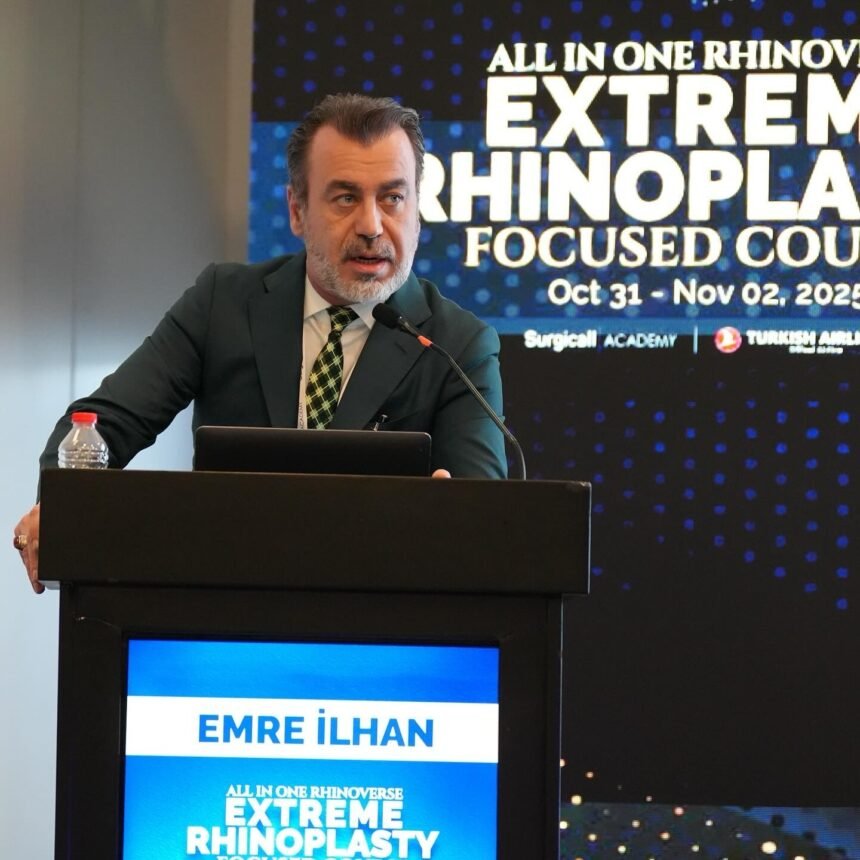
His involvement in the All in One Rhinoplasty Congress reflects his commitment to advancing knowledge in primary and revision rhinoplasty.
As a co-director of the 2026 All in One Rhinoplasty & Face Congress in Istanbul, he helped bring together international specialists to exchange surgical techniques, discuss complex cases, and explore developments in facial aesthetic surgery. EAFPS+1
The congress programme included discussions on preservation rhinoplasty, structural reconstruction, nasal function, cartilage grafting, and surgical planning.
Through educational activities involving live surgical demonstrations, anatomy courses, and scientific presentations, Dr. İlhan contributes to professional conversations that extend beyond his own operating theatre.
His teaching interests include primary and revision rhinoplasty and ultrasonic bone surgery, connecting practical surgical experience with the education of other medical professionals.
For him, professional development involves not only refining personal techniques but also participating in the wider exchange of surgical knowledge.
Why Experience Matters When Choosing Rhinoplasty Abroad
For patients considering rhinoplasty outside their home country, choosing a surgeon involves several important considerations.
Experience, specialist training, communication, hospital standards, and postoperative care all contribute to an informed decision.
Turkey’s position in international rhinoplasty reflects a substantial volume of surgical activity, but national procedure numbers alone cannot establish the quality or suitability of an individual surgeon.
For patients travelling from the Gulf, careful planning is particularly important because rhinoplasty recovery requires appropriate monitoring and follow-up.
Before proceeding, patients should understand the proposed surgical technique, possible complications, realistic outcomes, recovery timeline, and arrangements for care after returning home.
Dr. İlhan’s consultation approach places emphasis on examining individual anatomy and determining whether a requested change is appropriate.
His experience in both primary and revision procedures also allows him to consider the different challenges associated with first-time surgery and reconstruction following previous operations.
For international patients, the value of an individualised consultation lies in understanding not only what surgery may change but also what should remain untouched.
A Philosophy of Preservation, Precision and Natural Harmony
Throughout his career, Dr. Emre İlhan’s approach has reflected the importance of balancing surgical intervention with respect for natural anatomy.
A successful rhinoplasty plan is not simply about reducing a nasal bridge, refining a tip, or changing a profile.
It also requires considering the structures that support breathing, facial expression, and long-term nasal stability.
His use of Piezo ultrasonic instruments, attention to dynamic nasal movement, and structured evaluation of revision cases demonstrate how different techniques can serve specific surgical purposes.
Rather than relying on a single method for every patient, his approach begins with understanding the problem and selecting the appropriate surgical response.
This philosophy is especially relevant in modern aesthetic medicine, where patients increasingly seek changes that complement their natural appearance rather than completely transform it.
For Dr. İlhan, preserving individuality remains an important part of surgical planning.
Looking Ahead: Advancing Rhinoplasty Through Experience and Innovation
Today, Dr. Emre İlhan continues his professional work in Istanbul, focusing on primary and revision rhinoplasty, surgical education, and the development of specialised techniques.
His career reflects more than 25 years of experience, thousands of procedures, and continued participation in international scientific exchange.
Yet the principles guiding his work remain centred on individual anatomy, responsible decision-making, and the relationship between appearance and nasal function.
For Gulf patients considering rhinoplasty in Turkey, his approach offers an example of how surgical experience, modern technology, and personalised planning can come together within a specialist practice.
From controlled bone reshaping with Piezo instruments to dynamic rhinoplasty and structural reconstruction in revision cases, each technique serves a different purpose.
The essential decision is determining which approach is appropriate for the individual patient.
Ultimately, Dr. Emre İlhan’s professional journey demonstrates that rhinoplasty is not simply about changing the appearance of a nose. It is about understanding its structure, respecting its function, and making carefully considered changes that complement the individual.
Follow Dr. Emre İlhan on Instagram
Read More – Buying a Used Car in the Gulf: 15 Powerful Checks