



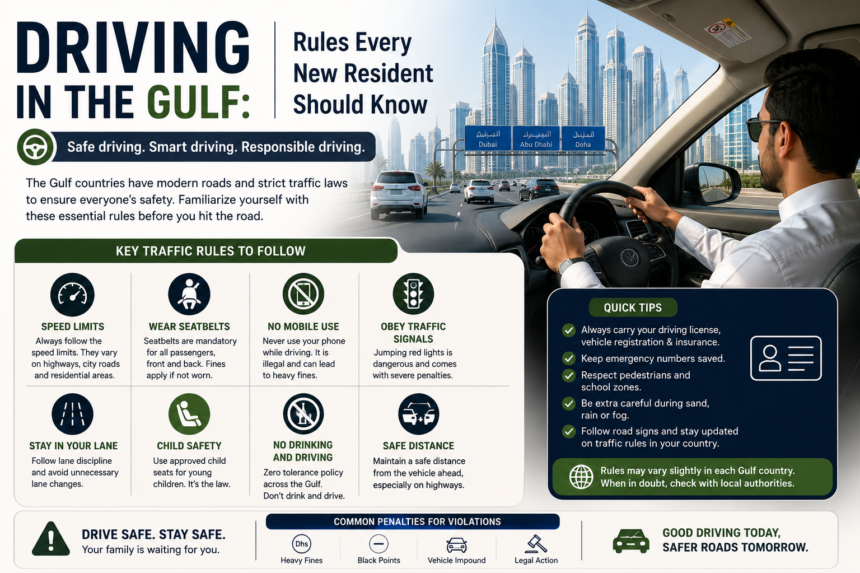
Essential Rules for New Residents
Moving to the Gulf can change the way you think about driving. Cities such as Dubai, Abu Dhabi, Riyadh, Doha, Muscat, Manama and Kuwait City have extensive modern road networks, but new residents can still find the experience challenging during their first few weeks. Large multi-lane highways, unfamiliar exits, fast-moving traffic, roundabouts, road cameras and different driving habits can make even experienced drivers feel uncertain at first.
- Driving in the Gulf at a Glance
- 1. Make Sure Your Driving Licence Is Valid for Your Residency Status
- 2. Do Not Treat Gulf Speed Limits as One Regional Rule
- 3. Understand That Speed Cameras Are Common
- 4. Seat Belts Should Be Used by Everyone
- 5. Avoid Using a Handheld Mobile Phone While Driving
- 6. Learn Lane Discipline Before Driving on Major Highways
- 7. Learn Roundabout Rules Carefully
- 8. Red Traffic Lights Must Be Taken Seriously
- 9. Children Need Proper Restraints
- 10. Insurance and Vehicle Registration Are Essential
- 11. Know What to Do After an Accident
- 12. Weather Can Change Driving Conditions Quickly
- 13. Extreme Heat Requires Vehicle Preparation
- 14. Driving Styles Differ Between Gulf Cities
- 15. Never Drive After Drinking Alcohol
- Driving in the UAE for New Residents
- Driving in Saudi Arabia for New Residents
- Driving in Qatar for New Residents
- Driving in Oman for New Residents
- Driving in Bahrain for New Residents
- Driving in Kuwait for New Residents
- Common Driving Mistakes New Gulf Residents Make
- Driving Across GCC Borders
- Renting a Car When You First Arrive
- Buying Your First Car in the Gulf
- Driving in the Gulf During Ramadan
- Essential Documents and Preparation for Gulf Drivers
- Driving in the Gulf: Rules Every New Resident Should Remember
- Final Thoughts on Driving in the Gulf
The Gulf Cooperation Council includes the UAE, Saudi Arabia, Qatar, Kuwait, Bahrain and Oman, and each country has its own traffic laws, licensing procedures, fines and vehicle regulations. There are many similarities across the region, particularly around speeding, seat belts, mobile-phone use and road safety, but residents should never assume that a rule or penalty in one GCC country automatically applies in another.
Driving legally also involves more than knowing how to operate a car. New residents need to understand whether their existing licence remains valid after becoming a resident, how local driving licences are obtained, what documents should be carried, how speed limits are enforced and what to do after an accident. Vehicle registration, insurance and inspection requirements are equally important.
This guide to Driving in the Gulf explains 15 essential rules and practical habits every new resident should understand before getting behind the wheel.
Driving in the Gulf at a Glance
Road infrastructure across much of the GCC is highly developed, particularly around major cities and highways. However, traffic conditions can change dramatically between a busy Dubai motorway, central Riyadh, Doha’s urban roads and a long-distance route through Oman. Drivers should therefore learn both the national traffic rules and the conditions specific to the city where they live.
| Area | What New Residents Should Know |
|---|---|
| Driving licence | Residency can change which licence you need |
| Speed | Follow the posted limit rather than assuming one standard limit |
| Seat belts | Treat them as essential for everyone in the vehicle |
| Mobile phones | Avoid handheld phone use while driving |
| Insurance | Confirm valid vehicle insurance before driving |
| Registration | Make sure the vehicle is legally registered |
| Children | Follow local child-restraint requirements |
| Cameras | Automated traffic enforcement is widespread |
| Accidents | Know the country’s reporting procedure |
| Weather | Fog, rain, dust and extreme heat require extra caution |
| Long-distance travel | Fuel, tyres and vehicle condition matter |
| Local rules | Never assume all six GCC countries use identical regulations |
The safest approach for a newcomer is to drive conservatively until the local road environment becomes familiar.
1. Make Sure Your Driving Licence Is Valid for Your Residency Status
One of the first mistakes a new resident can make is assuming that a licence used during a holiday or short visit will remain valid after obtaining residency. Visitor driving arrangements and resident licensing requirements are not necessarily the same.
Oman provides a clear example. Royal Oman Police guidance states that a visitor can use their home-country driving licence while holding a visit visa valid for up to three months, but someone intending to reside in Oman must obtain an Omani driving licence. The possibility of exchanging an overseas licence can also depend on the country that issued it.
Similar considerations apply elsewhere in the Gulf. Some foreign licences may qualify for exchange or recognition under national rules, while drivers from other countries may need to complete local tests or additional procedures.
New residents should check the official traffic authority immediately after receiving residency rather than relying on information provided by friends or old online discussions. Driving with an invalid licence can create legal and insurance problems that are far more serious than the inconvenience of completing the proper licensing process.
2. Do Not Treat Gulf Speed Limits as One Regional Rule
There is no single GCC speed limit. Limits vary according to the country, road, city and type of route, and drivers should always follow the posted traffic signs.
Urban residential streets can have relatively low limits, while major highways allow considerably faster travel. Limits can also change along the same journey as a road moves from a highway into a developed urban area.
New residents sometimes make the mistake of following the speed of surrounding traffic instead of watching the signs. This is particularly risky on wide highways where a road can feel safe at high speed even though the legal limit is lower.
Saudi Arabia’s official National Platform specifically identifies exceeding the specified speed as a traffic violation. Similar enforcement exists throughout the GCC, and automated systems make it increasingly difficult to treat speeding as something that will only be noticed when a police officer is nearby.
The simplest rule is to follow the displayed limit and adjust your speed further when weather or traffic conditions make the legal maximum unsafe.
3. Understand That Speed Cameras Are Common
Traffic enforcement in Gulf cities increasingly relies on technology. Drivers can encounter fixed cameras, mobile enforcement systems and other monitoring technologies across major road networks.
For newcomers, this means the absence of visible police vehicles does not mean a road is not being monitored. A driver may receive a violation without having been stopped at the roadside.
Cameras and traffic systems may monitor different types of behaviour depending on the country and road. Speeding and red-light violations are among the most important areas for drivers to take seriously.
Trying to memorise camera locations is therefore a poor driving strategy. Road layouts change, enforcement systems expand and mobile monitoring can appear in different locations.
Driving consistently within the law is much easier than attempting to slow down only when approaching a familiar camera.
4. Seat Belts Should Be Used by Everyone
A seat belt should become automatic before the vehicle starts moving. This applies not only to the driver but also to passengers.
Saudi Arabia’s official transport guidance specifically instructs drivers to ensure that all passengers fasten their seat belts before operating the vehicle, and failure to wear a seat belt is identified among the Kingdom’s traffic violations.
New residents should adopt the same habit throughout the GCC regardless of whether enforcement appears strict on a particular road. Rear-seat passengers should not assume they are protected simply because they are sitting behind the driver.
Seat belts become particularly important on Gulf highways, where vehicles may be travelling at significant speeds. Even a relatively ordinary collision can become much more dangerous when an occupant is not restrained.
Parents should pay additional attention to children and follow the specific child-restraint regulations applicable in their country of residence.
5. Avoid Using a Handheld Mobile Phone While Driving
Mobile-phone distraction is treated seriously across Gulf road-safety systems. Saudi Arabia’s official National Platform explicitly lists using a mobile phone while driving among traffic violations, alongside speeding, running red lights and failure to wear a seat belt.
The practical solution is simple: prepare navigation before beginning the journey and use an appropriate hands-free system when legally permitted. If something on the phone requires your full attention, stop somewhere safe before using it.
Navigation deserves special attention because new residents often depend heavily on mapping applications. Looking down repeatedly at a phone while approaching complicated junctions can be particularly dangerous.
Mount the device appropriately, enable voice guidance and review the general route before leaving. Missing an exit is inconvenient, but making a sudden manoeuvre because you were distracted by a navigation screen can be dangerous.
6. Learn Lane Discipline Before Driving on Major Highways
Multi-lane highways are common throughout the Gulf, and proper lane discipline makes driving safer and more predictable. Drivers should use indicators when changing lanes, maintain awareness of vehicles approaching from behind and avoid moving across several lanes at the last moment to reach an exit.
New residents can sometimes become overwhelmed by large junctions and attempt sudden lane changes when navigation tells them an exit is approaching. It is safer to miss the exit and allow the navigation system to recalculate the route.
Maintaining sufficient distance from the vehicle ahead is equally important. High speeds reduce the amount of time available to react to sudden braking, road debris or congestion.
Aggressive tailgating should never be copied simply because another driver is doing it. Increase your own safety margin and avoid turning another person’s poor driving decision into your emergency.
7. Learn Roundabout Rules Carefully
Roundabouts remain common in parts of the Gulf, particularly in Oman and some older or less densely developed areas. New residents who come from countries with different lane practices may initially find large multi-lane roundabouts confusing.
The correct approach is to follow road markings, signs and local traffic regulations rather than relying entirely on habits learned elsewhere. Choose the appropriate lane before entering when possible and signal clearly when required.
Avoid changing several lanes inside a roundabout simply because you suddenly realise your exit is approaching. Continuing around or safely adjusting the route is better than making an unpredictable manoeuvre.
Drivers should also watch carefully for pedestrians, motorcycles and vehicles entering or leaving nearby service roads. Roundabouts require awareness of several directions at once, so reducing distraction is especially important.
8. Red Traffic Lights Must Be Taken Seriously
Running a red light is a serious road-safety issue throughout the Gulf. Saudi Arabia’s official National Platform specifically includes running a red light among traffic violations, and automated enforcement is widely associated with major junctions across GCC cities.
Drivers should begin slowing appropriately when approaching a signal rather than accelerating in an attempt to cross before it changes. Sudden braking at the last second can also create a collision risk for vehicles behind.
New residents should pay particular attention when turning at signal-controlled intersections. Rules governing movements at red lights should never be assumed based on what was permitted in your home country.
Follow the displayed signal, directional arrows, lane markings and traffic signs. If the permitted movement is unclear, waiting is safer than making an illegal turn.
9. Children Need Proper Restraints
Families moving to the Gulf should research child-seat requirements before purchasing or renting a vehicle. Child-restraint rules can depend on the child’s age, size and seating position, and the detailed legal requirements differ between GCC countries.
Regardless of the minimum legal standard, small children should never be allowed to move freely around a vehicle while it is travelling. Holding a child in an adult’s arms is also not a substitute for an appropriate restraint system.
This becomes especially important during highway journeys. Gulf families and expatriates often travel considerable distances by car, whether between cities or across borders, which can mean extended periods at higher road speeds.
Parents should choose an appropriate child seat, install it correctly and make sure children remain restrained throughout the journey rather than only when travelling through busy city traffic.
10. Insurance and Vehicle Registration Are Essential
Having a valid driving licence does not by itself make a vehicle legal to drive. Registration and insurance requirements also need to be satisfied.
Saudi Arabia’s official transport guidance, for example, states that vehicle registration is mandatory and highlights periodic vehicle inspection as part of the country’s road-safety system. Other GCC countries operate their own registration, insurance and inspection frameworks.
Anyone buying a used car should make sure ownership is transferred correctly and confirm the status of insurance and registration. Do not assume that paperwork from the previous owner automatically protects the new driver.
People using company cars should also understand which vehicles they are authorised to drive and what insurance arrangements apply. Rental-car users should review the rental agreement, insurance coverage and accident procedure before leaving the rental location.
Keeping digital or physical access to important vehicle documents can make traffic stops, accidents and administrative procedures much easier.
11. Know What to Do After an Accident
Even a minor accident can become stressful when it happens in an unfamiliar country. New residents should learn the local reporting procedure before they ever need to use it.
Depending on the country and circumstances, accidents may be reported through police services, dedicated applications or other authorised channels. Serious accidents involving injuries obviously require immediate emergency assistance.
After a minor collision, avoid arguing with the other driver. Follow the official reporting procedure, document the situation where safe and obtain the information required for insurance.
Do not arrange unofficial settlements simply because the damage appears minor without understanding the legal and insurance implications. A small bumper repair can become much more complicated if the insurer later requires an official accident record.
Saving relevant emergency and roadside-assistance numbers in your phone when you first move can prevent unnecessary confusion later.
12. Weather Can Change Driving Conditions Quickly
The Gulf is often associated with clear skies and dry roads, but drivers still need to prepare for difficult weather. Fog can significantly reduce visibility in parts of the UAE and other coastal areas, while heavy rain can create standing water and slippery conditions. Dust and sand can reduce visibility in several GCC countries.
The biggest mistake is continuing to drive at normal highway speed simply because the road is familiar. Poor visibility reduces reaction time and makes it more difficult to see stopped vehicles, lane markings and hazards.
Reduce speed according to conditions, increase the distance from the vehicle ahead and use the appropriate vehicle lights. Avoid unnecessary sudden braking or aggressive lane changes.
Drivers should also take official weather and traffic warnings seriously. When authorities advise motorists to avoid unnecessary journeys or particular roads, delaying the trip can be much safer than attempting to continue through severe conditions.
13. Extreme Heat Requires Vehicle Preparation
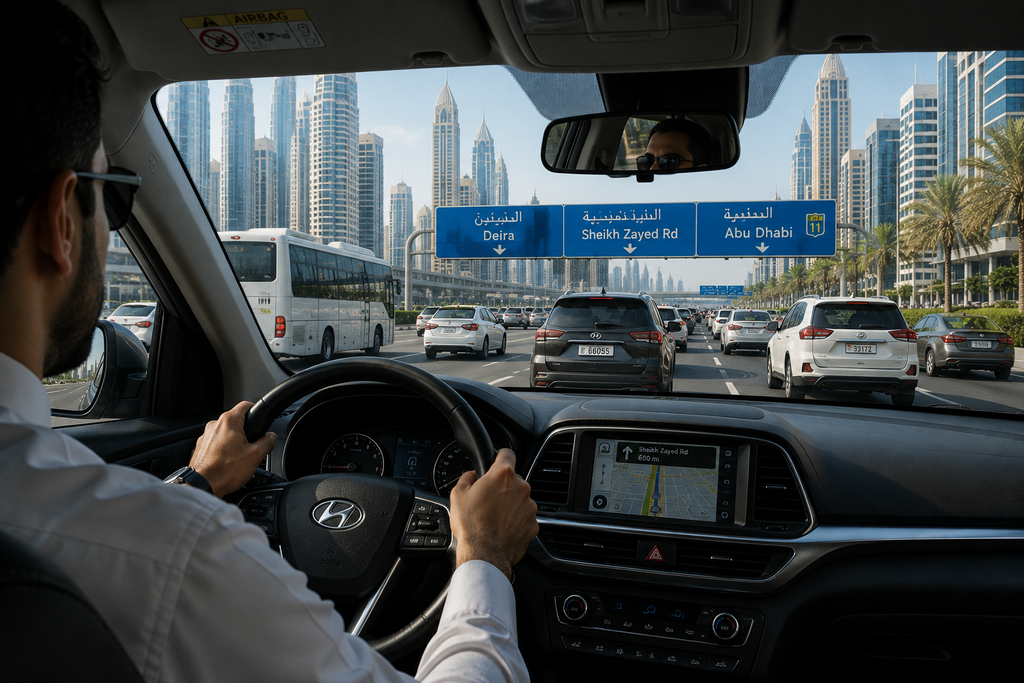
Summer temperatures across the Gulf can place considerable stress on vehicles. Tyres, batteries, cooling systems and air conditioning all operate under demanding conditions, particularly during long-distance travel.
Saudi Arabia’s official transport guidance advises drivers to check the vehicle, tyres, fuel and temperature indicators before driving. This is good practice across the entire region.
Tyres deserve particular attention because long journeys at highway speed combined with high temperatures can expose existing damage or poor maintenance. Drivers should check pressure according to the vehicle manufacturer’s guidance and inspect tyres regularly.
A basic summer road-safety routine should include checking:
- Tyre condition and pressure
- Engine coolant
- Battery condition
- Air conditioning
- Fuel level
- Warning lights
- Spare tyre or repair equipment
- Drinking water for longer journeys
- Roadside-assistance details
A well-maintained vehicle is particularly important when travelling through less populated areas where immediate assistance may not be nearby.
14. Driving Styles Differ Between Gulf Cities
A new resident should not expect driving conditions in every Gulf city to feel the same. Dubai has dense multi-lane highways and complicated interchanges. Riyadh covers an enormous urban area and often requires long car journeys. Doha combines newer expressways with busy urban roads, while Muscat has a different road environment shaped by mountains, roundabouts and long stretches between different parts of the city.
Kuwait City and Manama have their own congestion patterns and road layouts. Even within the same country, driving in a capital city can feel very different from travelling through smaller towns or rural areas.
Give yourself time to adapt. During the first few weeks, avoid scheduling journeys with extremely tight arrival times because rushing increases the temptation to speed or make aggressive lane changes.
Navigation applications are useful, but learning major road names, districts and landmarks gradually will make driving less stressful.
15. Never Drive After Drinking Alcohol
Driving under the influence should be treated as completely unacceptable throughout the Gulf. Alcohol regulations themselves differ significantly between GCC countries, but drinking and driving can lead to serious legal consequences.
Residents should never assume that feeling capable of driving means they are legally safe to do so. If alcohol has been consumed in a country where it is legally available, arrange a taxi, ride-hailing service or designated driver.
This rule is particularly important for newcomers who may be familiar with legal blood-alcohol thresholds in another country. Do not import those assumptions into the Gulf.
The safest approach is straightforward: if you drink, do not drive.
Driving in the UAE for New Residents
The UAE has an extensive road network, with Dubai and Abu Dhabi offering some of the region’s largest multi-lane highways. New residents should become familiar with their local driving-licence requirements, road signs, lane discipline, parking systems and automated enforcement.
Dubai can initially be challenging because exits and interchanges may require drivers to move into the correct lane well in advance. Relying on last-second navigation instructions can result in unsafe lane changes, so reviewing the route beforehand is useful.
Residents should also remember that traffic rules and some administrative procedures can differ between emirates. Official UAE and emirate-level transport or police sources should therefore be checked whenever a driver is uncertain about a particular requirement.
Driving in Saudi Arabia for New Residents
Saudi Arabia’s large geography means driving can be an essential part of everyday life, particularly in cities such as Riyadh where residential areas, offices and commercial districts can be widely separated.
The Saudi National Platform emphasises several fundamental driver responsibilities, including checking the vehicle before operation, ensuring doors are closed, adjusting mirrors and seating, fastening seat belts and following traffic signs and signals. It also identifies speeding, mobile-phone use while driving, failure to wear a seat belt, running red lights, driving without a valid licence and failing to give pedestrians priority among traffic violations.
Residents can electronically check driving-licence information through official government services using their identification or residency details. New expatriates should make sure their licensing status is correct before driving rather than assuming their previous licence remains sufficient.
Driving in Qatar for New Residents
Qatar’s modern road infrastructure has expanded considerably, particularly around Doha. Expressways make travel between different areas relatively straightforward, but new residents still need time to become familiar with interchanges, exits and local traffic conditions.
Residents should verify whether their foreign licence can be used, exchanged or whether they need to complete the local licensing process. The correct route depends on the driver’s status and the licence they currently hold.
Doha traffic can become busy during peak periods, so allowing extra travel time is useful. Drivers should pay close attention to posted speed limits, road cameras and lane markings rather than simply following surrounding traffic.
As elsewhere in the Gulf, official government traffic guidance should be checked when licensing or legal requirements are unclear.
Driving in Oman for New Residents
Oman offers one of the Gulf’s most interesting driving environments because city roads, mountain routes and long-distance highways can all form part of normal travel. Muscat itself stretches along the coast, which means residents may regularly cover substantial distances.
Royal Oman Police states that people intending to reside in Oman need an Omani driving licence rather than continuing indefinitely on the licence arrangements available to short-term visitors. New licences require the applicant to pass the specified tests and meet the required conditions.
Vehicle preparation is especially important for longer journeys outside Muscat. Drivers heading towards mountains, deserts or more remote regions should check fuel, tyres and vehicle condition before leaving.
Oman’s scenery makes road trips appealing, but unfamiliar mountain roads require patience and careful driving rather than treating them like ordinary urban highways.
Driving in Bahrain for New Residents
Bahrain’s relatively compact geography means distances are shorter than in Saudi Arabia or Oman, but congestion can still become significant around Manama and major commuting routes.
New residents should become familiar with local licence requirements, vehicle registration, insurance and parking regulations. Cross-border travellers also need to understand the separate requirements that apply when driving between Bahrain and Saudi Arabia.
Do not assume that a short journey means road-safety rules are less important. Seat belts, safe following distances, indicators and careful lane changes remain essential in dense urban traffic.
Learning alternative routes can also make daily commuting easier when major roads become congested.
Driving in Kuwait for New Residents
Driving is an important part of everyday life for many Kuwait residents because the country relies heavily on road transport. Kuwait City and surrounding residential areas are connected through major highways, and owning or regularly using a car can make commuting considerably easier.
Expatriates should pay particular attention to the eligibility rules for obtaining and maintaining a Kuwaiti driving licence because requirements for foreign residents can differ from those applying to citizens.
Traffic can be fast-moving, making defensive driving particularly valuable. Maintaining safe distances, avoiding unnecessary lane changes and watching carefully around busy junctions can reduce risk.
As with every GCC country, residents should use current official traffic guidance when checking licence eligibility, vehicle requirements or penalties.
Common Driving Mistakes New Gulf Residents Make
Many driving problems happen because newcomers continue using habits from their home countries instead of adapting to the local road system. Driving rules that appear familiar may have different enforcement practices or penalties in the GCC.
Some of the most important mistakes to avoid include:
- Driving after residency begins without checking licence validity
- Following traffic speed instead of the posted limit
- Using a handheld phone for navigation
- Making last-second motorway lane changes
- Following another vehicle too closely
- Ignoring rear-seat seat belts
- Failing to check child-restraint requirements
- Driving an uninsured or improperly registered vehicle
- Ignoring tyre condition during extreme summer heat
- Driving too quickly in fog, rain or dust
- Assuming rules are identical across all GCC countries
- Not knowing the local accident-reporting procedure
Correcting these habits early makes driving considerably easier and safer.
Driving Across GCC Borders
Residents who enjoy road trips should remember that crossing from one GCC country into another creates additional requirements. A driving licence that is valid for everyday use in the country where you live does not automatically answer every question about cross-border driving.
Vehicle ownership, insurance, permission to take a financed or rented vehicle abroad and border documentation should all be checked before travelling. Rental cars can have specific restrictions on cross-border use, and company vehicles may require authorisation.
Drivers should also check the rules of the destination country rather than assuming that the regulations from their country of residence continue unchanged after crossing the border.
Preparing documents before departure can turn a potentially stressful border journey into a much smoother experience.
Renting a Car When You First Arrive
Many new residents rent a vehicle before deciding whether to purchase one. This can be a practical way to learn the city and understand what type of vehicle suits everyday needs.
Before leaving the rental company, inspect the vehicle and document any existing damage. Understand the insurance coverage, excess amount, fuel policy, mileage restrictions and accident-reporting procedure.
Drivers should also clarify whether additional drivers are covered and whether the vehicle can legally be taken outside the country.
Do not assume the rental company is responsible for traffic violations committed during the rental period. Fines can be charged back to the driver according to the rental agreement.
Buying Your First Car in the Gulf
Buying a car can make sense for residents who expect to remain for several years, particularly in cities where daily commuting by road is common. However, price should not be the only consideration.
Look at insurance, registration, maintenance history, fuel consumption and expected resale value. When buying used, obtain appropriate inspection and ownership information rather than relying entirely on the seller’s description.
The Gulf climate also makes maintenance history important. Cooling systems, batteries, tyres and air conditioning can all be affected by extreme heat.
A slightly more expensive vehicle with a clear maintenance history can sometimes be a better long-term choice than a cheaper car with uncertain mechanical condition.
Driving in the Gulf During Ramadan
Ramadan can change daily traffic patterns across Gulf cities because working hours, school schedules, shopping habits and dining routines change. Roads can become particularly busy before iftar as people travel home or meet family and friends.
New residents should allow additional time for journeys rather than rushing. Fatigue and changes in daily routines can also affect concentration, making patient and defensive driving especially important.
Late-evening traffic may remain active because restaurants, malls and social activities often operate later during Ramadan.
Understanding these changing patterns can make commuting much easier during the holy month.
Essential Documents and Preparation for Gulf Drivers
New residents should organise their driving documents soon after settling into the country. Requirements vary, but having easy access to the relevant information makes routine driving and unexpected situations much easier.
Useful items to keep organised include your valid driving licence, residence identification, vehicle registration details, insurance information, roadside-assistance contact and rental agreement where applicable. Parents should also install suitable child restraints before travelling with young children.
Drivers should periodically check licence, registration and insurance expiry dates rather than waiting until a document has already expired.
Digital government services across the Gulf have made many of these checks easier, but responsibility still remains with the driver.
Driving in the Gulf: Rules Every New Resident Should Remember
Driving in the Gulf becomes much easier once residents stop treating the region as one single road system. The six GCC countries share many road-safety principles, but their licensing procedures, penalties and administrative rules remain separate.
The most important habits are straightforward. Drive only with a licence valid for your status, obey posted speed limits, use seat belts, avoid handheld phones, maintain safe distances and keep the vehicle legally registered and insured. Parents should understand child-restraint requirements, while every driver should know what to do after an accident.
Weather and climate deserve additional attention. Fog, heavy rain, dust and extreme summer temperatures can transform normal driving conditions quickly, making vehicle maintenance and defensive driving particularly important.
New residents should also give themselves time to learn. Missing an exit, taking a longer route or arriving a few minutes late is always preferable to making a dangerous manoeuvre.
Final Thoughts on Driving in the Gulf
Driving in the Gulf can provide enormous freedom. A car makes it possible to commute between residential and business districts, explore neighbouring cities and experience landscapes ranging from Oman’s mountains to Saudi Arabia’s vast highways and the UAE’s modern urban centres. For many residents, driving quickly becomes an essential part of everyday life.
That convenience comes with responsibility. The Gulf has invested heavily in road infrastructure, traffic monitoring and digital government services, and drivers are expected to understand and follow the rules. Speeding, distracted driving, failure to wear seat belts and other unsafe behaviour can result in penalties while also putting lives at risk.
The most important lesson for a new resident is not to assume that previous driving experience automatically means you understand Gulf roads. Learn the licensing requirements of your country, follow posted signs, prepare your vehicle for the climate and drive defensively until you become familiar with local conditions.
A few weeks of careful adjustment can make a significant difference. Once the road network, exits, driving patterns and local regulations become familiar, driving across the Gulf can become considerably more comfortable and enjoyable.
follow us on Instagram
Read More – Public vs Private Healthcare in Gulf Countries: 12 Essential Differences