



How the Six GCC E-Commerce Markets Are Developing
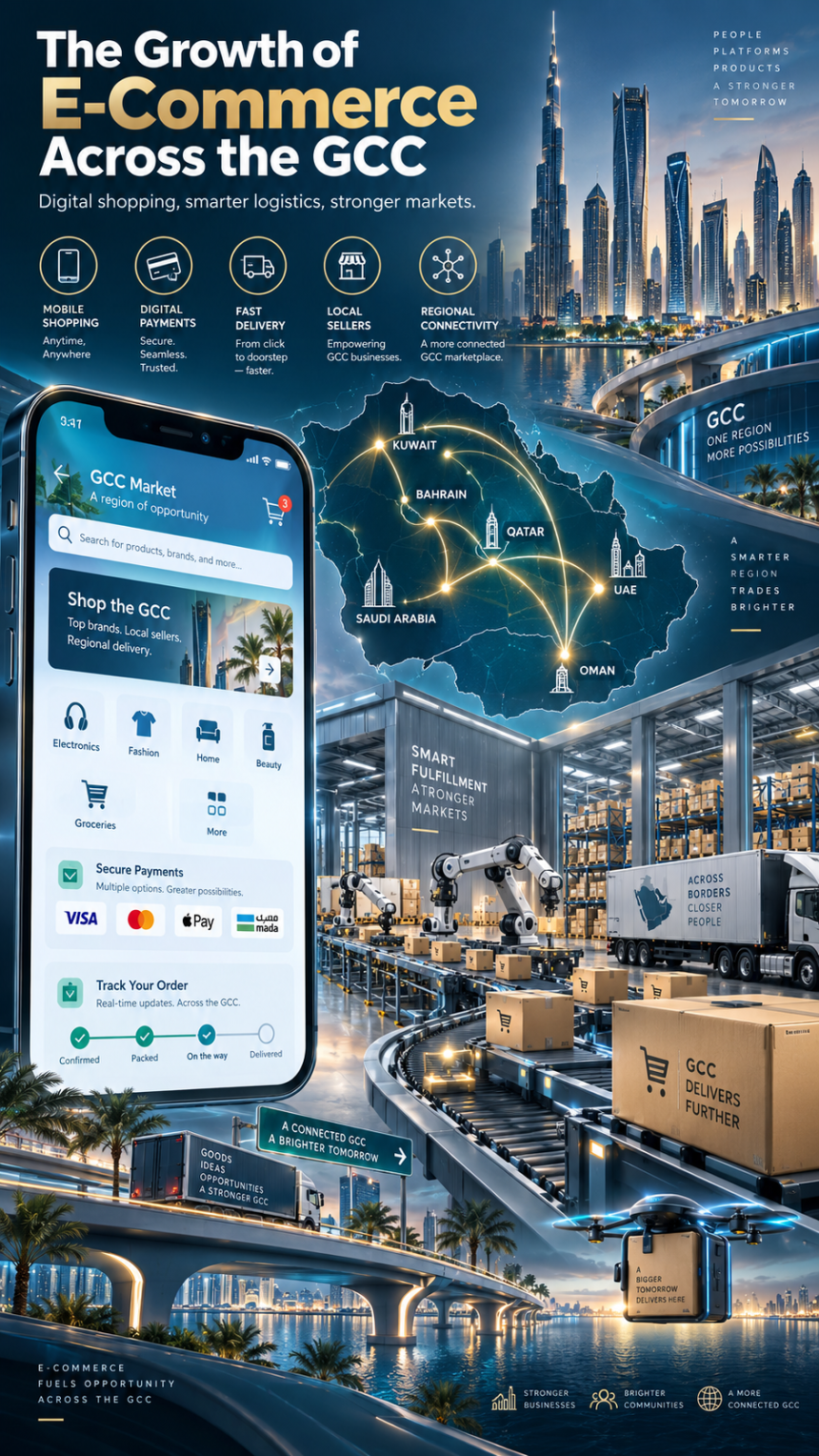
E-commerce across the GCC is becoming one of the most important parts of the Gulf’s rapidly expanding digital economy. Consumers in Saudi Arabia, the UAE, Qatar, Kuwait, Oman and Bahrain are increasingly using smartphones to buy everything from electronics and fashion to groceries, beauty products, meals and household essentials.
- Why E-Commerce Across the GCC Is Growing So Quickly
- The UAE Has Built a Strong E-Commerce Ecosystem
- UAE E-Commerce Regulation Is Becoming More Mature
- Saudi Arabia Is Becoming a Major Online Retail Market
- Digital Payments Are Accelerating Saudi E-Commerce
- Mobile Commerce Is Becoming the Default Shopping Experience
- Social Commerce Is Creating New Online Businesses
- Oman Is Rapidly Formalising Its E-Commerce Market
- Ma’roof Oman Is Trying to Build Consumer Trust
- Qatar Is Building E-Commerce Around Trust and Delivery
- Bahrain Is Creating Clearer Rules for Online Stores
- Kuwait Is Modernising Its Digital Commerce Framework
- Quick Commerce Is Changing Consumer Expectations
- Warehouses Are Becoming Part of the Digital Retail Experience
- Last-Mile Delivery Is Becoming a Major Competitive Advantage
- Digital Payments Are Replacing Cash on Delivery
- Buy Now, Pay Later Is Changing Online Purchasing
- Cross-Border E-Commerce Is Expanding Consumer Choice
- AI Is Changing How Online Stores Sell
- Physical Stores Are Not Disappearing
- Small Businesses Can Reach Larger Markets
- Consumer Trust Will Determine the Next Stage of Growth
- How the Six GCC E-Commerce Markets Are Developing
- What Challenges Could Slow GCC E-Commerce Growth?
- What the Future of GCC E-Commerce Could Look Like
- E-Commerce Across the GCC Is Becoming Mainstream Retail
The change is not simply about traditional shops launching websites. Retail itself is becoming more digital. Mobile applications, online marketplaces, social media stores, digital wallets, instant payments and fast delivery services are changing what shoppers expect from businesses.
Saudi Arabia and the UAE are at the centre of this transformation, supported by large consumer markets, strong logistics infrastructure and widespread digital payments. However, smaller GCC markets are also developing quickly. Oman is expanding its licensed online business ecosystem, Bahrain has strengthened e-commerce rules, Qatar continues to promote digital merchants and Kuwait is modernising its digital commerce legislation.
The wider economic environment supports this shift. The World Bank has identified digital transformation as an increasingly important part of GCC economic diversification, alongside the continued growth of non-oil sectors.
As a result, the future of Gulf retail is unlikely to be divided clearly between physical and online shopping. Instead, both channels are increasingly becoming part of the same customer journey.
Why E-Commerce Across the GCC Is Growing So Quickly
Several conditions make Gulf countries particularly suitable for digital commerce.
Internet and smartphone use is extremely high across much of the region. Consumers are comfortable using applications for banking, transport, food delivery, government services and communication, making online shopping a natural extension of everyday digital behaviour.
The region also has highly urbanised populations. Large numbers of people live in cities such as Riyadh, Jeddah, Dubai, Abu Dhabi, Doha, Kuwait City, Manama and Muscat, where delivery companies can reach many customers within relatively small geographic areas.
Digital payments provide another important foundation. Saudi Arabia, for example, reported that electronic payments represented 85 percent of retail payment transactions in 2025, compared with 79 percent in 2024. The number of electronic transactions reached 14.6 billion during the year.
Consumers are also becoming more demanding. They increasingly expect fast delivery, easy returns, secure payments and personalised recommendations.
| Growth Driver | Impact on GCC E-Commerce |
|---|---|
| High smartphone use | Makes mobile shopping easy and frequent |
| Digital payments | Reduces dependence on cash on delivery |
| Young consumers | Increases demand for app-based shopping |
| Strong logistics | Enables faster local delivery |
| Government support | Encourages digital businesses and startups |
| Social media | Creates new discovery and sales channels |
| AI technology | Improves recommendations and customer service |
| Cross-border shopping | Expands product selection |
| Quick commerce | Makes online shopping useful for daily essentials |
Together, these factors are turning e-commerce from an alternative retail channel into a normal part of consumer life.
The UAE Has Built a Strong E-Commerce Ecosystem
The UAE has created one of the Gulf’s most developed digital-commerce environments.
Dubai’s combination of logistics infrastructure, international businesses, technology companies, free zones and a large expatriate population has helped create a strong market for online retail.
Dubai Chambers data estimates UAE retail e-commerce at around US$9.5 billion in 2025, rising to approximately US$10.8 billion in 2026. Its research also estimated that the UAE represented around 35 percent of the total GCC e-commerce market in 2023.
Fashion, electronics and appliances are among the largest online retail categories, while online food shopping is also becoming increasingly important.
Dubai International Chamber reported that UAE consumers spent about US$1.2 billion buying food through e-commerce channels in 2025, with further growth expected in the following years.
The UAE’s broader Digital Economy Strategy also aims to significantly increase the digital economy’s contribution to GDP, creating a supportive environment for online businesses, fintech companies and technology platforms.
UAE E-Commerce Regulation Is Becoming More Mature
Growth becomes more sustainable when customers know who they are buying from and businesses understand the rules they must follow.
The UAE regulates digital commerce through Federal Decree by Law No. 14 of 2023 concerning modern technology-based trade.
The framework applies to products and services sold through websites, mobile applications, online marketplaces and social platforms. It also requires online traders to operate through appropriate business licences.
The UAE has also created specialised business environments for digital commerce.
Companies can operate through free zones designed to support technology and online businesses, including Dubai CommerCity and other digital-business ecosystems.
Dubai CommerCity has continued developing cross-border e-commerce systems designed to connect customs, logistics and digital businesses more efficiently. It has also introduced partnerships using artificial intelligence to improve customs and e-commerce operations.
These developments matter because online retail requires much more than a website. Payment processing, customs clearance, warehousing, consumer protection and delivery all need to work together.
Saudi Arabia Is Becoming a Major Online Retail Market
Saudi Arabia’s combination of population size, purchasing power and rapid digital transformation gives it enormous influence over the future of GCC e-commerce.
Saudi Arabia has spent several years improving the infrastructure surrounding digital commerce. This includes payment systems, logistics, fintech, business registration and support for small and medium-sized enterprises.
A Monsha’at report on the Saudi e-commerce ecosystem identified tens of thousands of online stores and a large network of fulfilment centres, warehouses and delivery providers. The report also highlighted how government initiatives have focused on removing barriers to online trade and supporting fintech and logistics.
More recent payment data shows just how quickly online spending has expanded.
Saudi Central Bank statistics show mada-card e-commerce sales increasing from around SAR197.4 billion in 2024 to approximately SAR325.2 billion in 2025. The number of mada e-commerce transactions increased from roughly 1.13 billion to 1.77 billion during the same period.
These figures do not represent every online payment method used in Saudi Arabia, but they clearly illustrate the scale of digital shopping growth.
Digital Payments Are Accelerating Saudi E-Commerce
Online shopping becomes easier when payment requires only a few taps on a phone.
Saudi Arabia has invested heavily in reducing reliance on cash and improving electronic payment systems. By 2025, digital payments accounted for 85 percent of retail payment transactions.
The Saudi Central Bank also launched a new e-commerce payments interface in 2025.
The system was designed to make integration between mada and international payment networks easier while introducing technologies such as payment card tokenisation. It also created infrastructure that can support new financing solutions for e-commerce businesses.
Mobile wallets add another layer of convenience.
Google Pay was introduced through the mada infrastructure during 2025, joining an expanding range of digital payment options available in the Kingdom.
As payment friction decreases, consumers may become more comfortable completing smaller and more frequent purchases online.
Mobile Commerce Is Becoming the Default Shopping Experience
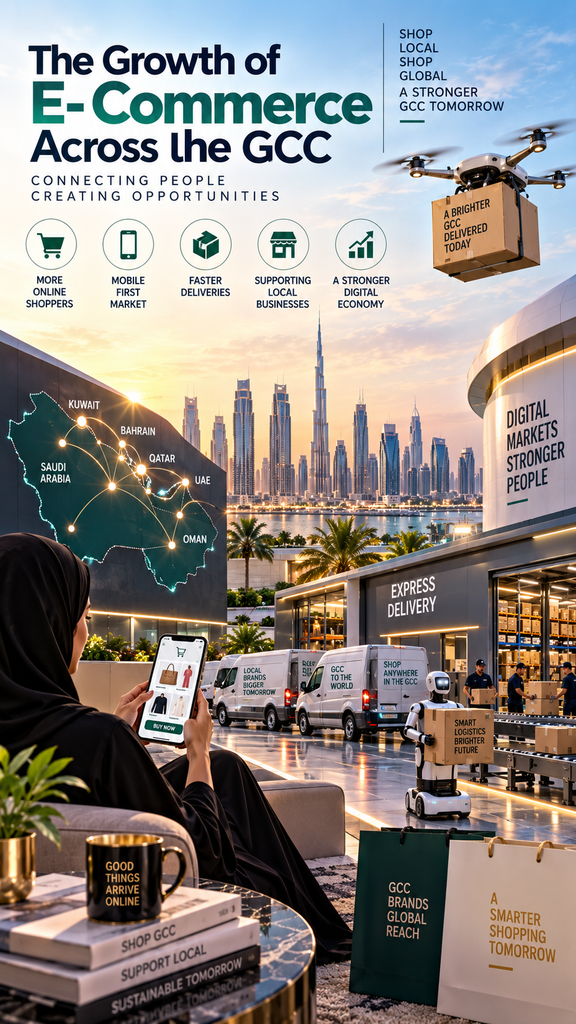
The future of GCC e-commerce is increasingly mobile.
Many consumers do not sit at a desktop computer and visit an online shop. They discover a product through Instagram, TikTok or another digital channel, open an application, compare prices and complete the transaction from the same phone.
This behaviour is particularly important in the Gulf because smartphone ownership and mobile connectivity are high.
The 2025 EZDubai e-commerce report identified mobile-first behaviour, youthful demographics and increasing digital-payment adoption as major drivers of regional online-shopping growth.
This means businesses need to think differently about their digital stores.
A website that works well on a laptop but performs badly on a smartphone may lose customers immediately. Checkout must be fast, product photographs need to load quickly and payment options should be simple.
Mobile shopping also creates opportunities for personalised notifications, location-based offers and loyalty programmes.
For many GCC consumers, the smartphone is becoming the shopping mall.
Social Commerce Is Creating New Online Businesses
Traditional e-commerce usually begins with a customer visiting an online marketplace or company website.
Social commerce can begin much earlier.
A consumer may see a product demonstrated by a content creator, discover a local business through Instagram or receive a product recommendation through a social platform.
This has lowered the barrier to starting an online business.
Small companies may no longer need expensive physical stores before reaching customers. They can begin with social media, build an audience and eventually expand into a dedicated online store or marketplace.
However, the growth of social commerce also creates regulatory challenges.
Authorities need to distinguish between casual social media use and commercial activity. Customers also need to know whether they are purchasing from a legitimate business.
Oman and Bahrain provide good examples of governments formalising this sector through licensing and verification systems rather than allowing online retail to develop entirely outside traditional commercial regulation.
Oman Is Rapidly Formalising Its E-Commerce Market
Oman’s online retail market is smaller than those of Saudi Arabia and the UAE, but it has significant growth potential.
An IMF analysis estimated Oman’s e-commerce market at about US$660 million in early 2024, representing only around 1 percent of total retail sales. The IMF noted that the country’s near-universal internet access, widespread smartphone use, improving payment options and stronger regulation create considerable room for growth.
The government is actively developing the sector.
In February 2026, Oman’s Ministry of Commerce, Industry and Investment Promotion reported 9,637 active e-commerce licences and another 929 licences covering marketing and promotion through social media.
The country’s National E-Commerce Plan 2022-2027 had reached an implementation rate of 83 percent by the end of 2025, according to the ministry.
These numbers show that online commerce is becoming an increasingly formal part of Oman’s business sector rather than remaining limited to informal social-media sellers.
Ma’roof Oman Is Trying to Build Consumer Trust
Trust remains one of the most important challenges for any developing e-commerce market.
Consumers need confidence that a digital shop actually exists, products will arrive and refunds will be honoured when something goes wrong.
Oman created the Ma’roof Oman platform to address this problem.
The platform allows buyers to identify licensed online stores and review their information, while legitimate businesses can demonstrate that they hold the necessary commercial approvals.
By February 2026, the platform had received hundreds of registrations and applications from online merchants.
Oman also introduced a new Electronic Transactions Law through Royal Decree 39/2025. The legislation covers areas including electronic contracts, digital transactions, intermediary responsibilities and trust services.
This combination of licensing, verification and legal protection could help more consumers feel comfortable purchasing online.
Qatar Is Building E-Commerce Around Trust and Delivery
Qatar also has the digital infrastructure required for a strong online-shopping market.
Its national e-commerce programme is designed around several priorities: strengthening regulation, improving delivery, enabling secure electronic payments, increasing consumer adoption and supporting online merchants.
The programme also created the Theqa trustmark to help consumers identify participating e-commerce businesses that meet certain requirements.
This focus on trust is important because customers need confidence before they are willing to move more spending online.
Qatar also benefits from very high internet usage and widespread social-media adoption. A 2025 U.S. government market guide reported internet penetration at approximately 99 percent, providing a strong foundation for digital retail.
The country has also developed mobile payment infrastructure, including the Qatar Mobile Payment System and standardised QR-code payment systems.
As these systems become more familiar, online shopping can move beyond occasional purchases and become part of everyday retail behaviour.
Bahrain Is Creating Clearer Rules for Online Stores
Bahrain’s relatively small geographic size and digitally connected population make it well suited to e-commerce.
The Ministry of Industry and Commerce has established specific licensing requirements for retail sales through the internet.
Online retailers are required to provide an operational website, clear returns and refund policies, terms of use, data-protection policies, secure online payment and an active shopping cart.
Authorities reinforced those requirements through a regulatory campaign in 2025 focused on ensuring that registered internet retailers complied with licensing and consumer-protection rules.
Bahrain has also expanded requirements relating to electronic payments.
A 2024 regulation required commercial establishments, including certain virtual businesses, to use commercial bank accounts and provide approved electronic-payment methods.
These rules can make online commerce more transparent by creating clearer separation between personal and commercial transactions.
Kuwait Is Modernising Its Digital Commerce Framework
Kuwait already has a highly active electronic-payment environment, giving e-commerce an important foundation.
Central Bank of Kuwait data shows substantial monthly transaction values through payment gateways, alongside rapidly used digital payment services.
In November 2025, Kuwait’s Cabinet approved a draft law intended to regulate digital commerce and modernise the legal framework surrounding online business.
Government reporting in early 2026 described the planned digital-commerce framework as part of Kuwait’s broader effort to modernise business regulation and support technology-driven economic activity.
Electronic payments are also formally regulated by the Central Bank of Kuwait under updated instructions that cover payment-service providers, cybersecurity, customer protection, governance and risk management.
A clearer digital-commerce framework could make it easier for businesses and customers to understand their rights and responsibilities as more retail activity moves online.
Quick Commerce Is Changing Consumer Expectations
Traditional e-commerce once meant ordering a product and waiting several days for delivery.
Quick commerce has changed that expectation.
Consumers can now order groceries, snacks, medicines, personal-care products and household essentials for delivery within a much shorter window.
This is particularly well suited to dense GCC cities.
A 2026 market study estimated the GCC quick-commerce sector at approximately US$4.59 billion in 2026, up from US$3.76 billion in 2025, and projected continued strong growth through 2031.
While those figures are industry estimates rather than official government statistics, they illustrate how rapidly this part of online retail is expanding.
Quick commerce changes the competition too.
Consumers are no longer comparing an online store only with another website. They may compare it with the convenience of visiting a nearby supermarket.
This puts pressure on companies to manage inventory, warehouses and delivery fleets more efficiently.
Warehouses Are Becoming Part of the Digital Retail Experience
E-commerce may happen on a phone, but every physical product still needs to exist somewhere.
Warehouses and fulfilment centres are therefore becoming central to digital retail.
When a customer clicks buy, inventory software needs to confirm that the item is available. A warehouse worker or automated system must locate it, pack it and move it to a delivery provider.
Faster delivery requires inventory to be stored closer to customers.
This is encouraging the development of urban fulfilment centres and smaller distribution locations.
Saudi Arabia’s e-commerce ecosystem already contains a large network of warehouses, fulfilment centres and delivery companies.
Dubai has also invested heavily in logistics and cross-border digital trade infrastructure through facilities such as Dubai CommerCity.
This demonstrates an important point: the growth of online shopping does not remove the need for physical infrastructure.
It changes the kind of physical infrastructure retailers need.
Last-Mile Delivery Is Becoming a Major Competitive Advantage
The final journey from a distribution centre to the customer is often the most difficult part of e-commerce.
A warehouse can process thousands of packages efficiently, but each parcel eventually needs to reach a specific home, apartment, office or collection point.
This is known as the last mile.
GCC delivery companies are using route optimisation, real-time tracking and automated notifications to make this process more efficient.
Customers increasingly expect to know exactly where their package is and when it will arrive.
Alternative delivery models may also grow.
Parcel lockers can allow customers to collect items without waiting at home. Pickup points can reduce repeated delivery attempts, while autonomous delivery robots may eventually become practical within selected communities.
The last mile is therefore becoming part of the customer experience rather than simply a logistics function.
Digital Payments Are Replacing Cash on Delivery
Cash on delivery played an important role during the early development of Gulf e-commerce because consumers were sometimes hesitant to enter card details online.
That behaviour is changing.
Saudi Arabia offers a clear example. A Saudi Central Bank payment study showed that debit cards were already the most common method used for respondents’ most recent online purchase, while cash on delivery remained important but represented a smaller share.
As digital wallets, debit cards, instant payments and tokenised payment systems become more widely accepted, the need for cash decreases.
This benefits retailers as well.
Cash on delivery creates extra operational work. Delivery companies must collect money, reconcile payments and return funds to merchants. Customers can also refuse orders when they arrive.
Digital payment confirms the transaction earlier and can make fulfilment more predictable.
The continued shift toward cashless economies across the GCC will therefore support further e-commerce growth.
Buy Now, Pay Later Is Changing Online Purchasing
Another development is the expansion of flexible payment services.
Buy now, pay later services allow eligible consumers to divide purchases into several payments rather than paying the full amount immediately.
These services can make higher-value products easier to purchase online.
For retailers, they may increase conversion rates because consumers can spread costs over time.
However, greater convenience also creates a need for responsible lending standards and clear information.
Consumers need to understand repayment schedules and any fees or consequences associated with missed payments.
As GCC fintech regulation develops, the relationship between e-commerce platforms and financial-service providers is likely to become even closer.
The online checkout is gradually becoming a financial-services marketplace as well as a payment page.
Cross-Border E-Commerce Is Expanding Consumer Choice
One of the biggest advantages of digital retail is that customers are not limited to products available in nearby stores.
Gulf consumers regularly purchase from businesses based outside their own countries.
This creates access to international fashion, electronics, beauty products, specialist goods and brands that may not have local retail locations.
For GCC businesses, the same system can work in reverse.
A small Gulf brand can potentially reach customers throughout the region without opening a physical shop in every country.
However, cross-border e-commerce is more complicated than domestic online retail.
Customs duties, product standards, returns, taxes, shipping times and import restrictions need to be managed correctly.
This is why improvements in digital customs clearance and regional logistics could become increasingly important for the next stage of GCC e-commerce.
AI Is Changing How Online Stores Sell
Artificial intelligence could become one of the biggest forces shaping the next phase of digital retail.
Online stores already use recommendation systems to suggest products based on browsing and purchasing behaviour.
AI can take this much further.
A customer may eventually describe exactly what they need in normal language and allow an AI shopping assistant to search thousands of products, compare specifications and recommend suitable options.
Retailers can use AI for customer support, inventory forecasting, pricing, product descriptions and fraud detection.
Dubai CommerCity has already announced AI partnerships focused on e-commerce and international trade operations.
AI could also improve logistics.
By predicting future demand, retailers can position inventory closer to the areas where products are most likely to be ordered.
The result could be faster delivery with less excess stock.
Physical Stores Are Not Disappearing
The growth of e-commerce does not mean Gulf shopping malls and traditional retailers will disappear.
Instead, physical and digital retail are merging.
A consumer might discover a product online, visit a store to see it physically and then purchase it through an application.
Another customer might order online and collect from a nearby branch.
Retailers increasingly need inventory systems that connect all these channels.
This model is often described as omnichannel retail.
The strongest businesses may therefore be those that avoid thinking of online and offline as separate operations.
A physical store can become a showroom, collection location, return point and local fulfilment centre at the same time.
For GCC malls, this creates a reason to evolve rather than disappear.
Small Businesses Can Reach Larger Markets
E-commerce is especially important for small and medium-sized businesses.
Opening a traditional retail location can require rent, interior design, staff and inventory before the business has proven customer demand.
Digital commerce can reduce some of those initial barriers.
A small fashion label, food brand or beauty company can begin through an online store or marketplace and expand as demand grows.
Social media further reduces the distance between small businesses and consumers.
Government programmes across the GCC are increasingly trying to bring these sellers into formal digital-commerce systems.
Oman’s rapid increase in e-commerce licences and Bahrain’s specific internet-retail registration framework show how authorities are adapting business regulation to this new generation of merchants.
E-commerce can therefore support entrepreneurship as well as retail growth.
Consumer Trust Will Determine the Next Stage of Growth
Online shopping depends heavily on trust.
Customers need to believe that payments are secure, personal data will be protected and the product they receive will match what was advertised.
Returns are another major issue.
A customer buying clothing online may hesitate if returning the wrong size is complicated or expensive.
Fake products, misleading advertisements and fraudulent websites can also damage confidence.
This explains why GCC countries are strengthening digital-commerce regulation.
Oman is verifying licensed stores through Ma’roof Oman. Bahrain requires internet retailers to provide secure payments and clear refund policies. The UAE’s modern technology-based trade legislation establishes a formal regulatory framework for online businesses.
Future growth will depend not only on making shopping faster, but also on making it safer.
How the Six GCC E-Commerce Markets Are Developing
| Country | Main E-Commerce Direction |
|---|---|
| UAE | Advanced online retail, digital commerce hubs, cross-border trade and strong logistics |
| Saudi Arabia | Large-scale consumer market, rapidly expanding online payments and logistics |
| Qatar | E-commerce adoption, secure payments, consumer trust and delivery development |
| Oman | Rapid licensing growth, stronger regulation and verified digital stores |
| Bahrain | Formal internet retail rules, secure payments and digital business registration |
| Kuwait | Strong electronic payments and a modernising digital-commerce legal framework |
Saudi Arabia and the UAE currently provide the greatest scale, but smaller GCC countries offer significant room for future growth.
The differences between them may also create opportunities for regional businesses.
A company that understands regulations, customer preferences and logistics across all six states could potentially treat the GCC as one connected digital marketplace.
What Challenges Could Slow GCC E-Commerce Growth?
Despite strong momentum, several challenges remain.
Delivery costs: Fast last-mile delivery can become expensive, especially for low-value orders.
Returns: Fashion and other categories can generate large numbers of returned products.
Cross-border complexity: Customs, duties and product regulations can make regional expansion difficult.
Consumer trust: Fraudulent stores and misleading advertising can discourage online spending.
Cybersecurity: More transactions create more opportunities for digital fraud.
Competition: Global marketplaces, regional platforms and local retailers compete for the same customers.
Profitability: High sales growth does not guarantee profits if discounts and delivery costs remain too high.
Sustainability: Rapid delivery can increase packaging, vehicle movements and returns.
These challenges mean the next phase will focus less on simply attracting online customers and more on making digital commerce efficient and sustainable.
What the Future of GCC E-Commerce Could Look Like
The future shopping experience is likely to become faster, more personalised and less dependent on traditional websites.
AI shopping assistants may help consumers search and compare products.
Mobile wallets could make checkout almost invisible. Customers may authenticate a payment through biometrics rather than repeatedly entering card details.
Warehouses could use more robotics.
Retailers may predict demand before orders are placed, positioning products in neighbourhood fulfilment centres for same-day or even near-immediate delivery.
Cross-border systems could become more automated, reducing the time required for customs processing.
Social commerce and livestream shopping may also become more important.
At the same time, physical stores will continue to evolve into part of a connected retail ecosystem.
The boundary between an online purchase and an offline purchase will become increasingly difficult to define.
E-Commerce Across the GCC Is Becoming Mainstream Retail
E-commerce across the GCC is moving beyond the stage where online shopping is considered a separate or experimental part of retail.
Saudi Arabia’s mada e-commerce sales rose sharply during 2025, while electronic payments reached 85 percent of retail transactions. The UAE continues building one of the region’s most developed digital-commerce and logistics ecosystems, while Oman reported thousands of active e-commerce licences as its National E-Commerce Plan moved closer to completion.
Qatar is strengthening digital merchant support and consumer trust, Bahrain is formalising online-store requirements and Kuwait is modernising its digital-commerce framework.
At the same time, consumer behaviour is changing.
People increasingly expect to shop from a phone, pay digitally, track deliveries in real time and receive products quickly. Retailers that cannot provide that experience may find it harder to compete.
The next phase of GCC e-commerce will therefore be about more than market growth.
It will be about better logistics, safer payments, stronger regulations, artificial intelligence, cross-border trade and closer integration between online and physical retail.
The Gulf’s shopping culture has long been associated with major malls and destination retail. Those spaces will remain important, but another retail environment now exists alongside them.
It fits inside a smartphone, remains open around the clock and can connect almost any seller with almost any customer.
That digital marketplace is becoming an increasingly important part of the GCC economy.
Do follow us on Instagram
Read More – Food Security in Gulf Countries: How the GCC Is Tackling the Challenge