



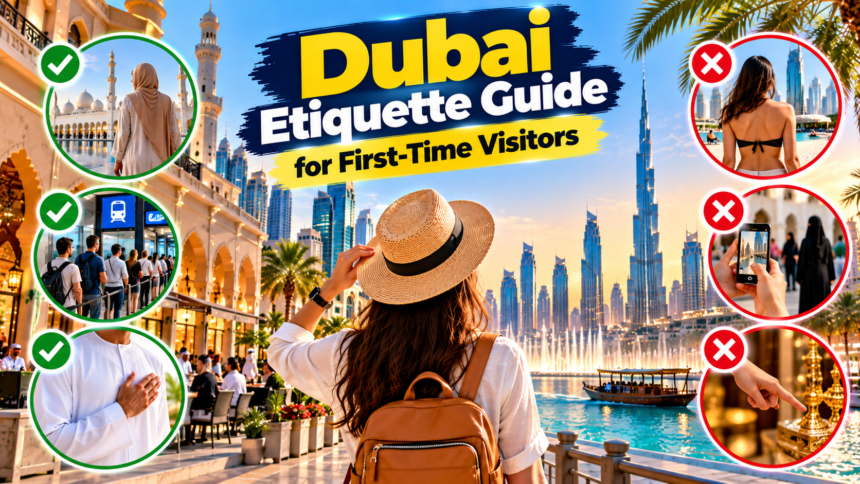
Remember That Friday Has Cultural Significance
Dubai etiquette guide for first-time visitors can help travellers enjoy the city confidently without overthinking every social interaction. Dubai is highly international, welcoming and accustomed to millions of visitors, but it remains part of the UAE, where local culture, Islamic traditions and respect for privacy continue to shape expectations in public places.
- Dubai Etiquette Guide for First-Time Visitors: Quick Overview
- Dress for the Place You Are Visiting
- Women Do Not Normally Need to Cover Their Hair
- Understand Mosque Etiquette Before Visiting
- Let the Other Person Lead When Greeting Them
- Keep Public Affection Discreet
- Ask Before Photographing People
- Be Careful Around Government, Military and Security Locations
- Understand Alcohol Etiquette in Dubai
- Avoid Aggressive Arguments, Offensive Gestures and Bad Language
- Respect Ramadan Even if You Are Not Fasting
- Do Not Assume Ramadan Means Dubai Shuts Down
- Learn Basic Dining Etiquette When Visiting Emirati Hosts
- Understand Arabic Coffee Etiquette
- Stand for Elders and Important Guests in Traditional Settings
- Avoid Pointing Directly at People
- Tipping Is Appreciated but Not Compulsory
- Check the Bill Before Adding a Tip
- Respect Queues and Personal Space
- Be Respectful on Dubai Metro
- Remember That Friday Has Cultural Significance
- Behave Respectfully Inside Malls
- Beach Etiquette Is More Relaxed but Still Has Limits
- Be Mindful When Visiting Old Dubai
- Do Not Make Assumptions About Emirati Culture
- Use Your Right Hand in More Traditional Settings
- Avoid Turning Every Cultural Difference Into a Rule
- Common Dubai Etiquette Mistakes to Avoid
- First-Time Visitor Etiquette Checklist
- Is Dubai Strict for First-Time Tourists?
- How to Follow Dubai Etiquette Without Overthinking Your Holiday
Most visitors do not need to radically change the way they behave. Normal politeness, appropriate clothing for the setting, respectful photography, sensible behaviour around alcohol and some awareness of Ramadan will cover most situations. Official Visit Dubai guidance describes the emirate as cosmopolitan and accepting of diverse clothing and cultures, while recommending more conservative dress in historic districts and places of worship.
The UAE Government also advises visitors to respect privacy, avoid offensive language and gestures, keep public affection restrained and ask before photographing people. These expectations are straightforward once you understand the cultural context behind them.
This complete guide explains greetings, clothing, mosque etiquette, photography, dining, tipping, Ramadan, alcohol, public behaviour and other cultural details first-time Dubai visitors should know.
Dubai Etiquette Guide for First-Time Visitors: Quick Overview
Dubai is easier to navigate socially when you focus on the setting rather than trying to memorise a long list of rules. What is completely normal at a beach resort may not be appropriate inside a mosque, government office or heritage neighbourhood.
The table below provides a simple starting point for first-time travellers.
| Situation | Good Etiquette |
|---|---|
| Everyday clothing | Comfortable clothing suitable for the setting |
| Beaches and pools | Swimwear is appropriate |
| Malls and public places | Avoid beachwear and excessively revealing clothing |
| Mosques | Cover shoulders, arms and legs; women may need head covering |
| Greeting someone | Be polite and follow their lead |
| Opposite-gender handshake | Wait for the other person to offer |
| Public affection | Keep it discreet |
| Photography | Ask before photographing people |
| Alcohol | Use licensed venues and drink responsibly |
| Ramadan | Respect the significance of fasting and local traditions |
| Tipping | Appreciated but generally optional |
| Local homes | Respect host customs and remove shoes if requested |
The most important principle is respect rather than fear. Dubai does not require visitors to understand every local tradition perfectly, but courtesy and cultural awareness are appreciated.
Dress for the Place You Are Visiting
One of the biggest sources of confusion for first-time visitors is Dubai’s dress code. Some online advice makes the city sound extremely restrictive, while other travellers assume that anything suitable for a beach resort is appropriate everywhere.
The reality is more balanced. Visit Dubai states that the city is cosmopolitan and that almost all forms of clothing and cultural expression are accepted. Swimwear is appropriate at beaches, pools, waterparks and spa areas, while it is not considered appropriate in places such as shopping malls and business districts.
For normal sightseeing, lightweight everyday clothing is usually practical. Visitors should simply consider the environment, especially when travelling to older neighbourhoods, cultural attractions, religious sites or government buildings.
For heritage and religious locations, more conservative clothing is recommended. Clothing that covers the shoulders and knees is a sensible choice, while mosque visits usually require additional coverage.
Clothing Guide by Location
| Location | What Generally Works |
|---|---|
| Hotel | Normal casual clothing |
| Shopping mall | Regular casual clothing |
| Beach | Swimwear |
| Waterpark | Swimwear |
| Hotel pool | Swimwear |
| Fine-dining restaurant | Smart casual or venue dress code |
| Old Dubai | Modest casual clothing appreciated |
| Mosque | Shoulders, arms and legs covered |
| Government office | Conservative smart clothing |
| Desert activity | Comfortable, practical clothing |
Visitors do not need to buy traditional Emirati clothing simply to walk around Dubai.
Women Do Not Normally Need to Cover Their Hair
Another common misunderstanding is that female visitors must cover their hair throughout Dubai. They do not.
The UAE Government states that women travelling in the UAE are not generally expected to cover their heads or wear traditional Muslim clothing. Head covering becomes relevant primarily when entering certain religious spaces such as mosques.
Visit Dubai’s 2026 clothing guidance similarly advises travellers to choose comfortable clothing appropriate to the activity, with more modest options recommended for cultural areas, museums and religious locations.
Pack one modest outfit specifically for cultural visits. A lightweight long-sleeved top, trousers or long skirt and scarf can make mosque or heritage visits easier without affecting the rest of your holiday wardrobe.
Understand Mosque Etiquette Before Visiting
Mosques can provide some of the most meaningful cultural experiences during a UAE visit, but they are active places of worship rather than ordinary tourist attractions.
Visitors should follow the instructions provided at the entrance. Clothing normally needs to cover the shoulders, arms and legs, while women may be required to cover their hair. Some mosques provide suitable garments to visitors.
Inside the mosque, speak quietly, avoid disturbing worshippers and follow photography restrictions. Shoes are normally removed before entering prayer areas, so wearing footwear that is easy to take off can be useful.
Visitors should also avoid walking directly in front of someone who is praying. If you are unsure where tourists should stand or move, follow staff or guide instructions rather than assuming the building functions like a museum.
Let the Other Person Lead When Greeting Them
Dubai is home to people from a huge range of cultures, so greetings vary significantly. Handshakes are common in business and social environments, but visitors should pay attention when greeting a Muslim person of the opposite gender.
The UAE Government advises not to initiate a handshake with a Muslim person of the opposite gender unless that person extends their hand first. Some people prefer not to shake hands across genders for religious reasons.
A smile and verbal greeting are always safe starting points. If someone offers their hand, respond normally. If they do not, there is no reason to feel awkward or offended.
The Arabic greeting “As-salamu alaykum” means “peace be upon you,” while “Marhaba” is a common way of saying hello or welcome. You do not need Arabic to travel around Dubai, but learning a few words is often appreciated.
Keep Public Affection Discreet
Couples visiting Dubai do not need to behave as though they cannot acknowledge each other in public, but excessive physical affection should be avoided.
Official Visit Dubai information says holding hands is acceptable, while visitors are advised to avoid excessive public displays of affection. The broader UAE Government guidance is more conservative and recommends keeping public affection minimal.
The safest approach is discretion. Holding hands while walking is very different from prolonged intimate behaviour in a family-oriented public space.
Hotels and resorts naturally provide more private environments, but the basic principle of respectful public behaviour remains useful throughout the city.
Ask Before Photographing People
Dubai is extremely photogenic, but people should not automatically become part of your travel photography simply because they are wearing traditional clothing or standing in a picturesque setting.
The UAE Government explicitly advises visitors not to photograph people without their permission. It also warns against photographing certain government and military facilities.
If a person is clearly identifiable and is the main subject of your picture, ask first. This is especially important when photographing families, women and children.
Visitors should also respect signs restricting cameras or phones. If security staff tell you photography is not allowed, follow the instruction even if you do not immediately understand the reason.
Be Careful Around Government, Military and Security Locations
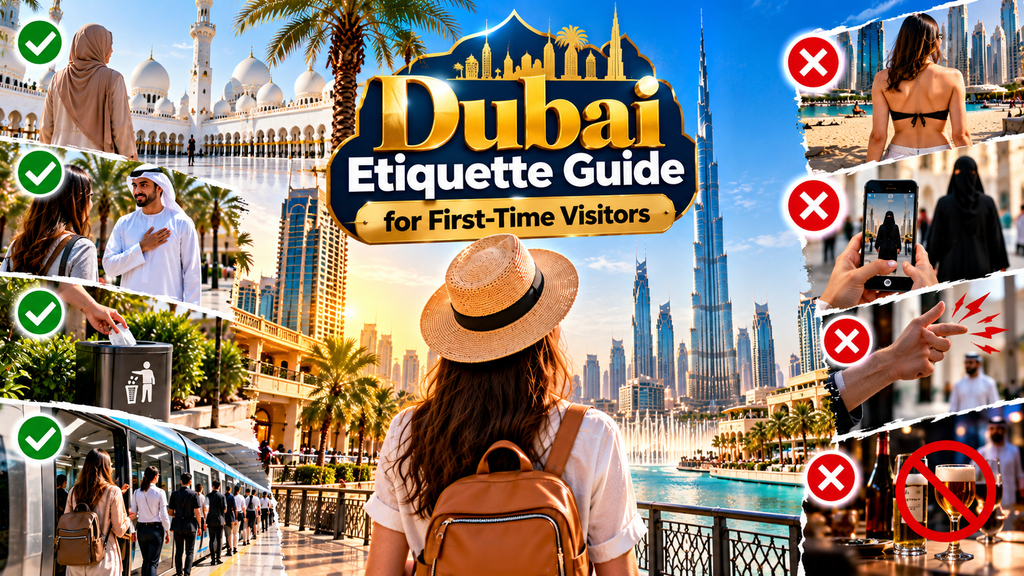
Most tourist districts are designed for photography, but some infrastructure and official facilities have restrictions.
The UAE Government specifically advises against photographing certain government buildings and military installations. Its public guidance also warns against photographing aircraft or engaging in plane spotting in restricted contexts.
Normal tourist awareness is usually enough. Photograph Burj Khalifa, the skyline, beaches, architecture and attractions freely where permitted, but pay attention to signs and security instructions around official facilities.
If you are uncertain whether a location can be photographed, ask rather than guessing.
Understand Alcohol Etiquette in Dubai
Alcohol is available in Dubai, but it is regulated.
Visit Dubai’s official 2026 city information states that adults aged 21 and above can consume alcohol in licensed hotels, restaurants and establishments.
The important distinction is between drinking responsibly in an authorised venue and behaving intoxicated in public. Visitors should avoid disorderly conduct and should never drink and drive.
Use licensed venues, know your limits and arrange transport afterwards. Dubai has extensive taxi and ride-hailing availability, so there is no practical reason to drive after drinking.
Visitors carrying medication should also check official UAE medication guidance when travelling with prescription drugs rather than assuming medicine legal in another country is automatically unrestricted in the UAE.
Avoid Aggressive Arguments, Offensive Gestures and Bad Language
Visitors sometimes underestimate how seriously public behaviour can be treated because Dubai feels relaxed and international.
The UAE Government advises against obscene gestures, offensive language, disruptive noise and disrespectful behaviour toward the UAE, its religion or its leadership.
The practical advice is straightforward: stay calm during disagreements. A traffic argument, disagreement with service staff or dispute in a public place should not turn into shouting, insulting language or aggressive gestures.
This is good travel behaviour anywhere, but it is particularly sensible in a destination where public-conduct expectations are clearly established.
Respect Ramadan Even if You Are Not Fasting
Ramadan is one of the most important periods in the Islamic calendar. Muslims fast from dawn until sunset and focus on prayer, reflection, charity and family life.
Visit Dubai’s 2026 Ramadan guidance explains that fasting includes avoiding food and drink from dawn until sunset, alongside a broader emphasis on modesty, patience, kindness and spiritual reflection.
Dubai remains open to tourists during Ramadan, and visitors can still enjoy restaurants, hotels, beaches and attractions. However, operating hours and the rhythm of daily life can change, with evenings becoming especially lively after sunset.
If you visit during Ramadan, dress respectfully, understand that fasting colleagues or guides may have different schedules and consider experiencing an iftar meal after sunset. It can become one of the most memorable cultural experiences of the trip.
Do Not Assume Ramadan Means Dubai Shuts Down
Older travel advice sometimes suggests that tourists will struggle to find food or activities during Ramadan. Modern Dubai is much more accommodating.
Visit Dubai actively promotes Ramadan as a period when international visitors can experience local traditions, dining and community events.
Restaurants and attractions may operate on adjusted schedules, so checking current timings is more useful than assuming normal opening hours.
Plan around the evening atmosphere. Ramadan nights can include late dining, shopping and family gatherings, giving visitors a very different experience from other times of the year.
Learn Basic Dining Etiquette When Visiting Emirati Hosts
Most tourists will eat mainly in restaurants, where international dining etiquette works perfectly well. However, travellers invited into an Emirati home or majlis may encounter more traditional customs.
The UAE Government notes that food sharing has cultural importance and that it is customary to accept and pass food or drink with the right hand. Guests may also be expected to remove their shoes when entering a majlis.
Visit Dubai’s cultural guide similarly highlights Arabic coffee, hospitality and removing shoes when entering a local home.
Follow your host rather than worrying about getting everything perfect. If everyone removes shoes, do the same. If Arabic coffee is offered, accepting a small cup is a friendly gesture unless you have a reason to decline.
Traditional Hospitality Quick Guide
| Situation | Polite Approach |
|---|---|
| Entering a majlis | Follow host guidance and remove shoes if appropriate |
| Offered Arabic coffee | Accept politely if comfortable |
| Passing food | Right hand is traditional |
| Greeting elders | Show respect and attention |
| Unsure what to do | Follow the host’s example |
Being interested and respectful is more important than performing traditions perfectly.
Understand Arabic Coffee Etiquette
Arabic coffee, known as gahwa, is an important symbol of hospitality in Emirati culture. Guests may be offered small cups, often alongside dates or other refreshments.
Visit Dubai notes that guests traditionally hand back their empty coffee cup using the right hand.
If you have had enough coffee, a gentle shake of the cup before returning it is traditionally understood as a signal that you do not require another serving.
Do not worry if you forget a detail. Most hosts understand that international visitors may not know every custom and are likely to appreciate sincere interest more than perfect technique.
Stand for Elders and Important Guests in Traditional Settings
Respect for elders and senior guests is an important part of traditional Emirati social etiquette.
The UAE Government advises that guests should stand when new guests, older people or higher-ranking individuals enter certain formal social settings such as a majlis.
Tourists will not encounter this situation during most ordinary sightseeing, but it can become relevant if you attend a cultural programme, private gathering or business meeting.
Observe what others are doing and follow their lead. Local etiquette becomes much easier when you treat it as responsive behaviour rather than a set of rules you must memorise in advance.
Avoid Pointing Directly at People
Hand gestures have different meanings across cultures.
The UAE Government advises against pointing directly at people with one finger in formal or traditional contexts and suggests using the whole hand when indicating something.
This is not something tourists need to obsess over while ordering lunch or navigating a mall. It is simply useful cultural awareness, particularly in formal gatherings.
Open-handed gestures generally appear more polite and less confrontational. The same principle works well in many international environments.
Tipping Is Appreciated but Not Compulsory
Visitors from countries with strict tipping expectations often wonder how much they are required to leave in Dubai.
Visit Dubai’s March 2026 tipping guide says tipping is appreciated but is not compulsory, and there are no fixed rules. It suggests roughly 10 to 15% in restaurants when service is good, with smaller amounts such as AED5 to AED10 commonly used for taxis, porters and certain other services.
Dubai Tipping Quick Guide
| Service | Common Optional Tip |
|---|---|
| Restaurant | Around 10–15% for good service |
| Café | AED5–10 or around 10% for larger orders |
| Taxi | AED5–10 or round up |
| Hotel porter | AED5–10 |
| Housekeeping | Around AED10 per night |
| Delivery driver | AED5–10 for good service |
| Salon | AED10–20 depending on service |
| Tour guide | Around 10% up to roughly AED100 for excellent service |
These are guidelines rather than obligations. Service quality and personal preference should determine whether and how much you tip.
Check the Bill Before Adding a Tip
Restaurants, tours and activities may already include taxes or service-related charges. Visit Dubai advises checking the bill because a service charge may already appear, although that amount does not necessarily go directly to the individual staff member.
If you want to personally thank someone for good service, a small cash tip can sometimes be more straightforward. Keeping a few AED5 and AED10 notes is useful for this purpose.
Do not feel pressured to tip heavily simply because Dubai has luxury hotels and restaurants. Tipping culture is relatively relaxed compared with destinations where gratuity is effectively mandatory.
Respect Queues and Personal Space
Dubai’s population is extremely international, which means public spaces bring together many different cultural ideas about queuing and personal distance.
The easiest etiquette is to wait your turn at hotel desks, attractions, taxis, ticket counters and public transport gates. Avoid pushing past people simply because an area is busy.
Metro etiquette matters especially during rush hour. Allow passengers to exit before boarding, avoid blocking train doors and pay attention to designated cabins and priority seating.
These are not uniquely Emirati customs, but they make travelling around a crowded city much easier for everyone.
Be Respectful on Dubai Metro
Visitors using Dubai Metro should pay attention to cabin signs and transport rules.
Some cabins are designated for Gold Class, while others are reserved for women and children. Boarding the wrong cabin can lead to problems, so first-time visitors should check platform markings before entering.
Food and behaviour rules also matter on public transport. Keep stations and trains clean, avoid loud disruptive behaviour and follow RTA signage rather than treating Metro like a sightseeing bus.
Using public transport respectfully is part of normal Dubai etiquette just as much as behaviour in hotels or cultural attractions.
Remember That Friday Has Cultural Significance
Friday has particular religious significance for Muslims, with congregational prayers taking place around midday.
Dubai remains active throughout Friday, and businesses, attractions and restaurants continue operating, but visitors may notice increased activity around mosques and changing patterns during prayer time.
Allow space around worshippers and avoid obstructing mosque entrances for photographs. If you happen to be exploring a historic neighbourhood during Friday prayers, observe respectfully rather than treating the gathering as a tourist spectacle.
This is especially relevant around well-known mosques and older parts of the city.
Behave Respectfully Inside Malls
Dubai malls are tourist attractions as well as shopping centres, but they remain family-oriented public spaces.
Normal casual clothing is widely accepted, while swimwear belongs at beaches and pool areas rather than inside shopping centres. Visit Dubai explicitly identifies malls as places where beachwear is not appropriate.
Keep noise, behaviour and clothing appropriate to a shared indoor environment. This does not mean visitors need to dress formally, only that the setting is different from a beach club.
Many malls also contain prayer rooms, family areas and cultural events, reinforcing their role as everyday community spaces rather than purely tourist shopping destinations.
Beach Etiquette Is More Relaxed but Still Has Limits
Dubai beaches are naturally much more relaxed about clothing. Swimwear is acceptable at beaches, hotel pools, waterparks and similar recreational areas.
However, the UAE Government states that nudity and topless sunbathing are not permitted and that swimwear should remain within appropriate beach or pool areas.
Bring a cover-up if you plan to move between the beach and nearby cafés, hotel corridors or shopping areas. That small step makes transitions between environments much easier.
Visitors should also follow lifeguard instructions, respect family areas and avoid photographing other beachgoers without permission.
Be Mindful When Visiting Old Dubai
Areas around Al Fahidi Historical Neighbourhood, Dubai Creek and traditional souks provide a very different atmosphere from Marina or Downtown.
Visit Dubai recommends more conservative clothing in historic areas, and visitors may encounter mosques, traditional businesses and local communities alongside tourist attractions.
Slow down and observe rather than treating every space like a staged attraction. Ask shopkeepers before taking close photographs, remain respectful near religious sites and avoid blocking narrow lanes while creating social-media content.
Old Dubai is one of the best places to understand how the emirate developed, and respectful behaviour usually produces a more rewarding experience.
Do Not Make Assumptions About Emirati Culture
Dubai’s skyline and international population can make the city feel completely globalised, but Emirati culture remains central to its identity.
Avoid treating traditional dress as a costume or making jokes about religion, cultural customs or local traditions. Curiosity is welcome, but respectful questions are very different from stereotypes.
If you want to learn more, cultural institutions and guided experiences can provide context around Emirati hospitality, food, architecture and religion.
Visit Dubai highlights hospitality as a central element of Bedouin and Emirati tradition, including welcoming guests, serving Arabic coffee and showing generosity toward visitors.
Use Your Right Hand in More Traditional Settings
The UAE Government notes that the right hand is traditionally used when accepting food or drink in Arab hospitality settings.
This is most relevant during traditional meals, majlis visits or cultural experiences rather than ordinary restaurant dining.
If you accidentally use the other hand, there is no reason to panic. The purpose of learning etiquette is to demonstrate awareness and consideration, not to create anxiety around every movement.
Remember the rule when practical, but focus primarily on being a gracious guest.
Avoid Turning Every Cultural Difference Into a Rule
One mistake first-time visitors make is reading so many online warnings that they arrive worried about doing anything at all.
Dubai receives international visitors constantly, and people working in hotels, restaurants, attractions and transport are accustomed to different cultures. Most normal tourist behaviour causes no difficulty when it is respectful and appropriate to the location.
Use common sense as your main guide. Beach behaviour belongs at the beach, mosque etiquette belongs at the mosque, nightlife belongs in licensed venues and photography should respect other people’s privacy.
This mindset is easier and more accurate than carrying a long list of frightening internet myths.
Common Dubai Etiquette Mistakes to Avoid
Most etiquette mistakes are simple and preventable. Problems usually occur when visitors ignore their surroundings rather than because they misunderstand a minor traditional custom.
| Common Mistake | Better Approach |
|---|---|
| Wearing swimwear away from beach areas | Cover up before entering public indoor spaces |
| Photographing strangers | Ask permission |
| Initiating every handshake | Follow the other person’s lead |
| Excessive public affection | Keep it discreet |
| Becoming aggressive in disagreements | Stay calm and polite |
| Ignoring mosque dress rules | Dress conservatively |
| Treating Ramadan like any other month | Respect its significance |
| Assuming tipping is mandatory | Tip based on service |
| Mocking traditions | Ask respectful questions instead |
| Photographing restricted locations | Follow signage and security |
| Drinking irresponsibly | Stay within licensed venues |
| Treating locals as photo props | Respect personal privacy |
Visitors who avoid these basic mistakes are unlikely to experience significant etiquette problems.
First-Time Visitor Etiquette Checklist
A quick check before leaving your hotel can help when your itinerary includes several different environments.
For everyday sightseeing, wear comfortable clothing suitable for the weather and carry a lightweight layer if you expect to visit a more conservative location.
For mosque or heritage visits, make sure shoulders and legs can be covered and carry a scarf if needed. Check whether photography is allowed and follow local staff instructions.
For nightlife, confirm that the venue is licensed if alcohol is part of your plans, carry valid identification and arrange safe transportation home.
For Ramadan travel, check current attraction and restaurant timings, expect a stronger evening atmosphere and use the opportunity to experience iftar or other cultural activities.
Daily Etiquette Checklist
| Check | Ready? |
|---|---|
| Clothing suits destination | □ |
| Mosque covering available if needed | □ |
| Photography restrictions checked | □ |
| Valid ID available | □ |
| Transport home planned after nightlife | □ |
| Ramadan timings checked if relevant | □ |
| Small cash available for optional tips | □ |
| Cultural site rules reviewed | □ |
This takes less than a minute and can prevent most avoidable situations.
Is Dubai Strict for First-Time Tourists?
Dubai has clear rules and cultural expectations, but describing the city simply as “strict” can create a misleading picture.
Official tourism guidance presents Dubai as highly cosmopolitan, with diverse clothing and cultures widely accepted. Visitors can enjoy beaches, nightlife, restaurants, attractions and public spaces much as they would in other major international destinations, provided they respect the setting.
The areas where visitors should pay particular attention are understandable: privacy, respectful public behaviour, religious spaces, alcohol, photography and culturally sensitive locations.
Women do not generally need to cover their hair, couples can hold hands, and tipping is optional rather than compulsory. At the same time, beachwear should remain around beaches and pools, intimate public behaviour should stay discreet and photographs of individuals should be taken with permission.
That combination makes Dubai relatively easy for first-time international travellers to navigate.
How to Follow Dubai Etiquette Without Overthinking Your Holiday
The most useful Dubai etiquette guide for first-time visitors can be reduced to a few simple principles: dress for the location, respect personal privacy, stay calm in public, be considerate around religion and follow the rules of whichever venue you are visiting.
Dubai’s own tourism guidance makes clear that the city is multicultural and accepts a wide variety of clothing and lifestyles. More conservative dress is mainly relevant to historic areas, places of worship and certain formal environments.
When meeting people, do not assume everyone will want the same style of greeting. Allow a Muslim person of the opposite gender to initiate a handshake, and remember that verbal greetings are perfectly polite when a handshake does not happen.
Keep public affection discreet, ask before photographing individuals and use alcohol responsibly in licensed venues. During Ramadan, recognise that you are visiting during an important religious month and use the opportunity to understand local traditions rather than viewing the changes as an inconvenience.
Tipping remains your choice. Visit Dubai’s 2026 guidance specifically describes gratuities as appreciated but not compulsory, meaning good manners matter more than following an exact percentage.
Most importantly, do not arrive frightened of accidentally making a small mistake. Dubai welcomes visitors from around the world, and genuine respect is much more important than perfect knowledge of every custom.
Do follow us on Instagram
Read More – Common Mistakes Tourists Make When Visiting Dubai: 15 Essential Tips