



How to Find Accommodation in Gulf Countries Without Overpaying
Finding the right home is one of the first major challenges when moving to the Gulf.
- How to Find Accommodation in Gulf Countries Before You Arrive
- 1. Set a Realistic Housing Budget First
- 2. Ask Whether Your Employer Provides Accommodation
- 3. Research the Neighbourhood Before the Building
- 4. Calculate the Real Commute
- 5. Decide Between Furnished and Unfurnished Accommodation
- 6. Use Established Property Platforms and Licensed Agents
- 7. View the Property in Person Whenever Possible
- 8. Understand the Rental Contract Before Signing
- 9. Understand How Rent Is Paid
- 10. Budget for the Security Deposit and Additional Costs
- 11. Check Utilities Before Choosing a Property
- 12. Inspect Parking and Transport Access
- 13. Families Should Choose the School Before the Home
- 14. Protect Yourself From Rental Scams
- 15. Document the Condition of the Property at Handover
- Finding Accommodation in the UAE
- Finding Accommodation in Saudi Arabia
- Finding Accommodation in Qatar
- Finding Accommodation in Bahrain
- Finding Accommodation in Oman
- Finding Accommodation in Kuwait
- Should You Live Alone or Share Accommodation?
- Apartment or Villa: Which Is Better?
- How Much Should You Spend on Rent?
- Questions to Ask Before Renting in the Gulf
- A Simple Gulf Accommodation Comparison
- Documents You May Need to Rent Accommodation
- How to Find Accommodation in Gulf Countries Without Making Expensive Mistakes
- Final Thoughts on How to Find Accommodation in Gulf Countries
The UAE, Saudi Arabia, Qatar, Bahrain, Oman and Kuwait all have large expatriate communities, but their rental markets are not identical. The way you search for an apartment in Dubai can be different from finding a villa in Riyadh, a family apartment in Doha or accommodation in Muscat.
Rent is also likely to become one of your biggest monthly or annual expenses.
A property that looks affordable can become expensive once deposits, agent fees, utilities, parking, commuting and furniture are included. On the other hand, paying slightly more for a home close to work may reduce transportation costs and save several hours every week.
New expats therefore need to look beyond attractive property photographs.
You need to understand the neighbourhood, contract, payment structure, landlord, building, commute and total cost before signing anything.
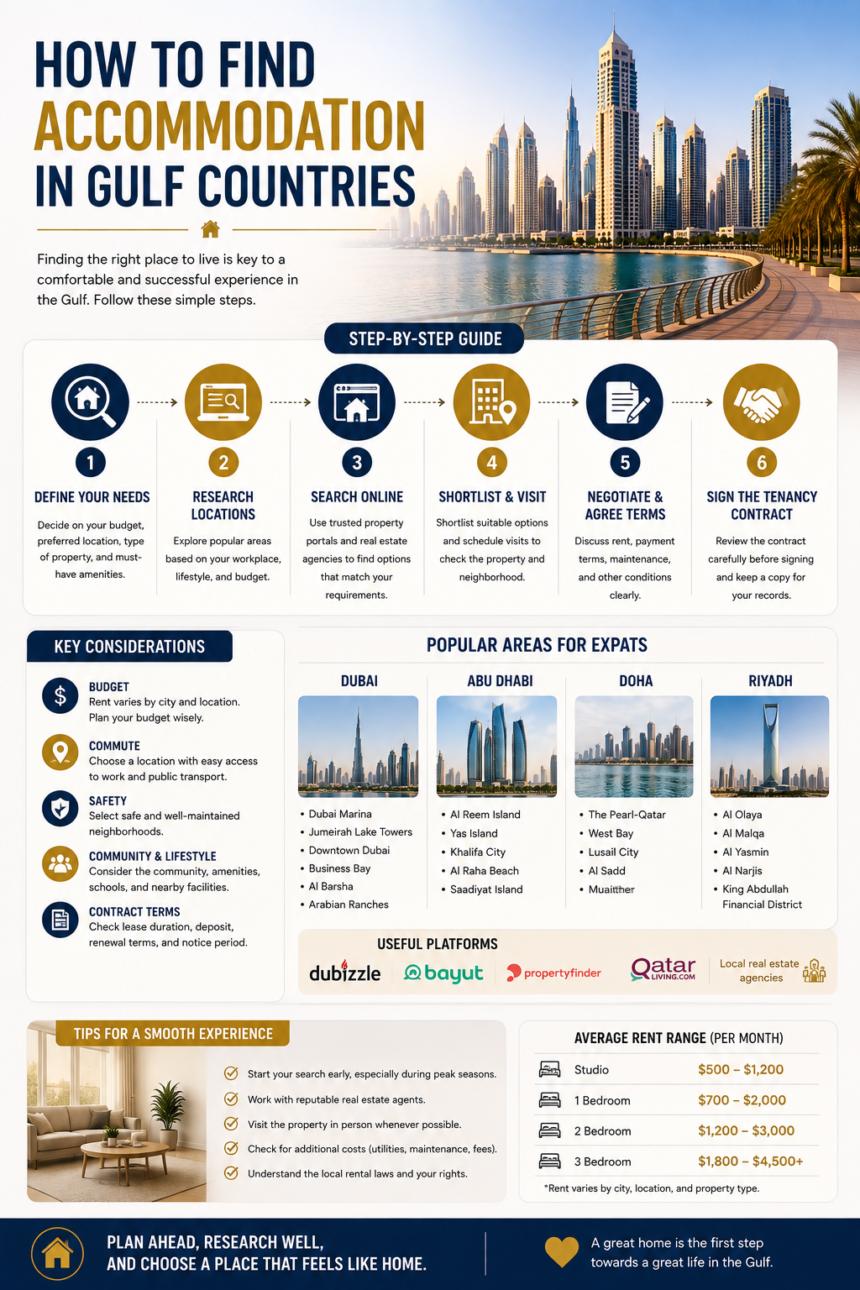
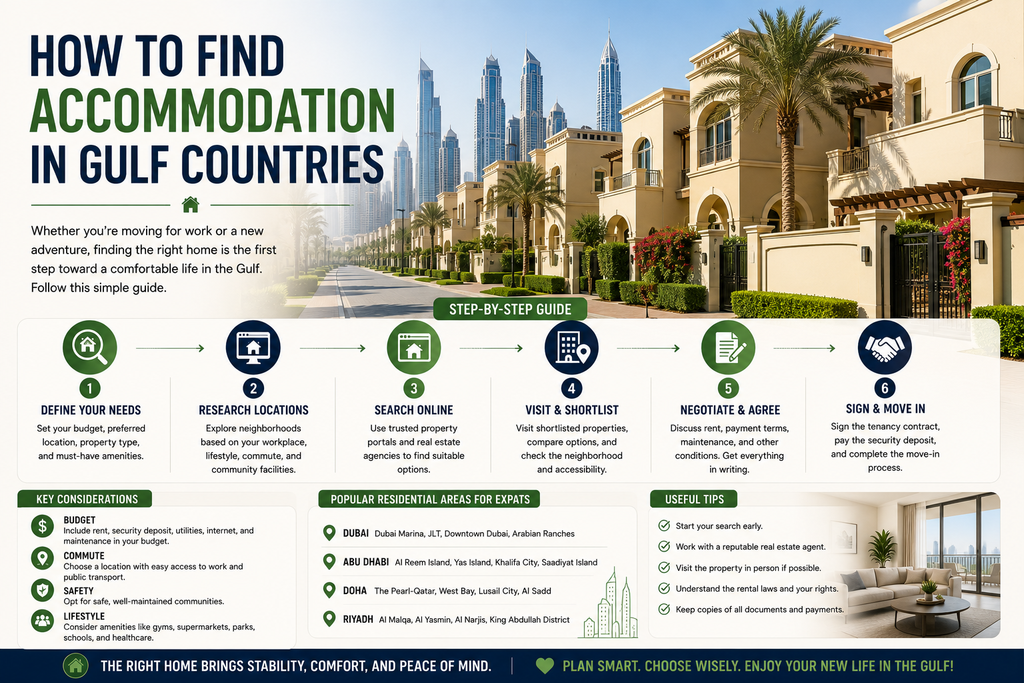
This guide explains How to Find Accommodation in Gulf Countries and what expatriates should check before choosing a home.
How to Find Accommodation in Gulf Countries Before You Arrive
You can begin researching accommodation before your flight, but it is usually wise to avoid committing to a long-term property without understanding the location properly.
Start by identifying your workplace.
Then look at the surrounding residential areas and calculate realistic commuting times.
If you are moving with children, school location becomes equally important.
A useful order for families is:
Workplace → School → Neighbourhood → Property
This approach can prevent one of the most common relocation mistakes: choosing a beautiful home and later discovering that the daily commute is exhausting.
Online research is useful for understanding approximate rents, property types and available neighbourhoods. However, photographs and maps cannot show you everything.
Traffic, construction noise, parking shortages, building maintenance and neighbourhood atmosphere are much easier to understand after visiting personally.
For that reason, temporary accommodation during your first days or weeks can be valuable.
1. Set a Realistic Housing Budget First
Do not begin your property search by looking at luxury apartments and deciding later whether you can afford them.
Set your budget first.
Housing costs should leave enough income for utilities, groceries, transportation, healthcare, education, savings and normal lifestyle expenses.
The right percentage of income to spend on housing depends on your salary and family circumstances.
A single professional earning a strong salary may choose to spend more for a central location.
A family supporting children may prefer lower rent because school fees already consume a significant part of the household budget.
Remember that advertised rent is not necessarily the complete housing cost.
Depending on the country and property, you may also need to budget for deposits, agency commissions, utilities, internet, parking, maintenance or municipality-related charges.
Calculate the complete annual cost before comparing two homes.
2. Ask Whether Your Employer Provides Accommodation
Before searching independently, check your employment package.
Some Gulf employers provide staff accommodation.
Others offer a housing allowance.
Certain senior or specialist employment packages may include company-arranged apartments or villas.
These benefits can significantly change the value of a job offer.
Company accommodation can make relocation easier because the employee does not immediately need to understand the local rental market.
However, you should still ask where the accommodation is located, whether it is shared, what utilities are included and whether family members can live there.
If you receive a housing allowance instead, find out whether it is paid monthly or through another arrangement.
Do not assume the words “housing provided” and “housing allowance” mean the same thing.
3. Research the Neighbourhood Before the Building
A beautiful apartment in the wrong location can quickly become frustrating.
Before comparing individual properties, shortlist neighbourhoods.
Think about what you need within a normal week.
A family may prioritise schools, supermarkets, parks, clinics and children’s activities.
A young professional may care more about Metro access, restaurants and being close to the office.
Someone working shifts may prioritise a short commute over entertainment.
Also visit the neighbourhood after dark if possible.
An area that appears quiet during a weekday morning may become crowded in the evening.
Check nearby construction as well.
Gulf cities develop quickly, and an empty plot beside your building can potentially become an active construction site.
4. Calculate the Real Commute
Distance on a map can be misleading.
A home 15 kilometres from work may take 20 minutes at one time of day and considerably longer during rush hour.
This matters particularly in large and fast-growing cities.
Dubai commuters need to consider congestion around major roads and business districts.
Riyadh covers a huge urban area, making neighbourhood selection especially important.
Doha is more compact, but traffic patterns can still affect daily journeys.
Muscat stretches along the coast, so choosing the wrong location can add substantial driving.
Do not rely entirely on the distance displayed by a property advertisement.
Test the journey during the hours when you will actually travel.
If you expect to use public transport, check the complete door-to-door journey rather than simply whether a Metro station exists somewhere nearby.
5. Decide Between Furnished and Unfurnished Accommodation
Gulf rental markets offer both furnished and unfurnished properties.
Furnished accommodation can be useful for someone moving for a short assignment.
You can arrive with luggage and avoid immediately purchasing beds, sofas, tables and appliances.
However, furnished units may cost more.
Furniture quality can also vary.
Unfurnished properties can make more sense for long-term residents who want to create their own home.
But understand what “unfurnished” actually includes.
In some properties, major kitchen appliances may be installed.
In others, you may need to purchase almost everything.
Ask exactly what remains in the property before signing.
Take photographs of included furniture and appliances during handover.
6. Use Established Property Platforms and Licensed Agents
Online property portals are one of the easiest ways to understand the rental market.
Major Gulf cities have large numbers of listings, allowing expats to compare neighbourhoods, building types and prices before arranging viewings.
However, online listings should be treated as the beginning of the process, not proof that a property or agent is genuine.
Where the local system provides agent or broker licensing, verify who you are dealing with.
Avoid transferring large amounts of money simply because someone sends photographs and claims other tenants are waiting.
Be particularly careful with unusually cheap listings.
If a luxury apartment is advertised far below similar properties in the same building, investigate why.
Scammers often use attractive prices to create urgency.
7. View the Property in Person Whenever Possible
A property advertisement is designed to make the home look attractive.
Wide-angle photography can make rooms appear larger.
Old photographs may not show current damage.
Noise cannot be seen in a photograph.
Neither can smells, weak air conditioning or poor water pressure.
During the viewing, test the property.
Check:
- Air conditioning
- Water pressure
- Doors and locks
- Windows
- Kitchen appliances
- Bathrooms
- Mobile signal
- Parking
- Building access
- Noise levels
Look at the common areas as well.
The condition of corridors, lifts and parking areas can tell you a lot about building management.
If possible, speak briefly with an existing resident.
A five-minute conversation can sometimes reveal more than an hour with an agent.
8. Understand the Rental Contract Before Signing
Never sign a rental contract simply because the property agent says it is “standard.”
Read it.
Understand the rent, payment dates, deposit, contract duration and renewal conditions.
Check who is responsible for maintenance.
Understand what happens if you need to leave early.
Look for rules concerning pets, alterations, subletting and other relevant conditions.
The legal structure differs between GCC countries.
Dubai, for example, operates formal tenancy-registration and rental-regulation systems.
Other Gulf countries have their own rental laws and administrative procedures.
The important principle is the same everywhere:
Do not rely on verbal promises.
If the landlord agrees to repair something before you move in, make sure the commitment is documented.
9. Understand How Rent Is Paid
Do not assume every Gulf rental market operates through a simple monthly payment.
Payment structures differ.
Some landlords accept monthly payments.
Others may request quarterly or other scheduled payments.
In certain markets, especially Dubai, tenants may encounter annual rental arrangements divided across an agreed number of payments.
The payment schedule can affect your cash flow significantly.
An apartment may be affordable when viewed as a monthly average but difficult if a large payment is required in advance.
Ask about payment structure before spending time negotiating a property.
When comparing homes, compare both the total rent and the payment schedule.
10. Budget for the Security Deposit and Additional Costs
The first housing payment can be considerably larger than normal monthly living expenses.
You may need to pay some combination of:
- Rent
- Security deposit
- Agent commission
- Utility deposit
- Internet setup
- Moving costs
- Furniture
- Household items
- Parking charges
The exact costs differ by country and property.
This is why new expats should arrive with an emergency fund.
Do not use every available dirham, riyal or dinar simply to secure a premium apartment.
You still need money to live after receiving the keys.
Before paying anything, request proper documentation explaining what the payment covers.
11. Check Utilities Before Choosing a Property
Two apartments with identical rent can have very different running costs.
Air conditioning is especially important in the Gulf.
Ask how cooling is provided and billed.
Depending on the building and country, cooling may be included, separately metered or handled through a district-cooling provider.
Electricity and water arrangements also differ.
Ask current tenants or building management for a realistic idea of typical bills.
Internet availability matters as well.
Someone working from home should check which providers serve the building and what connection options are available.
Do not wait until after moving to discover that your preferred service is unavailable.
12. Inspect Parking and Transport Access
Parking can become an everyday frustration if ignored during the property search.
If you own or plan to buy a car, ask whether the apartment includes a dedicated parking space.
Check whether additional family vehicles require payment.
Look at visitor parking.
Also examine how easy it is to enter and leave the building during rush hour.
For residents without cars, public transport can be even more important.
In Dubai, living near the Metro can significantly reduce dependence on driving.
Doha’s Metro also makes certain locations particularly convenient.
Riyadh’s expanding Metro network has created new possibilities for public-transport-based commuting.
In more car-dependent cities, the practical value of a parking space becomes much greater.
13. Families Should Choose the School Before the Home
Parents often make the mistake of renting a property first.
Then they select a school.
That can create an exhausting school run.
International schools are spread across Gulf cities, and children may spend a substantial amount of time travelling if home and school are far apart.
Begin by identifying suitable schools.
Check curriculum, fees and availability.
Then examine neighbourhoods that provide reasonable access to both the school and workplace.
A slightly more expensive home in the right location may produce a much better family routine.
Parents should also check parks, playgrounds, nurseries, clinics and supermarkets.
The most fashionable neighbourhood is not automatically the most practical neighbourhood for a family.
14. Protect Yourself From Rental Scams
Rental fraud can happen anywhere, especially when newcomers do not understand the local market.
One common warning sign is extreme urgency.
A person may tell you that several tenants are ready to pay immediately and you must transfer money before viewing the property.
Another warning sign is a price far below comparable properties.
Be cautious when the person requesting payment cannot clearly prove their connection to the property.
Never send money based only on social-media messages and photographs.
Verify the property, landlord or authorised representative according to the local rental system.
Request proper payment receipts.
Keep copies of contracts and correspondence.
And if something feels inconsistent, do not allow pressure to force a decision.
There will always be another property.
15. Document the Condition of the Property at Handover
Your work does not end when you sign the contract.
Inspect the property carefully when receiving the keys.
Take photographs and videos.
Record scratches, damaged furniture, cracked tiles, stains and malfunctioning appliances.
Send the condition report through a traceable communication method where appropriate.
This creates evidence that existing damage was present before you moved in.
It can become important when requesting the return of your security deposit.
Also record the number of keys, access cards and parking remotes received.
Keep the handover documentation with your tenancy agreement.
Finding Accommodation in the UAE
The UAE has one of the Gulf’s largest and most varied rental markets.
Dubai alone offers everything from studios and shared accommodation to waterfront apartments and luxury villas.
Abu Dhabi provides another substantial rental market, while Sharjah can appeal to residents seeking more affordable housing while remaining within the UAE’s major urban corridor.
For Dubai tenants, the official rental framework is particularly important.
Tenancy contracts are registered through Ejari, which creates an official record of the rental agreement.
Dubai’s Real Estate Regulatory Agency also provides systems and rules governing the rental market.
Before renting, check the property’s location carefully.
A lower-priced apartment in Sharjah may look attractive to someone working in Dubai, but the commute can significantly change the value of the saving.
Similarly, living near a Dubai Metro station may justify paying higher rent if it eliminates the need for a car.
Finding Accommodation in Saudi Arabia
Saudi Arabia’s rental market is changing alongside the country’s rapid urban development.
Riyadh is the biggest consideration for many international professionals.
The city is geographically large, and commuting should be taken seriously.
Professionals working in major business districts should examine neighbourhoods based on road and Metro access rather than choosing solely according to rent.
Jeddah offers a different residential environment, with coastal neighbourhoods and major commercial areas.
Al Khobar and Dhahran are important for workers connected with the Eastern Province’s energy and industrial sectors.
Saudi Arabia operates the Ejar system for the rental sector, providing an official framework for electronic rental contracts and related services.
Expats should ensure their tenancy follows the appropriate formal process rather than depending solely on an informal agreement.
Finding Accommodation in Qatar
Most expatriates looking for accommodation in Qatar will focus on Doha and its surrounding residential areas.
The city offers apartments, compounds and villas across a wide range of budgets.
Premium areas such as The Pearl and parts of West Bay can appeal to professionals seeking modern apartment living.
Families may prefer residential compounds or quieter communities depending on school and workplace locations.
Doha’s Metro makes transport an important part of neighbourhood selection.
A property close to useful Metro connections can reduce dependence on taxis or a private car.
When comparing rentals, ask what is included.
Some properties may include utilities or certain services, while others charge separately.
Read the contract carefully and confirm payment terms before committing.
Finding Accommodation in Bahrain
Bahrain’s compact size can make the accommodation search easier than in larger GCC countries.
Most expatriates concentrate around Manama and surrounding residential areas.
Apartments are widely available, while families may also consider villas or compounds.
Popular areas can differ significantly in atmosphere.
Some locations are active and entertainment-focused, while others are more residential.
Because Bahrain is relatively small, expats may have greater flexibility to choose a home based on lifestyle rather than being completely controlled by commuting distance.
Still, test the journey to work during peak traffic.
Check whether utilities and building services are included in the advertised rent.
A slightly cheaper property can become less attractive once additional costs are added.
Finding Accommodation in Oman
Muscat offers a noticeably different rental experience from Dubai or Riyadh.
The city extends along the coast rather than concentrating around one central business district.
This makes location important.
Professionals should identify where they will work before selecting a neighbourhood.
Areas around major commercial and residential districts offer apartments and villas, while premium developments provide additional lifestyle facilities.
Oman can also offer more space for the money compared with some premium Gulf markets, depending on location and property type.
However, car ownership is particularly useful.
A beautiful property far from work can create a long daily drive.
Check supermarkets, schools, healthcare and road access before deciding.
Finding Accommodation in Kuwait
Kuwait’s expatriate rental market includes everything from affordable apartments to larger family homes.
Location should be considered according to workplace and family requirements.
Salmiya remains one of the most familiar areas for expatriates because of its established residential and commercial environment.
Other locations may provide more space or easier access to particular employment areas.
Kuwait is relatively car-oriented, so parking and road access deserve serious attention.
Families should investigate school locations before choosing a neighbourhood.
As elsewhere in the Gulf, do not judge a property only by advertised rent.
Understand the complete payment structure, utilities and other recurring housing expenses.
Should You Live Alone or Share Accommodation?
For young professionals, sharing accommodation can significantly reduce costs.
However, this needs to be approached carefully.
Do not assume every form of partitioning, overcrowding or informal subletting is legally permitted.
Rules vary by city, building and tenancy agreement.
If you plan to share, make sure the arrangement complies with local regulations and the property’s contract.
Understand exactly what your payment includes.
Check how many people live in the property and whether bathrooms, kitchens and parking are adequate.
Privacy matters as well.
Saving money is valuable, but living in an uncomfortable or non-compliant arrangement can create bigger problems later.
Apartment or Villa: Which Is Better?
Apartments generally suit single professionals, couples and smaller families who value convenience.
They may include facilities such as gyms, pools, security and maintenance.
Villas provide more space and privacy.
Families with several children may appreciate additional bedrooms, gardens and parking.
But larger homes usually bring higher running costs.
Cooling a large villa during Gulf summer can be significantly different from cooling a compact apartment.
Maintenance can also require more attention.
Choose based on household needs rather than status.
A well-located two-bedroom apartment can provide a much better lifestyle than a large villa far from work and school.
How Much Should You Spend on Rent?
There is no single percentage that works for every expatriate.
Someone whose employer pays school fees and transportation can potentially allocate more income to housing.
Someone supporting family members abroad may want to spend much less.
Instead of following a fixed rule, create a complete monthly budget.
Start with net income.
Subtract expected savings.
Then subtract fixed commitments such as school fees, debt repayments and family support.
After that, determine how much remains for housing and normal living costs.
This approach prevents rent from consuming money that was supposed to be saved.
Questions to Ask Before Renting in the Gulf
Before signing, ask the landlord or agent about the issues that could affect everyday life.
Confirm the total annual rent and payment schedule.
Ask about the security deposit and whether there is an agency fee.
Find out who handles maintenance and air-conditioning problems.
Ask whether parking is included.
Confirm which utilities you must register and pay separately.
Check whether pets are allowed if relevant.
Understand the notice period and early-termination terms.
Ask about renewal procedures.
For furnished accommodation, obtain a written inventory.
The answers should match the contract.
A Simple Gulf Accommodation Comparison
The characteristics of the major rental markets can be summarised like this:
| Country | Main Rental Consideration | Transport Factor | Best Advice |
|---|---|---|---|
| UAE | Wide choice but large price differences | Metro useful in Dubai | Compare neighbourhood and commute |
| Saudi Arabia | Location critical in large cities | Riyadh Metro increasingly useful | Live reasonably close to work |
| Qatar | Doha dominates expat market | Metro can reduce car dependence | Compare inclusions carefully |
| Bahrain | Compact rental market | Car useful | Choose based on work and lifestyle |
| Oman | Muscat is geographically spread out | Car highly useful | Prioritise workplace access |
| Kuwait | Established expat neighbourhoods | Car often important | Check parking and school commute |
This table should be used as a starting point rather than a substitute for neighbourhood-level research.
Documents You May Need to Rent Accommodation
The exact paperwork varies by jurisdiction, landlord and property.
However, expats should keep their main identification and residence documents organised.
You may need documents connected with:
- Passport
- Residence identification
- Employment
- Contact information
- Tenancy registration
- Payments
- Utility setup
Never hand over original identity documents permanently simply because an unofficial agent requests them.
Where copies are needed, understand who is receiving them and why.
Keep your own copy of every signed tenancy document and payment receipt.
How to Find Accommodation in Gulf Countries Without Making Expensive Mistakes
The biggest mistake is rushing.
New expats often feel pressure to establish a permanent home immediately.
That pressure can lead to choosing the wrong neighbourhood, paying too much or accepting poor contract terms.
Temporary accommodation can buy you valuable time.
Use those first days to travel to work during rush hour.
Visit supermarkets.
Test public transport.
Explore neighbourhoods during both daytime and evening.
Talk to colleagues who already live locally.
Then begin serious property viewings.
A week of careful research can prevent a year of frustration.
Final Thoughts on How to Find Accommodation in Gulf Countries
Finding accommodation in the Gulf is not simply about choosing the most attractive apartment within your budget.
Start with location.
Identify your workplace and, for families, potential schools.
Then determine which neighbourhoods provide realistic daily commuting.
Set a complete housing budget that includes rent, deposits, agent fees, utilities, internet, parking and transportation.
Use established property platforms and reputable agents.
View properties personally whenever possible.
Inspect the building as carefully as the apartment.
Read the tenancy agreement.
Understand the payment schedule and maintenance responsibilities.
Verify who you are paying.
Document the property’s condition when you receive the keys.
And avoid rushing simply because someone tells you another tenant is ready to pay.
Dubai may offer the Gulf’s widest variety of accommodation.
Riyadh requires careful attention to commuting.
Doha provides a relatively compact rental market with useful Metro connectivity.
Bahrain’s smaller size can make location decisions more flexible.
Muscat rewards residents who choose homes according to its spread-out geography.
Kuwait requires particular attention to road access, parking and family commuting.
The right Gulf home is therefore not necessarily the cheapest, newest or largest property.
It is the one that fits your budget, workplace, family needs and daily routine.
Choose those four things correctly, and your accommodation can make Gulf life considerably easier from the first month.
follow us on Instagram
Read More – Documents Gulf Expat Should Keep Ready: 15 Must-Haves